Hookworm, Iron-Deficiency Anemia, and Blood Loss
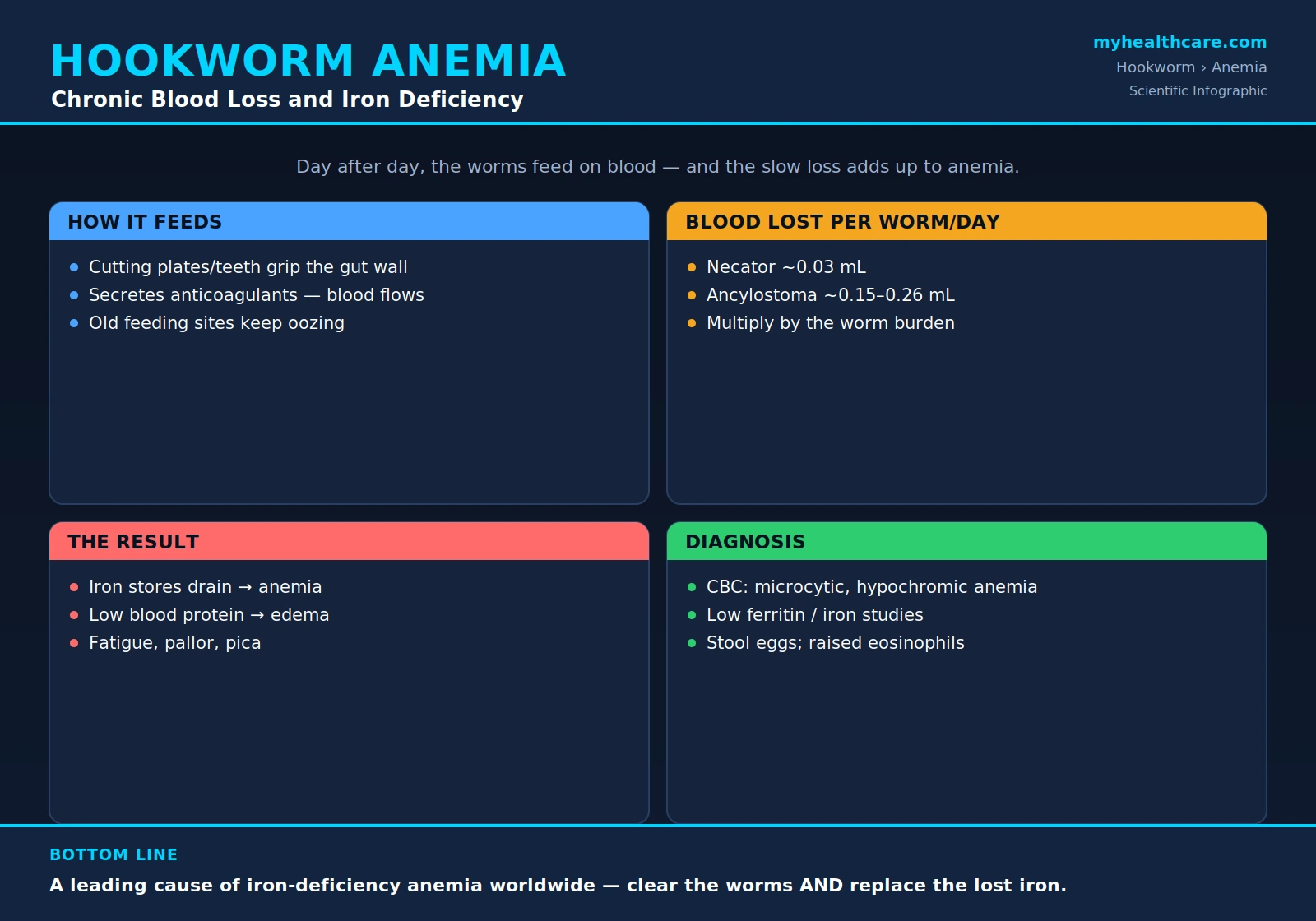
Iron-deficiency anemia is the hallmark of hookworm disease — the single feature that, more than any other, explains why this small intestinal worm has shaped human health across the tropics for thousands of years. The mechanism is brutally simple: adult hookworms attach to the lining of the small intestine and feed on blood. A few worms drain only a little; a heavy infection, sustained month after month and year after year, slowly bleeds a person of the iron their body needs to build red blood cells. The result is a quiet, grinding anemia — pale skin, exhaustion, breathlessness, a heart that races on the smallest effort — that can blunt a child's growth and learning and leave an adult too tired to work. This page explains exactly how the worm feeds, roughly how much blood each one takes, how that loss multiplies into anemia, what the anemia feels like, who is most at risk, how doctors confirm it, and why the cure has two halves: clear the worms and put the iron back.
Table of Contents
- How the Worm Feeds on Blood
- How Much Blood Is Lost
- From Blood Loss to Iron-Deficiency Anemia
- Protein Loss and Swelling
- What the Anemia Feels Like
- Pica: Craving Soil and Ice
- Worm Burden Versus Severity
- Who Is Most Vulnerable
- How It Is Diagnosed
- The Global Picture
- Treatment: Clear the Worms and Replace the Iron
- Key Research Papers
- Featured Videos
1. How the Worm Feeds on Blood
An adult hookworm is only about a centimeter long, but it is built to bleed its host. At its head end sits a buccal capsule — a hardened mouth cavity armed with structures that bite into the gut wall. Ancylostoma duodenale, the “Old World” hookworm, carries paired teeth; Necator americanus, the species that dominates in the Americas and much of sub-Saharan Africa and Asia, has a pair of curved cutting plates instead. Either way, the worm uses this apparatus to grip and gouge the lining of the small intestine, drawing a plug of mucosa into its mouth and rupturing the small blood vessels packed just beneath the surface.
Once latched on, the worm does something that turns a minor wound into a steady leak: it secretes a cocktail of anticoagulants. Hookworms release proteins that block the body's clotting machinery — including inhibitors of clotting factors and of platelet clumping — so the blood at the bite site keeps flowing instead of sealing itself off. The worm essentially keeps the tap open. It ingests this blood, digesting the red cells for nourishment, while the host loses the iron locked inside them.
The damage is compounded by a habit that makes hookworm uniquely wasteful of blood: the worms move. Rather than feeding from one fixed spot, an individual worm detaches and re-anchors at a new site on the intestinal wall from time to time. Each abandoned bite site, primed with the worm's anticoagulants, does not immediately clot — it keeps oozing for a while after the worm has gone. So at any moment a person harbors not only the blood being actively swallowed by attached worms but also a scatter of old wounds still seeping into the gut. This is why the blood loss of hookworm disease exceeds what the worms actually consume: a meaningful share simply leaks away.
2. How Much Blood Is Lost
The amount of blood a person loses to hookworm depends on two things: how much each worm takes and how many worms there are. These were worked out in classic studies in the mid-twentieth century, when researchers fed volunteers and patients red cells tagged with a radioactive iron or chromium label and measured how much appeared in the stool — a direct accounting of daily blood loss. Decades later the measurements were refined with chemical assays of blood (heme) in the feces. The findings have held up remarkably well.
The key result is that the two human hookworm species are not equal bleeders. Ancylostoma duodenale is the more voracious: per worm, it draws appreciably more blood each day than Necator americanus does. The widely cited approximate figures — on the order of roughly 0.15–0.26 mL of blood per Ancylostoma worm per day, versus roughly 0.03–0.05 mL per Necator worm per day — come from this radioisotope and chemical work, summarized in the authoritative reviews by Roche & Layrisse and by Crompton & Whitehead (see Key Research Papers). The exact numbers vary between studies and individuals, so they are best read as orders of magnitude rather than precise constants: the central, reliable message is that, worm for worm, Ancylostoma costs its host several times as much blood as Necator.
That per-worm figure then multiplies by the worm burden. A person carrying a handful of worms loses a trickle; a person carrying hundreds loses a torrent. A heavy Necator infection of, say, several hundred worms, or even a modest number of the thirstier Ancylostoma, can drain on the order of tens of milliliters of blood per day — the equivalent of giving away a small portion of a blood-bank unit every single day, indefinitely. The body has no way to recover the iron that leaves in that blood. Over months, that arithmetic — a small daily loss, never repaid, multiplied by many worms and many days — is the entire story of hookworm anemia.
3. From Blood Loss to Iron-Deficiency Anemia
To see why chronic blood loss causes iron-deficiency anemia specifically, it helps to follow the iron. The great majority of the body's iron is held inside hemoglobin, the oxygen-carrying pigment in red blood cells. Every milliliter of blood that the hookworms drain therefore carries away a small, fixed quantity of iron. The body cannot manufacture iron; it can only recycle what it has and absorb a little more from food each day. When the daily intestinal loss exceeds the small amount the gut can absorb, the body runs a slow deficit.
This deficit unfolds in stages. First the body spends its iron stores — the ferritin-bound reserves in the liver, spleen, and bone marrow — to keep making normal red cells. For a time the blood count looks fine even though the tank is draining; this is iron depletion without anemia yet. Once the stores are exhausted, the bone marrow can no longer get enough iron to fill new red cells with hemoglobin. It still produces red cells, but they come out small (microcytic) and pale (hypochromic) — under the microscope they are undersized and washed-out, with a too-large central pallor, because each one is short of the pigment it needs. The number and quality of red cells fall, the blood carries less oxygen, and the person is now anemic. This microcytic, hypochromic pattern is the fingerprint of iron-deficiency anemia, and in regions where hookworm is common it is one of its leading causes.
The link is not merely theoretical. Field studies that measured hookworm burden and iron status in the same people — classically the work of Layrisse and Roche, and later the Zanzibar studies by Stoltzfus and colleagues — found a clear dose relationship: the heavier the hookworm load, the lower the hemoglobin and the more depleted the iron stores. Treating the worms and replacing iron reverses it, which is the clinching evidence that the worms are the cause and not a bystander.
4. Protein Loss and Swelling
Blood is not only red cells and iron; it is also plasma protein, chiefly albumin. In heavy, long-standing hookworm infection the host loses protein into the gut along with the blood, and the gut's own inflamed lining leaks more. If this protein loss outpaces what the body can replace — especially in someone whose diet is already poor in protein — the level of protein in the blood falls (a state called hypoproteinemia, or specifically hypoalbuminemia).
Albumin is what holds fluid inside the blood vessels by exerting osmotic pull. When it drops too low, fluid seeps out of the circulation into the tissues, and the person develops edema — swelling, classically of the face, the feet and ankles, and in severe cases a generally puffy, swollen appearance. In the heaviest historical infections this could progress to widespread swelling and the bloated look that older descriptions of severe hookworm disease recorded. Edema is therefore a marker of heavy disease: it signals that the infection has gone beyond draining iron to draining the body's protein reserves as well, and it tends to accompany the most profound anemia.
5. What the Anemia Feels Like
The symptoms of hookworm anemia are the symptoms of any severe, slowly developing iron-deficiency anemia — the body starved of the oxygen-carrying capacity it needs. Because the anemia comes on gradually, the body partly adapts, and a person may not realize how unwell they have become until the deficit is large. The common features include:
- Fatigue and weakness — a deep, persistent tiredness and lack of energy. Older medical writing called this lassitude: a heavy, listless weariness, the sense of having no reserves, that was once so characteristic of hookworm-burdened communities that the disease earned nicknames tied to laziness and apathy. We now understand that “laziness” for what it was — not a character flaw but an anemic body running on empty.
- Pallor — pale skin, and especially pale linings of the eyes, the inside of the lips, the gums, and the nail beds, reflecting the shortage of red pigment in the blood.
- Breathlessness on exertion — getting winded climbing a hill or doing physical work, because blood with too little hemoglobin cannot deliver enough oxygen to working muscles.
- Palpitations and a fast heartbeat — the heart compensating for thin, oxygen-poor blood by pumping harder and faster; in long-standing severe anemia this strain can eventually affect the heart itself.
- Dizziness, headache, and poor concentration — the brain, too, feeling the oxygen shortfall.
- Reduced work capacity — measurably less physical stamina and productivity, which at the community level translates into lost labor and lost livelihood, and in children into poorer growth and learning.
None of these symptoms is unique to hookworm — they describe iron-deficiency anemia from any cause. What points to hookworm is the setting: these symptoms appearing in someone who lives or has lived where the parasite is common, who goes barefoot on contaminated soil, and whose stool reveals the worm's eggs.
6. Pica: Craving Soil and Ice
One striking and easily overlooked clue to severe iron deficiency is pica — a compulsion to eat substances that are not food. People with profound iron deficiency, including hookworm-driven anemia, may find themselves craving and eating soil or clay (geophagia), raw rice or starch, paper, chalk, or — very commonly — large quantities of ice (a form called pagophagia). The craving can be intense and is often something the person feels embarrassed to mention.
The biology behind pica is still not fully understood, but the clinical pattern is well established: it tracks with iron deficiency and frequently resolves once iron is replaced, which is itself strong evidence that the deficiency drives the craving. In a hookworm-endemic area there is a grim irony to geophagia, because eating contaminated soil can expose a person to still more infection. For clinicians and families, a new craving for ice or earth in someone who is tired and pale should raise the suspicion of iron-deficiency anemia and prompt testing rather than be dismissed as a mere quirk.
7. Worm Burden Versus Severity
A crucial, reassuring point is that not everyone infected with hookworm becomes anemic. The severity of disease tracks closely with the intensity of infection — the actual number of worms a person carries — and, just as importantly, with the person's own iron reserves and diet.
Most people in an endemic community carry only a light worm load, and a light load may cause little or no measurable anemia. Such a person can feel entirely well, with normal blood counts, while still passing eggs in their stool. Disease emerges as the burden climbs into the moderate-to-heavy range. This is why epidemiologists classify infections by intensity (typically estimated from the number of worm eggs counted per gram of stool, which broadly reflects the number of egg-laying females): light, moderate, and heavy categories predict the likelihood of anemia far better than the simple yes/no fact of infection.
The person's iron buffer matters just as much as the worm count. The same modest worm burden may be silent in a well-nourished adult with full iron stores and ample iron in the diet, yet cause overt anemia in a growing child, a menstruating or pregnant woman, or someone on an iron-poor diet whose reserves were thin to begin with. Hookworm anemia, in other words, is the meeting point of two forces: how fast iron is leaving (the worm burden) and how little iron is coming in or held in reserve (diet and physiological demand). Severe disease happens where a heavy burden meets a poor reserve.
8. Who Is Most Vulnerable
Because hookworm anemia is the collision of iron loss with iron need, the people who suffer most are those whose iron needs are already high or whose reserves are already low:
- Pregnant women. Pregnancy hugely increases iron demand — to expand the mother's blood volume and to build the baby's. A hookworm load that a non-pregnant woman might tolerate can tip a pregnant woman into serious anemia, with risks to her and to the baby (low birth weight, prematurity). This is covered in depth on the Hookworm in Pregnancy and Children page.
- Infants and young children. Growth itself consumes iron, and children's small reserves leave little margin. Hookworm anemia in childhood is linked to stunted growth and to impaired cognitive development and school performance — effects that can shadow a child for life.
- Menstruating women and adolescent girls, who already lose iron monthly and so have less reserve to absorb the additional hookworm drain.
- People on iron-poor diets — diets low in meat and in absorbable (heme) iron, or high in foods that block iron absorption — who enter the infection with little buffer.
- Anyone carrying a heavy worm burden, especially of the thirstier Ancylostoma duodenale, regardless of other factors.
These vulnerabilities overlap and stack: a pregnant adolescent on a poor diet with a heavy worm burden sits at the dangerous intersection of every risk factor at once, which is why hookworm anemia in pregnancy is a major focus of global control programs.
9. How It Is Diagnosed
Confirming hookworm anemia means proving two things in tandem: that the person is anemic and iron-deficient, and that hookworm is the cause. The workup combines blood tests with stool tests.
- Complete blood count (CBC). The starting point. It shows the anemia (low hemoglobin and hematocrit) and, characteristically, red cells that are small (low MCV, microcytic) and pale (low MCH, hypochromic) — the classic iron-deficiency pattern.
- Iron studies, especially ferritin. A low serum ferritin is the most useful single marker of depleted iron stores and confirms that the anemia is truly due to iron deficiency rather than another cause. Low serum iron and a raised iron-binding capacity support the picture.
- Stool examination for eggs. The definitive proof of hookworm is finding its characteristic eggs in the stool under the microscope. Beyond a simple positive/negative result, an egg count (eggs per gram of feces, by a quantitative method such as Kato-Katz) estimates the intensity of infection — light, moderate, or heavy — which, as noted above, predicts how much anemia to expect.
- Fecal occult blood. A test for hidden blood in the stool is often positive, reflecting the ongoing intestinal bleeding from the worms' feeding and oozing bite sites.
- Eosinophilia. A raised count of eosinophils — a white-cell type the body mobilizes against parasitic worms — is a common supporting clue on the blood count and points toward a worm infection in a person with iron-deficiency anemia.
Putting these together — a microcytic, hypochromic anemia with low ferritin, hookworm eggs in the stool, occult blood, and eosinophilia — builds a confident diagnosis and, through the egg count, an estimate of how heavy the infection is. In a returned traveler or a person from an endemic area with unexplained iron-deficiency anemia, stool testing for hookworm is an essential part of the search for the source.
10. The Global Picture
Hookworm is not a historical curiosity. Hundreds of millions of people are infected worldwide, overwhelmingly in poorer, warmer regions of sub-Saharan Africa, South and East Asia, and parts of the Americas — places where the soil stays warm and moist, sanitation is limited, and people walk barefoot. Within that vast infected population, hookworm stands as one of the leading causes of iron-deficiency anemia in the developing world, and a major contributor to the global burden of anemia in pregnant women and young children.
The toll is measured not only in test results but in lost human potential: anemic children who grow and learn less, anemic adults who work less, anemic mothers who face more dangerous pregnancies. Because hookworm preys on the poor and because its harm is quiet and chronic, it has historically been neglected — one reason it is classed among the neglected tropical diseases targeted for global control. Programs that periodically deworm whole at-risk groups (see Mass Drug Administration and Control) aim squarely at this anemia, treating the parasitic cause of a problem that would otherwise be fought, less successfully, with iron alone.
11. Treatment: Clear the Worms and Replace the Iron
The single most important principle of treating hookworm anemia is that it has two halves, and both are necessary. Treating one without the other leaves the job unfinished.
First, clear the worms. If the worms are not removed, they keep bleeding the person, and any iron given is poured into a leaking bucket. A short course of an anthelmintic (deworming) drug — typically albendazole or mebendazole — kills the adult worms in the intestine and stops the blood loss at its source. This is the indispensable first step.
Second, replace the iron. Killing the worms stops further loss, but it does not refill the iron the person has already lost; the depleted stores and the anemia must be corrected separately. This means iron repletion — usually oral iron supplements taken for a sustained period (months) to rebuild both the blood count and the body's iron reserves, alongside an iron-rich diet. In severe anemia, additional measures may be needed.
Done together — deworm to stop the leak, then repair the deficit with iron — the recovery is often dramatic: energy returns, pallor fades, and a child's growth and an adult's working capacity can rebound. The full regimen, dosing, and the reasons both steps matter are detailed on the Anthelmintic Treatment and Iron Repletion page, and the broader management and prevention picture on the Treatment & Prevention hub. Preventing reinfection — through footwear and sanitation — is what keeps the cure from being undone.
Key Research Papers
Peer-reviewed reviews, classic blood-loss measurements, and field studies on hookworm feeding, blood and iron loss, and the resulting anemia. Journal names appear as plain text; the year/volume/pages link opens the full citation via DOI.
- Roche M, Layrisse M. The Nature and Causes of “Hookworm Anemia.” The American Journal of Tropical Medicine and Hygiene. 1966;15(6, Pt 2):1032–1102.
- Stoltzfus RJ, Albonico M, Chwaya HM, Savioli L, Tielsch J, Schulze K, Yip R. Hemoquant Determination of Hookworm-Related Blood Loss and Its Role in Iron Deficiency in African Children. The American Journal of Tropical Medicine and Hygiene. 1996;55(4):399–404.
- Layrisse M, Roche M, Rusián E, López-Calzón G. The Relationship Between Anemia and Hookworm Infection. American Journal of Epidemiology. 1964;79(3):279–301.
- Layrisse M, Paz A, Blumenfeld N, Roche M. Hookworm Anemia: Iron Metabolism and Erythrokinetics. Blood. 1961;18(1):61–72.
- Stoltzfus RJ, Chwaya HM, Tielsch JM, Schulze KJ, Albonico M, Savioli L. Epidemiology of Iron Deficiency Anemia in Zanzibari Schoolchildren: The Importance of Hookworms. The American Journal of Clinical Nutrition. 1997;65(1):153–159.
- Crompton DWT, Whitehead RR. Hookworm Infections and Human Iron Metabolism. Parasitology. 1993;107(S1):S137–S145.
- Hotez PJ, Brooker S, Bethony JM, Bottazzi ME, Loukas A, Xiao S. Hookworm Infection. New England Journal of Medicine. 2004;351(8):799–807.
- Loukas A, Hotez PJ, Diemert D, Yazdanbakhsh M, McCarthy JS, Correa-Oliveira R, Croese J, Bethony JM. Hookworm Infection. Nature Reviews Disease Primers. 2016;2:16088.
- Bethony J, Brooker S, Albonico M, Geiger SM, Loukas A, Diemert D, Hotez PJ. Soil-Transmitted Helminth Infections: Ascariasis, Trichuriasis, and Hookworm. The Lancet. 2006;367(9521):1521–1532.
- Brooker S, Hotez PJ, Bundy DAP. Hookworm-Related Anaemia Among Pregnant Women: A Systematic Review. PLoS Neglected Tropical Diseases. 2008;2(9):e291.
- Cross JH, Pawlowski ZS, Schad GA, Stott GJ. Hookworm Infection and Anaemia: Approaches to Prevention and Control. The Journal of Parasitology. 1992;78(6):993.
Live PubMed Searches
Each link opens a live PubMed query so results stay current as new papers are indexed.
- Hookworm iron-deficiency anemia
- Hookworm intestinal blood loss
- Necator americanus blood loss per worm
- Ancylostoma duodenale anaemia
- Hookworm anticoagulant feeding
- Hookworm anaemia in pregnancy
- Hookworm egg count, intensity, and haemoglobin
- Deworming and iron supplementation for anemia
Connections
- All Parasites
- Hookworm Overview
- Symptoms & Diagnosis
- Ground Itch & Larval Migration
- Hookworm in Pregnancy & Children
- Treatment & Prevention
- Anthelmintic Treatment & Iron Repletion
- Prevention: Footwear & Sanitation
- Mass Drug Administration & Control
- Hematology
- Anemia
- Iron-Deficiency Anemia — the general condition from every cause: ferritin thresholds, the full workup, and oral versus intravenous iron.
- Infectious Disease
- All Conditions