Hookworm Treatment: Anthelmintic Drugs and Iron Repletion
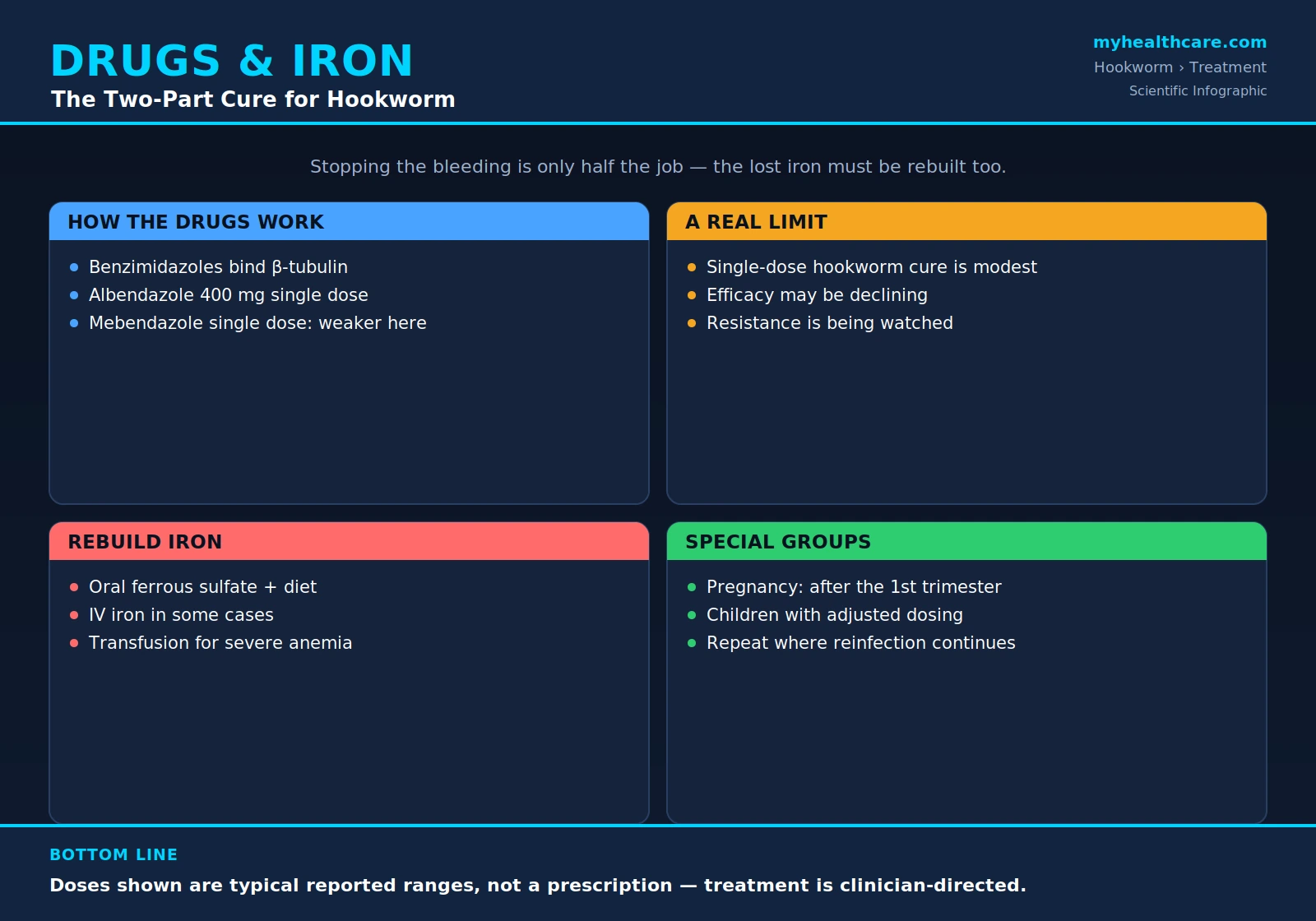
Treating hookworm well means doing two things, not one. The first is obvious: kill the worms living in the intestine so they stop feeding on blood. The second is just as important but often forgotten: rebuild the iron the worms have already drained away. A single deworming tablet can clear the infection, but it does nothing to refill the empty iron tank that years of slow blood loss have created. The body has to make new red blood cells, and to do that it needs iron back. This page explains that two-part cure in plain language — how the deworming drugs work, which one is preferred and why, what their real-world cure rates are (and the worrying signs that single doses are losing some of their punch against hookworm), and how iron repletion through diet, pills, and — in severe cases — intravenous iron or transfusion completes the recovery. The drug and dose figures here are typical reported ranges as described in the medical literature, not a prescription; actual treatment is directed by a clinician who knows the individual patient.
Table of Contents
- Why Hookworm Needs a Two-Part Cure
- How the Deworming Drugs Work
- Albendazole — the Preferred Drug
- Mebendazole — and Its Weak Single Dose
- Cure Rate, Egg Reduction, and Drug Resistance
- Pyrantel Pamoate — an Alternative
- The Second Half: Iron Repletion
- Why Diet Plus Deworming Works Best
- Treatment in Pregnancy and Young Children
- Repeating Treatment Where Reinfection Continues
- Key Research Papers
- Featured Videos
1. Why Hookworm Needs a Two-Part Cure
Hookworms are blood-feeders. Adult worms latch onto the lining of the small intestine and draw blood, and the steady, day-after-day loss of that blood — and the iron it carries — is what makes hookworm so damaging over time. A person with a heavy worm burden can lose enough blood to slip into iron-deficiency anemia, sometimes severe. (The mechanics of that loss are covered on the Iron-Deficiency Anemia and Blood Loss page.)
Here is the key insight that shapes treatment: clearing the worms stops the bleeding, but it does not replace the iron that has already been lost. Think of it like a slow leak in a tank. A deworming tablet plugs the leak — the worms die, the daily blood loss stops — but the tank is still empty. To get better, the patient must also refill the tank with iron so the bone marrow can manufacture the red blood cells that were never made while the body was scrambling just to keep up with the loss.
That is why effective hookworm care is genuinely two-pronged:
- Anthelmintic (deworming) drugs — to kill the adult worms and end the ongoing blood loss.
- Iron repletion — to rebuild the body's iron stores and correct the anemia the infection caused.
Treat the worms alone, and a deeply anemic patient may still feel exhausted and short of breath for a long time, because nothing has refilled the iron. Give iron alone, and you fight a losing battle against worms that keep draining it. Done together, the two halves let the patient actually recover — the leak is sealed and the tank refills.
2. How the Deworming Drugs Work
The mainstay drugs for hookworm belong to a family called the benzimidazoles — chiefly albendazole and mebendazole. They share the same elegant mechanism, and understanding it makes their strengths and limits easier to grasp.
Inside every cell — the worm's cells included — there is a microscopic scaffolding made of a protein called tubulin, which assembles into tiny tubes (microtubules) that the cell uses to move things around, take up nutrients, and hold its shape. The benzimidazoles work by binding to the worm's β-tubulin (beta-tubulin), the building block of those microtubules. When the drug latches on, the tubulin can no longer assemble properly. The worm's internal transport system breaks down, it can no longer absorb glucose (its energy supply), its cells starve, and the worm gradually dies and loses its grip on the intestinal wall.
A crucial point in their favor: the benzimidazoles bind much more tightly to the worm's tubulin than to the human version. That selectivity is why a dose strong enough to kill the parasite is generally well tolerated by the person taking it — the drug targets the worm's machinery far more than our own. Because the worm dies slowly over a day or two rather than instantly, these drugs are described as acting gradually, which is part of why dosing and, in some regimens, repeat dosing matter.
3. Albendazole — the Preferred Drug
For hookworm, albendazole is the preferred benzimidazole. The typical reported regimen is a single 400 mg oral dose — one tablet, taken once. Its great practical advantages are simplicity and reliability: a single dose is easy to give, easy to take, and easy to deliver at scale in community programs, and it works against hookworm more reliably than a single dose of mebendazole does.
This difference is well documented. In meta-analyses and multi-country field studies, single-dose albendazole consistently cures a substantially higher proportion of hookworm infections than single-dose mebendazole. A large seven-country assessment of albendazole in schoolchildren found it generally effective against hookworm while also flagging variation between sites — an early hint that efficacy is not uniform everywhere. For most individual patients and for the mass-treatment programs that drive global hookworm control, the single 400 mg albendazole dose is the workhorse.
Albendazole is usually well tolerated. Short courses for intestinal worms cause few side effects; mild, temporary abdominal discomfort or headache are the most common. (As noted below, its use is approached more cautiously in the first trimester of pregnancy.) Taking it with a fatty meal can increase how much drug is absorbed, which is sometimes relevant when albendazole is used for tissue-dwelling parasites, though a single dose for intestinal hookworm is effective taken simply.
4. Mebendazole — and Its Weak Single Dose
Mebendazole is the other widely used benzimidazole, and it is a perfectly good drug — but its performance against hookworm depends heavily on how it is dosed. Two regimens are commonly reported:
- A single 500 mg oral dose — convenient and used in mass programs, but, as explained below, notably less effective against hookworm.
- 100 mg twice daily for 3 days — a longer course that is considerably more effective against hookworm than the single dose.
The important, and somewhat counter-intuitive, fact is this: a single dose of mebendazole is markedly less effective against hookworm than it is against Ascaris (the giant roundworm). Against Ascaris, one dose of mebendazole cures the large majority of infections; against hookworm, a single dose clears only a minority. The two worms are simply not equally susceptible to a one-shot exposure of this particular drug. This is exactly why, when mebendazole is chosen to actually treat an individual's hookworm (rather than to reduce worm burden across a population), the 3-day course is generally preferred over the single dose — the extended exposure gives the drug time to do what a single dose cannot.
The practical takeaway: if mebendazole is used and the goal is to cure the patient, the multi-day regimen is the more dependable choice for hookworm; the single 500 mg dose is better suited to programmatic worm-burden reduction than to reliably curing one person.
5. Cure Rate, Egg Reduction, and Drug Resistance
To judge how well a deworming drug works, researchers report two different numbers, and it helps to know the difference:
- Cure rate — the percentage of treated people whose stool no longer contains any worm eggs afterward. This is the strict measure: it asks whether the infection was completely cleared.
- Egg-reduction rate — how much the number of eggs in the stool fell after treatment, on average. A drug can dramatically lower the egg count (and therefore the worm burden and the blood loss) even if it does not clear every last worm, so the egg-reduction rate is often higher than the cure rate.
Both numbers matter. For an individual hoping to be rid of the infection, the cure rate is what counts. For a community program trying to drive down transmission and morbidity, a high egg-reduction rate is valuable even when outright cure is incomplete.
The documented concern is that single-dose efficacy against hookworm is only modest — and there are signs it may be declining. A pooled analysis of single-dose treatments reported that single-dose albendazole cured roughly seventy-some percent of hookworm infections while single-dose mebendazole cured only on the order of fifteen percent — far below the near-total cure these drugs achieve against Ascaris. A network meta-analysis of the recommended drugs reached the same broad picture: albendazole outperforms a single dose of mebendazole against hookworm, but neither single dose is a guaranteed cure. Most strikingly, field studies in some endemic areas — for example in Lao PDR — have found low single-dose efficacy of both albendazole and mebendazole against hookworm, well under what older data predicted.
Why does this matter so much? Because the world relies on these few drugs, given over and over in mass campaigns, and because the same benzimidazoles are used to deworm livestock — a setting where resistance has unequivocally emerged. Falling cure rates in humans raise the worry that hookworm could be developing reduced susceptibility too. That is the reason for ongoing surveillance: efficacy is monitored over time so that declining cure rates can be detected early, and so that alternatives or drug combinations can be brought in before the existing tools fail. This concern is a central theme of the Mass Drug Administration and Control page.
6. Pyrantel Pamoate — an Alternative
Pyrantel pamoate is an alternative deworming drug that works by an entirely different mechanism from the benzimidazoles. Rather than starving the worm by wrecking its tubulin, pyrantel paralyzes it: the drug acts on the worm's neuromuscular junctions, causing a spastic (rigid) paralysis so the worm can no longer hold onto the intestinal wall and is swept out of the body in the stool. Because it is poorly absorbed from the gut, it stays where the worms are and has little effect on the rest of the body.
Pyrantel is useful as an alternative where the benzimidazoles are unavailable, not tolerated, or being deliberately rotated, and it is sometimes preferred in particular settings. It is most often dosed by body weight as a single oral dose. While effective against hookworm, it is generally regarded as a secondary option to single-dose albendazole for routine treatment and for large programs, where the benzimidazoles' convenience and track record keep them first-line.
7. The Second Half: Iron Repletion
Killing the worms is only half the cure. The other half — iron repletion — is what actually pulls a patient out of anemia, because it gives the body back the raw material it needs to rebuild blood. There is a ladder of options, chosen to match how severe the anemia is.
Oral iron and an iron-richer diet (the usual approach). For most people, iron is replaced by mouth. Ferrous sulfate and other iron salts (ferrous fumarate, ferrous gluconate) are inexpensive, effective, and the standard first step. They are typically taken over a period of weeks to months — not days — because refilling the body's iron stores after long-standing depletion is slow work; treatment usually continues for some time after the blood count normalizes to top the stores back up. Oral iron can cause stomach upset, nausea, or constipation, which sometimes limits how much a person can tolerate. Alongside the pills, an iron-richer diet helps (see the next section). Even modest, low-dose daily iron has been shown to improve iron status, underscoring that consistent repletion — not just a brief course — is what rebuilds stores.
Intravenous (IV) iron. When oral iron is not enough — the anemia is severe, the gut does not tolerate the pills, or stores must be refilled faster than swallowing tablets allows — iron given directly into a vein is an option in selected patients. IV iron bypasses the gut entirely and can restore iron stores more quickly and completely. It is administered in a medical setting.
Blood transfusion (reserved for the severe and symptomatic). In the most serious cases — profound, symptomatic anemia where the heart is straining or the patient is in danger — a blood transfusion may be needed in selected cases to rapidly raise the red-cell count and stabilize the person. Transfusion is a rescue measure for life-threatening anemia, not a routine part of hookworm treatment; it buys time while the worms are cleared and iron stores are rebuilt by other means.
The choice among these — diet and oral iron for the many, IV iron for some, transfusion for the few — is a clinical decision based on how anemic and how symptomatic the patient is. The principle, though, is constant: the worms must be killed and the iron put back.
8. Why Diet Plus Deworming Works Best
Deworming and iron repletion are not rivals — they are partners, and they work best together. The logic is simple. Deworming stops the loss: with the worms gone, the daily drain of blood and iron ends, so iron given afterward actually accumulates instead of being bled away. Iron repletion repairs the damage: it rebuilds the stores and the red cells the infection destroyed. Give iron while the worms are still feeding and much of it is wasted; kill the worms but give no iron and the deeply anemic patient stays depleted for a long time. Pair them, and recovery follows.
An iron-richer diet reinforces the medicine. Iron in food comes in two forms: heme iron, found in animal foods such as red meat, liver, poultry, and fish, which the body absorbs readily; and non-heme iron, found in plant foods such as beans, lentils, dark leafy greens, and iron-fortified staples, which is absorbed less efficiently but is the main source for many people worldwide. A practical, well-known tip: pairing plant (non-heme) iron with a source of vitamin C — citrus, tomatoes, peppers — markedly improves its absorption, while strong tea or coffee taken with the meal can blunt it. Diet alone rarely reverses an established hookworm anemia quickly, which is why food supports rather than replaces medicinal iron and deworming — but a sustained, iron-rich diet helps hold the gains and protects against slipping back.
9. Treatment in Pregnancy and Young Children
Two groups deserve special care because hookworm anemia hits them hardest: pregnant women and young children. (Their particular vulnerability is the focus of the Hookworm in Pregnancy and Children page.)
Pregnancy. Hookworm-related iron-deficiency anemia in pregnancy endangers both mother and baby, so treatment matters — but the timing of the deworming drug is handled carefully. As reported by the World Health Organization, the benzimidazoles are generally avoided in the first trimester (the period of early organ formation) and are considered acceptable after the first trimester as part of programs to reduce hookworm anemia in pregnant women in endemic areas. Just as important — arguably more so — is the iron side of the equation: iron and folic acid supplementation is a cornerstone of antenatal care and is used to prevent and correct the anemia regardless of deworming. Decisions in any individual pregnancy are made by the clinician weighing the stage of pregnancy and the severity of anemia.
Young children. Children carry some of the heaviest worm burdens and are highly vulnerable to the effects of iron deficiency on growth and development. Deworming drugs are widely used in children in endemic areas, with age-appropriate dosing, and are commonly delivered through school- and community-based programs. As in pregnancy, deworming is paired with attention to iron status — iron-rich foods and, where indicated, iron supplementation — so that treated children both stop losing blood and rebuild what they have lost. The doses and combinations used in these groups are program- and clinician-directed; the figures elsewhere on this page are typical reported ranges, not individual prescriptions.
10. Repeating Treatment Where Reinfection Continues
One sobering reality shapes hookworm treatment in endemic regions: a cure is not necessarily permanent. The drugs kill the worms a person currently harbors, but they leave behind no lasting protection. If the larvae are still in the soil — because sanitation is poor and people walk barefoot on contaminated ground — a treated person can simply pick up new worms and be reinfected within months. In heavily affected communities, infection levels often climb back toward where they started not long after a treatment round.
This is why deworming in endemic areas is usually repeated on a schedule rather than given once. Periodic re-treatment — for example, regular rounds in schoolchildren and other high-risk groups — keeps worm burdens low enough to prevent serious anemia even though it does not eliminate exposure. But repeated drug rounds treat the symptom of a contaminated environment, not its cause. Lasting freedom from hookworm comes only when reinfection is interrupted at the source — through sanitation and footwear (see Prevention: Footwear and Sanitation) — and the large, coordinated treatment campaigns that drive community-wide worm burdens down are described on the Mass Drug Administration and Control page. Drugs plus iron treat the person; sanitation, footwear, and sustained programs protect the community.
Key Research Papers
Peer-reviewed meta-analyses, field trials, and reviews on the drug treatment of hookworm and the iron repletion that completes the cure. Journal names appear as plain text; the year/volume/pages link opens the full citation via DOI.
- Keiser J, Utzinger J. Efficacy of Current Drugs Against Soil-Transmitted Helminth Infections: Systematic Review and Meta-analysis. JAMA. 2008;299(16):1937–1948.
- Moser W, Schindler C, Keiser J. Efficacy of Recommended Drugs Against Soil Transmitted Helminths: Systematic Review and Network Meta-analysis. BMJ. 2017;358:j4307.
- Vercruysse J, Behnke JM, Albonico M, et al. Assessment of the Anthelmintic Efficacy of Albendazole in School Children in Seven Countries Where Soil-Transmitted Helminths Are Endemic. PLoS Neglected Tropical Diseases. 2011;5(3):e948.
- Soukhathammavong PA, Sayasone S, Phongluxa K, et al. Low Efficacy of Single-Dose Albendazole and Mebendazole against Hookworm and Effect on Concomitant Helminth Infection in Lao PDR. PLoS Neglected Tropical Diseases. 2012;6(1):e1417.
- Keiser J, Tritten L, Sayasone S. Present Drugs and Future Perspectives in Treating Soil-Transmitted Helminthiasis. Frontiers in Tropical Diseases. 2023;4:1282725.
- Bethony J, Brooker S, Albonico M, et al. Soil-Transmitted Helminth Infections: Ascariasis, Trichuriasis, and Hookworm. The Lancet. 2006;367(9521):1521–1532.
- Hotez PJ, Brooker S, Bethony JM, Bottazzi ME, Loukas A, Xiao S. Hookworm Infection. New England Journal of Medicine. 2004;351(8):799–807.
- Loukas A, Hotez PJ, Diemert D, et al. Hookworm Infection. Nature Reviews Disease Primers. 2016;2:16088.
- Roche M, Layrisse M. The Nature and Causes of "Hookworm Anemia". The American Journal of Tropical Medicine and Hygiene. 1966;15(6):1032–1102.
- Camaschella C. Iron-Deficiency Anemia. New England Journal of Medicine. 2015;372(19):1832–1843.
- Salam RA, Cousens S, Welch V, et al. Mass Deworming with Antihelminthics for Soil-Transmitted Helminths during Pregnancy. Cochrane Database of Systematic Reviews. 2021;5:CD005547.
- Chway HM, Stoltzfus RJ, Tielsch JM, et al. Low Dose Daily Iron Supplementation Improves Iron Status and Appetite but Not Anemia, whereas Quinine Supplementation Improves Hemoglobin Concentration. The Journal of Nutrition. 2004;134(2):348–356.
Live PubMed Searches
Each link opens a live PubMed query so results stay current as new papers are indexed.
- Albendazole vs mebendazole efficacy against hookworm
- Single-dose albendazole hookworm cure rate
- Benzimidazole resistance in soil-transmitted helminths
- Hookworm iron-deficiency anemia treatment
- Pyrantel pamoate for hookworm
- Deworming in pregnancy and anemia
- Egg-reduction rate of anthelmintics against hookworm
- Iron supplementation in hookworm-endemic children
Connections
- All Parasites
- Hookworm Overview
- Symptoms & Diagnosis
- Iron-Deficiency Anemia & Blood Loss
- Ground Itch & Larval Migration
- Hookworm in Pregnancy & Children
- Treatment & Prevention
- Prevention: Footwear & Sanitation
- Mass Drug Administration & Control
- Anemia (Hematology)
- Infectious Disease
- All Conditions