Ground Itch and Larval Migration in Hookworm
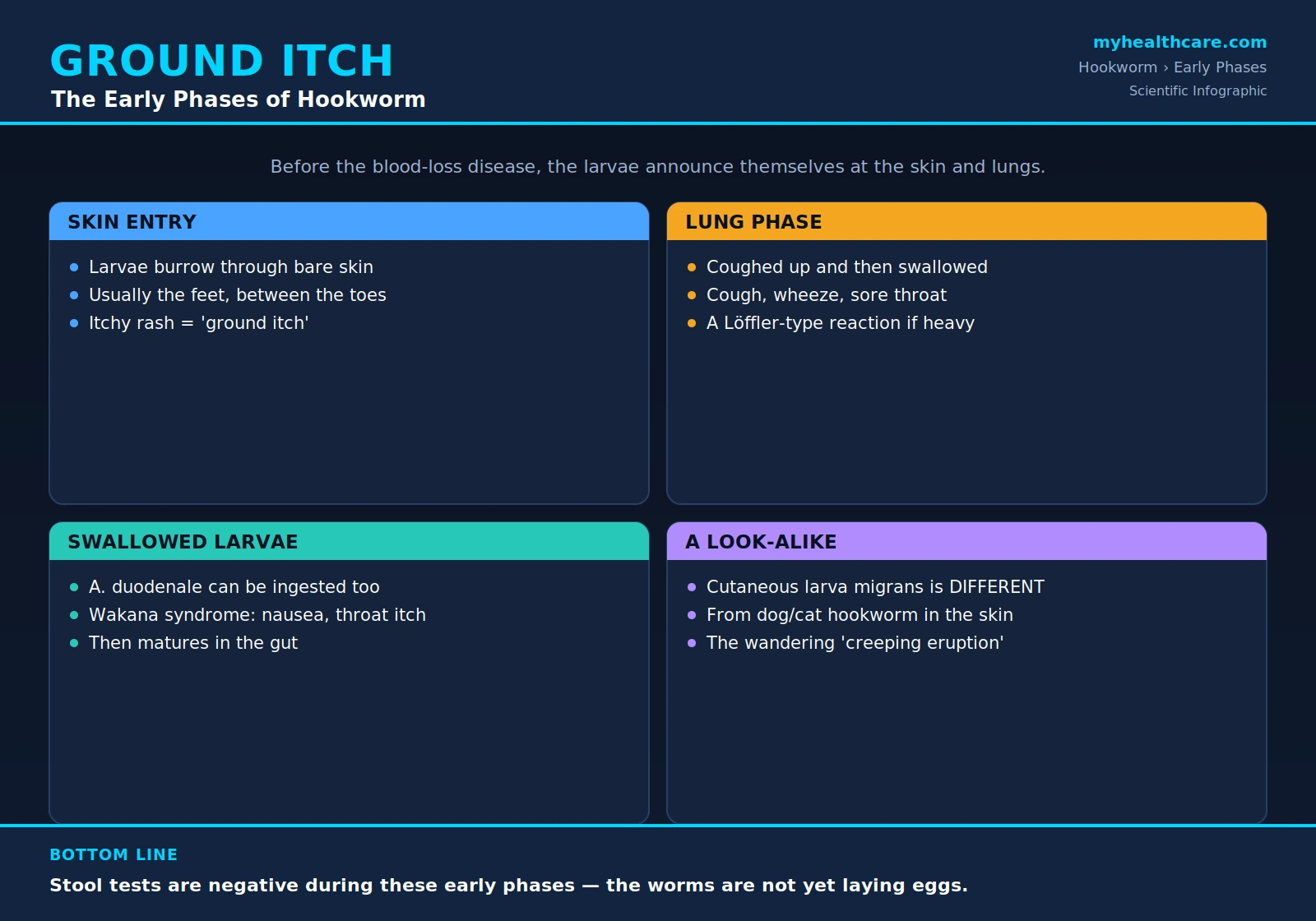
Long before hookworm becomes the slow, draining anemia it is famous for, the infection announces itself in two earlier and very different ways: an itchy rash where the worm gets in, and a cough as it passes through the lungs. These are the early phases of human hookworm infection — the days and weeks before the worms settle in the gut and start feeding on blood. This page walks through those early phases in order: the moment the larva burrows through your skin, the “ground itch” rash that follows, the journey through the lungs, an unusual swallowed-larva form called Wakana syndrome, and the first stirrings of stomach upset as the worms reach the intestine. It also explains a condition that looks similar and is constantly confused with it — cutaneous larva migrans, the “creeping eruption” that travelers bring home from the beach — which is caused by a different, animal hookworm and behaves quite differently. Understanding these early signs matters, because this is exactly the window when a stool test will come back negative and the infection can be missed.
A note on the two kinds of hookworm, because the whole page turns on it. Human hookworms — chiefly Necator americanus and Ancylostoma duodenale — are adapted to people: their larvae enter us, mature, and live for years in the human gut. The animal (zoonotic) hookworms — Ancylostoma braziliense and Ancylostoma caninum from dogs and cats — are not adapted to people: their larvae can get into human skin but generally cannot complete their life cycle in us, so they wander and die. Both can cause an early skin reaction, but only the human species go on to cause the blood-loss disease.
Table of Contents
- Two Different Hookworms, Two Different Diseases
- Skin Penetration: How the Larva Gets In
- Ground Itch (Dew Itch, Coolie Itch)
- The Lung-Migration Phase
- Löffler-Type Reaction in Heavy Exposure
- Wakana Syndrome: When Larvae Are Swallowed
- Gut Arrival: The First Stomach Symptoms
- Timing of Each Early Phase
- Cutaneous Larva Migrans: A Related but Different Condition
- Eosinophilic Enteritis from Ancylostoma caninum
- Why Stool Tests Are Negative Early (the Pre-Patent Period)
- Recognizing and Managing the Early Phases
- Key Research Papers
- Featured Videos
1. Two Different Hookworms, Two Different Diseases
Because this page describes skin and lung symptoms that both kinds of hookworm can cause, it is worth being very clear at the outset about which worm does what. Keeping these straight is the single most useful thing on this page.
Human hookworms. The two species that cause true human hookworm disease are Necator americanus (the dominant species across much of the tropics) and Ancylostoma duodenale (more common in parts of the Mediterranean, Middle East, North Africa, and Asia). Their infective larvae are built to live in people. When they enter human skin, they follow a fixed migration route — skin, then blood, then lungs, then windpipe, then swallowed into the gut — and finally settle in the small intestine, where the adult worms attach to the lining and feed on blood for years. These are the worms behind the iron-deficiency anemia covered on the Iron-Deficiency Anemia and Blood Loss page.
Animal (zoonotic) hookworms. Dogs and cats have their own hookworms — chiefly Ancylostoma braziliense and Ancylostoma caninum. Their larvae are shed in animal feces, contaminate sand and soil, and can penetrate human skin just as readily. But people are the wrong host. In us, these larvae usually cannot finish their journey: they get stuck in the skin and wander there for days or weeks, producing the winding, itchy track called cutaneous larva migrans (the “creeping eruption”). One of them, Ancylostoma caninum, can occasionally reach the human gut and cause an inflammatory bowel reaction (eosinophilic enteritis) — but even then it does not establish the chronic blood-feeding infection that human hookworms do.
So the same early event — a hookworm larva drilling into your skin — can lead to two very different stories depending on which worm it was. A human-hookworm larva moves on and eventually causes gut disease. An animal-hookworm larva is trapped in the skin and causes a creeping rash that, while miserable and itchy, is self-limited and never produces anemia.
2. Skin Penetration: How the Larva Gets In
Human hookworm infection nearly always begins through the skin. In warm, moist, shaded soil contaminated with human feces, hookworm eggs hatch and develop into the infective stage — the filariform larva (technically the third-stage, or L3, larva). These larvae are small, slender, and remarkably active. They climb to the top of moist soil or grass and wave their front ends in the air, “questing” for a passing host. When skin touches the soil, the larva responds to warmth and to chemical and touch cues and begins to burrow.
Crucially, these larvae penetrate intact skin — you do not need a cut or a sore. They use a combination of muscular boring movements and enzymes that soften and dissolve a path through the outer layers of the skin. The classic sites of entry are the parts of the body that meet contaminated ground: the bare feet, the soles, the spaces between the toes, the ankles, and the hands (in people who work the soil with their hands). This is fundamentally a disease of going barefoot in a place where human waste has reached the ground, which is why footwear and sanitation are so central to prevention — see Prevention: Footwear and Sanitation.
(Ancylostoma duodenale has a second trick that the others lack: its larvae can also infect a person who swallows them in contaminated food or water, and they may even pass to a baby through breast milk. The swallowed route produces the distinctive Wakana syndrome described below. But for both human species, skin penetration is the main way in.)
3. Ground Itch (Dew Itch, Coolie Itch)
The first sign of infection appears right where the larvae enter: an itchy, red skin reaction known for more than a century as ground itch. It has gone by several folk names tied to where and how people picked it up — dew itch (from walking through dewy grass in the early morning) and the older, historical term coolie itch (from the barefoot plantation laborers in whom it was rife).
What you actually see and feel is a patch of intense itching, usually on the feet or between the toes, with small red bumps (papules) and sometimes tiny blisters (vesicles). It develops within minutes to a day or two of exposure and reflects the body's local inflammatory and allergic response to the larvae punching through the skin. In a light, first-time exposure the reaction can be mild and easily missed — just a bit of itch written off as a bug bite. The rash is typically self-limited, settling over a few days as the larvae move on out of the skin and into the bloodstream.
Why repeat exposure matters. Ground itch tends to be worse in people who are exposed over and over — for example, agricultural workers in an endemic area who contact contaminated soil season after season. Repeated exposure sensitizes the immune system, so each new wave of penetrating larvae provokes a stronger, itchier, more pronounced reaction than the first. This is why ground itch is often described as a more vivid and recognizable problem in long-term residents and laborers than in a first-time visitor, in whom it may be subtle. The same allergic sensitization that makes the skin reaction stronger also shapes the lung phase that follows.
4. The Lung-Migration Phase
Once a human-hookworm larva leaves the skin, it enters small blood or lymph vessels and is carried in the bloodstream to the heart and then to the lungs. There it is too big to slip through the tiny lung capillaries, so it breaks out of the bloodstream into the air sacs (the alveoli). From the alveoli it crawls up the airways — the bronchi and windpipe — to the back of the throat, where it is coughed up and then swallowed, passing down the esophagus to begin the final leg of its journey to the small intestine. This roundabout path through the lungs is shared by several worms (it is the same route the roundworm Ascaris takes) and is the reason a gut parasite can cause chest symptoms.
Most of the time this lung passage is brief and produces only mild, transient symptoms: a dry cough, some wheezing, a mild sore throat, and occasionally a low-grade hoarseness or throat irritation. Because the symptoms are vague and short-lived, they are commonly mistaken for an ordinary cold or a touch of bronchitis, and the connection to a hookworm exposure weeks earlier is rarely made. In light infections, many people have no noticeable chest symptoms at all.
The intensity of the lung phase depends heavily on how many larvae are migrating at once and on whether the person has been sensitized by earlier exposure. A single, light exposure typically causes little or nothing. A heavy exposure — a large dose of larvae arriving in the lungs at the same time, especially in someone already sensitized — can provoke a much more dramatic allergic reaction in the lungs, described next.
5. Löffler-Type Reaction in Heavy Exposure
When many larvae sweep through the lungs together in a sensitized person, the result can be a Löffler-type reaction (also written Löffler's syndrome or eosinophilic pneumonia). This is an allergic inflammation of the lungs in which a flood of migrating larvae triggers the immune system — and especially a type of white blood cell called the eosinophil, which specializes in fighting parasites — to pour into the lung tissue.
Clinically, a Löffler-type reaction looks like a more pronounced version of the ordinary lung phase: cough, wheeze, sometimes shortness of breath, occasionally a low fever and a feeling of tightness in the chest. Two laboratory and imaging clues are characteristic. First, the eosinophil count in the blood rises (eosinophilia), reflecting the immune system's anti-parasite gearing-up. Second, a chest X-ray may show fleeting, shifting patches of shadowing that appear in one area, fade, and reappear elsewhere over days — so-called migratory or transient pulmonary infiltrates, mirroring the larvae's movement through the lungs.
The reassuring part is that, like the rest of the early phases, a Löffler-type reaction from hookworm is usually self-limited: it settles once the wave of larvae has finished passing through the lungs and moved on to the gut. It is, however, a useful diagnostic flag — an unexplained cough with wheeze, blood eosinophilia, and migratory chest-X-ray shadows in someone with a relevant soil or travel exposure should raise the possibility of a migrating worm such as hookworm.
6. Wakana Syndrome: When Larvae Are Swallowed
Wakana syndrome is a distinctive early presentation that occurs when the larvae of Ancylostoma duodenale are swallowed — in contaminated food or water — rather than entering through the skin. It is named for outbreaks first described in Japan that were traced to eating contaminated vegetables. (It is essentially specific to A. duodenale, the species able to infect by the oral route; Necator infection comes almost exclusively through the skin.)
When the larvae go down the throat instead of in through the foot, they irritate the lining of the mouth, throat, and upper gut directly, producing a recognizable cluster of symptoms: an intensely itchy or irritated throat (pharyngeal itch), together with nausea, vomiting, and a cough, sometimes with hoarseness. The picture reflects the larvae's passage and the local allergic reaction along the swallowed route, rather than the skin-and-lung route of the usual infection.
Wakana syndrome is uncommon and tends to appear where the oral route of A. duodenale transmission is plausible — for example, where night soil (human waste) is used to fertilize vegetables that are then eaten raw. Recognizing it matters because the symptoms — sore, itchy throat with nausea and cough — are easy to mistake for an ordinary upper-respiratory infection, missing the parasitic cause entirely.
7. Gut Arrival: The First Stomach Symptoms
After the larvae are swallowed and reach the small intestine, they molt and grow into adult worms over the following weeks, attaching to the intestinal lining with their cutting plates or teeth. As they mature and begin to take hold, some people develop a new set of symptoms centered on the upper abdomen.
The typical early-gut complaints are epigastric pain (a gnawing or burning discomfort high in the middle of the abdomen, sometimes likened to an ulcer or to bad indigestion), along with nausea, a poor appetite, bloating, and sometimes diarrhea. The discomfort comes from the developing worms attaching to and irritating the lining of the small bowel. These symptoms can be more noticeable in heavier infections and tend to be mild or absent when only a few worms are present.
This gut-arrival phase marks the hinge between the early, migratory disease covered here and the chronic phase that follows. The same worms that cause this initial stomach upset are the ones that will, over months, feed on blood and drain the body's iron stores — the slow, anemia-producing disease detailed on the Iron-Deficiency Anemia and Blood Loss page and, for those most vulnerable to it, on the Hookworm in Pregnancy and Children page.
8. Timing of Each Early Phase
The early phases unfold in a fairly predictable sequence, although the exact timing varies with the number of larvae and the individual. As a rough guide:
- Ground itch (skin): within minutes to a day or two of skin contact with contaminated soil — the very first event, lasting a few days.
- Lung migration: roughly within the first one to two weeks after exposure, as the larvae pass through the lungs — usually brief and transient.
- Wakana syndrome (if larvae were swallowed): soon after ingesting contaminated food or water, reflecting the larvae's passage through the throat and upper gut.
- Gut-arrival symptoms: developing over the following few weeks as the worms reach the small intestine and begin to mature.
- Egg-laying (patency) and chronic blood loss: the adult worms generally begin producing eggs roughly five to nine weeks after exposure, after which the long-term anemia disease can develop — and only at this point does a stool test become reliably positive.
The single most important consequence of this timeline is highlighted in its own section below: during the early phases — ground itch, the cough, the first stomach upset — the worms are not yet laying eggs, so the standard stool test is negative even though the infection is fully under way.
9. Cutaneous Larva Migrans: A Related but Different Condition
This is the condition most often confused with hookworm's ground itch, and it is essential to understand that it is related but genuinely different. Cutaneous larva migrans (CLM), also called the creeping eruption, is caused not by the human hookworms but by the animal (zoonotic) hookworms of dogs and cats — principally Ancylostoma braziliense, and to a lesser extent Ancylostoma caninum.
Why it behaves differently. When these animal-hookworm larvae penetrate human skin, they are in the wrong host. They cannot complete their life cycle in a person — they lack the enzymes to break through into the deeper circulation and move on to the lungs and gut the way a human-hookworm larva does. So instead of moving on, they become trapped in the skin and wander aimlessly within its upper layers for days to weeks until they eventually die. As a larva crawls along, it leaves a visible track.
What it looks like. The hallmark is a raised, red, intensely itchy, serpiginous (snake-like, winding) track that slowly advances — often by a few millimeters to a couple of centimeters a day — as the larva migrates. The track typically appears on skin that touched contaminated ground: the feet, soles, and toes, the buttocks (from sitting on contaminated sand), and the hands. The itching is often severe, especially at night. Because the larva is confined to the skin, CLM does not cause the lung phase, the gut disease, or the anemia of true human hookworm infection.
Who gets it. CLM is one of the most common skin problems acquired by travelers returning from tropical and subtropical regions, and classically affects beachgoers who have walked barefoot or sat on warm, shaded sand contaminated by dog or cat feces — Caribbean, Central and South American, African, and Southeast Asian beaches are frequent sources. It is a leading reason a returning traveler sees a doctor for an itchy rash.
How it is managed. Because CLM is caused by larvae that will die on their own, it is technically self-limited — but the itching can be intolerable and the rash can persist for weeks, so treatment is usually given to speed resolution and relief. Effective options include the oral antiparasitic drugs ivermectin and albendazole; randomized comparison has found ivermectin highly effective for the creeping eruption. The key clinical lesson is simply to recognize the winding track for what it is, so that an itchy, advancing line on a returned traveler's foot is treated as CLM rather than misdiagnosed as a fungal infection, a worm under the skin, or a simple allergic rash.
10. Eosinophilic Enteritis from Ancylostoma caninum
There is one further way the dog hookworm can affect people, and it sits at the boundary between the skin condition above and true gut infection. In some regions — the syndrome was characterized in detail in northeastern Australia — larvae of the dog hookworm Ancylostoma caninum can occasionally reach the human intestine and provoke an inflammatory reaction there called eosinophilic enteritis.
In this situation the dog-hookworm worm partially establishes in the human gut but does not mature into a normal egg-laying adult population the way a human hookworm would. Instead it triggers an intense local allergic, eosinophil-rich inflammation of the bowel wall. The result can be abdominal pain — sometimes severe and colicky, occasionally mimicking appendicitis or other surgical emergencies — together with a raised eosinophil count in the blood. Because a single worm can cause it and because it rarely produces eggs that show up in stool, this diagnosis is easily missed and was historically a puzzle until the dog hookworm was identified as the cause.
The practical point is that Ancylostoma caninum blurs the neat “skin-only animal hookworm” rule: usually it causes cutaneous larva migrans, but in some people it goes further and causes an allergic enteritis of the gut — yet even then it does not establish the chronic, blood-feeding, anemia-causing infection that defines true human hookworm disease.
11. Why Stool Tests Are Negative Early (the Pre-Patent Period)
This is perhaps the most clinically important idea on the page, because it explains how an active hookworm infection can be repeatedly “ruled out” by a normal test result. The standard way to diagnose hookworm is to examine a stool sample under the microscope for the worms' eggs. That test only works once the adult worms are mature enough to be laying eggs.
The gap between the moment of infection and the moment the worms start producing eggs is called the pre-patent period. For hookworm it is roughly five to nine weeks (it varies by species and by the route and size of the exposure). During all of the early phases described on this page — the ground itch, the cough and wheeze of the lung phase, Wakana syndrome, and the first stomach symptoms — the worms are still larvae or immature adults and have not yet started laying eggs. There are therefore no eggs in the stool to find, and a stool examination will come back negative even though the person is genuinely infected.
This timing mismatch is a real diagnostic trap. A patient with an itchy foot rash, a cough, and abdominal discomfort after a relevant soil or travel exposure can have a perfectly normal stool test and be told nothing is wrong — only to develop egg-positive stool, and the slow anemia, weeks later. The lesson is that during the early phases the diagnosis often rests on the clinical picture and exposure history (and supportive clues such as blood eosinophilia), not on a single stool result; and that a negative early stool test does not exclude hookworm. If suspicion is high, the stool examination can be repeated after the pre-patent period has passed.
12. Recognizing and Managing the Early Phases
Pulling the threads together, the early phases of hookworm are recognized mostly by pattern and context rather than by a single test. The combination that should prompt thought about a migrating worm is: an itchy papular or vesicular rash on the feet after soil contact (ground itch); followed weeks later by a transient cough or wheeze, sometimes with blood eosinophilia and fleeting chest-X-ray shadows (the lung phase, up to a Löffler-type reaction); and early upper-abdominal discomfort as the worms reach the gut — all in someone with a plausible exposure (going barefoot on contaminated soil in, or travel to, an endemic area). A swallowed-larva history with throat itch, nausea, and cough points to Wakana syndrome.
Management of these early phases is mostly supportive and reassuring, because each phase is self-limited: the ground-itch rash is soothed with topical measures and settles in days; the lung phase passes on its own; and the gut symptoms are managed symptomatically while the diagnosis is pursued. The decisive treatment — the deworming drugs (albendazole or mebendazole) that kill the adult worms, given with iron when anemia has set in — is aimed at the established intestinal infection and is covered on the Anthelmintic Treatment and Iron Repletion page and the Treatment and Prevention hub. Cutaneous larva migrans, the animal-hookworm look-alike, is its own situation: recognized by its winding track and treated with ivermectin or albendazole for relief.
Above all, the early phases are the place where prevention has the greatest leverage. Because the whole sequence begins with a larva penetrating bare skin in contaminated ground, wearing shoes and improving sanitation so that human waste never reaches the soil stop the infection before it starts — the subject of the Prevention: Footwear and Sanitation page and, at the community scale, the Mass Drug Administration and Control page.
Key Research Papers
Peer-reviewed reviews and studies on the early phases of human hookworm infection (skin penetration, larval migration, the lung phase) and on the related animal-hookworm conditions cutaneous larva migrans and eosinophilic enteritis. Journal names appear as plain text; the year/volume/pages link opens the full citation via DOI.
- Hotez PJ, Brooker S, Bethony JM, Bottazzi ME, Loukas A, Xiao S. Hookworm Infection. New England Journal of Medicine. 2004;351(8):799–807.
- Loukas A, Hotez PJ, Diemert D, et al. Hookworm Infection. Nature Reviews Disease Primers. 2016;2:16088.
- Bethony J, Brooker S, Albonico M, et al. Soil-Transmitted Helminth Infections: Ascariasis, Trichuriasis, and Hookworm. The Lancet. 2006;367(9521):1521–1532.
- Brooker S, Bethony J, Hotez PJ. Human Hookworm Infection in the 21st Century. Advances in Parasitology. 2004;58:197–288.
- Maxwell C, Hussain R, Nutman TB, Poindexter RW, Little MD, Schad GA, Ottesen EA. The Clinical and Immunologic Responses of Normal Human Volunteers to Low Dose Hookworm (Necator americanus) Infection. The American Journal of Tropical Medicine and Hygiene. 1987;37(1):126–134.
- Heukelbach J, Feldmeier H. Epidemiological and Clinical Characteristics of Hookworm-Related Cutaneous Larva Migrans. The Lancet Infectious Diseases. 2008;8(5):302–309.
- Hochedez P, Caumes E. Hookworm-Related Cutaneous Larva Migrans. Journal of Travel Medicine. 2007;14(5):326–333.
- Caumes E, Danis M. From Creeping Eruption to Hookworm-Related Cutaneous Larva Migrans. The Lancet Infectious Diseases. 2004;4(11):659–660.
- Caumes E, Carriere J, Datry A, Gaxotte P, Danis M, Gentilini M. A Randomized Trial of Ivermectin Versus Albendazole for the Treatment of Cutaneous Larva Migrans. The American Journal of Tropical Medicine and Hygiene. 1993;49(5):641–644.
- Prociv P, Croese J. Human Eosinophilic Enteritis Caused by Dog Hookworm Ancylostoma caninum. The Lancet. 1990;335(8701):1299–1302.
- Prociv P, Croese J. Human Enteric Infection with Ancylostoma caninum: Hookworms Reappraised in the Light of a “New” Zoonosis. Acta Tropica. 1996;62(1):23–44.
Live PubMed Searches
Each link opens a live PubMed query so results stay current as new papers are indexed.
- Hookworm ground itch and larval penetration
- Necator americanus larval migration in the lung
- Löffler syndrome and hookworm eosinophilic pneumonia
- Wakana disease and Ancylostoma duodenale
- Cutaneous larva migrans (creeping eruption)
- Ancylostoma braziliense cutaneous larva migrans in travelers
- Ancylostoma caninum eosinophilic enteritis
- Hookworm pre-patent period and diagnosis
Connections
- All Parasites
- Symptoms & Diagnosis
- Iron-Deficiency Anemia & Blood Loss
- Hookworm in Pregnancy & Children
- Treatment & Prevention
- Anthelmintic Treatment & Iron Repletion
- Prevention: Footwear & Sanitation
- Mass Drug Administration & Control
- Hookworm Overview
- Dermatology
- Infectious Disease
- All Conditions