Mass Drug Administration and Hookworm Control
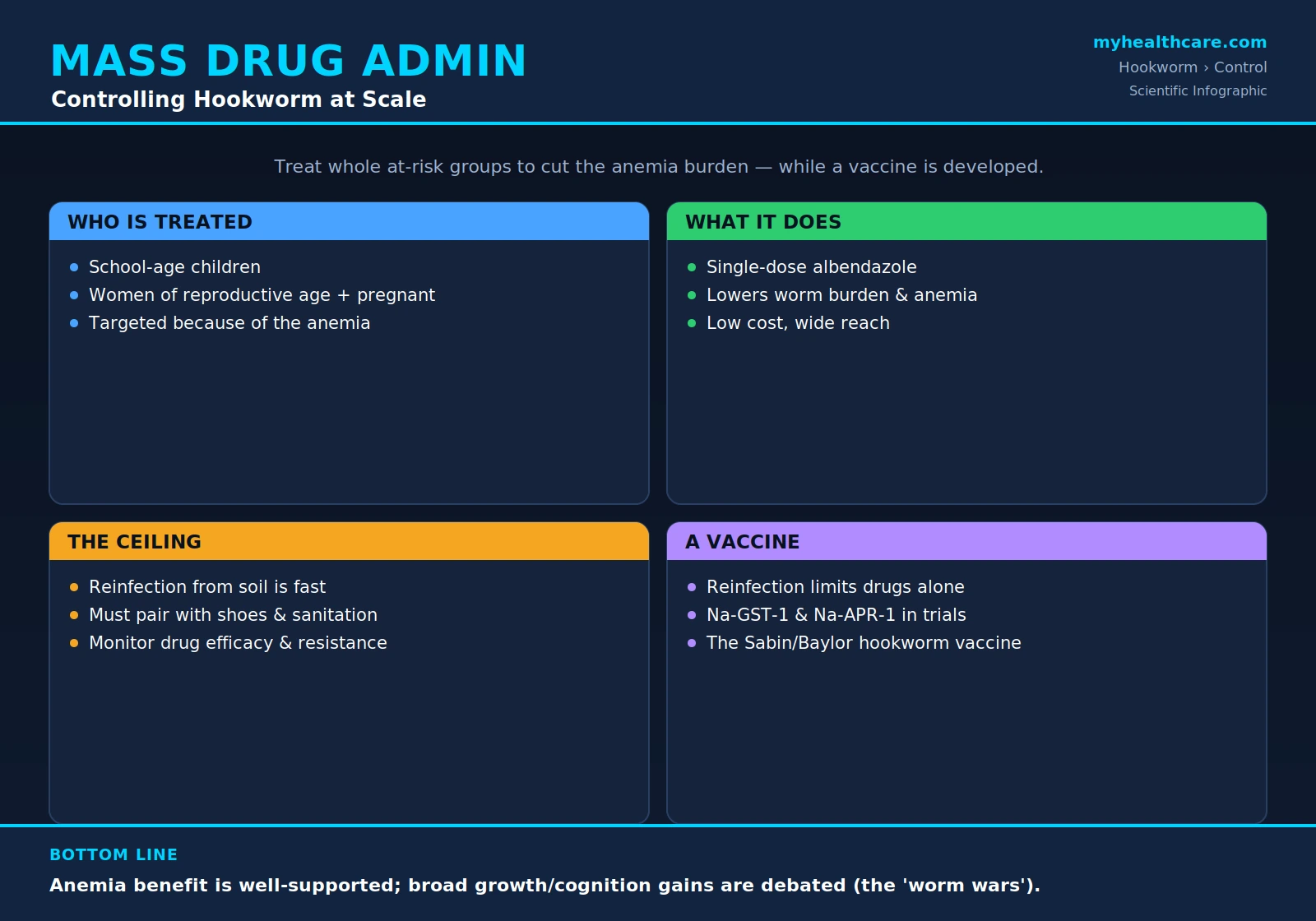
Treating one person who has hookworm is straightforward. But hookworm is rarely a one-person problem: in the places where it thrives, it infects a large share of an entire community at once, and the soil itself is contaminated with the eggs and larvae that keep the cycle turning. Mass drug administration (MDA) — giving a deworming tablet to whole populations at risk, on a regular schedule, without first testing each individual — is the public-health strategy built to attack the problem at that community scale. This page explains what MDA (also called preventive chemotherapy) actually involves, who it targets, which drug is used, and how often. It also tackles the harder questions honestly: how well does it really work, and for which outcomes? There is good evidence that deworming reduces the anemia that hookworm causes, but the broader claims sometimes made for community-wide mass deworming — that it reliably improves children's growth, cognition, and schooling — are genuinely contested by careful systematic reviews. We will lay out both the program rationale and the skeptical evidence, then look at the two things that explain why drugs alone can never finish the job: relentless reinfection, and the search for a hookworm vaccine.
Table of Contents
- What Mass Drug Administration Means
- Who Gets Treated — and Why Women Are Included
- The Drug: Single-Dose Albendazole
- Coverage and Frequency by Endemicity
- The Documented Impact on Worms and Anemia
- The Reinfection Ceiling: Why Drugs Alone Are Not Enough
- The "Worm Wars": An Honest Look at the Evidence
- Drug-Efficacy Monitoring and Resistance Surveillance
- The Hookworm Vaccine Effort
- Integration with Other NTD Programs
- Key Research Papers
- Featured Videos
1. What Mass Drug Administration Means
In ordinary medicine, you get sick, you get tested, and then you get treated. Mass drug administration flips that order on its head. In a community where hookworm and the other soil-transmitted worms are common, the World Health Organization (WHO) recommends giving a safe deworming tablet to everyone in the at-risk groups, on a schedule, without testing each person first. The formal name for this approach is preventive chemotherapy — "preventive" because the goal is not just to cure the people who happen to feel ill, but to drive down the total number of worms across the whole population, before they cause harm.
The logic rests on three facts. First, the deworming drugs are cheap, single-dose, and very safe — safe enough to give to a healthy-seeming child without a diagnosis. Second, in a heavily affected community, so many people are infected that testing everyone individually would cost far more than the tablets themselves and would slow everything down. Third, and most importantly, hookworm transmission depends on the total worm burden in the community: every infected person who passes eggs in their stool seeds the soil with the next generation of larvae. Lowering the average worm count across the whole population — not just curing isolated individuals — is what reduces the contamination that keeps the cycle going.
So MDA is best understood as a population-level tool. Its target is not really the individual patient; it is the community's collective parasite load. A person who is treated and then walks barefoot across the same contaminated ground will, predictably, pick the worms up again. That is not a failure of the drug — it is the central limitation that this whole page keeps returning to, and the reason MDA must be one part of a larger strategy rather than the whole of it.
2. Who Gets Treated — and Why Women Are Included
For most of the soil-transmitted worms, the headline target group of preventive chemotherapy is preschool- and school-age children, who tend to carry the heaviest worm burdens and who are easy to reach through schools. Hookworm, however, has a distinctive feature that widens the target list, and it traces directly to the kind of harm hookworm does.
The signature injury of hookworm is not a childhood-only problem. The worms latch onto the lining of the small intestine and feed on blood, and a heavy or long-standing infection drains iron faster than the diet can replace it, producing iron-deficiency anemia. That anemia is especially dangerous in two groups whom the worm hits hardest: women of reproductive age (who already lose iron through menstruation and the demands of pregnancy) and pregnant women, in whom hookworm-related anemia is linked to poorer outcomes for both mother and baby. Systematic review of the evidence has confirmed that hookworm is an important and treatable contributor to anemia in pregnancy across endemic regions.
Because of this anemia burden, WHO's preventive-chemotherapy guidance for hookworm-endemic areas distinctively extends deworming beyond schoolchildren to women of reproductive age, including pregnant women. For pregnant women the standard precaution is to give the deworming dose after the first trimester — the first trimester is avoided out of caution during the period of fetal organ formation, while treatment from the second trimester onward is considered appropriate and is recommended in settings where hookworm and maternal anemia are common. Treating these women, often alongside iron and folic-acid supplementation, is aimed squarely at reducing maternal anemia and its downstream harms. The full clinical picture of why pregnancy and childhood are the points of greatest vulnerability is covered on the Hookworm in Pregnancy and Children page; the key point here is that the anemia is the reason the control program's reach is broadened to include adult women at all.
3. The Drug: Single-Dose Albendazole
The deworming drugs used in mass programs belong to a family called the benzimidazoles, and the two workhorses are albendazole and mebendazole. They work by interfering with the worm's ability to absorb glucose, in effect starving the parasite so that it loses its grip and is passed out of the gut. Both are inexpensive, taken by mouth, and have an excellent safety record, which is exactly why they can be handed out on a community scale.
For hookworm specifically, the drug of choice in single-dose programs is albendazole, given as one 400 mg tablet. The reason is a real difference in performance: against hookworm, a single dose of albendazole clears the infection considerably more often than a single dose of mebendazole. When researchers pooled the trial data on how well each drug performs against the different worms, single-dose albendazole came out as the more reliable choice for hookworm, while the two drugs perform more similarly against some of the other soil-transmitted species. Because hookworm is the worm whose anemia makes it the priority target, programs in hookworm-endemic areas lean toward the more hookworm-effective benzimidazole — albendazole — for their single-dose campaigns.
It is worth being clear-eyed about what "single-dose" buys and what it does not. One tablet is what makes mass treatment logistically and financially possible — but, as the next sections show, a single dose does not cure everyone, and the modest single-dose cure rate against hookworm is one of the practical limits the program has to manage.
4. Coverage and Frequency by Endemicity
How often a community is dewormed is matched to how heavily that community is infected — a measure called endemicity, usually expressed as the proportion of people (the prevalence) carrying worms. WHO frames the schedule in terms of this prevalence so that effort is concentrated where the burden is greatest:
- High-transmission areas — where roughly half or more of the at-risk group is infected — warrant treating the target groups twice a year.
- Moderate-transmission areas — where a substantial minority is infected — warrant treating once a year.
- Lower-transmission areas may need treatment less often, or a more targeted approach, as the goal shifts from controlling heavy disease toward driving prevalence down further.
Two other ideas matter here. One is coverage — the share of the target population that actually swallows the tablet during a campaign. A program can recommend the right drug at the right frequency, but if it only reaches half the eligible people, the worm burden left behind in the untreated half keeps reseeding the environment. High, repeated coverage is what makes the difference between nudging a community's worm load and genuinely suppressing it. The other is the rationale for repetition: because people become reinfected from contaminated soil, the worm burden creeps back up after each round. Treating twice a year in high-transmission settings is an attempt to keep the burden suppressed during the windows between rounds, rather than letting it fully rebound.
5. The Documented Impact on Worms and Anemia
What does a round of mass deworming actually accomplish? Two things are well documented.
It sharply lowers the worm burden. A round of albendazole clears or greatly reduces the worms in a large fraction of those treated, so the average number of worms per person — and the contamination of the environment with eggs — drops after a campaign. This is the most direct and least disputed effect: deworming removes worms. The honest caveat, developed in the next two sections, is that the effect is temporary in the face of reinfection, and that a single dose does not clear hookworm in everyone.
It reduces hookworm-related anemia. This is the outcome with the strongest claim to a real, health-relevant benefit, and it is the reason the control program exists. Because hookworm causes anemia by draining blood and iron, removing the worms allows hemoglobin to recover. A systematic review focused specifically on this question found that, in non-pregnant populations, hookworm infection is associated with lower hemoglobin and that deworming is associated with improvement in anemia — the heavier the worm burden in a setting, the larger the anemia benefit from clearing it. In pregnant women, where the anemia stakes are highest, deworming (typically combined with iron and folic acid) is used precisely to lift maternal hemoglobin and reduce the harms of anemia. So when the evidence is judged on the outcome that hookworm most clearly causes — anemia — mass deworming has reasonably good support.
Keep that framing in mind, because it is the hinge of the whole evidence debate: deworming's case is strongest for the specific harm of hookworm (anemia) and much weaker for the general developmental benefits sometimes claimed for it.
6. The Reinfection Ceiling: Why Drugs Alone Are Not Enough
Here is the hard ceiling that limits every mass-drug program: the tablet kills the worms a person already has, but it does nothing to stop them getting new ones. Albendazole has no lasting protective effect. The day after treatment, a child who walks barefoot across soil contaminated with hookworm larvae — larvae that penetrate the skin of the feet — can be reinfected. In heavily affected communities, worm burdens are often climbing back toward their pre-treatment levels within months.
This is why MDA, on its own, can suppress hookworm but rarely eliminates it. The drug attacks the worms inside people; it leaves the source of infection — the contaminated environment — completely untouched. As long as human feces containing hookworm eggs reach the soil, and as long as people walk that soil barefoot, the larvae will be waiting to start the cycle again no matter how many times the population is dewormed.
The conclusion that the control field has reached is unambiguous: deworming must be paired with the measures that break the transmission cycle itself — sanitation that keeps human waste out of the soil (latrines, safe disposal of feces) and footwear that keeps larvae from reaching the skin. Drugs lower the worm burden quickly; sanitation and footwear are what keep it down and offer any realistic path toward genuine, lasting control. These environmental and behavioral defenses are the subject of the Prevention: Footwear and Sanitation page, and they are the indispensable partner to everything described here.
7. The "Worm Wars": An Honest Look at the Evidence
No discussion of mass deworming is complete — or honest — without the debate that researchers nicknamed the "worm wars." The dispute is not about whether deworming kills worms (it does) or whether it helps hookworm anemia (the evidence reasonably supports that). It is about a much bigger and more sweeping claim: that giving deworming tablets to whole communities reliably makes children grow more, think more clearly, and do better in school — and that it does so broadly enough to justify community-wide mass treatment as a development intervention, not just a disease-control one.
That broader claim is genuinely contested. The Cochrane systematic reviews — among the most rigorous syntheses of clinical evidence — have repeatedly examined the trials of public-health deworming programs for soil-transmitted worms in children and concluded that, when treating whole communities (rather than only children already known to be infected), the evidence shows little to no consistent effect of mass deworming on average weight, height, hemoglobin across all settings, cognition, or school performance. In other words, the across-the-board developmental dividends sometimes promised for mass deworming are not reliably borne out in the pooled trial data.
It is important to state precisely what this does and does not mean, because the debate is easily misread in both directions:
- It is not a claim that hookworm is harmless. Heavy hookworm infection clearly causes anemia and harm, and treating an individual who has a heavy worm burden helps that person. The Cochrane finding is about the average effect of treating everyone, which is diluted when many of the people treated are lightly infected or not infected at all.
- It does not erase the anemia benefit. The specific, mechanism-driven benefit — clearing the blood-feeding worms that cause iron loss — remains the most defensible reason to deworm, especially in high-burden settings and in women and children at risk of anemia (covered above and in the Anemia and Blood Loss page).
- It does temper the grand claims. Presenting mass deworming as a near-guaranteed boost to childhood growth, IQ, and schooling goes beyond what the most careful reviews support.
The balanced position — and the one this page takes — is that mass deworming is a cheap, safe, defensible tool for reducing hookworm worm burden and the anemia it causes, particularly where infection is intense, while the larger promises about community-wide developmental gains should be treated with the skepticism the Cochrane reviews invite. Good public-health policy can hold both of those truths at once.
8. Drug-Efficacy Monitoring and Resistance Surveillance
A program that hands the same drug to millions of people, over and over, has to keep asking a critical question: is the drug still working? Two facts make this monitoring essential.
First, even at its best, a single dose of albendazole does not cure hookworm in everyone. Measured cure rates for single-dose hookworm treatment are only modest — a meaningful fraction of treated people still harbor worms afterward — which is one reason high-transmission areas are dewormed twice a year and why egg-reduction (how much the worm burden falls) is often a more useful gauge of a drug's effect than cure alone. A worsening cure or egg-reduction rate over successive rounds is exactly the kind of signal a program watches for.
Second, repeatedly exposing worm populations to a single drug class is precisely the pressure that, in veterinary medicine, has bred widespread anthelmintic resistance in the worms of livestock. The worry that the human soil-transmitted worms could follow the same path is real and has been carefully assessed. The current expert view is that, so far, there is no convincing evidence of established drug resistance in human hookworm, but that reliance on essentially one class of drug, given on a massive scale, makes ongoing surveillance of drug efficacy a genuine priority — both to catch any drift in cure and egg-reduction rates and to detect emerging resistance early enough to respond. This combination of modest single-dose cure and the long shadow of resistance is a major part of why the field is not content to rely on drugs forever — and why it is investing in a vaccine.
9. The Hookworm Vaccine Effort
If you wanted to design a disease that drugs alone could never conquer, you would design something very like hookworm: the medicine removes the worms but grants no lasting protection, the contaminated environment refills the moment treatment stops, and people are reinfected again and again. That relentless reinfection is the core reason researchers have spent years pursuing a hookworm vaccine. A vaccine that produced durable immunity could do what a tablet cannot — protect a person through the gaps between treatments and across years of continued exposure, breaking the otherwise endless reinfection loop.
The leading effort is the Human Hookworm Vaccine, developed over many years by the Sabin Vaccine Institute together with the Baylor College of Medicine group led by researchers including Peter Hotez and Maria Elena Bottazzi. Rather than using a whole organism, the vaccine is built from recombinant protein antigens — purified copies of specific hookworm proteins the parasite needs in order to feed on blood. The strategy is to provoke an immune response against these feeding-related proteins so that, when real worms try to establish and feed, the immune system blunts them, lowering both the worm burden and the blood loss that drives anemia. Two of the lead antigens are:
- Na-GST-1 — a glutathione S-transferase the worm uses in handling the blood it ingests; and
- Na-APR-1 — an aspartic protease (a hemoglobin-digesting enzyme) the worm relies on to break down host blood.
Both candidates have advanced into clinical trials testing their safety and their ability to generate the intended immune response in human volunteers, including studies in adults who have never been infected and field studies in hookworm-endemic regions. The overarching aim of the program, as its developers describe it, is explicitly to prevent hookworm disease and anemia — the same anemia burden that drives the whole control effort — rather than merely to lower egg counts.
It is important to be measured about where this stands. As of the mid-2020s the Human Hookworm Vaccine remains investigational: it is in clinical development, not in routine use, and no hookworm vaccine is yet licensed or deployed in control programs. But the rationale is compelling precisely because of everything above — the reinfection ceiling, the only-modest single-dose cure, and the looming concern over relying on one drug class. A working vaccine would shift hookworm control from the endless, repeating task of mass deworming toward the possibility of durable, individual protection. Until then, the vaccine effort is a complement to MDA, not a replacement for it, and the day-to-day work of control still rests on the drug-and-environment strategy described on this and the companion pages.
10. Integration with Other NTD Programs
Hookworm does not travel alone. The communities where it is endemic are typically the same communities burdened by the other soil-transmitted worms (roundworm and whipworm) and often by other neglected tropical diseases (NTDs) such as schistosomiasis and lymphatic filariasis. This overlap is an opportunity, and modern control programs exploit it by integrating their efforts rather than running a separate campaign for every parasite.
The practical payoff is efficiency. The same community visits, the same trained distributors, the same registers and supply chains, and in many cases co-administered medicines can be used to deliver preventive chemotherapy against several NTDs at once. Albendazole, the hookworm workhorse, is itself part of the combination used in some lymphatic-filariasis programs, so a single distribution event can serve more than one disease-control goal. Integrating in this way lowers the cost per person reached, reduces the burden on stretched health systems, and helps push coverage higher than any single-disease program could manage on its own.
Seen from this angle, mass drug administration for hookworm is best understood not as a standalone intervention but as one thread in a coordinated NTD-control effort — one that still depends, for any lasting success, on the unglamorous foundations of sanitation and footwear, and that may one day be reinforced by a hookworm vaccine. For the wider treatment and prevention picture, see the Treatment & Prevention hub and the Hookworm Overview.
Key Research Papers
Peer-reviewed reviews, clinical trials, systematic reviews, and program analyses on the mass treatment, control, evidence base, drug efficacy, and vaccine development for hookworm and the soil-transmitted helminths. Journal names appear as plain text; the year/volume/pages link opens the full citation via DOI.
- Loukas A, Hotez PJ, Diemert D, Yazdanbakhsh M, McCarthy JS, Correa-Oliveira R, Croese J, Bethony JM. Hookworm infection. Nature Reviews Disease Primers. 2016;2:16088.
- Hotez PJ, Brooker S, Bethony JM, Bottazzi ME, Loukas A, Xiao S. Hookworm Infection. New England Journal of Medicine. 2004;351(8):799–807.
- Bethony J, Brooker S, Albonico M, Geiger SM, Loukas A, Diemert D, Hotez PJ. Soil-transmitted helminth infections: ascariasis, trichuriasis, and hookworm. The Lancet. 2006;367(9521):1521–1532.
- Jourdan PM, Lamberton PHL, Fenwick A, Addiss DG. Soil-transmitted helminth infections. The Lancet. 2018;391(10117):252–265.
- Brooker S, Hotez PJ, Bundy DAP. Hookworm-Related Anaemia among Pregnant Women: A Systematic Review. PLoS Neglected Tropical Diseases. 2008;2(9):e291.
- Smith JL, Brooker S. Impact of hookworm infection and deworming on anaemia in non-pregnant populations: a systematic review. Tropical Medicine & International Health. 2010;15(7):776–795.
- Keiser J, Utzinger J. Efficacy of Current Drugs Against Soil-Transmitted Helminth Infections: Systematic Review and Meta-analysis. JAMA. 2008;299(16):1937–1948.
- Taylor-Robinson DC, Maayan N, Donegan S, Chaplin M, Garner P. Public health deworming programmes for soil-transmitted helminths in children living in endemic areas. Cochrane Database of Systematic Reviews. 2019;(9):CD000371.
- Vercruysse J, Albonico M, Behnke JM, Kotze AC, Prichard RK, McCarthy JS, Montresor A, Levecke B. Is anthelmintic resistance a concern for the control of human soil-transmitted helminths? International Journal for Parasitology: Drugs and Drug Resistance. 2011;1(1):14–27.
- Hotez PJ, Beaumier CM, Gillespie PM, Strych U, Hayward T, Bottazzi ME. Advancing a vaccine to prevent hookworm disease and anemia. Vaccine. 2016;34(26):3001–3005.
- Diemert DJ, Zumer M, Campbell D, Grahek S, Li G, Peng J, Bottazzi ME, Hotez P, Bethony J. Safety and immunogenicity of the Na-APR-1 hookworm vaccine in infection-naïve adults. Vaccine. 2022;40(42):6084–6092.
- Puchner KP, Bottazzi ME, Periago V, Grobusch MP, et al. Vaccine value profile for Hookworm. Vaccine. 2024;42(19):S25–S41.
Live PubMed Searches
Each link opens a live PubMed query so results stay current as new papers are indexed.
- Hookworm mass drug administration and control
- Preventive chemotherapy for soil-transmitted helminths
- Single-dose albendazole hookworm cure rate
- Deworming, anemia, and hemoglobin in pregnancy
- Deworming and growth, cognition, and schooling
- Anthelmintic resistance in human helminths
- Human hookworm vaccine: Na-GST-1 and Na-APR-1
- Hookworm reinfection after treatment and sanitation
Connections
- All Parasites
- Symptoms & Diagnosis
- Iron-Deficiency Anemia & Blood Loss
- Ground Itch & Larval Migration
- Hookworm in Pregnancy & Children
- Treatment & Prevention
- Anthelmintic Treatment & Iron Repletion
- Prevention: Footwear & Sanitation
- Hookworm Overview
- Hematology
- Infectious Disease
- All Conditions