Hookworm in Pregnancy and Children
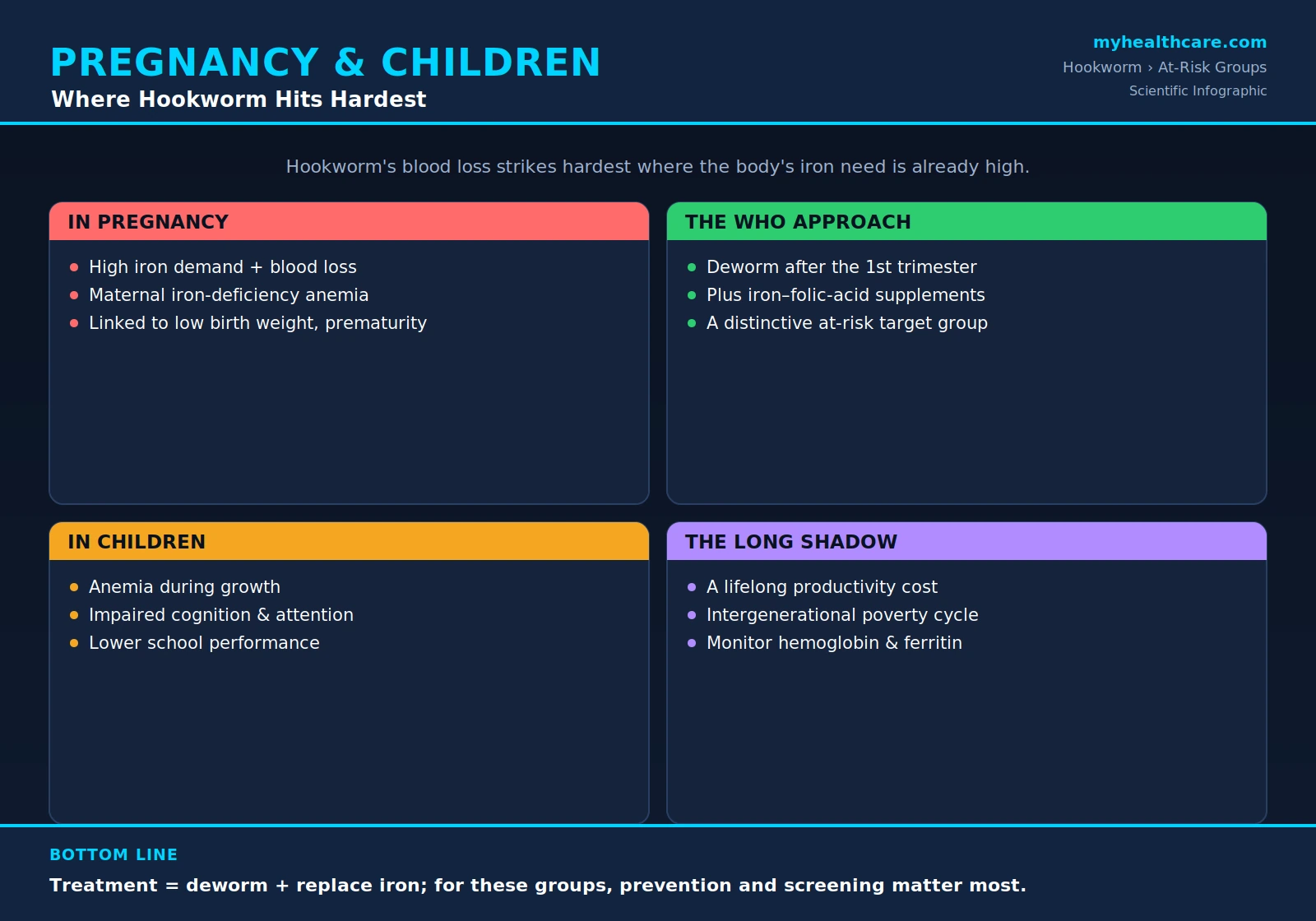
Hookworm is a quiet, slow disease — the worms attach to the lining of the small intestine and feed on blood, day after day, often for years. For most healthy adults, that steady drip of blood loss is something the body can keep up with. But two groups cannot keep up so easily, and it is in them that hookworm does its greatest harm: pregnant women and growing children. Both have unusually high demands for iron at exactly the time hookworm is draining it away, and in both the result — iron-deficiency anemia — reaches past the individual to affect a developing baby, a child's growing brain, and even the economic future of a whole community. This page explains why these two groups are hit hardest, what the consequences are, what the World Health Organization (WHO) reports about treating them, and how they are diagnosed, monitored, treated, and protected.
Table of Contents
- Why Pregnancy and Childhood Are the High-Risk Times
- Why Pregnancy Is High-Risk: Iron Demand Meets Blood Loss
- Maternal and Fetal Consequences
- The WHO Position on Antenatal Deworming
- Children: Growth, Iron, and the Developing Brain
- The Lifelong and Economic Cost
- How Infection Intensity Peaks by Age
- Diagnosis and Monitoring in These Groups
- Treatment in Pregnancy and Childhood
- Prevention Focused on These Groups
- Key Research Papers
- Featured Videos
1. Why Pregnancy and Childhood Are the High-Risk Times
Hookworm causes harm mainly through one mechanism: chronic intestinal blood loss. Adult worms (Necator americanus or Ancylostoma duodenale) anchor to the wall of the small intestine and feed on blood, and each worm causes a small but continuous daily loss. Multiply that by dozens or hundreds of worms, sustained over years, and the body slowly bleeds away iron faster than diet can replace it. The end result is iron-deficiency anemia. (The mechanism is covered in depth on the Iron-Deficiency Anemia and Blood Loss page.)
Whether that blood loss tips someone into anemia depends on a simple balance: how much iron is being lost versus how much iron the body needs and can absorb. A well-nourished adult man with light infection has iron to spare and may stay perfectly healthy. But two groups sit on the wrong side of that balance because their baseline iron requirements are already pushed to the limit:
- Pregnant women, whose bodies must supply iron for an expanding blood volume, a growing placenta, and the developing fetus — all at once.
- Children, whose rapidly growing bodies need iron to build new blood and tissue, and whose smaller iron reserves are quickly exhausted.
In both groups, the same daily blood loss that an adult man might shrug off becomes the difference between adequate iron and frank anemia. That is the core reason hookworm is, above all, a disease of mothers and children.
2. Why Pregnancy Is High-Risk: Iron Demand Meets Blood Loss
Pregnancy is one of the most iron-demanding states the human body ever experiences. Even without any parasite, iron requirements rise sharply across pregnancy. The mother's blood volume expands by roughly half to carry oxygen for two; the fetus must build its own blood and store iron for the first months of life; and the placenta itself requires iron to grow. For this reason, iron-deficiency anemia is common in pregnancy worldwide, even where hookworm is absent.
Now add hookworm. The worms' steady, daily blood loss is layered directly on top of pregnancy's already-elevated iron demand. A woman who entered pregnancy with marginal iron stores — which describes a great many women in hookworm-endemic regions — has little or no buffer. The parasite's drain pushes her past the threshold into iron-deficiency anemia, and often into moderate or severe anemia rather than a mild dip. Studies in endemic areas have repeatedly shown that the intensity of hookworm infection (how many worms, measured by egg counts in stool) tracks closely with how low a pregnant woman's hemoglobin falls: the heavier the worm burden, the worse the anemia. The systematic review by Brooker, Hotez, and Bundy of hookworm-related anaemia among pregnant women drew this relationship together across many studies and remains the central reference on the question.
The practical consequence is that, in hookworm-endemic regions, the parasite is a major and treatable driver of the anemia of pregnancy. It is not the only cause — dietary iron shortage, malaria, and other factors contribute — but it is a cause that can be removed with a single, cheap, safe deworming dose, which is precisely why it draws so much public-health attention.
3. Maternal and Fetal Consequences
The anemia hookworm causes in pregnancy is not a number on a lab report — it carries real consequences for both mother and baby.
For the mother, iron-deficiency anemia means fatigue, breathlessness, weakness, and reduced capacity for daily work and care — a heavy burden during pregnancy. More importantly, anemia reduces a woman's physiological reserve for the demands of labor and delivery. Childbirth normally involves significant blood loss; a woman who is already severely anemic has far less margin to tolerate that loss safely. Where anemia is severe, this contributes to the risk of complications around delivery, and severe maternal anemia is recognized as a contributor to maternal mortality in low-resource settings. In other words, hookworm anemia does not merely make pregnancy harder — in its severe forms it can make childbirth more dangerous.
For the baby, maternal iron-deficiency anemia is associated with poorer pregnancy outcomes. Across many studies, maternal anemia has been linked with an increased risk of low birth weight and preterm birth (prematurity), both of which are leading reasons newborns struggle in the first weeks of life. A baby born too small or too early starts life at a disadvantage — and a mother with depleted iron stores also gives her infant a smaller iron endowment to draw on, setting the stage for infant anemia as well. It is important to be precise here: these are associations, and maternal anemia is one contributing factor among several rather than a single direct cause. But the pattern is consistent enough across populations that reducing maternal anemia — including the share of it caused by hookworm — is treated as a genuine opportunity to improve newborn health.
4. The WHO Position on Antenatal Deworming
Because hookworm is a removable cause of anemia in pregnancy, public-health guidance has long addressed whether and how to treat it during pregnancy. The following describes reported World Health Organization guidance; it is presented for general understanding, and any individual treatment decision belongs to a woman's own clinician, who can weigh her specific situation.
As reported, WHO recommends that in areas where hookworm (and other soil-transmitted helminths) is endemic and anemia is a public-health problem, pregnant women be offered a single dose of a benzimidazole anthelmintic — the drug class that includes albendazole and mebendazole — after the first trimester. The first-trimester caveat reflects ordinary caution about giving medicines during the period of early organ development, even though the available safety data on these drugs in pregnancy have been broadly reassuring. This deworming is meant to be given together with iron and folic-acid supplementation, not as a substitute for it: deworming stops the ongoing blood loss, while iron and folate rebuild the depleted stores. The two work as a pair.
It is worth presenting this in a balanced way. The logic — remove the worms, replace the iron — is sound, and antenatal deworming has been incorporated into antenatal-care packages in many endemic countries. At the same time, the size of the benefit measured in trials has varied, and the evidence on hard outcomes such as birth weight and infant survival is mixed rather than uniform: one well-known trial in rural Nepal (Christian and colleagues) reported improvements in birthweight and infant survival with antenatal anthelmintic treatment, while other studies have found smaller or less consistent effects. What is not in serious dispute is that deworming reliably reduces the worm burden and the associated blood loss, and that pairing it with iron-folate supplementation is a reasonable, low-cost strategy in endemic settings. Women of reproductive age are, for this reason, a distinct target group in WHO's broader control strategy (see the prevention section below).
5. Children: Growth, Iron, and the Developing Brain
The second high-risk group is children, and here hookworm's harm reaches into growth and the developing brain.
Physical growth. A growing child needs a steady supply of iron and protein to build new tissue. Chronic hookworm blood loss bleeds away iron and protein during exactly this period, and the result can be impaired physical growth — children who are shorter, lighter, and more poorly nourished than they would otherwise be. Heavy, long-standing infection can contribute to stunting and wasting, and in severe cases to the swelling and protein loss of advanced disease.
The developing brain. Iron is not only for blood; it is essential for normal brain development and function. In childhood, iron-deficiency anemia is linked with impaired cognition, reduced attention, and poorer school performance. A child who is iron-deficient may be listless, struggle to concentrate, learn more slowly, and fall behind peers in the classroom. Landmark work in school-age children — including Stoltzfus and colleagues' studies in Zanzibar, which showed how strongly hookworm intensity drove iron-deficiency anemia in schoolchildren — helped establish hookworm as a meaningful threat to children's iron status and, through it, to their learning. The damage here is especially troubling because it strikes at a one-time window: the years when a child's brain is developing and when schooling lays the foundation for the rest of life.
Importantly, much of this harm is reversible or preventable. Treating the infection and repleting iron can restore hemoglobin, and deworming programs in schoolchildren have been associated with improvements in iron status, growth, and (in some studies) school attendance and performance. The tragedy of hookworm in children is not that it is untreatable — it is that, left unrecognized, it silently steals growth and learning that simple treatment could have protected.
6. The Lifelong and Economic Cost
The consequences of childhood hookworm do not end in childhood. Impaired growth, lost schooling, and diminished cognitive development translate, over a lifetime, into reduced earning capacity and productivity in adulthood. A child who learns less and attends school less because of chronic anemia tends to become an adult who earns less — an effect documented in long-term economic analyses of childhood worm infection. Hookworm thereby imposes a cost that is measured not only in hemoglobin points but in human potential and economic output, which is part of why Crompton and others have framed it as a disease of major public-health importance rather than a mere nuisance.
This is also where hookworm helps perpetuate an intergenerational cycle of poverty. Poverty — with its bare feet, earthen floors, and inadequate sanitation — exposes people to the larvae in contaminated soil. Hookworm then deepens that poverty by sapping the health, growth, and learning of children and the working capacity of adults, including pregnant women. Poorer, sicker families are in turn less able to escape the conditions that spread the parasite. An anemic mother may bear a low-birth-weight baby who grows into an anemic child who learns less and earns less — and the loop closes. Breaking that cycle is one of the strongest arguments for treating and preventing hookworm in mothers and children specifically: doing so is not only a medical intervention but an investment that reaches across generations.
7. How Infection Intensity Peaks by Age
One reason hookworm concentrates its harm in particular groups is that the intensity of infection — the number of worms a person carries — is not the same at every age. The harm hookworm causes depends far more on how heavy the infection is than on simply whether a person is infected at all, because a handful of worms loses little blood while a heavy burden loses a great deal.
For the two hookworm species that infect humans, worm burdens tend to rise through childhood and remain high into adulthood — a pattern that differs from some other intestinal worms (such as roundworm and whipworm), where the heaviest burdens peak in young children and then fall. This means school-age children and adults, including women of reproductive age, commonly carry substantial worm burdens, which is part of why hookworm's heaviest toll falls on schoolchildren and on women during their childbearing years. Knowing how intensity is distributed by age is also what lets control programs aim their efforts — targeting the ages and groups carrying the worms that cause the most blood loss. (The age and intensity patterns are described in the epidemiological reviews by Bethony, Brooker, and colleagues listed below.)
8. Diagnosis and Monitoring in These Groups
In pregnant women and children, diagnosis and monitoring combine a check for the worm with a check for its main effect, iron-deficiency anemia.
Hemoglobin. The simplest and most important measurement is hemoglobin, which detects anemia and grades its severity. In pregnant women and young children, hemoglobin is checked as part of routine care in many settings, and a low value in a hookworm-endemic area should prompt thought about the parasite. Hemoglobin is also the natural measure for tracking recovery: it should rise once the worms are cleared and iron is replaced.
Ferritin and iron studies. Where available, ferritin (a marker of the body's iron stores) and other iron studies confirm that an anemia is genuinely due to iron deficiency rather than another cause, and they reveal depleted stores even before hemoglobin has fully fallen. This matters in pregnancy and childhood, where catching iron depletion early allows it to be corrected before it becomes severe. (Ferritin can be elevated by inflammation, so it is interpreted in context.)
Stool examination for eggs. Hookworm infection itself is confirmed by finding the characteristic eggs in a stool sample under the microscope, and egg counts give a rough measure of infection intensity — useful because, as noted, intensity is what predicts harm. In children and pregnant women, a stool examination establishes that hookworm is the cause and gauges how heavy the burden is.
Used together, these tests answer the two questions that matter for these groups: is there a treatable worm infection? and how much has it harmed the person's iron and blood? — and they provide the baseline against which treatment is monitored.
9. Treatment in Pregnancy and Childhood
The treatment principle for both groups is the same two-part strategy used for hookworm anemia generally: clear the worms, then replace the iron. Removing the worms stops the ongoing blood loss; iron repletion rebuilds the hemoglobin and stores that have been drained. Neither half alone is enough — deworming without iron leaves the deficit unfilled, and iron without deworming keeps pouring water into a leaking bucket. The combined approach, and the specific drugs and iron formulations, are covered in detail on the Anthelmintic Treatment and Iron Repletion page.
In childhood, deworming with a single-dose benzimidazole (albendazole or mebendazole) is the mainstay and is widely used in school-based and community programs; iron supplementation is added to correct established anemia. In pregnancy, as described in the antenatal-deworming section above, reported WHO guidance supports a single benzimidazole dose after the first trimester together with iron and folic-acid supplementation, in endemic settings. Specific drug, dose, and timing decisions — particularly in pregnancy and in very young children — are clinician-directed, taking into account the stage of pregnancy, the child's age and weight, the severity of anemia, and local guidelines. Severe anemia, in either group, is a more urgent situation that may require closer medical management beyond a single deworming dose. The encouraging news is that, treated, the anemia of hookworm in mothers and children typically recovers — hemoglobin rises, energy returns, and in children growth and iron status improve.
10. Prevention Focused on These Groups
Because mothers and children bear the greatest burden, prevention efforts are deliberately aimed at them. Two complementary layers matter.
Stopping exposure. Hookworm larvae live in soil contaminated by human feces and infect people through the skin — classically through bare feet. The foundational protections are therefore footwear, sanitation (safe disposal of human waste), and hygiene, which break the cycle at its source and protect everyone, including pregnant women and children. These measures are described on the Prevention: Footwear and Sanitation page.
Targeted periodic treatment. The second layer is large-scale preventive deworming, in which whole at-risk groups are treated periodically to keep worm burdens low rather than waiting for individuals to fall ill. This is the strategy of mass (or targeted) drug administration, detailed on the Mass Drug Administration and Control page. Crucially, women of reproductive age are a distinctive target group in WHO's hookworm control strategy — alongside preschool and school-age children — precisely because of the pregnancy risks described on this page. Treating women before and between pregnancies, and treating schoolchildren regularly, aims to keep iron-draining worm burdens low in exactly the people who can least afford them. In this sense, the prevention of hookworm in pregnancy and childhood is not an afterthought to general control — it is a central goal of it.
Key Research Papers
Peer-reviewed systematic reviews, cohort studies, and field trials on hookworm-related anemia in pregnancy and childhood, antenatal deworming, and the effects of childhood infection on iron status and development. Journal names appear as plain text; the year/volume/pages link opens the full citation via DOI.
- Brooker S, Hotez PJ, Bundy DAP. Hookworm-Related Anaemia among Pregnant Women: A Systematic Review. PLoS Neglected Tropical Diseases. 2008;2(9):e291.
- Larocque R, Casapia M, Gotuzzo E, Gyorkos TW. Relationship between Intensity of Soil-Transmitted Helminth Infections and Anemia during Pregnancy. The American Journal of Tropical Medicine and Hygiene. 2005;73(4):783–789.
- Christian P, Khatry SK, West KP Jr. Antenatal Anthelmintic Treatment, Birthweight, and Infant Survival in Rural Nepal. The Lancet. 2004;364(9438):981–983.
- Stoltzfus RJ, Chwaya HM, Tielsch JM, Schulze KJ, Albonico M, Savioli L. Epidemiology of Iron Deficiency Anemia in Zanzibari Schoolchildren: The Importance of Hookworms. The American Journal of Clinical Nutrition. 1997;65(1):153–159.
- Stoltzfus RJ, Albonico M, Chwaya HM, Savioli L, Tielsch J, Schulze K, Yip R. Hemoquant Determination of Hookworm-Related Blood Loss and Its Role in Iron Deficiency in African Children. The American Journal of Tropical Medicine and Hygiene. 1996;55(4):399–404.
- Smith JL, Brooker S. Impact of Hookworm Infection and Deworming on Anaemia in Non-Pregnant Populations: A Systematic Review. Tropical Medicine & International Health. 2010;15(7):776–795.
- Bethony J, Brooker S, Albonico M, Geiger SM, Loukas A, Diemert D, Hotez PJ. Soil-Transmitted Helminth Infections: Ascariasis, Trichuriasis, and Hookworm. The Lancet. 2006;367(9521):1521–1532.
- Hotez PJ, Brooker S, Bethony JM, Bottazzi ME, Loukas A, Xiao S. Hookworm Infection. New England Journal of Medicine. 2004;351(8):799–807.
- Loukas A, Hotez PJ, Diemert D, Yazdanbakhsh M, McCarthy JS, Correa-Oliveira R, Croese J, Bethony JM. Hookworm Infection. Nature Reviews Disease Primers. 2016;2:16088.
- Brooker S, Clements ACA, Bundy DAP. Global Epidemiology, Ecology and Control of Soil-Transmitted Helminth Infections. Advances in Parasitology. 2006;62:221–261.
- Crompton DWT. The Public Health Importance of Hookworm Disease. Parasitology. 2000;121(S1):S39–S50.
- Larocque R, Casapia M, Gotuzzo E, MacLean JD, Soto JC, Rahme E, Gyorkos TW. A Double-Blind Randomized Controlled Trial of Antenatal Mebendazole to Reduce Low Birthweight in a Hookworm-Endemic Area of Peru. PubMed search (Tropical Medicine & International Health, 2006).
Live PubMed Searches
Each link opens a live PubMed query so results stay current as new papers are indexed.
- Hookworm anaemia in pregnancy
- Antenatal deworming and iron in pregnancy
- Hookworm and iron-deficiency anemia in children
- Helminths, children's cognition and school performance
- Maternal anemia, low birth weight, preterm birth
- Albendazole / mebendazole safety in pregnancy
- Hookworm infection intensity by age
- Deworming women of reproductive age (control)
Connections
- All Parasites
- Symptoms & Diagnosis
- Iron-Deficiency Anemia & Blood Loss
- Ground Itch & Larval Migration
- Treatment & Prevention
- Anthelmintic Treatment & Iron Repletion
- Prevention: Footwear & Sanitation
- Mass Drug Administration & Control
- Hookworm Overview
- Anemia
- Reproductive Medicine
- Infectious Disease
- All Conditions