Preventing Hookworm: Footwear and Sanitation
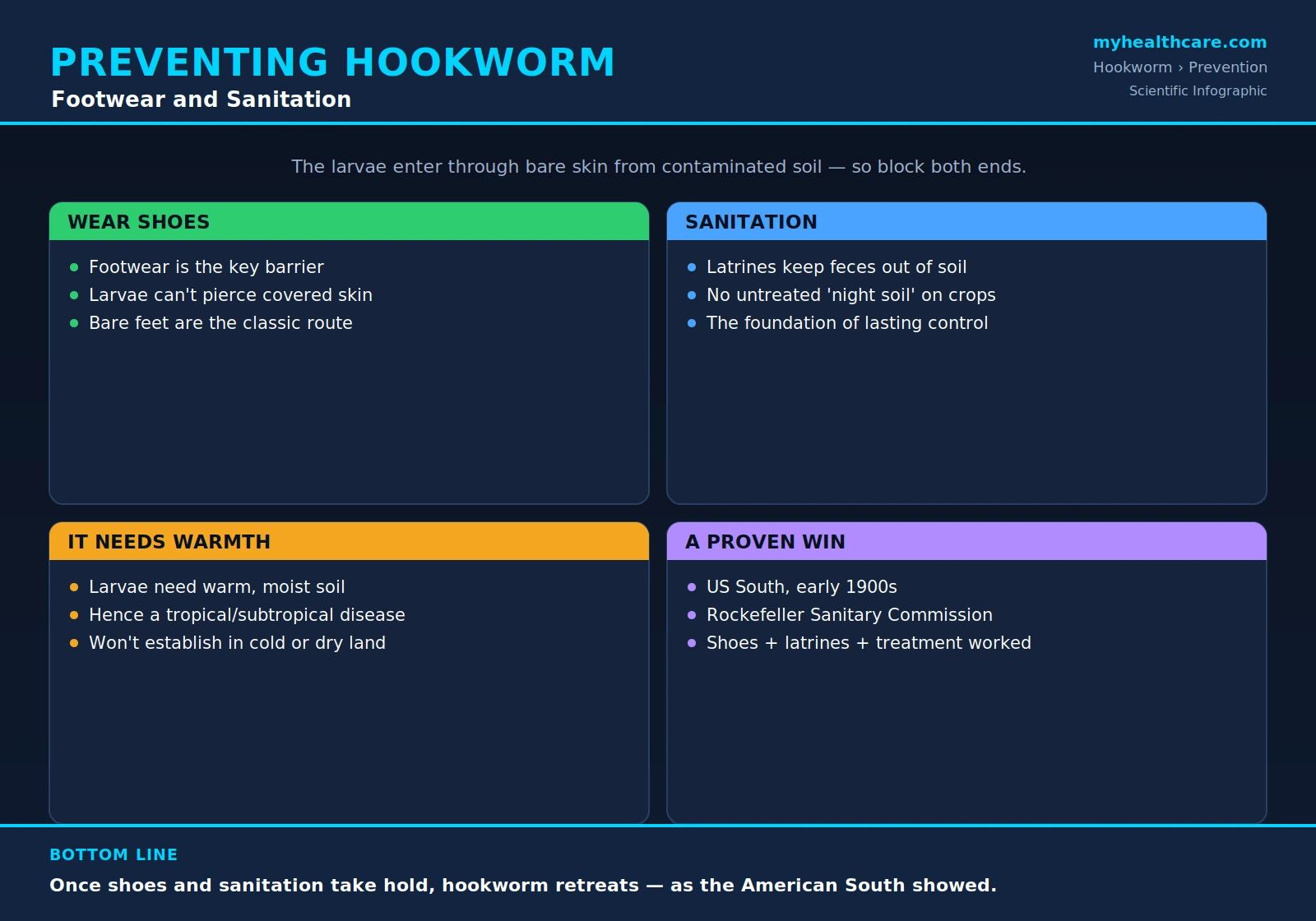
Hookworm is one of the few serious infectious diseases that an ordinary person can largely block with two simple, low-tech habits: wearing shoes and safely disposing of human waste. Unlike many infections, hookworm has a life cycle with two clear weak points, and you do not have to attack both to win — breaking either link stops the chain. The larvae must crawl up out of warm, damp soil and bore through bare human skin to get in; and the worm's eggs must get back down into that soil, in human feces, to keep the cycle going. Put on shoes, and the larvae have nothing to burrow into. Build and use a proper toilet, and the eggs never reach the ground. This page explains exactly how those two barriers work, why hookworm needs a warm, humid climate to survive at all, how handwashing and food hygiene matter for one of the two hookworm species, and how the modern strategy pairs sanitation with periodic deworming. It closes with one of the great public-health success stories of the 20th century: how the American South — once heavily infested — drove hookworm out, largely through shoes, latrines, and treatment.
Table of Contents
- The Two Attack Points
- Wear Shoes: The Personal Barrier
- Latrines and Sanitation: The Community Barrier
- Night Soil: Don't Fertilize With Human Waste
- Why Climate Sets the Limits
- Handwashing and Food Hygiene
- Combining WASH With Deworming
- The Southern United States Eradication Story
- Why Prevention Lasts
- Key Research Papers
- Featured Videos
1. The Two Attack Points
To understand hookworm prevention, picture the parasite's journey as a loop with two essential hand-offs. Both happen at the soil. If you break either one, the loop cannot close, and transmission stops.
Attack point one: the larvae must penetrate skin from contaminated soil. Hookworm eggs that land in warm, moist, shaded soil hatch into tiny larvae. After a few days these mature into the infectious stage (called filariform larvae), which wriggle up to the surface film of moisture and wait. When bare human skin — classically the sole of a foot — touches that soil, the larvae bore straight through it, enter the bloodstream, and begin their migration toward the gut. This is the moment a barrier of footwear can stop the entire infection. No skin contact with contaminated soil means no new infection, full stop.
Attack point two: the eggs must reach the soil in feces. Adult hookworms live in the small intestine and shed thousands of eggs a day, which leave the body in stool. For the cycle to continue, that stool — and its eggs — has to end up in open soil where the eggs can hatch. This is the moment that proper sanitation can stop the cycle. If human feces are contained and safely disposed of (in a latrine or a sewer) instead of being deposited on the ground, the eggs never reach the soil, larvae never develop, and the loop is broken at its source.
This two-points picture is the single most useful thing to carry away from this page. Footwear is the personal shield that protects an individual at attack point one. Sanitation is the community measure that shuts down attack point two for everyone at once. The best programs do both — but even one, done consistently, dramatically reduces transmission. The biology of the two soil-transmitted hand-offs, and why interrupting either works, is laid out in the major reviews of soil-transmitted helminths by Bethony and colleagues and by Jourdan and colleagues.
2. Wear Shoes: The Personal Barrier
Of all the things an individual can do, wearing shoes is the single most powerful personal barrier against hookworm. The reason is mechanical and direct: the infectious larvae cannot fly, jump, or travel any distance — they can only burrow through skin that is pressed against the soil they live in. A layer of shoe leather, rubber, or plastic between the sole of the foot and the ground simply denies them the contact they need.
Bare feet are the classic route of infection for a reason. In communities where people walk barefoot on damp, shaded, fecally contaminated ground — around the house, in fields, along paths to the latrine — the feet make repeated contact with exactly the soil where larvae gather. Each barefoot step on contaminated ground is an opportunity for larvae to enter. Putting on closed shoes removes that opportunity at the most common point of entry.
A few practical points make footwear more effective:
- Closed shoes beat open sandals. Larvae can penetrate any exposed skin, so footwear that covers the whole foot, including the sides and the top, gives more protection than flip-flops or open sandals that leave skin bare. Sandals are still far better than nothing, because they protect the sole — the area in heaviest contact with the ground.
- Wear them where the soil is, not just on the road. The riskiest ground is often the damp, shaded earth right around the home and in cultivated fields, not the dry, sun-baked road. Protection means having shoes on in the yard, the garden, and the fields — the places where contact actually happens.
- Children especially. Children frequently play and walk barefoot on the very ground most likely to be contaminated, which is one reason they often carry heavy worm burdens. Getting shoes onto children's feet is one of the highest-value preventive steps a family can take. (See Hookworm in Pregnancy and Children.)
It is worth being honest about the limits. Footwear protects the wearer, but it does not remove larvae from the soil or stop the eggs that keep re-seeding it — so on its own, shoe-wearing reduces an individual's risk without ending transmission in the community. It is the personal half of a two-part defense. Hands and other skin can also pick up larvae (for example, when children sit or crawl on contaminated ground, or when soil is handled), so footwear is necessary but not, by itself, complete. That is exactly why sanitation matters so much.
3. Latrines and Sanitation: The Community Barrier
If footwear is the personal shield, safe sanitation is the foundation of lasting hookworm control. It attacks the second weak point: the moment eggs would otherwise reach the soil. Containing and safely disposing of human feces — through latrines, improved toilets, or sewerage — keeps hookworm eggs out of the environment in the first place, so larvae never develop and the ground never becomes infectious.
The logic is simple and powerful. Open defecation — depositing feces on open ground — is what seeds the soil with eggs. Every latrine or toilet that replaces open defecation removes a source of contamination. When a whole community uses proper toilets, the soil is no longer being continuously re-seeded; existing larvae die off over weeks to months and are not replaced. Over time, the environment itself becomes safe, protecting even those who go barefoot.
This is why sanitation, not footwear, is what ultimately eliminates hookworm from a place. Shoes protect individuals one at a time; sanitation cleans the shared environment for everyone. The evidence backs this up: a systematic review and meta-analysis by Ziegelbauer and colleagues found that access to and use of sanitation was associated with significantly lower odds of soil-transmitted helminth infection, including hookworm. A broader review by Strunz and colleagues looking at the full package of water, sanitation, and hygiene (WASH) reached the same conclusion — these measures are consistently linked to less infection.
The key word, though, is use. A latrine that is built but not used — or used by only some households — leaves the cycle running. Lasting control depends on enough of the community consistently using safe sanitation that the soil stops being re-seeded. This is the durable, structural half of prevention, and it is why hookworm has historically retreated as living standards, plumbing, and sanitation infrastructure improved.
4. Night Soil: Don't Fertilize With Human Waste
There is one specific sanitation practice that deserves its own warning because it directly defeats the purpose of having toilets: using untreated human feces — historically called “night soil” — as fertilizer on crops and gardens.
Human waste is rich in nutrients, and for centuries many cultures collected it to fertilize fields. But untreated night soil is also full of live hookworm eggs. Spreading it directly onto cultivated soil is, from the parasite's point of view, the ideal outcome: it delivers eggs straight into warm, worked, moist earth where people walk and work barefoot. In effect, it short-circuits the benefit of a latrine — the feces were contained, then deliberately returned to the soil.
The preventive message is straightforward: do not apply untreated human waste to soil where food is grown or where people go barefoot. If human waste is to be used agriculturally at all, it must first be properly treated — through adequate composting, storage, or other processes that kill the eggs — before it ever touches a field. This single point closes a loophole that has historically kept hookworm circulating even in places that had latrines.
5. Why Climate Sets the Limits
One of the most reassuring facts about hookworm is that the parasite is fragile in the environment, and that fragility sets a hard geographic limit on where it can survive. Hookworm larvae need warmth and moisture to develop in the soil. Take away either, and the free-living stages die before they can become infectious.
The eggs and developing larvae cannot mature in cold ground, and they cannot survive in soil that dries out. They need:
- Warmth — the larvae develop best in warm soil and are killed by freezing and by cold winters.
- Moisture — the larvae live in the thin film of water on soil particles and on plants; they die when the soil bakes dry.
- Shade and loose soil — sandy or loamy, shaded ground holds moisture and protects larvae from direct sun, whereas hard, sunbaked, or waterlogged ground is hostile to them.
Because of these requirements, hookworm is a disease of warm, humid, tropical and subtropical regions, and it simply cannot establish itself in cold or arid climates. A frozen winter or a parched desert breaks the life cycle for free. This is why the global map of hookworm tracks climate so closely, and it is part of the explanation for why the disease eventually disappeared from cooler, drier, and more developed regions even before everyone wore shoes year-round. The climate dependence of the soil stages is a recurring theme in the epidemiology reviews by Brooker and colleagues and in the Nature Reviews disease summary by Loukas and colleagues.
For prevention, the practical implication is that risk is highest in exactly the warm, damp, shaded soil people most want to walk on barefoot — and that the same warmth and humidity which make a place pleasant also make it hospitable to the parasite. It is in those climates that footwear and sanitation matter most.
6. Handwashing and Food Hygiene
Most hookworm infection happens through the skin, which is why shoes loom so large. But there is a second species worth knowing about, because it adds a mouth-based route that handwashing and food hygiene can block. The two human hookworms are Necator americanus and Ancylostoma duodenale. Both infect chiefly by skin penetration, but Ancylostoma duodenale can also infect when its larvae are swallowed — for example, on contaminated hands, on raw produce grown in contaminated soil, or in contaminated water.
Where Ancylostoma duodenale matters, ordinary hygiene measures add a useful extra layer of protection:
- Wash hands with soap and water after contact with soil, after using the toilet, and before preparing or eating food — this removes larvae that hands may have picked up from the ground.
- Wash raw vegetables and fruit thoroughly, especially anything grown low to the ground or in soil that may have been contaminated.
- Use safe water for drinking and for washing food.
These are the same commonsense practices that protect against many other soil- and fecal-borne infections, so they pay off broadly. For the skin route (which dominates with Necator americanus, the main species in much of the Americas and Africa), handwashing matters less than footwear and sanitation — you cannot wash away an exposure that happens through the sole of the foot. The point is that hygiene complements, rather than replaces, the two core barriers.
7. Combining WASH With Deworming
Modern hookworm control does not treat prevention and treatment as either/or. The most effective and durable strategy integrates WASH — water, sanitation, and hygiene — with periodic deworming, because the two do different jobs and reinforce each other.
Here is why each is incomplete alone:
- Deworming alone treats people but not the environment. Mass distribution of deworming medicine (see Mass Drug Administration and Control) clears the worms from people's intestines and quickly lowers the community worm burden. But it does nothing to clean the soil. If the soil is still contaminated and people are still going barefoot, those same people get re-infected, and the medicine has to be given again and again, indefinitely.
- WASH alone changes the environment but works slowly. Building and using latrines, providing safe water, and promoting footwear and handwashing gradually stop the soil from being re-seeded — but people already carrying heavy worm burdens stay sick until those worms die off naturally, which can take years.
Put them together and the logic is compelling. Deworming brings the worm burden down fast; WASH keeps it down by stopping re-infection. The deworming buys time and relieves the immediate disease (the anemia, the fatigue, the impaired growth in children); the sanitation, footwear, and hygiene make sure the gains are not lost to a re-contaminated environment. Campbell and colleagues argued explicitly that WASH is a critical component of sustainable soil-transmitted helminth control — that deworming programs which ignore the environment are signing up for endless rounds of treatment, whereas those paired with WASH can move toward lasting reduction and eventual elimination. This is the consensus model behind today's neglected-tropical-disease control programs described by Hotez and colleagues.
8. The Southern United States Eradication Story
The clearest proof that footwear and sanitation can defeat hookworm comes from history. In the late 1800s and early 1900s, hookworm was widespread across the rural American South, where the warm, humid climate, sandy soils, widespread barefoot habits, and poor rural sanitation created ideal conditions for transmission. The infection was so common, and its draining anemia and fatigue so visible, that it helped fuel a cruel stereotype of Southern sloth — the listlessness that was, in many cases, the symptom of a blood-feeding parasite rather than any failing of character.
Two threads came together to change this. The zoologist Charles Wardell Stiles identified the American hookworm and argued forcefully in the early 1900s that this single parasite lay behind much of the region's rural ill health — making the scientific case that the problem was a treatable, preventable infection. Then, in 1909, the philanthropist John D. Rockefeller funded the creation of the Rockefeller Sanitary Commission for the Eradication of Hookworm Disease, a campaign that ran in the American South from 1909 to roughly 1914. The Commission combined the very measures this page describes: it surveyed and treated infected people to clear their worms, it promoted the building and use of sanitary privies (latrines) to keep eggs out of the soil, and it educated communities about wearing shoes to block skin penetration — treatment, sanitation, and footwear, working together.
The Commission did not, by itself, eradicate hookworm in a few years — its lasting contribution was as much in education, in building public-health institutions, and in changing attitudes as in the worms it cleared. But it began a long decline. Over the following decades, as the campaign's lessons took hold and as living standards rose — bringing better housing, shoes as an everyday norm, indoor plumbing, and proper sewage disposal — hookworm gradually retreated and ultimately all but disappeared from the American South. By the mid-20th century, a disease that had once afflicted millions of Southerners had become rare. The story is documented in public-health histories such as the account by Elman and colleagues of how the Rockefeller Sanitary Commission extended public health in the American South.
The lesson is encouraging and exactly on point: hookworm was driven out of a heavily infested region by the unglamorous combination of latrines, shoes, treatment, and rising prosperity — not by any miracle cure. It stands as a landmark public-health success and a real-world demonstration that the two attack points described at the top of this page are not theoretical. Break the skin-entry link with shoes, break the soil-contamination link with sanitation, treat the people who are already infected, and hookworm loses its grip.
9. Why Prevention Lasts
One of the most valuable features of footwear-and-sanitation prevention is how durable it is once it takes hold. This is what sets it apart from a strategy of repeated medication alone.
The reason is structural. When a community shifts to consistently wearing shoes and using safe toilets, it is not just lowering the worm burden for a season — it is removing the very conditions the parasite needs to persist. The soil stops being re-seeded with eggs, the developing larvae are not replaced as they die off, and the ground itself slowly becomes safe. These changes are usually tied to lasting improvements in housing, infrastructure, and habits, so they do not reverse the moment a program ends. A region that has crossed over to widespread sanitation and footwear tends to stay free of hookworm, as the American South did.
Contrast that with deworming alone: stop the drug rounds in a still-contaminated environment, and the worms come back. Medication treats the people who are sick now; sanitation and footwear change the world those people live in. That is why, once a society reaches a certain level of sanitation and shoe-wearing, hookworm does not simply dip — it largely disappears and stays gone. The most enduring protection is the one built into everyday life: a toilet that is always used and shoes that are always worn.
For the population-scale programs that combine all of these tools — mass treatment, sanitation, and health education — to push hookworm down and keep it down, see Mass Drug Administration and Control. For the individual treatment that clears an existing infection and restores lost iron, see Anthelmintic Treatment and Iron Repletion.
Key Research Papers
Peer-reviewed reviews, meta-analyses, and a public-health history covering the prevention of hookworm and other soil-transmitted helminths — the role of sanitation, water and hygiene (WASH), the climate dependence of the soil stages, and the historic Rockefeller Sanitary Commission campaign in the American South. Journal names appear as plain text; the year/volume/pages link opens the full citation via DOI.
- Bethony J, Brooker S, Albonico M, Geiger SM, Loukas A, Diemert D, Hotez PJ. Soil-Transmitted Helminth Infections: Ascariasis, Trichuriasis, and Hookworm. The Lancet. 2006;367(9521):1521–1532.
- Jourdan PM, Lamberton PHL, Fenwick A, Addiss DG. Soil-Transmitted Helminth Infections. The Lancet. 2018;391(10117):252–265.
- Hotez PJ, Brooker S, Bethony JM, Bottazzi ME, Loukas A, Xiao S. Hookworm Infection. New England Journal of Medicine. 2004;351(8):799–807.
- Hotez PJ, Molyneux DH, Fenwick A, Kumaresan J, Sachs SE, Sachs JD, Savioli L. Control of Neglected Tropical Diseases. New England Journal of Medicine. 2007;357(10):1018–1027.
- Ziegelbauer K, Speich B, Mäusezahl D, Bos R, Keiser J, Utzinger J. Effect of Sanitation on Soil-Transmitted Helminth Infection: Systematic Review and Meta-Analysis. PLoS Medicine. 2012;9(1):e1001162.
- Strunz EC, Addiss DG, Stocks ME, Ogden S, Utzinger J, Freeman MC. Water, Sanitation, Hygiene, and Soil-Transmitted Helminth Infection: A Systematic Review and Meta-Analysis. PLoS Medicine. 2014;11(3):e1001620.
- Campbell SJ, Savage GB, Gray DJ, Atkinson JM, Soares Magalhães RJ, Nery SV, McCarthy JS, Velleman Y, Wicken JH, Traub RJ, Williams GM, Andrews RM, Clements ACA. Water, Sanitation, and Hygiene (WASH): A Critical Component for Sustainable Soil-Transmitted Helminth and Schistosomiasis Control. PLoS Neglected Tropical Diseases. 2014;8(4):e2651.
- Brooker S, Bethony J, Hotez PJ. Human Hookworm Infection in the 21st Century. Advances in Parasitology. 2004;58:197–288.
- Loukas A, Hotez PJ, Diemert D, Yazdanbakhsh M, McCarthy JS, Correa-Oliveira R, Croese J, Bethony JM. Hookworm Infection. Nature Reviews Disease Primers. 2016;2:16088.
- Elman C, McGuire RA, Wittman B. Extending Public Health: The Rockefeller Sanitary Commission and Hookworm in the American South. American Journal of Public Health. 2014;104(1):47–58.
Live PubMed Searches
Each link opens a live PubMed query so results stay current as new papers are indexed.
- Hookworm prevention and footwear
- Sanitation and soil-transmitted helminth infection
- WASH and deworming integration
- Necator americanus soil transmission
- Ancylostoma duodenale oral route
- Hookworm eradication in the American South
- Open defecation and helminth control
- Soil-transmitted helminths and climate
Connections
- All Parasites
- Hookworm Overview
- Symptoms & Diagnosis
- Iron-Deficiency Anemia & Blood Loss
- Ground Itch & Larval Migration
- Hookworm in Pregnancy & Children
- Treatment & Prevention
- Anthelmintic Treatment & Iron Repletion
- Mass Drug Administration & Control
- Hematology
- Infectious Disease
- All Conditions