Hookworm Treatment and Prevention
Anthelmintic Treatment & Iron Repletion
The two-part cure — clear the worms with albendazole, then rebuild the lost iron.
Read the deep dive →Prevention: Footwear & Sanitation
Shoes and latrines — the simple barriers that drove hookworm out of the American South.
Read the deep dive →Mass Drug Administration & Control
WHO deworming for at-risk groups, the reinfection challenge, and the hookworm-vaccine effort.
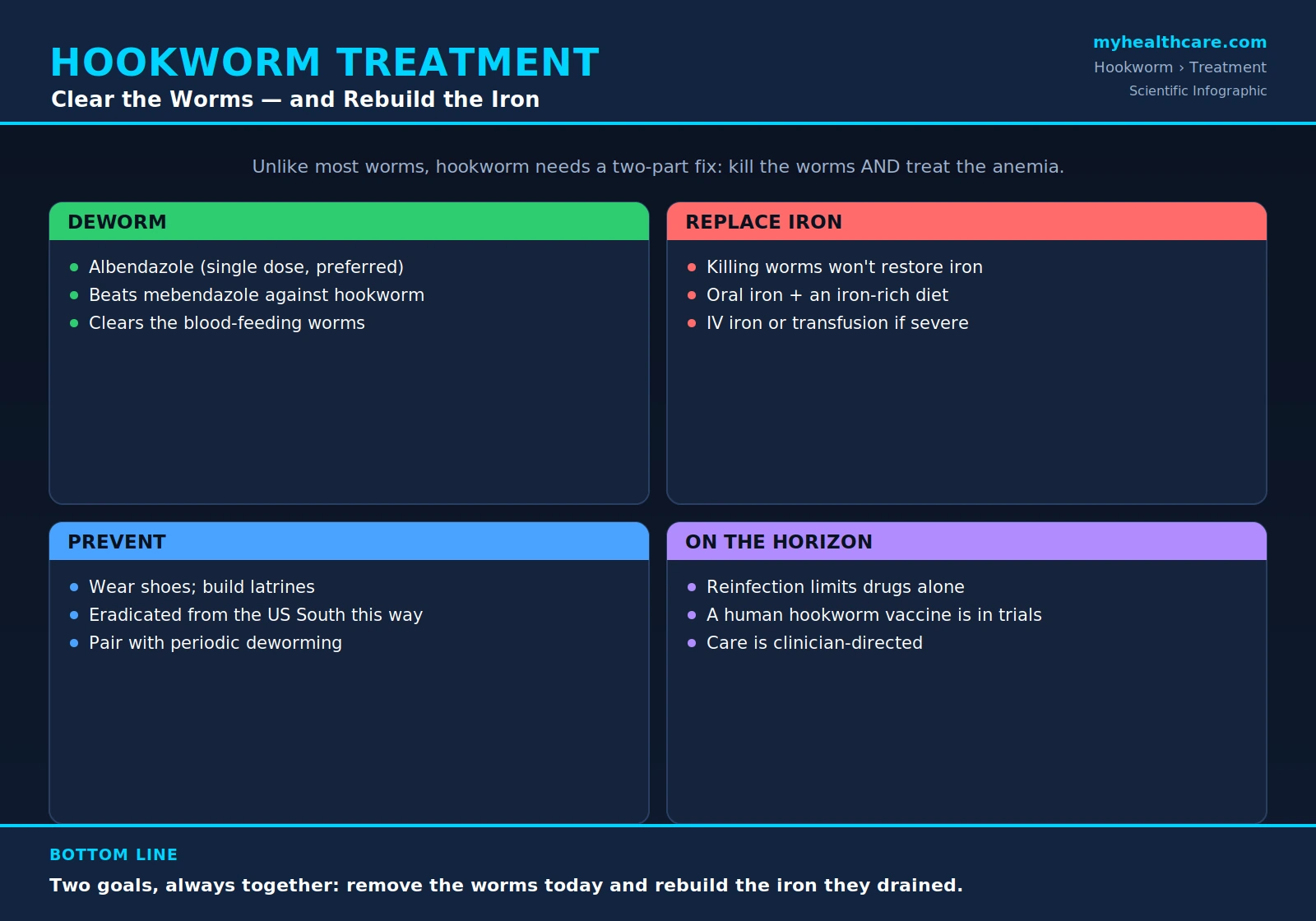
Read the deep dive →Treating hookworm is, in an important way, different from treating most other intestinal worm infections — because clearing the worms is only half the job. Hookworms damage the body chiefly by drinking blood from the lining of the small intestine, and over months and years that slow, steady blood loss drains the body's iron and produces iron-deficiency anemia. So a complete cure has two goals: remove the worms and correct the anemia they caused. A single dose of a deworming tablet can kill the worms in a day, but the iron stores they emptied can take weeks or months to refill. This page is the hub for hookworm treatment and prevention: it gives an overview of the deworming drugs and iron repletion, the everyday prevention of shoes and sanitation, the large-scale programs that treat whole communities, why reinfection keeps happening, the historic eradication of hookworm from the southern United States, and the vaccine now in development. Each topic links to a fuller page below. Treatment details here describe what is reported in the medical literature; actual treatment is clinician-directed.
Table of Contents
1. Two Goals: Worms and Anemia
The single most important idea on this page is that hookworm treatment is a two-part repair. With most worm infections, killing the parasite ends the problem. Hookworm is different because the parasite causes harm by feeding on blood: each adult worm clamps onto the wall of the small intestine and consumes a tiny but continuous amount of blood, and the wounds it leaves keep oozing even between meals. A person carrying dozens or hundreds of worms loses that blood day after day. The body draws down its iron reserves to keep making red blood cells, and when those reserves run out the result is iron-deficiency anemia, which can leave a person pale, exhausted, breathless, and — in a child — behind on growth and learning.
Because of this, the worms and the anemia have to be addressed as two separate tasks:
- Clear the worms. A deworming medicine stops the ongoing blood loss by killing the adult worms so they detach and pass out of the gut. This closes the leak.
- Correct the anemia. Killing the worms does not instantly refill an iron tank that has been running near empty for months. Restoring iron — usually with iron supplements and an iron-rich diet — is what actually rebuilds the blood. This can take weeks to months, depending on how depleted the person was.
Thinking of treatment as "stop the leak, then refill the tank" captures why deworming alone is not always enough, especially for someone who has been heavily infected for a long time. The combined approach — the drugs and the iron together — is covered in depth on Anthelmintic Treatment and Iron Repletion.
2. Deworming Drugs and Iron Repletion
The medicines used against hookworm belong to a family called the benzimidazoles, and the two used most widely are albendazole and mebendazole. They work by starving the worm: they bind to a structural protein the parasite needs to take up glucose, so the worm runs out of energy, loses its grip on the intestinal wall, and dies. Both drugs have a long track record and are taken by mouth.
For hookworm specifically, an important practical point is that albendazole given as a single dose is generally more reliably effective than a single dose of mebendazole. Reviews of treatment trials have found that one 400 mg dose of albendazole clears hookworm in a high proportion of people, while a single standard dose of mebendazole tends to perform less consistently against hookworm. This is why albendazole is often the preferred single-dose choice when hookworm is the target. The convenience of a single tablet matters enormously in the real world: it is easy to give, easy to swallow, and well suited to community programs.
The second half of treatment is iron repletion. Once the worms are gone and the blood loss has stopped, the body needs help rebuilding what it lost. For a person with iron-deficiency anemia, this typically means oral iron supplements taken for a sustained period, along with iron-rich foods, so the bone marrow can resume normal red-blood-cell production. In someone who was severely anemic, the recovery of iron stores is measured in months, not days — another reminder that the deworming tablet is the start of the cure, not the whole of it. The drug regimens, dosing, side effects, and the practical details of iron recovery are all covered on Anthelmintic Treatment and Iron Repletion.
3. Prevention: Shoes and Sanitation
Treatment cures the person who is infected today, but it does nothing to stop them — or anyone else — from being infected again tomorrow. Lasting protection comes from prevention, and for hookworm two simple, low-technology measures do most of the work: wearing shoes and improving sanitation.
Hookworm has a very specific way of getting into the body. Its larvae live in warm, moist, shaded soil that has been contaminated with human feces, and they infect a new host by burrowing directly through the skin — most often the skin of a bare foot that steps on contaminated ground. This is the origin of the itchy rash known as "ground itch." Two interventions break this chain:
- Footwear. Because the larvae enter through skin in contact with soil, simply wearing shoes or sandals puts a physical barrier between the foot and the infective ground. It is one of the cheapest and most effective personal protections available.
- Sanitation. The larvae only exist in the soil because feces containing hookworm eggs were deposited there. Safe disposal of human waste — latrines and proper sewage — keeps eggs out of the soil in the first place, so larvae never develop and the cycle is starved at its source.
These measures are humble but historically decisive: they are precisely what ended hookworm as a mass disease in wealthy countries. They are explained in full, along with the biology of why they work, on Prevention: Footwear and Sanitation.
4. Mass Drug Administration
In regions where hookworm and the other soil-transmitted worms are common, treating people one at a time as they fall ill is not enough to control the disease across a whole population. The strategy the World Health Organization recommends is preventive chemotherapy, often delivered as mass drug administration (MDA): giving a single dose of a deworming drug, on a regular schedule, to entire at-risk groups — whether or not any individual is known to be infected.
The logic is public-health rather than purely individual. Treating everyone in a high-risk group at once lowers the overall number of worms being shed into the environment, which reduces transmission for the whole community, and it spares the trouble and cost of testing each person first. School-age children are the classic target, because they tend to carry the heaviest worm burdens and are easy to reach through schools. But hookworm control has a distinctive extra target that sets it apart from programs aimed only at children: women of reproductive age. Because hookworm-driven iron loss is especially dangerous in pregnancy — threatening both the mother's health and the baby's growth — WHO guidance specifically includes women of childbearing age, and pregnant women in their second and third trimesters, among the groups to receive preventive deworming. This focus on reproductive-age women is a hallmark of hookworm control in a way it is not for some other intestinal worms.
The aim of these programs is not usually to eliminate every last worm but to keep infection intensity low enough that serious disease — especially anemia — becomes rare. The structure of MDA programs, who is targeted, how often treatment is given, and the challenges they face are covered on Mass Drug Administration and Control.
5. The Reinfection Problem
A frustrating reality of hookworm control is that a person can be cured and then become infected all over again within months. The deworming tablet kills the worms inside the body, but it leaves no lasting protection — it does not act like a vaccine. The moment treatment ends, the person is just as susceptible as before.
The reason reinfection is so common comes down to the parasite's reservoir and the way people live. The infective larvae persist in the contaminated soil itself, and in places where sanitation is poor and going barefoot is normal, the ground around homes, fields, and paths can be seeded with larvae. A person treated today walks across that same soil tomorrow and picks up new larvae through the skin. Because the soil reservoir is not cleared by treating people, and because exposure continues day after day, deworming has to be repeated — which is exactly why MDA programs are run on a recurring schedule rather than as a one-time campaign.
This is also the central argument for why drugs alone cannot be the whole answer. As long as the soil reservoir exists and bare feet keep meeting it, chemotherapy is a treadmill: it controls the disease only as long as it is kept up. Durable progress requires attacking the cycle from the other side — through the sanitation and footwear that stop new larvae from entering people in the first place — and, ideally, through a vaccine that could give the lasting immunity the drugs cannot.
6. Eradication from the American South
It is worth pausing on a genuine public-health triumph, because it shows that hookworm can be beaten. In the early twentieth century, hookworm was rampant across the southern United States, where it sapped the energy of millions of rural people and was popularly — and unfairly — blamed for an image of Southern "laziness" that was in reality the fatigue of chronic anemia. Beginning in 1909, a major campaign (organized through the Rockefeller Sanitary Commission for the Eradication of Hookworm Disease) set out to treat infected people and, crucially, to change the conditions that spread the worm.
What ultimately drove hookworm out of the American South was not the medicine alone but the same humble measures emphasized above — the spread of shoes and the building of sanitary privies, alongside treatment and public education — reinforced over the following decades by rising living standards. As bare feet gave way to footwear and open defecation gave way to latrines and indoor plumbing, the larvae lost their route into people and their source in the soil, and the disease faded. The lesson is encouraging and directly relevant to control efforts today: hookworm is not an unbeatable foe, and the interventions that defeated it were simple and affordable. The historical campaign and what it teaches are discussed further on Prevention: Footwear and Sanitation.
7. The Hookworm Vaccine Effort
The reinfection treadmill is the main reason researchers have worked for years to develop a hookworm vaccine. If deworming gave lasting immunity, a single course would protect a person for life — but it does not, and natural infection itself does not produce strong protective immunity either. A vaccine that trained the immune system to resist the worm could, in principle, break the cycle in a way repeated drug treatment never can.
Developing such a vaccine is genuinely difficult. Hookworms are large, complex multicellular animals — far more sophisticated than the bacteria and viruses against which most vaccines are made — and they have evolved an array of molecules to evade and dampen the host's immune response. The leading research strategy has been to target the worm's blood-feeding machinery: vaccine candidates have been built around the parasite's own proteins, including enzymes the worm uses to digest the blood it drinks. Early candidates such as Na-ASP-2 and, later, Na-APR-1 have been tested in clinical trials for safety and immune response. As of the mid-2020s a hookworm vaccine is still in development and not yet available for general use, but it remains an active and important goal precisely because reinfection limits what drugs alone can achieve. The science behind the vaccine effort is covered further on Mass Drug Administration and Control.
8. Safety in Pregnancy and Children
Two groups deserve special mention because they are both the most vulnerable to hookworm's harms and the focus of particular care in treatment: pregnant women and children.
In pregnancy, hookworm anemia is especially dangerous: a pregnant woman already needs extra iron to support her growing baby, and a worm-driven iron drain on top of that can lead to maternal anemia, low birth weight, and other complications. The deworming drugs are generally avoided in the first trimester as a precaution during the period of early fetal development. After the first trimester, WHO guidance supports giving a single dose of albendazole or mebendazole to pregnant women in endemic areas as part of routine antenatal care, together with iron, because the benefit of clearing a blood-draining infection is judged to outweigh the risk; controlled trials of deworming in pregnancy have examined both efficacy and safety in this setting. The specifics of antenatal deworming are addressed on Hookworm in Pregnancy and Children.
In children, hookworm matters not only for the anemia it causes but for its toll on growth, physical development, and the ability to concentrate and learn — effects that can shadow a child for years. This is why children are the cornerstone of deworming programs and why the drugs have a long, reassuring record of safe use in this age group, typically from about one year of age onward at the doses used in control programs. As always, the dose, timing, and choice of drug for any individual — child, pregnant woman, or adult — are matters for a clinician; the information here describes what is reported in the medical literature and is not a substitute for medical advice.
Key Research Papers
Peer-reviewed reviews, drug-efficacy studies, and control and vaccine research on the treatment and prevention of human hookworm infection. Journal names appear as plain text; the year/volume/pages link opens the full citation via DOI.
- Hotez PJ, Brooker S, Bethony JM, Bottazzi ME, Loukas A, Xiao S. Hookworm Infection. New England Journal of Medicine. 2004;351(8):799–807. — doi:10.1056/NEJMra032492
- Loukas A, Hotez PJ, Diemert D, et al. Hookworm Infection. Nature Reviews Disease Primers. 2016;2:16088. — doi:10.1038/nrdp.2016.88
- Bethony J, Brooker S, Albonico M, et al. Soil-Transmitted Helminth Infections: Ascariasis, Trichuriasis, and Hookworm. The Lancet. 2006;367(9521):1521–1532. — doi:10.1016/S0140-6736(06)68653-4
- Keiser J, Utzinger J. Efficacy of Current Drugs Against Soil-Transmitted Helminth Infections: Systematic Review and Meta-Analysis. JAMA. 2008;299(16):1937–1948. — doi:10.1001/jama.299.16.1937
- Vercruysse J, Behnke JM, Albonico M, et al. Assessment of the Anthelmintic Efficacy of Albendazole in School Children in Seven Countries Where Soil-Transmitted Helminths Are Endemic. PLoS Neglected Tropical Diseases. 2011;5(3):e948. — doi:10.1371/journal.pntd.0000948
- Albonico M, Allen H, Chitsulo L, Engels D, Gabrielli AF, Savioli L. Controlling Soil-Transmitted Helminthiasis in Pre-School-Age Children through Preventive Chemotherapy. PLoS Neglected Tropical Diseases. 2008;2(3):e126. — doi:10.1371/journal.pntd.0000126
- Hotez PJ, Molyneux DH, Fenwick A, et al. Control of Neglected Tropical Diseases. New England Journal of Medicine. 2007;357(10):1018–1027. — doi:10.1056/NEJMra064142
- Bartsch SM, Hotez PJ, Asti L, et al. The Global Economic and Health Burden of Human Hookworm Infection. PLoS Neglected Tropical Diseases. 2016;10(9):e0004922. — doi:10.1371/journal.pntd.0004922
- Brooker S, Hotez PJ, Bundy DAP. Hookworm-Related Anaemia among Pregnant Women: A Systematic Review. PLoS Neglected Tropical Diseases. 2008;2(9):e291. — doi:10.1371/journal.pntd.0000291
- Smith JL, Brooker S. Impact of Hookworm Infection and Deworming on Anaemia in Non-Pregnant Populations: A Systematic Review. Tropical Medicine & International Health. 2010;15(7):776–795. — doi:10.1111/j.1365-3156.2010.02542.x
- Ndyomugyenyi R, Kabatereine N, Olsen A, Magnussen P. Efficacy of Ivermectin and Albendazole Alone and in Combination for Treatment of Soil-Transmitted Helminths in Pregnancy and Adverse Events: A Randomized Open Label Controlled Intervention Trial in Masindi District, Western Uganda. American Journal of Tropical Medicine and Hygiene. 2008;79(6):856–863. — doi:10.4269/ajtmh.2008.79.856
- Bethony JM, Simon G, Diemert DJ, et al. Randomized, Placebo-Controlled, Double-Blind Trial of the Na-ASP-2 Hookworm Vaccine in Unexposed Adults. Vaccine. 2008;26(19):2408–2417. — doi:10.1016/j.vaccine.2008.02.049
- Diemert DJ, Zumer M, Campbell D, et al. Safety and Immunogenicity of the Na-APR-1 Hookworm Vaccine in Infection-Naive Adults. Vaccine. 2022;40(42):6084–6092. — doi:10.1016/j.vaccine.2022.09.017
PubMed Topic Searches
Each link opens a live PubMed query so results stay current as new papers are indexed.
- PubMed: Hookworm treatment with albendazole
- PubMed: Albendazole vs mebendazole hookworm cure rate
- PubMed: Hookworm iron-deficiency anemia treatment
- PubMed: Soil-transmitted helminth mass drug administration
- PubMed: Deworming in pregnancy: albendazole safety
- PubMed: Hookworm reinfection after treatment
- PubMed: Hookworm vaccine (Na-APR-1, Na-ASP-2)
- PubMed: Hookworm control: sanitation and footwear
Connections
- All Parasites
- Hookworm Overview
- Symptoms & Diagnosis
- Iron-Deficiency Anemia & Blood Loss
- Ground Itch & Larval Migration
- Hookworm in Pregnancy & Children
- Anthelmintic Treatment & Iron Repletion
- Prevention: Footwear & Sanitation
- Mass Drug Administration & Control
- Hematology
- Anemia
- Infectious Disease
- All Conditions