Cryptosporidiosis Treatment and Prevention
Nitazoxanide & Treatment
The one approved drug, its real limits, and why restoring immunity matters most.
Read the deep dive →Supportive Care & Rehydration
Fluids, electrolytes, and nutrition — the backbone of getting through cryptosporidiosis.
Read the deep dive →Prevention: Water & Outbreaks
Chlorine-resistant oocysts, the Milwaukee outbreak, pools, and keeping water safe.
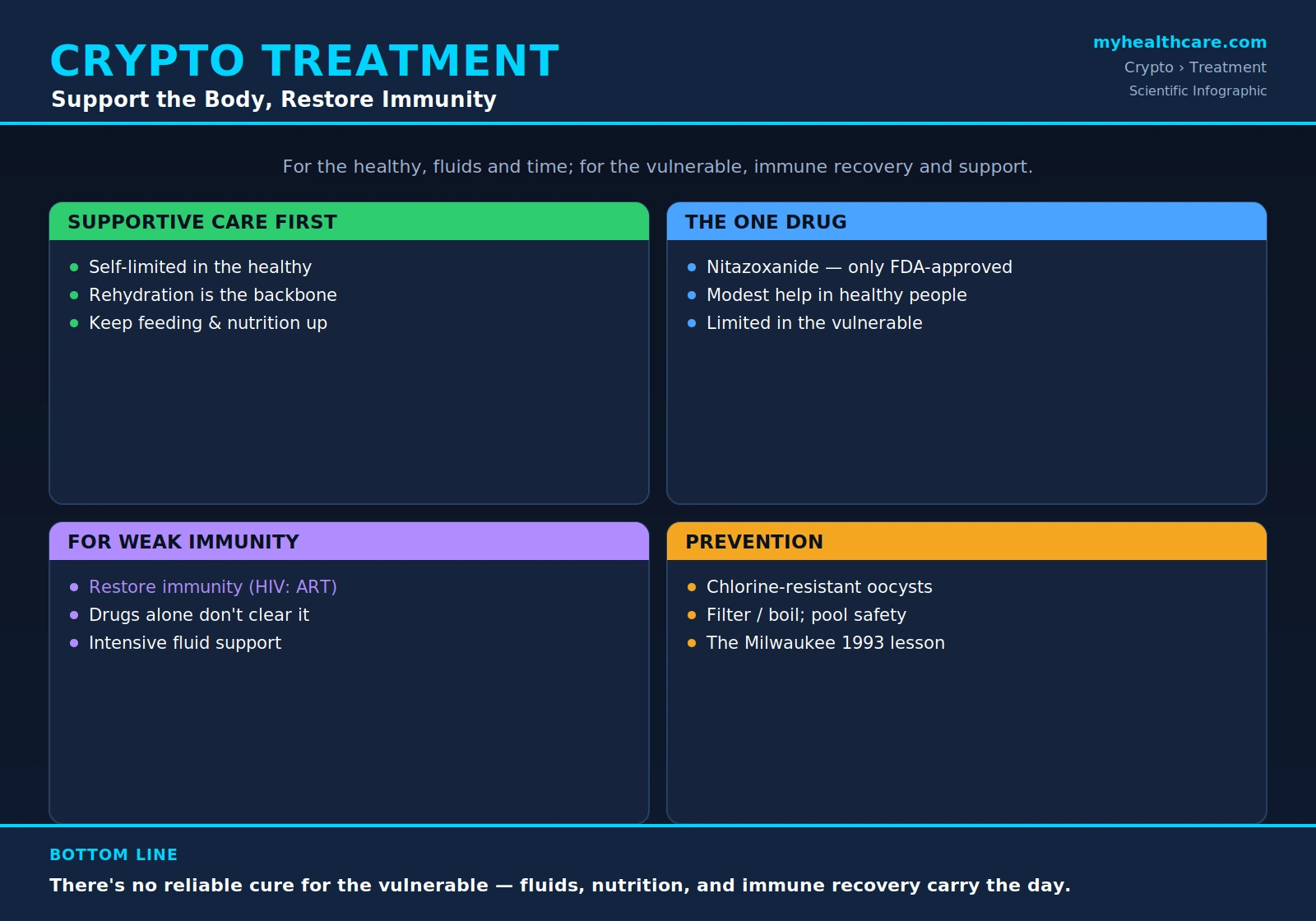
Read the deep dive →Here is the honest, and slightly uncomfortable, heart of cryptosporidiosis treatment: for most healthy people the illness gets better on its own, and the single most important thing you can do is drink enough fluid to replace what the diarrhea takes away. There is one approved drug — nitazoxanide — but its benefit is modest in healthy people and, critically, it has not been shown to work reliably in the two groups who suffer the most: people with weakened immune systems and severely malnourished young children. For people with advanced HIV, the real cure is not an antiparasitic pill at all — it is rebuilding the immune system with effective HIV treatment. And because the parasite's tough, chlorine-resistant egg (the oocyst) spreads so easily through drinking and swimming water, prevention does more good than any medicine we currently have. This page walks through who actually needs treatment, what the drugs can and cannot do, how to rehydrate, why immune recovery is central, how to prevent infection, and the frank reality of the treatment gap. The information here describes what is reported in the medical literature; actual treatment is always clinician-directed.
Table of Contents
- Overview: Who Actually Needs Treatment
- The Drugs: Nitazoxanide and Its Limits
- Supportive Care and Rehydration
- For People with HIV: Restoring the Immune System
- Prevention: Water, Oocysts, and Outbreaks
- The Honest Treatment Gap
- Special Considerations for Vulnerable Groups
- Practical Takeaways
- Key Research Papers
- Featured Videos
1. Overview: Who Actually Needs Treatment
Cryptosporidiosis — infection of the gut by the parasite Cryptosporidium — causes watery diarrhea, stomach cramps, nausea, and sometimes a low fever. The most important fact to hold onto is that in a person with a healthy immune system, this is usually a self-limited illness. That means it tends to run its course and resolve on its own, typically over one to two weeks, even with no specific antiparasitic drug at all. The body's own immune defenses clear the parasite. For these otherwise-healthy people, the job of "treatment" is mostly to keep them safely hydrated while they recover — replacing the fluid and salts lost in the diarrhea — rather than to attack the parasite directly.
So if the illness usually clears by itself, where is the hard problem? It lies with two groups in whom cryptosporidiosis is not a brief inconvenience but a serious, sometimes life-threatening disease, and in whom our drug options are genuinely poor:
- People with weakened immune systems — most importantly those with advanced HIV/AIDS, but also organ-transplant recipients, people on chemotherapy or strong immune-suppressing medicines, and children with primary immune deficiencies. In these patients the parasite is not cleared; the diarrhea can become severe, prolonged, and unrelenting, sometimes spreading beyond the intestine (for example into the bile ducts). See Cryptosporidiosis in the Immunocompromised.
- Malnourished young children, especially in low-resource settings, in whom cryptosporidiosis is both more dangerous and harder to treat. It is a major cause of moderate-to-severe diarrhea in infants and toddlers and contributes to a vicious cycle of poor growth, further malnutrition, and increased risk of death. See Cryptosporidiosis in Children and Malnutrition.
This split — benign and self-limited in the healthy, dangerous and drug-resistant in the vulnerable — shapes everything that follows. The reason there is so much emphasis on rehydration and on prevention, rather than on a miracle pill, is precisely that the pill we have works least well in the people who need it most.
2. The Drugs: Nitazoxanide and Its Limits
When people ask "what is the medicine for cryptosporidiosis?", the answer is a single drug with a complicated record. Nitazoxanide is the only treatment approved by the U.S. Food and Drug Administration (FDA) for cryptosporidiosis, and it is specifically approved for diarrhea caused by Cryptosporidium in people aged one year and older who have healthy immune systems. It is an antiparasitic and antimicrobial medicine taken as a short oral course, and it interferes with an enzyme the parasite needs to generate energy.
In otherwise-healthy people, nitazoxanide offers a modest benefit: studies show it can shorten the duration of diarrhea and help clear the parasite somewhat faster than no treatment. That is a real, if limited, advantage — useful, but not dramatic, and layered on top of an illness that was already going to get better.
The crucial honest point is what happens in the vulnerable groups. In people with weakened immune systems — particularly those with advanced HIV/AIDS — nitazoxanide has limited or unproven benefit. Clinical trials have generally failed to show that it reliably cures the infection in this setting; the parasite tends to persist as long as the immune system remains profoundly suppressed. A Cochrane systematic review of treatment for cryptosporidiosis in immunocompromised patients found no convincing evidence that nitazoxanide (or any other antiparasitic agent) is consistently effective at curing the infection in this group. The signal is just as sobering in severely malnourished children: a randomized trial in HIV-positive Zambian children found that even high-dose, prolonged nitazoxanide was not effective. So the drug that the label and the textbooks point to is, in real terms, of modest help to the healthy and limited or unproven help to the most vulnerable.
A small number of other antiparasitic and antibiotic agents have been studied (and are sometimes used off-label in difficult cases), but none has emerged as a dependable cure, and a meta-analysis of these agents in immunocompromised patients did not establish a clearly effective regimen. For a fuller account of nitazoxanide, the dosing and course, the trial evidence, and the agents that have been tried, see Nitazoxanide and Treatment. The take-home message belongs here, though: there is no antiparasitic drug that reliably cures cryptosporidiosis in the people who suffer the most, which is exactly why supportive care and immune recovery carry so much weight.
3. Supportive Care and Rehydration
If the drugs are weak, what actually carries a person through cryptosporidiosis? Fluids. The single greatest danger from this illness in an otherwise-healthy person is not the parasite itself but dehydration — losing more water and salts in the watery diarrhea than the body can take in. Supportive care, centered on rehydration, is the backbone of treatment for nearly everyone with cryptosporidiosis, and it is genuinely effective in a way the drugs are not.
The cornerstone is oral rehydration: drinking enough fluids that contain the right balance of water, salts (electrolytes), and a little sugar to replace what is being lost. Oral rehydration solution (ORS) — a low-cost, precisely balanced mixture that the World Health Organization has long promoted — is the gold standard, because it is formulated to be absorbed even by an inflamed, leaky gut. ORS is one of the most important and life-saving tools in all of medicine for diarrheal illness, particularly for infants and young children who can become dangerously dehydrated very quickly. When diarrhea is severe and a person cannot keep up with the losses by drinking — or is vomiting, very young, very old, or already dehydrated — intravenous (IV) fluids in a medical setting may be needed.
Beyond fluids, supportive care includes keeping up nutrition (continuing to eat and, for breastfed infants, continuing to breastfeed, since starving the gut prolongs recovery and worsens malnutrition) and managing symptoms. Anti-diarrheal medicines that slow the gut are used cautiously and selectively, and are generally avoided in young children. Because supportive care is where most of the real benefit lies — especially when the parasite cannot be cleared by drugs — it is covered in depth, with practical guidance on ORS, IV fluids, electrolytes, and feeding, on the Supportive Care and Rehydration page.
4. For People with HIV: Restoring the Immune System
For someone with advanced HIV, the central principle of cryptosporidiosis treatment is one of the most important — and most hopeful — ideas on this page: the thing that actually controls the infection is not an antiparasitic drug, but restoring the immune system with effective HIV treatment.
The reasoning is direct. In a person with advanced, untreated HIV, the immune system has been worn down to the point where it can no longer hold Cryptosporidium in check, and the parasite causes severe, persistent diarrhea precisely because that immune control is gone. Antiparasitic drugs cannot make up for that missing immune defense. But antiretroviral therapy (ART) — the combination of medicines that suppresses HIV — allows the immune system to recover. As ART drives down the virus and the CD4 count (a key measure of immune strength) rises, the body regains its ability to clear Cryptosporidium, and the cryptosporidiosis often resolves. In the era before effective ART, chronic cryptosporidiosis was a feared and frequently fatal complication of AIDS; the arrival of modern ART transformed that picture, because immune reconstitution does what no antiparasitic pill can.
The practical lesson for a person with HIV and cryptosporidiosis is therefore that getting onto, and staying on, effective ART is the most powerful treatment — far more decisive than nitazoxanide. Supportive rehydration carries them through the acute illness; immune recovery is what ends it. (The immunocompromised picture, including non-HIV causes of weakened immunity, is detailed on the Cryptosporidiosis in the Immunocompromised page, and the broader connection to infectious disease care is relevant here too.)
5. Prevention: Water, Oocysts, and Outbreaks
Because treatment is so limited, preventing infection in the first place is the most valuable tool we have — and to understand prevention you have to understand the parasite's remarkable survival capsule. Cryptosporidium is shed in stool as a microscopic, hardy egg called an oocyst. This oocyst is the reason the parasite is so hard to stop: it is resistant to chlorine at the levels normally used to disinfect drinking water and swimming pools. Most germs are killed by chlorine within minutes; Cryptosporidium oocysts can survive for days in properly chlorinated water. They are also very infectious — it takes only a small number of swallowed oocysts to cause illness.
This combination — chlorine-resistant, long-surviving, low-dose-infectious — makes contaminated drinking and recreational water the central concern. The most famous illustration is the 1993 Milwaukee outbreak, when Cryptosporidium passed through a municipal water-treatment plant and contaminated the public drinking water of a major U.S. city. It became the largest documented waterborne disease outbreak in U.S. history, with an estimated 400,000 people sickened. Milwaukee was a turning point: it proved that even a modern, treated public water supply could deliver this parasite to an entire city, and it drove major reforms in how water is filtered and monitored. Today, recreational water — swimming pools, water parks, splash pads, and lakes — is a leading route of spread, because oocysts shed by one infected swimmer can survive chlorine and infect others.
Prevention therefore rests on a few practical habits: thorough hand-washing with soap (alcohol hand sanitizers do not reliably kill oocysts), not swallowing pool or lake water and staying out of the water while ill with diarrhea (and for two weeks after), and — for people at high risk such as those with weakened immune systems — taking extra care with water (for example, boiling or using a filter or bottled water certified to remove the parasite during an outbreak or when tap-water safety is uncertain). The full story of the oocyst, the Milwaukee outbreak, pool and travel safety, and how to protect a vulnerable household is on the Prevention: Water and Outbreaks page.
6. The Honest Treatment Gap
It is worth stating plainly, without sugar-coating, what the previous sections add up to: there is a real treatment gap in cryptosporidiosis. For an otherwise-healthy person the gap barely matters, because the illness clears on its own and good rehydration is enough. But for the people who suffer the most — those with profoundly weakened immune systems and severely malnourished young children — we do not have a reliably curative drug. Nitazoxanide, the one approved option, has not been shown to dependably cure the infection in these groups, and no alternative agent has filled that void. The only thing that reliably ends severe cryptosporidiosis in an immunocompromised person is the return of immune function itself.
This gap has real consequences. Globally, Cryptosporidium is one of the leading causes of moderate-to-severe diarrhea and of diarrhea-related deaths in young children, and it is a significant contributor to childhood malnutrition and impaired growth — harms that persist precisely because we cannot simply treat the infection away. That recognition has spurred active research toward better drugs and a vaccine: scientists are working to develop new antiparasitic compounds that can cure the infection even when the immune system is weak, and to create a vaccine that could prevent it in the first place — an especially important goal for infants in the regions where the disease does the most damage. As of now, neither a dependable curative drug nor a licensed human vaccine exists, and this unmet need is one of the central, openly acknowledged problems in the field. Being honest about that gap is not pessimism; it is what makes the case for rehydration, for immune recovery, and above all for prevention so compelling.
7. Special Considerations for Vulnerable Groups
Because the same illness behaves so differently depending on who has it, a few situation-specific points deserve emphasis. None of this replaces individual medical advice; treatment is clinician-directed, and the notes below describe general principles reported in the literature.
People with advanced HIV/AIDS. The decisive intervention is effective antiretroviral therapy to rebuild the immune system, as described above. Until immune recovery takes hold, aggressive supportive care — vigorous rehydration, attention to electrolytes, and nutrition — carries the person through, and nitazoxanide may be tried but should not be relied upon as a cure. Spread beyond the gut (for example to the bile ducts, causing biliary disease) is a particular danger in this group and may need additional specialist care.
Other immunocompromised patients. Transplant recipients and people on chemotherapy or strong immunosuppressants face the same core problem: drugs do not reliably clear the parasite. Where it is medically possible and safe, reducing the intensity of immune-suppressing medication — a decision only a specialist can make — can help restore enough immune function to control the infection, mirroring the ART principle.
Malnourished and very young children. Here the stakes are highest and the tools weakest. Drug benefit is limited, so the priorities are preventing and treating dehydration with ORS, maintaining feeding (including continued breastfeeding) to break the diarrhea-malnutrition cycle, addressing zinc and overall nutrition as part of standard diarrhea care, and seeking prompt medical attention, since severe cryptosporidiosis in a malnourished child can be fatal. Prevention — clean water, hygiene, and safe food — is especially protective for this group. See Cryptosporidiosis in Children and Malnutrition.
Pregnant people and the very elderly. While cryptosporidiosis is usually self-limited in healthy adults, those who are pregnant, frail, or elderly may be more vulnerable to the effects of dehydration and warrant a lower threshold for medical evaluation and careful fluid replacement.
The unifying thread across every group is the same: rehydrate first, restore immunity where that is the real driver, lean hard on prevention, and do not expect a pill to do what only the immune system reliably can.
8. Practical Takeaways
- If you are otherwise healthy: cryptosporidiosis usually clears on its own in one to two weeks. The main job is to drink enough fluids — ideally oral rehydration solution — to stay ahead of the losses. Seek care if you cannot keep fluids down, show signs of dehydration, have bloody stools, or the illness drags on.
- Nitazoxanide is the only FDA-approved drug, and its benefit is modest in healthy people and limited or unproven in the immunocompromised and in malnourished children. It is not a guaranteed cure.
- For people with HIV, effective antiretroviral therapy — restoring the immune system — is the most powerful treatment, far more so than any antiparasitic drug.
- The oocyst resists chlorine, so prevention focuses on hand-washing with soap, not swallowing pool or lake water, staying out of pools while ill (and for two weeks after), and extra water precautions for high-risk people.
- There is a genuine treatment gap for the most vulnerable, and research toward better drugs and a vaccine is ongoing. For now, prevention and supportive care matter more than medication.
- All treatment is clinician-directed. The descriptions here reflect what is reported in the medical literature, not a prescription.
Explore the companion pages for the details: Nitazoxanide and Treatment, Supportive Care and Rehydration, and Prevention: Water and Outbreaks — or step back to the Cryptosporidium Overview.
Key Research Papers
Peer-reviewed reviews, randomized trials, systematic reviews, and major epidemiological studies on the treatment, prevention, and global burden of cryptosporidiosis — covering the modest benefit and real limits of nitazoxanide, the failure of drugs in immunocompromised and malnourished patients, the landmark Milwaukee waterborne outbreak, and the disease's heavy toll on children. Journal names appear as plain text; the year/volume/pages link opens the full citation via DOI.
- Checkley W, White AC Jr, Jaganath D, et al. A Review of the Global Burden, Novel Diagnostics, Therapeutics, and Vaccine Targets for Cryptosporidium. The Lancet Infectious Diseases. 2015;15(1):85–94. — doi:10.1016/S1473-3099(14)70772-8
- Abubakar I, Aliyu SH, Arumugam C, Usman NK, Hunter PR. Prevention and Treatment of Cryptosporidiosis in Immunocompromised Patients. Cochrane Database of Systematic Reviews. 2007;(1):CD004932. — doi:10.1002/14651858.CD004932.pub2
- Amadi B, Mwiya M, Musuku J, et al. Effect of Nitazoxanide on Morbidity and Mortality in Zambian Children with Cryptosporidiosis: A Randomised Controlled Trial. The Lancet. 2002;360(9343):1375–1380. — doi:10.1016/S0140-6736(02)11401-2
- Amadi B, Mwiya M, Sianongo S, et al. High Dose Prolonged Treatment with Nitazoxanide Is Not Effective for Cryptosporidiosis in HIV Positive Zambian Children: A Randomised Controlled Trial. BMC Infectious Diseases. 2009;9:195. — doi:10.1186/1471-2334-9-195
- Mac Kenzie WR, Hoxie NJ, Proctor ME, et al. A Massive Outbreak in Milwaukee of Cryptosporidium Infection Transmitted through the Public Water Supply. New England Journal of Medicine. 1994;331(3):161–167. — doi:10.1056/nejm199407213310304
- Bouzid M, Hunter PR, Chalmers RM, Tyler KM. Cryptosporidium Pathogenicity and Virulence. Clinical Microbiology Reviews. 2013;26(1):115–134. — doi:10.1128/CMR.00076-12
- Kotloff KL, Nataro JP, Blackwelder WC, et al. Burden and Aetiology of Diarrhoeal Disease in Infants and Young Children in Developing Countries (the Global Enteric Multicenter Study, GEMS): A Prospective, Case-Control Study. The Lancet. 2013;382(9888):209–222. — doi:10.1016/S0140-6736(13)60844-2
- Sow SO, Muhsen K, Nasrin D, et al. The Burden of Cryptosporidium Diarrheal Disease among Children <24 Months of Age in Moderate/High Mortality Regions of Sub-Saharan Africa and South Asia, Utilizing Data from the Global Enteric Multicenter Study (GEMS). PLoS Neglected Tropical Diseases. 2016;10(5):e0004729. — doi:10.1371/journal.pntd.0004729
- Checkley W, Gilman RH, Epstein LD, et al. Effects of Cryptosporidium parvum Infection in Peruvian Children: Growth Faltering and Subsequent Catch-up Growth. American Journal of Epidemiology. 1998;148(5):497–506. — doi:10.1093/oxfordjournals.aje.a009675
- Hunter PR, Hughes S, Woodhouse S, et al. Health Sequelae of Human Cryptosporidiosis in Immunocompetent Patients. Clinical Infectious Diseases. 2004;39(4):504–510. — doi:10.1086/422649
- Carter BL, Stiff RE, Elwin K, et al. Health Sequelae of Human Cryptosporidiosis in Industrialised Countries: A Systematic Review. Parasites & Vectors. 2020;13(1):443. — doi:10.1186/s13071-020-04308-7
PubMed Topic Searches
Each link opens a live PubMed query so results stay current as new papers are indexed.
- PubMed: Cryptosporidiosis treatment nitazoxanide
- PubMed: Cryptosporidiosis treatment in the immunocompromised
- PubMed: Cryptosporidiosis, HIV, and antiretroviral therapy
- PubMed: Oral rehydration therapy for diarrhea in children
- PubMed: Cryptosporidium oocyst, chlorine, and water treatment
- PubMed: Cryptosporidium waterborne outbreak (Milwaukee)
- PubMed: Cryptosporidium, children, malnutrition, and growth
- PubMed: Cryptosporidium vaccine and drug development
Connections
- All Parasites
- Symptoms & Diagnosis
- Watery Diarrhea & Dehydration
- Cryptosporidiosis in the Immunocompromised
- Cryptosporidiosis in Children & Malnutrition
- Nitazoxanide & Treatment
- Supportive Care & Rehydration
- Prevention: Water & Outbreaks
- Cryptosporidium Overview
- Gastroenterology
- Infectious Disease
- All Conditions