Cryptosporidiosis in Children and Malnutrition
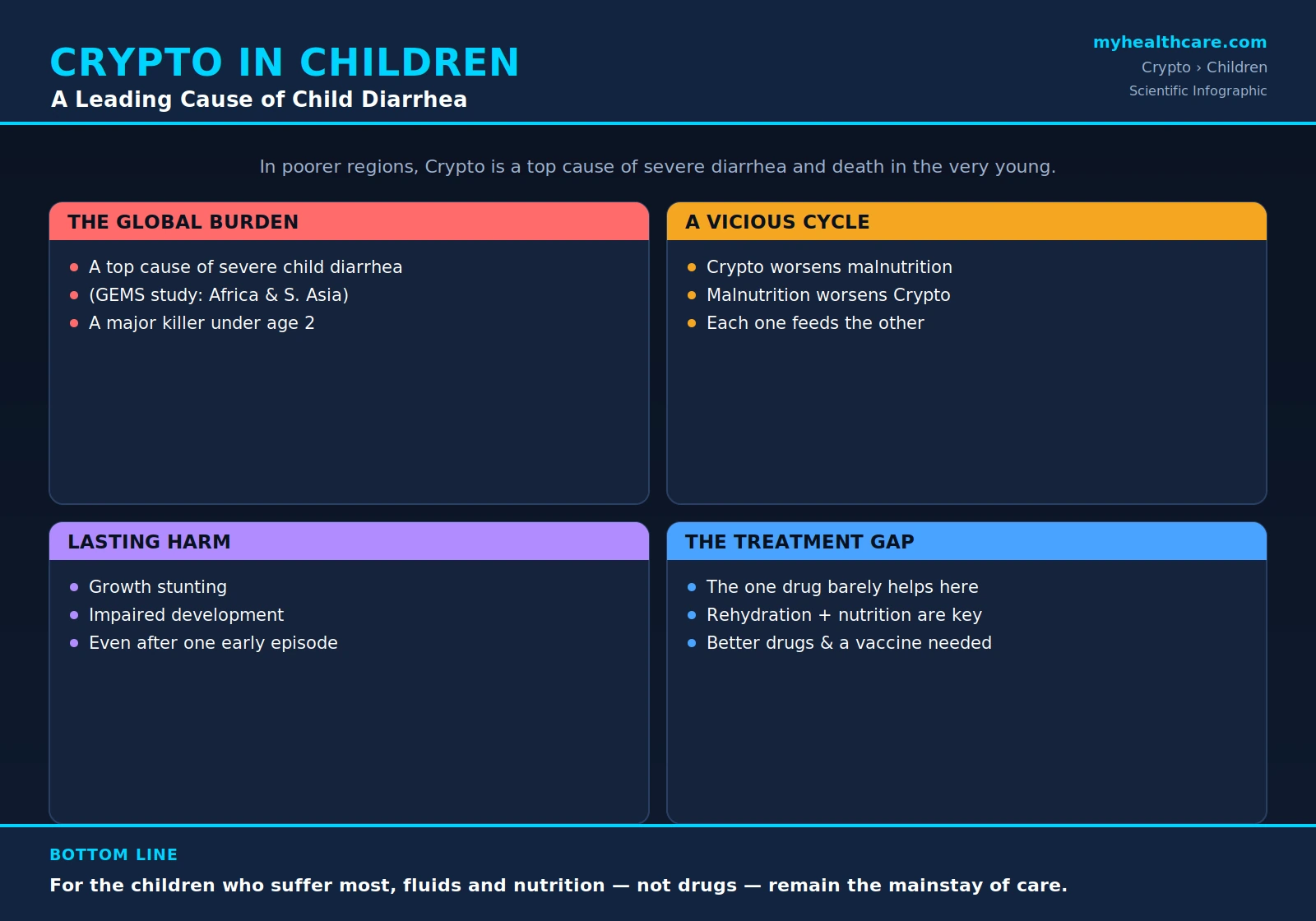
For most people in wealthy countries, cryptosporidiosis is an unpleasant but short-lived bout of watery diarrhea — a few rough days, then recovery. For a young child living in poverty in sub-Saharan Africa or South Asia, the same parasite can be something far more serious: one of the leading causes of life-threatening diarrhea in the first two years of life, and a quiet engine of malnutrition, stunted growth, and lasting harm to a child's body and mind. This page is about that under-appreciated toll — the heavy burden Cryptosporidium places on the world's most vulnerable children. The aim is to lay out what the major studies actually found, honestly and without exaggeration, and to explain why a disease that barely registers in a healthy adult can shape the whole course of a poor child's life.
The story runs through several connected ideas: that large multi-country studies have ranked Cryptosporidium near the top of the causes of severe childhood diarrhea; that diarrhea and malnutrition trap children in a vicious cycle, each making the other worse; that even a single early episode can leave a child permanently shorter and, in some studies, slower to develop and to learn; and that — painfully — the one drug we have works least well in exactly the children who need it most. Understanding all of this is the first step toward why safe water, good nutrition, and breastfeeding matter so much, and why researchers are urgently working toward better drugs and a vaccine.
Table of Contents
- The Global Child Burden
- The Vicious Cycle of Diarrhea and Malnutrition
- Growth Stunting and Lasting Deficits
- Cognitive Development and School Performance
- Environmental Enteropathy
- Why Young Children Are So Vulnerable
- The Treatment Gap
- The Need for Better Drugs and a Vaccine
- Prevention: Water, Hygiene, and Breastfeeding
- Key Research Papers
- Featured Videos
1. The Global Child Burden
The clearest picture of how much Cryptosporidium harms young children comes from a landmark study called the Global Enteric Multicenter Study (GEMS). GEMS was a very large investigation carried out at seven sites across sub-Saharan Africa and South Asia, comparing thousands of young children who came to clinics with moderate-to-severe diarrhea against healthy children from the same communities. By systematically testing what was causing the diarrhea, the researchers could rank the most important culprits — not just the most common germs, but the ones doing the most damage.
The finding that surprised many people was how high Cryptosporidium ranked. In GEMS, it emerged as one of the top causes of moderate-to-severe diarrhea in infants and toddlers, particularly in the first one to two years of life — sitting alongside long-recognized threats such as rotavirus and certain strains of E. coli. Crucially, GEMS also linked these episodes to death: children with moderate-to-severe diarrhea were far more likely to die in the following weeks than children without it, and Cryptosporidium was among the pathogens most associated with that increased risk in the youngest children. In other words, this was not a nuisance organism but a genuine, measurable contributor to childhood mortality.
A companion analysis from GEMS focused specifically on Cryptosporidium confirmed that it carried a substantial burden of diarrheal disease in children under two years old across these settings, and was independently associated with an increased risk of death. Later, when researchers behind the Global Burden of Disease (GBD) project assembled the worldwide numbers, they estimated that Cryptosporidium caused a very large number of diarrhea episodes and was responsible for an estimated burden on the order of tens of thousands of deaths each year in children younger than five — placing it among the leading diarrheal pathogens of early childhood. A second major birth-cohort study, the MAL-ED study (which followed children in eight low-resource countries from birth), reinforced the message from a different angle: Cryptosporidium was a leading attributable cause of diarrhea in the community — not only among children sick enough to reach a clinic, but in everyday life at home.
Taken together, three of the most important studies in global child health — GEMS, GBD, and MAL-ED — arrive at the same conclusion from different directions: in the poorest parts of the world, Cryptosporidium is a top-tier threat to the youngest children. It is precisely because it is so mild in the well-nourished and well-resourced that this burden has been, for decades, badly under-appreciated.
2. The Vicious Cycle of Diarrhea and Malnutrition
To understand why cryptosporidiosis is so damaging to poor children, it helps to picture a vicious cycle — a loop in which two problems feed each other. On one side is the infection; on the other is malnutrition; and each one makes the other worse.
How the infection worsens nutrition. Cryptosporidium infects the lining of the small intestine — the very surface where the body absorbs nutrients from food. When the parasite damages and inflames that lining, two things happen. First, the watery diarrhea itself flushes out fluids, salts, and partially digested food. Second, and more lasting, the damaged gut becomes worse at absorbing the nutrients a growing child desperately needs. A child can be eating, yet still not getting the full benefit of the food, because the “absorbing surface” is injured. The result is weight loss and, over time, a slide toward undernutrition.
How malnutrition worsens the infection. The cycle turns the other way, too. A child who is already malnourished has a weakened immune system, because building and running the body's defenses requires good nutrition. A poorly nourished child is therefore more likely to catch Cryptosporidium in the first place, more likely to suffer a prolonged or severe episode rather than a quick recovery, and more likely to be harmed by it. So malnutrition opens the door wider to infection, and infection deepens the malnutrition — round and round.
This is why cryptosporidiosis is so much more dangerous in a malnourished child than in a well-fed one, and why outcomes can be catastrophic in children who are already stunted or wasted. It is also why effective help has to address both sides of the loop at once: you cannot fully fix the nutrition without controlling the infection, and you cannot fully control the infection without supporting the nutrition. Breaking this cycle — through rehydration, feeding, clean water, and prevention — is the central goal of caring for these children.
3. Growth Stunting and Lasting Deficits
One of the most sobering discoveries about childhood cryptosporidiosis is that its harm does not end when the diarrhea stops. The infection can leave a lasting physical mark on a child's growth — and, strikingly, even a single early-childhood episode has been linked to deficits that persist long afterward.
The strongest early evidence came from long-running studies in the slums of Lima, Peru, where researchers followed young children closely from birth and recorded both their infections and their growth. They found that children who had cryptosporidiosis in early life were measurably shorter months later than children who had escaped it — a finding consistent with stunting, the technical term for being too short for one's age because of chronic adversity. The effect on height was real and durable, not a temporary dip that the child later “caught up” from. The growth shortfall was greatest in children who were already undernourished when they were infected, underscoring the vicious cycle described above.
Later birth-cohort work, including the multi-country MAL-ED study, reinforced and broadened these findings: across very different countries, early Cryptosporidium infection was associated with poorer linear growth (height gain) in the months that followed. Importantly, much of this growth damage occurred even in children whose infections were not severe — including some who had the parasite without obvious diarrhea at all. This matters enormously, because it means the harm is not limited to the dramatic, clinic-visiting cases. Quiet, “asymptomatic” carriage of the parasite can still chip away at a child's growth.
Why does this happen? Stunting is the visible outward sign of a deeper problem: repeated or prolonged gut injury, poor nutrient absorption, and the metabolic cost of fighting infection, all occurring during the narrow, irreplaceable window of early childhood when the body and brain are growing fastest. A child who is stunted by the age of two has, in a sense, lost growth potential that is very hard to recover. And because stunting is itself a powerful predictor of later illness and impaired development, an early bout of cryptosporidiosis can set a long chain of disadvantage in motion. This is the heart of why a “mild” childhood diarrheal infection deserves to be taken so seriously in poor settings.
4. Cognitive Development and School Performance
The damage from early-childhood cryptosporidiosis appears to reach beyond the body and into the developing mind. A number of long-term studies have found that children who suffered heavy burdens of early diarrhea — with Cryptosporidium prominent among the causes — tended, years later, to show poorer cognitive development and weaker school performance than peers who were spared.
The same Peruvian and Brazilian research groups who documented the growth deficits also followed children into later childhood and measured cognition and school readiness. They reported associations between early heavy diarrheal disease and lower scores on tests of thinking and learning, as well as delays that showed up when the children reached school age. One long-term analysis found that early childhood diarrhea predicted measurable cognitive delays in later childhood. The likely explanation is layered: undernutrition and stunting in the first years of life are themselves linked to slower brain development, and the same conditions of poverty, poor sanitation, and repeated infection that drive cryptosporidiosis also impair a child's chance to grow and learn. Disentangling the parasite's own contribution from the surrounding hardship is genuinely difficult, and researchers are careful to describe these findings as associations rather than proof that the infection alone causes the cognitive shortfall.
Even with that honest caveat, the pattern is consistent enough to be deeply concerning. It reframes cryptosporidiosis not merely as a cause of diarrhea and stunted height, but as one thread in a web of early adversity that can blunt a child's ability to learn, to do well in school, and ultimately to thrive as an adult. It is one more reason the burden of this parasite is far larger than its reputation as a “traveler's tummy” bug would suggest.
5. Environmental Enteropathy
A key concept that helps tie the growth and developmental harms together is environmental enteropathy (sometimes called environmental enteric dysfunction). This is a condition of chronic, low-grade damage to the small intestine that is common in children growing up in conditions of poor sanitation — and repeated gut infections like cryptosporidiosis are thought to be among its drivers.
The idea is this: a child living amid contaminated water, soil, and surfaces is exposed, over and over, to a steady stream of intestinal germs. Even when no single infection causes dramatic illness, this constant assault keeps the gut in a state of persistent inflammation. The intestinal lining changes — its normal finger-like projections (which vastly increase the surface for absorbing nutrients) become blunted — and the gut barrier grows leaky. The result is a chronically inflamed, poorly absorbing gut that quietly undermines nutrition month after month, without ever announcing itself as an obvious bout of illness.
Environmental enteropathy offers a powerful explanation for two of this page's central puzzles. It helps explain why children in these settings stay malnourished and stunted even when they are being fed — because a damaged gut cannot make full use of the food. And it helps explain why even mild or symptom-free Cryptosporidium infections are linked to lasting harm — because the damage is not really about any one episode, but about the cumulative, grinding injury of repeated exposure. Seen this way, cryptosporidiosis is both a cause and a symptom of environmental enteropathy: it both contributes to the chronic gut damage and thrives in the poor conditions that produce it. Breaking that pattern is one of the great unsolved challenges of global child health.
6. Why Young Children Are So Vulnerable
If cryptosporidiosis is so mild in healthy adults, why does it fall so hard on young children in poor settings? Several factors converge during the first two years of life to make this age group uniquely susceptible.
- Immature immunity. A baby's immune system is still developing and has not yet “learned” to fight off Cryptosporidium. Because protection against this parasite depends heavily on a working cellular immune response — the same arm of immunity that is weak in newborns and damaged by malnutrition — very young children mount a feebler defense and are prone to longer, more severe infections.
- The weaning window. The risk peaks around the age children stop relying on breast milk and start eating other foods and drinking other liquids. This weaning period is dangerous on two counts: the child loses the protective antibodies and clean nourishment that breast milk provides, and is simultaneously exposed to complementary foods and water that may be contaminated. Many children meet Cryptosporidium for the first time precisely at this fragile transition.
- Contaminated water and environments. Cryptosporidium spreads when the microscopic egg-like oocysts, shed in stool, are swallowed — and it takes only a tiny number to cause infection. In communities without safe drinking water, reliable sanitation, or sewage disposal, young children are surrounded by opportunities to ingest the parasite: drinking water, the hands and mouths of crawling exploration, soil, and shared spaces. The oocysts are tough and resist ordinary chlorination, so even some treated water supplies are not fully protective.
- Existing malnutrition. As the vicious-cycle section explained, a child who is already undernourished is both more likely to be infected and more likely to be badly harmed — so the children most exposed to the parasite are often the very ones least able to withstand it.
The combination is unforgiving. Immature defenses, the loss of breast-milk protection at weaning, heavy environmental exposure, and pre-existing undernutrition all stack on top of one another during the same brief, critical period — which is why the burden of childhood cryptosporidiosis is concentrated so sharply in infants and toddlers in low-income communities.
7. The Treatment Gap
Here the story turns especially difficult, and it has to be told honestly. The single drug approved for cryptosporidiosis is nitazoxanide. In otherwise healthy, well-nourished people, it can shorten the illness and help clear the parasite. But in the children who carry the heaviest burden — the malnourished and those living with HIV — the evidence for benefit is limited or, in important studies, absent.
The pivotal evidence came from a clinical trial in Zambian children. Among children who were not infected with HIV, nitazoxanide improved outcomes; but in the children with HIV, the drug did not show a meaningful benefit. A later study testing even higher, prolonged doses of nitazoxanide in malnourished and HIV-affected children likewise failed to demonstrate effectiveness. In short, the one medicine we have works least well in exactly the population that needs it most. There is no convincing evidence that it reliably reduces the diarrhea, the malnutrition, or the deaths in severely malnourished or immunodeficient children — the children most likely to die.
Because of this gap, the genuine mainstays of care for these children are not a magic antiparasitic pill but the unglamorous, life-saving basics: rehydration to replace the fluids and salts lost to diarrhea, and nutritional support to feed the child through the illness and rebuild what the infection takes away. Continued feeding (including continued breastfeeding) during diarrhea, oral rehydration solution, zinc supplementation in line with diarrhea-management guidelines, and treatment of any underlying condition such as HIV all do far more, in practice, than nitazoxanide can offer this population. For the practical detail of how rehydration and nutritional support are delivered, see Supportive Care and Rehydration; for the specifics of the drug itself — what it is, when it helps, and its real limits — see Nitazoxanide and Treatment.
8. The Need for Better Drugs and a Vaccine
The treatment gap leads directly to one of the clearest unmet needs in global child health: we urgently need better tools against Cryptosporidium. Given that this parasite ranks among the top causes of severe and fatal diarrhea in young children, the absence of a drug that reliably works in malnourished and HIV-affected children is a serious failure — and the absence of any vaccine is a glaring gap.
On the drug front, researchers are actively searching for new antiparasitic compounds that can clear Cryptosporidium effectively even in vulnerable children. For decades this was a neglected area, but interest has grown as the burden has become better recognized, and several candidate molecules are under investigation. The goal is a safe, affordable, effective treatment that performs where nitazoxanide does not.
On the vaccine front, the rationale is compelling: children who survive early infections do appear to develop some protective immunity, which suggests a vaccine to prime that immunity before the dangerous toddler years could prevent a great deal of disease and death. A vaccine that protected infants through the high-risk weaning window could, in principle, break the cycle at its most vulnerable point. No such vaccine yet exists, and developing one is scientifically challenging, but it is now recognized as a priority. Until better drugs and a vaccine arrive, prevention and supportive care must carry the entire load — which is exactly why the basic measures in the next section matter so much.
9. Prevention: Water, Hygiene, and Breastfeeding
Because we cannot yet rely on a drug or a vaccine, prevention is the most powerful weapon available against childhood cryptosporidiosis — and, encouragingly, the core measures are well understood and rooted in basic public health.
Safe water and sanitation. Since the parasite spreads through swallowing oocysts shed in stool, the foundation of prevention is interrupting that fecal–oral route: providing clean drinking water, building and using proper toilets and sewage systems, and keeping human and animal waste away from the water and places where children live and play. These “water, sanitation, and hygiene” (WASH) measures are the bedrock. Because Cryptosporidium oocysts resist standard chlorine levels, water safety often depends on physical removal (filtration) or other treatment; at the household level, boiling or properly filtering water can help where the supply is unsafe.
Hand hygiene. Thorough handwashing with soap — especially after using the toilet, after handling a child's stool or changing diapers, and before preparing food or feeding a child — is a simple, high-value habit that blocks transmission. Keeping young children's hands (and the objects they put in their mouths) clean is part of the same effort.
Breastfeeding. One of the most protective things of all costs nothing: breastfeeding. Breast milk shields infants in two ways — it supplies clean, safe nutrition that does not have to be mixed with potentially contaminated water, and it delivers maternal antibodies and other protective factors that help defend the immature gut. Breastfed infants are less exposed to the parasite and better equipped to resist it, which is why continued breastfeeding through the vulnerable weaning period is so strongly encouraged. Crucially, breastfeeding should also continue during a diarrheal illness, not be stopped — it helps maintain nutrition and hydration when the child needs them most.
These measures — safe water and sanitation, diligent hand hygiene, and breastfeeding — are the front line of defense for the children who bear the heaviest burden of this parasite. For the wider prevention picture, including how outbreaks arise and how communities and water systems guard against them, see Prevention: Water and Outbreaks, and for the full management overview see the Treatment & Prevention hub.
Key Research Papers
Peer-reviewed epidemiology, cohort studies, and treatment trials documenting the burden of Cryptosporidium in young children and its links to malnutrition, growth, and development. Journal names appear as plain text; the year/volume/pages link opens the full citation via DOI.
- Kotloff KL, Nataro JP, Blackwelder WC, et al. Burden and Aetiology of Diarrhoeal Disease in Infants and Young Children in Developing Countries (the Global Enteric Multicenter Study, GEMS): A Prospective, Case-Control Study. The Lancet. 2013;382(9888):209–222.
- Sow SO, Muhsen K, Nasrin D, et al. The Burden of Cryptosporidium Diarrheal Disease among Children < 24 Months of Age in Moderate/High Mortality Regions of Sub-Saharan Africa and South Asia, Utilizing Data from the Global Enteric Multicenter Study (GEMS). PLOS Neglected Tropical Diseases. 2016;10(5):e0004729.
- Khalil IA, Troeger C, Rao PC, et al. Morbidity, Mortality, and Long-Term Consequences Associated with Diarrhoea from Cryptosporidium Infection in Children Younger than 5 Years: A Meta-Analyses Study (Global Burden of Disease). The Lancet Global Health. 2018;6(7):e758–e768.
- Platts-Mills JA, Babji S, Bodhidatta L, et al. Pathogen-Specific Burdens of Community Diarrhoea in Developing Countries: A Multisite Birth Cohort Study (MAL-ED). The Lancet Global Health. 2015;3(9):e564–e575.
- Checkley W, White AC, Jaganath D, et al. A Review of the Global Burden, Novel Diagnostics, Therapeutics, and Vaccine Targets for Cryptosporidium. The Lancet Infectious Diseases. 2015;15(1):85–94.
- Korpe PS, Haque R, Gilchrist C, et al. Natural History of Cryptosporidiosis in a Longitudinal Study of Slum-Dwelling Bangladeshi Children: Association with Severe Malnutrition. PLOS Neglected Tropical Diseases. 2016;10(5):e0004564.
- Korpe PS, Gilchrist C, Burkey C, et al. Case-Control Study of Cryptosporidium Transmission in Bangladeshi Households. Clinical Infectious Diseases. 2023;76(12):2178–2186.
- Checkley W, Epstein LD, Gilman RH, Black RE, Cabrera L, Sterling CR. Effects of Cryptosporidium parvum Infection in Peruvian Children: Growth Faltering and Subsequent Catch-up Growth. American Journal of Epidemiology. 1998;148(5):497–506.
- Guerrant DI, Moore SR, Lima AAM, Patrick PD, Schorling JB, Guerrant RL. Association of Early Childhood Diarrhea and Cryptosporidiosis with Impaired Physical Fitness and Cognitive Function Four–Seven Years Later in a Poor Urban Community in Northeast Brazil. The American Journal of Tropical Medicine and Hygiene. 1999;61(5):707–713.
- Pinkerton R, Oriá RB, Lima AAM, et al. Early Childhood Diarrhea Predicts Cognitive Delays in Later Childhood Independently of Malnutrition. The American Journal of Tropical Medicine and Hygiene. 2016;95(5):1004–1010.
- Amadi B, Mwiya M, Musuku J, et al. Effect of Nitazoxanide on Morbidity and Mortality in Zambian Children with Cryptosporidiosis: A Randomised Controlled Trial. The Lancet. 2002;360(9343):1375–1380.
- Amadi B, Mwiya M, Sianongo S, et al. High Dose Prolonged Treatment with Nitazoxanide Is Not Effective for Cryptosporidiosis in HIV Positive Zambian Children: A Randomised Controlled Trial. BMC Infectious Diseases. 2009;9:195.
- Chen XM, Keithly JS, Paya CV, LaRusso NF. Cryptosporidiosis. New England Journal of Medicine. 2002;346(22):1723–1731.
Live PubMed Searches
Each link opens a live PubMed query so results stay current as new papers are indexed.
- Cryptosporidium in children, developing countries
- GEMS and Cryptosporidium
- Cryptosporidiosis and malnutrition in children
- Cryptosporidium, stunting and growth
- Early childhood diarrhea and cognition
- Environmental enteropathy in children
- Nitazoxanide in HIV / malnourished children
- Cryptosporidium vaccine development
Connections
- All Parasites
- Cryptosporidium Overview
- Symptoms & Diagnosis
- Watery Diarrhea & Dehydration
- Cryptosporidiosis in the Immunocompromised
- Treatment & Prevention
- Nitazoxanide & Treatment
- Supportive Care & Rehydration
- Prevention: Water & Outbreaks
- Gastroenterology
- Infectious Disease
- All Conditions