Cryptosporidiosis: Watery Diarrhea and Dehydration
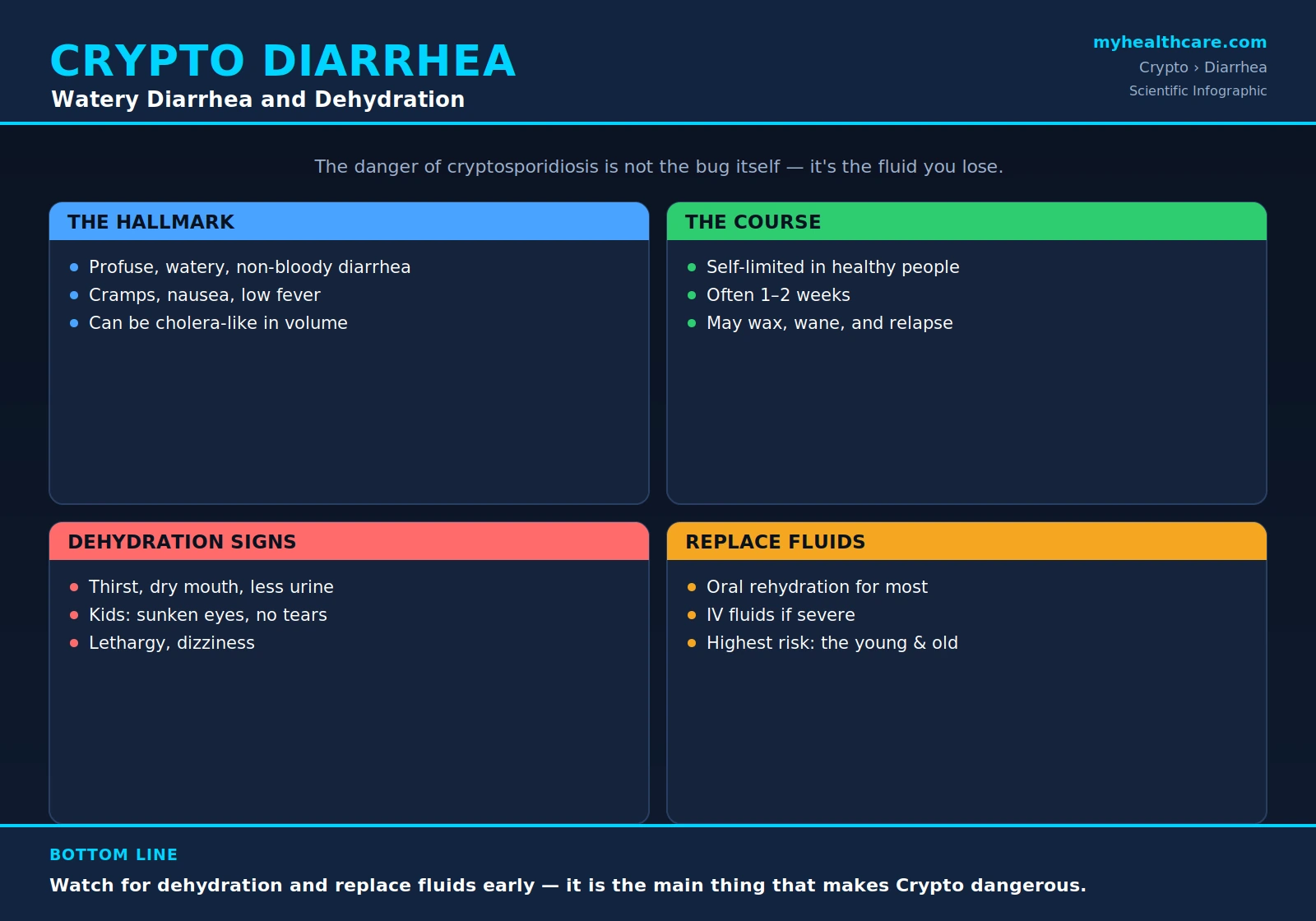
The single most important thing to understand about cryptosporidiosis — the infection caused by the microscopic parasite Cryptosporidium — is that its main illness is profuse, watery diarrhea, and its main danger is the fluid loss that comes with it. In an otherwise healthy person, the diarrhea is usually unpleasant but self-limited, clearing on its own over a week or two. The real risk is not the parasite itself but dehydration: the body losing water and salts faster than they can be replaced. That is why the cornerstone of care is so simple and so powerful — keep drinking the right fluids, recognize the warning signs of dehydration early, and know when to seek help. This page walks through what the diarrhea is like, why it happens, the other symptoms that come with it, how long it usually lasts, how to spot dehydration, and exactly when to get medical care.
Table of Contents
- The Hallmark: Watery, Non-Bloody Diarrhea
- Why It Happens: The Mechanism
- The Other Symptoms
- The Usual Course in Healthy People
- Dehydration: The Central Risk
- Salt and Electrolyte Losses
- Rehydration: The Mainstay of Care
- Who Is Most at Risk
- What Else Causes Watery Diarrhea?
- When to Seek Medical Care
- Key Research Papers
- Featured Videos
1. The Hallmark: Watery, Non-Bloody Diarrhea
The defining symptom of cryptosporidiosis is watery diarrhea. People describe it as frequent, loose, and genuinely watery — not soft or mushy but liquid, sometimes coming many times a day. Crucially, it is typically non-bloody: you do not usually see blood or mucus in the stool, and there is no pus. This is an important clue, because it points away from the kinds of infection (such as certain bacteria) that tend to cause bloody, dysentery-like diarrhea.
In the most severe cases — especially in young children in low-resource settings or in people with weakened immune systems — the volume of fluid lost can be remarkable. Doctors sometimes describe heavy cryptosporidial diarrhea as "cholera-like" in volume, meaning the body can pour out large amounts of watery stool, the way it does in cholera. In a healthy adult the volumes are usually far smaller, but even ordinary cases produce enough fluid loss to leave a person feeling drained, weak, and very thirsty.
The diarrhea is often watery from the start and stays that way. It can be accompanied by an urgent, gassy, "everything runs straight through" sensation. Because the fluid is what matters most, the practical takeaway is simple: the more watery and frequent the stool, the more carefully you need to keep up with drinking to replace what is being lost.
2. Why It Happens: The Mechanism
To understand the diarrhea, it helps to know where the parasite lives and what it does. After a person swallows Cryptosporidium (usually in contaminated water or food, or from contact with an infected person or animal), the parasite takes up residence in the lining of the small intestine — the long, coiled tube where most of the body's water and nutrient absorption normally happens. The parasite attaches to and infects the cells of this lining (the epithelium), nestling just inside them.
This infection disrupts the gut's normal handling of fluid in two ways at once, which is why the diarrhea is so watery:
- A secretory effect — the inflamed, infected lining actively pushes water and salts out into the gut, so fluid is added to the intestinal contents rather than held back.
- A malabsorptive effect — the damaged lining can no longer absorb water and nutrients as efficiently as it should, so fluid that would normally be reclaimed by the body stays in the gut and is lost in the stool.
The combination — the intestine secreting extra fluid while failing to absorb it back — produces a large, watery output. Importantly, Cryptosporidium tends to injure the surface lining without causing bleeding or invading deep into the gut wall the way some bacteria do. That is the biological reason the diarrhea is watery rather than bloody: the parasite blunts and damages the absorptive surface and stimulates fluid secretion, but it does not tear into blood vessels. This is also why blood tests and stool tests for blood are usually unremarkable, and why the illness is better thought of as a problem of fluid balance than of internal bleeding.
3. The Other Symptoms
Although watery diarrhea is the headline, cryptosporidiosis usually comes as a cluster of gastrointestinal symptoms. The common companions include:
- Crampy abdominal pain — gripping, colicky cramps in the belly, often coming in waves before a bowel movement.
- Nausea, and sometimes vomiting — a queasy stomach is common; some people vomit, which adds to fluid loss and makes it harder to keep drinks down.
- Low-grade fever — a mild fever may accompany the illness, though many people have little or no fever.
- Loss of appetite — food becomes unappealing, which is part of why people often eat very little during the illness.
- Weight loss — the combination of diarrhea, poor absorption, and not eating can cause a noticeable drop in weight over the days of illness.
People also frequently report general malaise — feeling tired, washed out, and unwell. None of these symptoms is unique to cryptosporidiosis, which is part of why it can be hard to tell apart from other causes of an "upset stomach" without a stool test. But the overall pattern — watery (not bloody) diarrhea, crampy pain, nausea, low-grade or no fever, and poor appetite, often after exposure to recreational or contaminated water — is a recognizable picture.
4. The Usual Course in Healthy People
For most people with a normal, healthy immune system, cryptosporidiosis is a self-limited illness — meaning the body clears it on its own without needing a specific anti-parasite drug. The diarrhea commonly improves within about one to two weeks. Many people are over the worst of it within a week.
One feature that surprises people is that the illness can wax and wane rather than simply fading away. It is common for the diarrhea to seem to be getting better, then flare up again before finally settling — a relapsing, on-and-off pattern that can stretch the total illness out and be discouraging. This stop-start course is typical and, in an otherwise healthy person, does not by itself signal something dangerous; it is the parasite being gradually cleared rather than a sign that treatment has failed.
The encouraging message is that, with attention to fluids, the great majority of healthy adults and children recover fully and the parasite is eliminated. The picture is very different, however, for people with weakened immune systems, in whom the infection can become severe, prolonged, and even life-threatening — that situation is covered separately on the Cryptosporidiosis in the Immunocompromised page.
5. Dehydration: The Central Risk
If there is one concept to take away from this page, it is this: in cryptosporidiosis, dehydration is the thing that actually hurts people. The parasite itself is rarely the direct cause of serious harm in healthy individuals; the danger is losing so much water and salt through the watery diarrhea (and any vomiting) that the body cannot function normally. Recognizing dehydration early — before it becomes severe — is the single most useful skill for managing this illness at home.
Warning signs in older children and adults:
- Increased thirst — a strong, persistent feeling of thirst is one of the earliest signals.
- Dry mouth and lips — a parched, sticky mouth and dry tongue.
- Reduced and darker urine — going to the bathroom less often, with urine that is small in amount and deep yellow or amber rather than pale.
- Dizziness, light-headedness, weakness, or lethargy — feeling faint when standing up, unusually tired, or hard to rouse.
Warning signs in babies and young children (who cannot tell you they are thirsty, and who become dehydrated faster):
- Sunken eyes — the eyes look hollow or set back.
- No tears when crying — crying without producing tears.
- Fewer wet diapers — far fewer than usual; a dry diaper for many hours is a red flag.
- A sunken soft spot (fontanelle) — in infants, the soft spot on the top of the head looks depressed rather than flat.
- Unusual drowsiness, floppiness, or fussiness that is hard to settle.
These signs exist on a spectrum. Mild dehydration (just thirst and a slightly dry mouth) can usually be managed at home with extra fluids. Signs of moderate to severe dehydration — very little or no urine, marked lethargy, sunken eyes, no tears, or a sunken fontanelle in a baby — mean it is time to seek medical care, because the body's fluid reserves are running low.
6. Salt and Electrolyte Losses
Watery diarrhea does not just drain water — it also carries away electrolytes, the dissolved salts (such as sodium, potassium, and chloride) and the bicarbonate that the body needs to keep its cells, nerves, and muscles working properly. With heavy, watery stool, these are lost in significant amounts along with the fluid.
This is why plain water alone is not the ideal thing to drink during a bad bout of diarrhea: it replaces the water but not the salts, and in large amounts can even dilute the body's remaining electrolytes. Losing potassium can leave muscles weak and crampy; losing sodium and bicarbonate disturbs the body's chemistry and can contribute to weakness, fatigue, and (when severe) more serious problems with the heart and nervous system. In small children and older adults, these electrolyte shifts can develop quickly and are an important part of why dehydration from diarrhea is dangerous.
The practical consequence is the reason oral rehydration solutions exist: they are designed to replace not only water but also the specific salts and a little sugar in the right proportions, so the body can absorb and hold onto the fluid efficiently. This is covered in the next section.
7. Rehydration: The Mainstay of Care
Because there is no quick "cure" for cryptosporidiosis in a healthy person — and because dehydration is the real threat — the mainstay of treatment is rehydration: replacing the fluids and salts being lost. For the great majority of people, this means drinking, not an IV.
Oral rehydration is the first-line approach. The most effective drink is an oral rehydration solution (ORS) — a precise mixture of water, salts, and a small amount of sugar (glucose). The science behind ORS is elegant: glucose and sodium are absorbed together across the gut lining through a shared transport system that keeps working even when the intestine is inflamed, and water follows the salt and sugar back into the body. This is why a properly made ORS replaces fluid far better than water alone. Commercially prepared ORS packets and ready-made oral rehydration drinks are widely available; modern reduced-osmolarity formulations are gentler on the gut and reduce the amount and duration of diarrhea compared with older recipes. The general approach is to sip small amounts frequently — little and often — rather than gulping large volumes, which is easier to keep down, especially if there is any nausea.
When intravenous (IV) fluids are needed. Most people never need an IV. IV fluids become necessary when oral rehydration cannot keep up or cannot be done — for example, when someone is vomiting so much they cannot keep fluids down, when the dehydration is already severe (marked lethargy, almost no urine, a state of shock), or in a young child or frail older adult who is deteriorating. In those situations, fluids and salts are given directly into a vein in a clinic or hospital to restore the body quickly and safely. The key point is that needing an IV is about the degree of dehydration and the ability to drink, not about the parasite itself.
For a fuller, practical walk-through of supportive care, fluids, and how to manage the illness day to day, see Supportive Care and Rehydration. The specific anti-parasitic medication used in some cases (nitazoxanide) is discussed on the Nitazoxanide and Treatment page.
8. Who Is Most at Risk of Dangerous Dehydration
Anyone with watery diarrhea can become dehydrated, but some groups become dangerously dehydrated more easily and need closer watching:
- Young children and infants — they have smaller bodies with smaller fluid reserves, can lose a large share of their body water quickly, and cannot tell you they are thirsty. Diarrheal dehydration is a leading cause of serious illness in young children worldwide. The particular issues of cryptosporidiosis in children, including its links to malnutrition and growth, are covered on the Cryptosporidiosis in Children and Malnutrition page.
- Older adults — the sense of thirst is often blunted with age, the kidneys conserve water less efficiently, and other medical conditions or medications can worsen fluid and salt balance, so dehydration can set in before it is obvious.
- Anyone with a weakened immune system — people with advanced HIV/AIDS, those on chemotherapy or immune-suppressing drugs, or transplant recipients can have far more severe and prolonged diarrhea, with much greater fluid loss and a real risk to life. This important group is addressed in detail on the Cryptosporidiosis in the Immunocompromised page.
If you or someone you are caring for falls into one of these groups, it is wise to start replacing fluids early and to have a lower threshold for seeking medical advice.
9. What Else Causes Watery Diarrhea?
Cryptosporidiosis is far from the only cause of acute watery diarrhea, and on symptoms alone it can look like several other infections. Knowing the company it keeps helps explain why a stool test is often needed to be sure. Other common causes include:
- Other parasites — most notably Giardia (giardiasis), which also causes watery, non-bloody, often greasy and foul-smelling diarrhea with bloating and gas, and which (like Cryptosporidium) spreads through contaminated water. The two are frequent companions in waterborne outbreaks and in travelers.
- Viruses — norovirus and rotavirus are extremely common causes of watery diarrhea and vomiting, usually short-lived (a day or a few days), and highly contagious.
- Bacteria — many bacterial infections cause watery diarrhea; some (such as certain strains of E. coli) produce toxins that drive a watery, cholera-like output, while others (such as Shigella or Campylobacter) more often cause bloody diarrhea, which helps distinguish them.
Because so many organisms produce similar symptoms, doctors usually identify Cryptosporidium by testing a stool sample — with special stains or, increasingly, modern molecular (DNA-based) tests that can detect the parasite and tell it apart from the look-alikes above. The practical point for patients is that the care for watery diarrhea — replacing fluids and salts — is largely the same no matter the cause, which is why rehydration should begin promptly even before a specific diagnosis is known.
10. When to Seek Medical Care
Most cases of cryptosporidiosis in healthy people can be ridden out at home with fluids. But there are clear situations in which you should contact a doctor or seek care. Get medical attention if you or the person you are caring for has any of the following:
- Signs of moderate or severe dehydration — very little or no urine for many hours, very dark urine, marked dizziness or fainting, extreme weakness or drowsiness; in a baby, sunken eyes, no tears, a sunken soft spot, or a long stretch with a dry diaper.
- Inability to keep fluids down — persistent vomiting that prevents drinking enough to keep up with the losses.
- Diarrhea that is severe, profuse, or not improving — very high-volume, frequent watery stools, or diarrhea lasting beyond a couple of weeks, or worsening after seeming to improve.
- High fever, severe abdominal pain, or any blood in the stool (which suggests a different or additional problem and should always be evaluated).
- A high-risk person is ill — a young infant, a frail older adult, a pregnant person, or anyone with a weakened immune system. For these groups, seek advice earlier rather than waiting.
When in doubt, it is reasonable to call a clinician for guidance — especially to ask whether the level of dehydration warrants being seen. The watchword for this illness is fluids: keep replacing them, watch for the warning signs above, and do not hesitate to get help when the body cannot keep up on its own.
Key Research Papers
Peer-reviewed reviews, cohort studies, outbreak investigations, and treatment trials on the clinical features, fluid losses, and management of cryptosporidiosis and acute watery diarrhea. Journal names appear as plain text; the year/volume/pages link opens the full citation via DOI.
- Chen XM, Keithly JS, Paya CV, LaRusso NF. Cryptosporidiosis. New England Journal of Medicine. 2002;346(22):1723–1731.
- Checkley W, White AC Jr, Jaganath D, Arrowood MJ, et al. A Review of the Global Burden, Novel Diagnostics, Therapeutics, and Vaccine Targets for Cryptosporidium. The Lancet Infectious Diseases. 2015;15(1):85–94.
- Hunter PR, Nichols G. Epidemiology and Clinical Features of Cryptosporidium Infection in Immunocompromised Patients. Clinical Microbiology Reviews. 2002;15(1):145–154.
- Kotloff KL, Nataro JP, Blackwelder WC, Nasrin D, et al. Burden and Aetiology of Diarrhoeal Disease in Infants and Young Children in Developing Countries (the Global Enteric Multicenter Study, GEMS): A Prospective, Case-Control Study. The Lancet. 2013;382(9888):209–222.
- MacKenzie WR, Hoxie NJ, Proctor ME, Gradus MS, et al. A Massive Outbreak in Milwaukee of Cryptosporidium Infection Transmitted through the Public Water Supply. New England Journal of Medicine. 1994;331(3):161–167.
- Checkley W, Gilman RH, Epstein LD, Suarez M, et al. Effects of Cryptosporidium parvum Infection in Peruvian Children: Growth Faltering and Subsequent Catch-Up Growth. American Journal of Epidemiology. 1998;148(5):497–506.
- Rossignol JF, Ayoub A, Ayers MS. Treatment of Diarrhea Caused by Cryptosporidium parvum: A Prospective Randomized, Double-Blind, Placebo-Controlled Study of Nitazoxanide. The Journal of Infectious Diseases. 2001;184(1):103–106.
- Amadi B, Mwiya M, Sianongo S, Payne L, et al. High Dose Prolonged Treatment with Nitazoxanide Is Not Effective for Cryptosporidiosis in HIV Positive Zambian Children: A Randomised Controlled Trial. BMC Infectious Diseases. 2009;9:195.
- Hahn S, Kim Y, Garner P. Reduced Osmolarity Oral Rehydration Solution for Treating Dehydration Due to Diarrhoea in Children: Systematic Review. BMJ. 2001;323(7304):81–85.
- Santosham M, Brown KH, Sack RB. Oral Rehydration Therapy and Dietary Therapy for Acute Childhood Diarrhea. Pediatrics in Review. 1987;8(9):273–278.
- Tzipori S, Smith M, Halpin C, Angus KW, et al. Human Cryptosporidiosis. New England Journal of Medicine. 1983;309(21):1325–1327.
Live PubMed Searches
Each link opens a live PubMed query so results stay current as new papers are indexed.
- Cryptosporidiosis watery diarrhea
- Cryptosporidium secretory and malabsorptive diarrhea
- Cryptosporidiosis dehydration and management
- Oral rehydration solution for acute diarrhea
- Cryptosporidiosis course in healthy people
- Cryptosporidium waterborne outbreaks
- Acute watery diarrhea differential diagnosis
- Nitazoxanide for cryptosporidiosis
Connections
- All Parasites
- Symptoms & Diagnosis
- Cryptosporidiosis in the Immunocompromised
- Cryptosporidiosis in Children and Malnutrition
- Treatment & Prevention
- Nitazoxanide and Treatment
- Supportive Care and Rehydration
- Prevention: Water and Outbreaks
- Cryptosporidium Overview
- Gastroenterology
- Infectious Disease
- All Conditions