Cryptosporidiosis Symptoms and Diagnosis
Watery Diarrhea & Dehydration
The profuse watery diarrhea of cryptosporidiosis — usually self-limited, sometimes dangerous.
Read the deep dive →Cryptosporidiosis in the Immunocompromised
Why a brief illness becomes chronic and life-threatening when immunity is low.
Read the deep dive →Cryptosporidiosis in Children & Malnutrition
A leading cause of severe diarrhea and death in young children — and its toll on growth.
Read the deep dive →Cryptosporidiosis is the watery-diarrhea illness caused by a tiny single-celled parasite called Cryptosporidium. For most healthy adults and older children it is an unpleasant but short-lived bout of diarrhea that clears on its own within a week or two. But the same parasite tells a very different story in two groups of people: in those whose immune systems are weak it can cause relentless, life-threatening diarrhea, and in young children — especially in lower-income regions — it is one of the leading causes of severe, sometimes fatal diarrhea, with lasting effects on growth. A central, practical fact runs through everything on this page: Cryptosporidium is not picked up by the ordinary stool test most labs run for parasites, so unless a doctor asks for it specifically, the diagnosis is easily missed. This page explains what the illness feels like, who is at greatest risk, how the parasite spreads, and exactly how it has to be looked for in the lab.
Table of Contents
- What Cryptosporidiosis Is
- A Spectrum — From Self-Limited to Life-Threatening
- The Cardinal Watery-Diarrhea Illness
- Disease in the Immunocompromised
- Disease in Children and Malnutrition
- The Classic Symptom Picture
- Incubation Period
- How People Catch It
- Diagnosis — It Must Be Looked For Specifically
- When to Test
- Key Research Papers
- Featured Videos
1. What Cryptosporidiosis Is
Cryptosporidiosis is an intestinal infection caused by the protozoan (single-celled) parasite Cryptosporidium. Two species cause the great majority of human disease: Cryptosporidium parvum, which lives in both people and animals (notably young cattle), and Cryptosporidium hominis, which is essentially a human parasite. The infectious form the parasite sheds is a tough, microscopic, egg-like capsule called an oocyst, and three features of that oocyst explain why this parasite is such a public-health problem.
First, the oocyst is remarkably hardy in the environment and is highly resistant to chlorine — the standard disinfectant in swimming pools and treated drinking water. The levels of chlorine that quickly kill most bacteria and viruses do not reliably kill Cryptosporidium, which is why it can survive in a properly chlorinated pool and cause outbreaks among swimmers. Second, the infectious dose is very low: swallowing only a small number of oocysts — in some human studies on the order of just a handful — can be enough to cause illness. Third, an infected person can shed enormous numbers of oocysts in their stool, and those oocysts are immediately infectious, so the parasite spreads readily from person to person. Together, a chlorine-proof, low-dose, heavily shed parasite is almost purpose-built to spread through water and close contact.
2. A Spectrum — From Self-Limited to Life-Threatening
The most important thing to understand about cryptosporidiosis is that the same parasite produces very different illnesses depending on who is infected and how strong their immune system is.
In a person with a healthy immune system, cryptosporidiosis is usually a self-limited illness: a stretch of watery diarrhea and crampy belly pain that, while genuinely miserable, resolves on its own as the immune system clears the parasite, typically within one to two weeks. Most healthy adults never even learn what caused it.
In a person whose immunity is weak — for example, someone with advanced, untreated HIV/AIDS, a transplant recipient, or a patient on strong immune-suppressing drugs — the picture changes completely. The body cannot clear the parasite, and the diarrhea can become chronic, severe, and life-threatening, with massive fluid loss and wasting. This is covered in depth on the Cryptosporidiosis in the Immunocompromised page.
And in young children, especially in low-income settings with unsafe water and existing undernutrition, Cryptosporidium is one of the leading causes of moderate-to-severe and life-threatening diarrhea — a parasite that not only kills but also stunts growth and development. This is covered on the Cryptosporidiosis in Children and Malnutrition page. Keeping this spectrum in mind makes the rest of the picture coherent: the brief illness one person shrugs off and the deadly one another suffers are the same infection seen through very different immune systems.
3. The Cardinal Watery-Diarrhea Illness
The defining feature of cryptosporidiosis — the symptom that overshadows all others — is profuse, watery diarrhea. Cryptosporidium infects the lining of the small intestine, and the result is a high-volume, non-bloody, watery diarrhea that can recur many times a day and lead to substantial loss of fluid and salts. In an otherwise healthy person this is the part that makes them feel ill and keeps them near a bathroom; in the most vulnerable, it is also the part that becomes dangerous, because heavy fluid loss leads to dehydration.
Because the watery-diarrhea illness and the dehydration it causes are the heart of cryptosporidiosis — what it is, how bad it gets, why it is rarely serious in the healthy but deadly in the vulnerable, and how to replace the lost fluids — they are treated in detail on their own page: Watery Diarrhea and Dehydration. The short version is that diarrhea is both the signature symptom and the source of the real risk, and that recognizing and replacing fluid loss is the single most important piece of everyday care.
4. Disease in the Immunocompromised
In people with weakened immunity, cryptosporidiosis stops being a brief inconvenience and becomes one of the most difficult opportunistic infections to manage. A normal immune system — particularly the part driven by CD4 T-cells — is what clears Cryptosporidium from the gut. When that defense is missing or badly weakened, the parasite is not cleared, and the diarrhea can become chronic and relentless: liters of fluid lost each day, profound weight loss and wasting, and, before effective HIV therapy existed, a frequently fatal course. In advanced immune suppression the infection can also spread beyond the intestine to involve the bile ducts and gallbladder, adding pain and complicating care.
The most important lesson from this group is that, in the immunocompromised, restoring the immune system is the real treatment — for people with HIV, that means antiretroviral therapy to rebuild the immune cells that clear the parasite. The full picture — who is at risk, how the disease behaves, and why immune recovery matters more than any antiparasitic drug — is on the dedicated page: Cryptosporidiosis in the Immunocompromised.
5. Disease in Children and Malnutrition
In much of the world, the people most harmed by Cryptosporidium are not adults with HIV but young children. Large multi-country studies of childhood diarrhea identified Cryptosporidium as one of the top causes of moderate-to-severe diarrhea in infants and toddlers in low-income regions of Africa and South Asia, and as a contributor to deaths in that age group — placing it among the most important diarrheal pathogens of early childhood, second only to rotavirus in some analyses.
What makes it especially insidious in children is a vicious cycle with malnutrition. A malnourished child is more susceptible to severe cryptosporidiosis; the infection, in turn, damages the gut and worsens nutrition, contributing to stunting (impaired linear growth) and developmental setbacks that can persist long after the diarrhea is gone. The disease, the undernutrition, and the lasting harm to growth are explored on the dedicated page: Cryptosporidiosis in Children and Malnutrition.
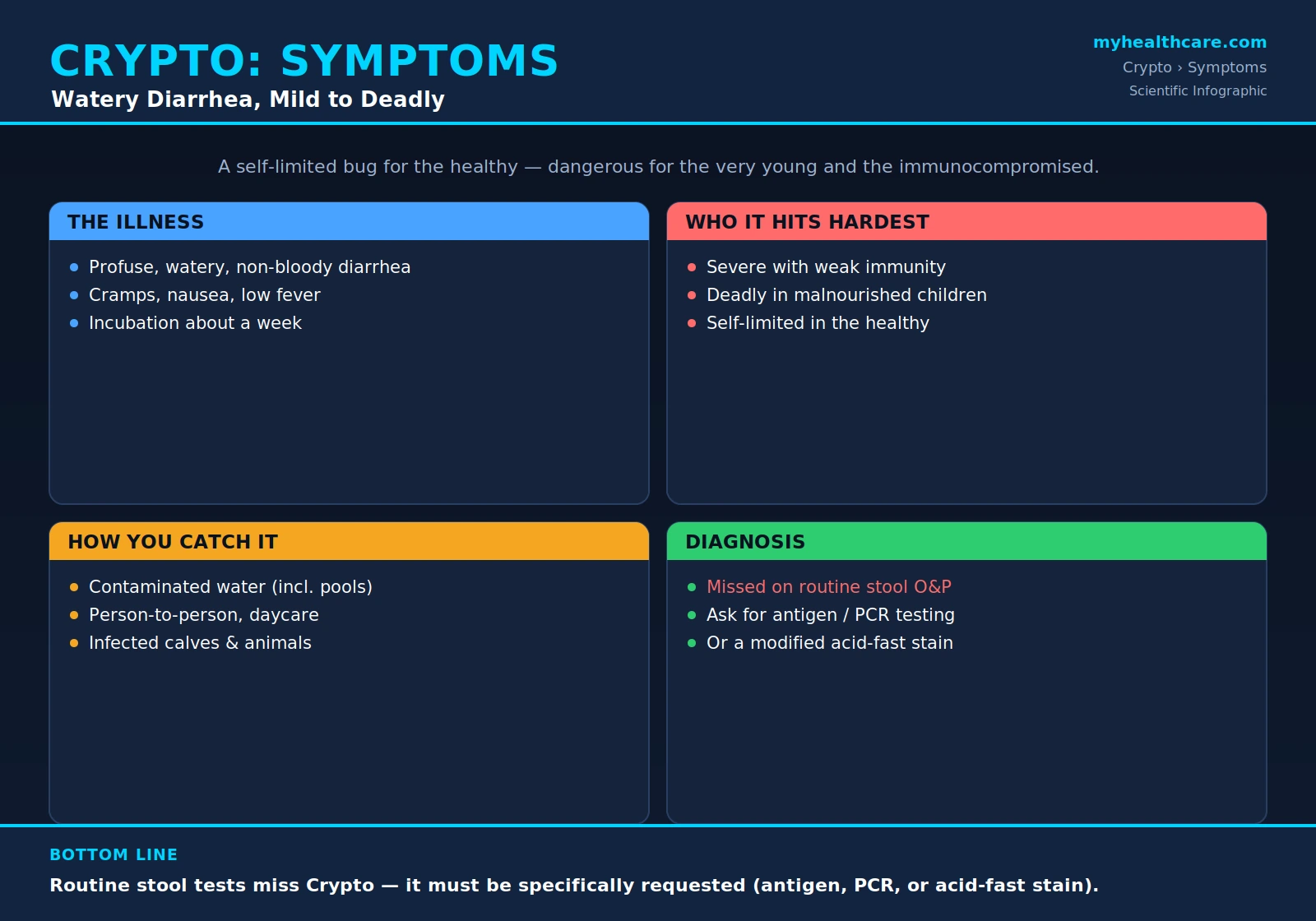
6. The Classic Symptom Picture
Putting the symptoms together, a typical bout of cryptosporidiosis in an otherwise healthy person looks like this:
- Profuse watery, non-bloody diarrhea — the dominant and most characteristic symptom, often frequent and high-volume.
- Abdominal cramps — crampy pain and discomfort in the belly that comes and goes with the diarrhea.
- Nausea (and sometimes vomiting), which can make it harder to keep fluids down.
- Low-grade fever — a mild rise in temperature in some, though not everyone.
- Loss of appetite — not feeling like eating, which compounds the fluid and energy loss.
- Dehydration — the consequence of all that fluid loss: thirst, dry mouth, reduced urination, light-headedness, and weakness.
One feature worth remembering is that the diarrhea is characteristically watery and non-bloody. Bloody diarrhea points instead toward other causes (such as certain bacteria or the parasite that causes amebic dysentery), which is a useful clue that helps separate cryptosporidiosis from other intestinal infections. In healthy people the whole illness is usually mild-to-moderate and self-limited; the symptoms above are the price of a passing infection rather than the warning signs of a dangerous one. It is in the immunocompromised and in young children that this same symptom list becomes serious.
7. Incubation Period
After a person swallows Cryptosporidium oocysts, symptoms do not appear right away. There is a typical incubation period of about a week — commonly in the range of roughly two to ten days — between exposure and the start of diarrhea. This delay matters for two practical reasons. First, it means the source of an infection is often something that happened days earlier — a swim, a drink of water, a visit to a farm — not necessarily the most recent meal, which is why people frequently struggle to pin down where they got it. Second, in outbreak investigations the week-long gap helps public-health workers trace cases back to a common exposure, such as a single contaminated pool or water supply, by working backward from when people first fell ill.
8. How People Catch It
Cryptosporidiosis is spread by the fecal–oral route: the oocysts shed in an infected person's or animal's stool are swallowed by the next person. Because the oocysts are hardy, chlorine-resistant, and infectious in tiny numbers, several everyday routes can deliver them:
- Contaminated drinking water — Cryptosporidium is a leading cause of waterborne disease, and large outbreaks have been traced to public water supplies, because the oocysts can slip through treatment that relies mainly on chlorine.
- Recreational water — swimming pools, water parks, lakes, and splash pads are classic sources; a single infected swimmer can contaminate a pool, and chlorine alone will not promptly kill the parasite.
- Person-to-person spread — common in households, childcare centers, and among caregivers, especially anywhere diapers and toileting bring people into contact with stool.
- Contact with infected animals — particularly young farm animals; infected calves are a well-known source, so visits to farms, petting zoos, and veterinary or agricultural work carry risk.
- Contaminated food — less common than water, but raw produce washed or irrigated with contaminated water, or food handled by an infected person, can transmit the parasite.
The same hardiness that makes Cryptosporidium hard to kill also shapes prevention: ordinary chlorination is not enough, so safe water, careful hand-washing, and care around animals and pools carry most of the protective weight. Prevention is covered in detail on the Prevention: Water and Outbreaks page.
9. Diagnosis — It Must Be Looked For Specifically
Here is the single most important practical point about diagnosing cryptosporidiosis: Cryptosporidium is not detected by the routine stool ova-and-parasite (O&P) exam. The standard O&P test that most laboratories perform to look for intestinal parasites does not reliably reveal Cryptosporidium, because its oocysts are very small and are not stained by the routine methods. As a result, the parasite is invisible on the ordinary test — and the diagnosis is frequently missed — unless the doctor asks for it specifically. If you suspect cryptosporidiosis, the test has to be requested by name; it will not be found by default.
When it is looked for specifically, several reliable methods can find it:
- Stool antigen tests (EIA / immunoassays). These detect Cryptosporidium proteins (antigens) in a stool sample using an enzyme immunoassay. They are widely available, relatively quick, and far more sensitive for this parasite than the routine microscopy exam, which makes them a common first-line test.
- Molecular tests (PCR and multiplex gastrointestinal panels). PCR detects the parasite's DNA, and modern multiplex GI panels test a single stool sample for many diarrhea-causing organisms at once — including Cryptosporidium. Molecular testing is the most sensitive approach, can identify the parasite even when only small numbers are present, and can distinguish species; it has increasingly become the modern method of choice where it is available.
- Special microscopy stains (modified acid-fast or DFA). Because the oocysts are missed by routine stains, the laboratory can use a modified acid-fast stain, which colors Cryptosporidium oocysts so they stand out under the microscope, or a direct fluorescent antibody (DFA) stain, which labels the oocysts so they glow under a fluorescence microscope. DFA is considered a particularly sensitive and specific microscopic method. The key idea is that a special stain — not the ordinary one — is what makes the parasite visible.
In short, cryptosporidiosis hides from the default test and reveals itself only to targeted ones — antigen immunoassays, molecular panels, or a special acid-fast/DFA stain. The take-home for patients and clinicians alike is simple: if cryptosporidiosis is on the table, the lab has to be told to look for it.
10. When to Test
Because the parasite is missed unless it is specifically requested, knowing when to ask for the test is what makes the difference between a diagnosis and a missed one. Testing for Cryptosporidium is especially warranted in these situations:
- Prolonged or severe watery diarrhea. Diarrhea that is unusually heavy, or that drags on longer than a routine stomach bug should — particularly watery, non-bloody diarrhea lasting more than a few days to a couple of weeks — should prompt a specific request for cryptosporidiosis testing, since ordinary stool studies will not catch it.
- The immunocompromised. In anyone with advanced HIV/AIDS, a transplant, or strong immune suppression, diarrhea should trigger a low threshold to test for Cryptosporidium, because in this group the infection can be chronic and life-threatening and demands prompt recognition.
- Outbreak settings. When diarrhea clusters around a shared exposure — a swimming pool or water park, a contaminated water supply, a childcare center, or a farm visit — cryptosporidiosis should be actively sought, both to diagnose the patient and to help public-health teams confirm and stop the outbreak.
Outside these scenarios, a brief bout of diarrhea in an otherwise healthy person often resolves before any specific testing is needed. But whenever diarrhea is prolonged, severe, occurring in a vulnerable person, or part of a possible outbreak, the right move is to remember that Cryptosporidium will not show up on its own — and to ask for the test that finds it.
Key Research Papers
Peer-reviewed reviews, global-burden studies, outbreak investigations, and diagnostic and treatment analyses on Cryptosporidium (C. parvum and C. hominis) infection. Journal names appear as plain text; the year/volume/pages link opens the full citation via DOI.
- Checkley W, White AC Jr, Jaganath D, et al. A Review of the Global Burden, Novel Diagnostics, Therapeutics, and Vaccine Targets for Cryptosporidium. The Lancet Infectious Diseases. 2015;15(1):85–94. — doi:10.1016/S1473-3099(14)70772-8
- Kotloff KL, Nataro JP, Blackwelder WC, et al. Burden and Aetiology of Diarrhoeal Disease in Infants and Young Children in Developing Countries (the Global Enteric Multicenter Study, GEMS): A Prospective, Case-Control Study. The Lancet. 2013;382(9888):209–222. — doi:10.1016/S0140-6736(13)60844-2
- Current WL, Garcia LS. Cryptosporidiosis. Clinical Microbiology Reviews. 1991;4(3):325–358. — doi:10.1128/CMR.4.3.325
- Chen XM, Keithly JS, Paya CV, LaRusso NF. Cryptosporidiosis. The New England Journal of Medicine. 2002;346(22):1723–1731. — doi:10.1056/NEJMra013170
- Hunter PR, Nichols G. Epidemiology and Clinical Features of Cryptosporidium Infection in Immunocompromised Patients. Clinical Microbiology Reviews. 2002;15(1):145–154. — doi:10.1128/CMR.15.1.145-154.2002
- Amadi B, Mwiya M, Musuku J, et al. Effect of Nitazoxanide on Morbidity and Mortality in Zambian Children with Cryptosporidiosis: A Randomised Controlled Trial. The Lancet. 2002;360(9343):1375–1380. — doi:10.1016/S0140-6736(02)11401-2
- Mac Kenzie WR, Hoxie NJ, Proctor ME, et al. A Massive Outbreak in Milwaukee of Cryptosporidium Infection Transmitted through the Public Water Supply. The New England Journal of Medicine. 1994;331(3):161–167. — doi:10.1056/NEJM199407213310304
- GBD 2016 Diarrhoeal Disease Collaborators. Estimates of the Global, Regional, and National Morbidity, Mortality, and Aetiologies of Diarrhoea in 195 Countries: A Systematic Analysis for the Global Burden of Disease Study 2016. The Lancet Infectious Diseases. 2018;18(11):1211–1228. — doi:10.1016/S1473-3099(18)30362-1
- Sow SO, Muhsen K, Nasrin D, et al. The Burden of Cryptosporidium Diarrheal Disease among Children < 24 Months of Age in Moderate/High Mortality Regions of Sub-Saharan Africa and South Asia, Utilizing Data from the Global Enteric Multicenter Study (GEMS). PLOS Neglected Tropical Diseases. 2016;10(5):e0004729. — doi:10.1371/journal.pntd.0004729
- Cama VA, Bern C, Roberts J, et al. Cryptosporidium Species and Subtypes and Clinical Manifestations in Children, Peru. Emerging Infectious Diseases. 2008;14(10):1567–1574. — doi:10.3201/eid1410.071273
- Putignani L, Menichella D. Global Distribution, Public Health and Clinical Impact of the Protozoan Pathogen Cryptosporidium. Interdisciplinary Perspectives on Infectious Diseases. 2010;2010:753512. — doi:10.1155/2010/753512
PubMed Topic Searches
Each link opens a live PubMed query so results stay current as new papers are indexed.
- PubMed: Cryptosporidiosis clinical manifestations
- PubMed: Cryptosporidium diagnosis (stool antigen)
- PubMed: Cryptosporidium PCR / multiplex GI panel
- PubMed: Cryptosporidium modified acid-fast stain
- PubMed: Cryptosporidium in the immunocompromised (HIV)
- PubMed: Cryptosporidium, children and malnutrition
- PubMed: Cryptosporidium waterborne outbreak
- PubMed: Cryptosporidium parvum and hominis epidemiology
Connections
- All Parasites
- Watery Diarrhea and Dehydration
- Cryptosporidiosis in the Immunocompromised
- Cryptosporidiosis in Children and Malnutrition
- Treatment & Prevention
- Nitazoxanide and Treatment
- Supportive Care and Rehydration
- Prevention: Water and Outbreaks
- Cryptosporidium Overview
- Gastroenterology
- Infectious Disease
- All Conditions