Nitazoxanide and the Treatment of Cryptosporidiosis
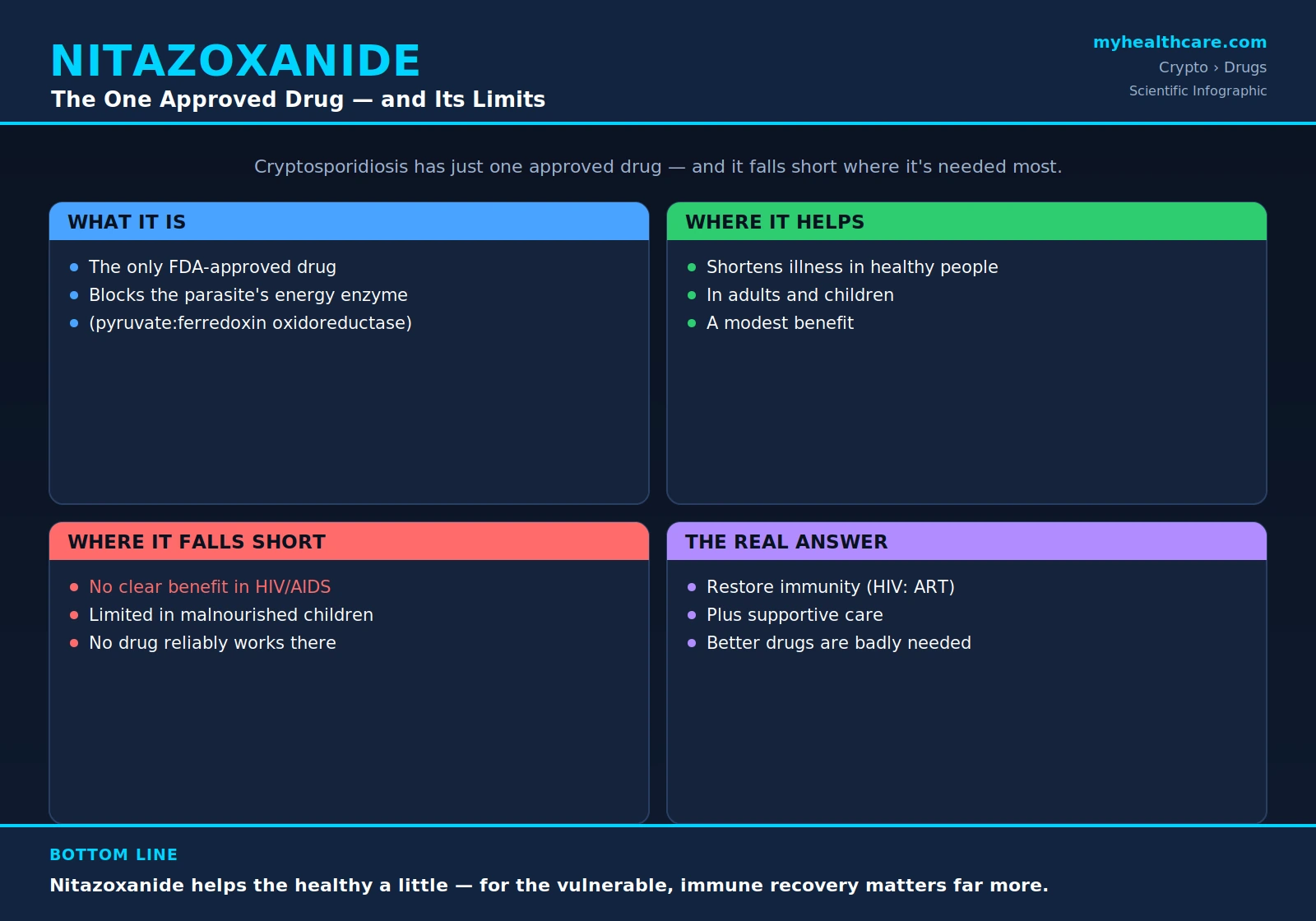
If you have been diagnosed with cryptosporidiosis — the watery diarrhea caused by the tiny parasite Cryptosporidium — one of the first questions is naturally: is there a pill that kills it? The honest answer is layered. There is one medicine, nitazoxanide, that the U.S. Food and Drug Administration (FDA) has approved specifically for this infection, and in otherwise-healthy people it does help — modestly shortening the diarrhea and helping the body clear the parasite faster. But for the people who suffer the most from Cryptosporidium — those with weakened immune systems, such as people with advanced HIV/AIDS, and severely malnourished children — the medicine has been a profound disappointment. Carefully done clinical trials show that without the immune system also recovering, nitazoxanide does not reliably work. This page lays out what the drug is, how it is thought to act, what the evidence actually shows in different groups of people, the other drugs that have been tried, and the single most important principle for someone with HIV: that rebuilding the immune system is the real cure. Everything below describes treatment as reported in the medical literature; actual treatment is clinician-directed, and any doses given are typical reported ranges, not a prescription.
Table of Contents
- The One Approved Drug
- How Nitazoxanide Is Thought to Work
- The Evidence in Otherwise-Healthy People
- The Disappointing Reality in the Immunocompromised
- Limited Benefit in Severely Malnourished Children
- Typical Dosing and Course
- Other Agents That Have Been Tried
- The Central Principle: Immune Recovery
- The Unmet Need and Current Research
- Key Research Papers
- Featured Videos
1. The One Approved Drug
For all the research effort poured into Cryptosporidium, the pharmacy shelf is remarkably bare. Nitazoxanide is the only drug the FDA has approved to treat cryptosporidiosis, and it carries that approval only for people with healthy immune systems. It belongs to a class of compounds called the thiazolides and was originally developed as a broad anti-parasite and anti-worm agent before being studied closely against Cryptosporidium. Sold under the brand name Alinia and also available as a generic, it comes as tablets and as a flavored oral suspension for children.
It is worth pausing on how unusual this situation is. Most common infections have several treatment options; cryptosporidiosis has essentially one approved drug, and even that one has clear limits. That scarcity is the backdrop for everything on this page. When you read that a treatment “does not reliably work” in a particular group, it is not because doctors are ignoring better alternatives — it is because, for this parasite, the alternatives are few and the evidence behind them is thin.
Two practical facts follow from this. First, in a healthy person nitazoxanide is a reasonable, evidence-backed choice that can speed recovery. Second, in a person whose immune system is not working, the conversation has to shift away from “which pill kills the parasite” and toward restoring immunity and keeping the body safe with fluids and nutrition — the themes of the Supportive Care and Rehydration page.
2. How Nitazoxanide Is Thought to Work
To understand both why nitazoxanide helps and why it has limits, it helps to know how it is believed to attack the parasite. Cryptosporidium, like several other gut parasites, relies on an unusual way of making energy that does not depend on oxygen — an anaerobic form of metabolism. A key step in that energy pathway uses an enzyme with a long name: pyruvate:ferredoxin oxidoreductase (often abbreviated PFOR). You can think of this enzyme as a spark plug in the parasite's energy engine. Nitazoxanide is thought to jam that spark plug — by interfering with PFOR-dependent electron transfer, it disrupts the anaerobic energy metabolism the organism depends on.
Because human cells do not use this particular enzyme in the same way, the drug can hit the parasite's machinery while largely sparing our own cells — which is part of why it is generally well tolerated. The same PFOR-targeting mechanism explains why nitazoxanide also works against other organisms that share this anaerobic chemistry, such as the parasites Giardia and Entamoeba and certain anaerobic bacteria. It is, in effect, a broad-spectrum anti-anaerobe.
But a mechanism that makes biological sense does not guarantee a cure in every patient. Slowing the parasite's energy production may buy the body time and reduce the parasite load, yet Cryptosporidium is notoriously hard to eliminate completely from the gut. As the sections below show, knocking back the parasite is often not enough on its own — the host's own immune defenses usually have to finish the job. That single fact is the thread connecting the encouraging results in healthy people with the discouraging ones in the immunocompromised.
3. The Evidence in Otherwise-Healthy People
In people with normal immune systems, cryptosporidiosis is usually a self-limiting illness — meaning the body clears it on its own within a week or two. The question studied in clinical trials was whether nitazoxanide could make that recovery faster and more complete. The answer is a qualified yes: in immunocompetent (immune-healthy) adults and children, nitazoxanide modestly shortens the duration of diarrhea and increases the likelihood that the parasite is cleared from the stool sooner than it would be with no treatment.
A landmark piece of evidence comes from a randomized controlled trial in Zambian children. In children who were not infected with HIV, a three-day course of nitazoxanide significantly improved outcomes compared with placebo — more children had their diarrhea resolve and more cleared the parasite from their stool (Amadi and colleagues, The Lancet, 2002). Separate placebo-controlled studies in immune-healthy adults and children with cryptosporidial diarrhea pointed the same direction, showing faster resolution of symptoms and improved parasite clearance with the drug (for example, Rossignol and colleagues, Journal of Infectious Diseases, 2001).
The honest framing matters here. The benefit in healthy people is real but modest: nitazoxanide tends to shorten an illness that was already going to get better, and helps the immune system mop up the parasite a little sooner. It is not a dramatic, life-or-death intervention in this group — because in this group the illness itself is usually not life-threatening. The drug's value is in reducing days of misery and shortening how long someone may be shedding the parasite and potentially infectious to others.
4. The Disappointing Reality in the Immunocompromised
This is the most important section on the page, and the one where honesty is essential. In people whose immune systems are weakened — most importantly those with advanced HIV/AIDS — cryptosporidiosis can be severe, prolonged, and even life-threatening. These are precisely the patients who most need an effective drug. And it is precisely here that nitazoxanide has fallen short.
The clearest evidence comes from a trial designed to give the drug its best chance. In HIV-infected Zambian children, researchers tested a high-dose, prolonged course of nitazoxanide — more drug, for longer, than the standard regimen — against placebo. The result was sobering: the extended high-dose treatment was not effective for cryptosporidiosis in these HIV-positive children (Amadi and colleagues, BMC Infectious Diseases, 2009). Pushing the dose higher and the course longer did not overcome the central problem — the missing immune response.
This single trial is not an outlier. Systematic reviews reach the same conclusion: no antiparasitic drug, including nitazoxanide, is reliably effective for cryptosporidiosis in immunocompromised patients who do not have immune recovery. A Cochrane systematic review of prevention and treatment of cryptosporidiosis in immunocompromised patients found no convincing evidence that nitazoxanide — or any other tested antiparasitic — produces a reliable cure in this group (Abubakar and colleagues, Cochrane Database of Systematic Reviews, 2007). Broader expert reviews of the field echo this: the drugs simply do not work dependably when the immune system cannot help (Checkley and colleagues, The Lancet Infectious Diseases, 2015).
It is worth being plain about why. The evidence from the immune-healthy suggests nitazoxanide works largely by partnering with a functioning immune system — it knocks the parasite back, and the body's defenses finish it off. Remove that immune partner, and the drug is left to do alone a job it was never able to complete by itself. This is the biological reason behind the clinical disappointment, and it is the reason the strategy for these patients must center on restoring immunity rather than on the antiparasitic pill (see the Cryptosporidiosis in the Immunocompromised page).
5. Limited Benefit in Severely Malnourished Children
There is a second vulnerable group where the limits of the drug appear: severely malnourished children, even those without HIV. Malnutrition itself weakens the immune system, and in the most undernourished children the benefit of nitazoxanide is reduced and less consistent than in well-nourished, immune-healthy children.
This pattern was visible within the very same body of research that showed the drug helping HIV-negative children: the children who were most depleted and immune-compromised by malnutrition responded less well. The lesson generalizes the theme of this page — the more the host's own defenses are impaired, whether by HIV or by severe undernutrition, the less a parasite-slowing drug can accomplish on its own. For these children, addressing the malnutrition and supporting the gut and immune system is as much a part of “treatment” as any antiparasitic, a point developed on the Cryptosporidiosis in Children and Malnutrition page.
6. Typical Dosing and Course
The following are typical reported dosing ranges from the medical literature, given here for understanding only — they are not a prescription, and real treatment must be directed by a clinician who knows the individual patient, their age, weight, kidney and liver function, other medicines, and immune status.
For immune-healthy people, the standard reported course of nitazoxanide for cryptosporidiosis is short — commonly three days. Reported adult dosing is typically in the range of 500 mg taken twice a day with food for three days. For children, the dose is lower and weight- or age-based, given as the flavored oral suspension — for example, smaller twice-daily doses for younger children and larger ones for older children, again over three days. Taking the drug with food is generally advised because it improves how well the body absorbs it.
Because the standard short course works by assisting a functioning immune system, simply lengthening or increasing it does not rescue patients who lack immune recovery — as the high-dose, prolonged HIV trial discussed above demonstrated. In immunocompromised patients, decisions about whether to use nitazoxanide at all, at what dose, and for how long are individualized and made by specialists, often as one part of a broader plan dominated by immune restoration and supportive care rather than by the antiparasitic itself. Nitazoxanide is generally well tolerated; the side effects most often reported are mild and gastrointestinal, such as stomach upset, and a harmless temporary yellow-green tint to the urine can occur.
7. Other Agents That Have Been Tried
Because nitazoxanide has such clear limits in the patients who need help most, doctors and researchers have tried a number of other drugs and approaches over the years. The honest summary is that the evidence for all of them is limited, inconsistent, or disappointing, which is exactly why nitazoxanide remains the only approved option.
- Paromomycin — an antibiotic of the aminoglycoside class that is poorly absorbed and stays largely in the gut, which in theory suits an intestinal parasite. Some early reports suggested partial, transient benefit, but a rigorous placebo-controlled trial in patients with advanced HIV found that paromomycin was no more effective than placebo for cryptosporidiosis (Hewitt and colleagues, Clinical Infectious Diseases, 2000). At best it has been considered a marginal, inconsistent option.
- Azithromycin — a macrolide antibiotic, sometimes tried alone or in combination, particularly in immunocompromised patients. The evidence is weak and inconsistent, and it is not an established cure.
- Combinations — for example, paromomycin paired with azithromycin, or nitazoxanide combined with other agents, have been explored in small or uncontrolled studies in the hope that two partial agents might together do better. The supporting evidence remains limited and unconvincing.
- Hyperimmune bovine colostrum — a historical approach in which the “first milk” from cows immunized against Cryptosporidium, rich in anti-parasite antibodies, was given by mouth to supply passive immunity directly to the gut. Reports were mixed, the product was difficult to standardize, and it never became an established, widely used therapy; it is mainly of historical and research interest.
None of these displaced nitazoxanide, and none solved the core problem: in a patient without immune recovery, parasite-directed therapy alone has repeatedly proven insufficient. Reviews of the treatment landscape consistently arrive at this same gap (Smith & Corcoran, Current Opinion in Infectious Diseases, 2004; Rossignol, Experimental Parasitology, 2010).
8. The Central Principle: Immune Recovery
If there is one idea to carry away from this page, it is this: for a person with HIV, the most effective “treatment” for cryptosporidiosis is restoring the immune system itself. The single most powerful intervention is antiretroviral therapy (ART) — the combination of medicines that suppresses HIV and allows the immune system, in particular the CD4 T-cells, to recover.
This is not a hopeful slogan; it is one of the most striking lessons of the HIV era. When effective ART rebuilds a patient's CD4 count, cryptosporidiosis that had been chronic, debilitating, and resistant to every antiparasitic drug often resolves — not because a parasite-killing pill finally worked, but because the body's own restored defenses clear the infection. In other words, the cure for the immunocompromised patient frequently comes not from attacking the parasite directly but from repairing the host. This is why specialists managing cryptosporidiosis in someone with HIV focus first and foremost on getting them onto effective ART, and why the details of that situation are covered on the Cryptosporidiosis in the Immunocompromised page.
While immune recovery is being achieved, the patient still has to be kept safe and as comfortable as possible. That means supportive care — aggressive replacement of the fluids and salts lost to watery diarrhea, attention to nutrition, and management of symptoms — which can be lifesaving in its own right and is described on the Supportive Care and Rehydration page. Antiretroviral therapy and supportive care together form the real backbone of treatment for this group; the antiparasitic drug, where used at all, is a secondary player.
9. The Unmet Need and Current Research
The picture painted above — one approved drug, that one drug failing the sickest patients, and a thin bench of alternatives — defines what scientists call an unmet medical need. Cryptosporidiosis is a major cause of diarrheal disease and contributes to death and stunted growth among young children in low-resource settings, and it remains a serious threat to people with weakened immunity. Yet the world still lacks a drug that reliably cures it in those who suffer most.
That gap is actively driving research. Investigators are working to understand the parasite's unusual biology in greater depth, to find new molecular targets, to develop and test new candidate compounds that might succeed where nitazoxanide stops short, and to pursue a vaccine that could prevent the infection in the first place. Expert reviews of the global burden and of the diagnostics, therapeutics, and vaccine targets for Cryptosporidium frame this work as a priority precisely because the current options are so limited (Checkley and colleagues, The Lancet Infectious Diseases, 2015; Innes and colleagues, Trends in Parasitology, 2020).
For a patient or family reading this today, the practical takeaway is honest and clear. In a healthy person, nitazoxanide is a reasonable option that can speed recovery from an illness the body would usually beat on its own. In a person whose immune system is impaired, the real fight is to restore that immune system — above all with antiretroviral therapy in HIV — while supportive care protects the body in the meantime. Better drugs and a vaccine are needed, and are being sought; until they arrive, understanding the true strengths and limits of the one approved medicine is itself part of good care. The broader management overview lives on the Treatment & Prevention hub.
Key Research Papers
Randomized controlled trials, systematic reviews, mechanism studies, and expert reviews on the treatment of cryptosporidiosis and the limits of nitazoxanide. Journal names appear as plain text; the year/volume/pages link opens the full citation via DOI.
- Amadi B, Mwiya M, Musuku J, Watuka A, Sianongo S, Ayoub A, Kelly P. Effect of Nitazoxanide on Morbidity and Mortality in Zambian Children with Cryptosporidiosis: A Randomised Controlled Trial. The Lancet. 2002;360(9343):1375–1380.
- Amadi B, Mwiya M, Sianongo S, Payne L, Watuka A, Katubulushi M, Kelly P. High Dose Prolonged Treatment with Nitazoxanide Is Not Effective for Cryptosporidiosis in HIV Positive Zambian Children: A Randomised Controlled Trial. BMC Infectious Diseases. 2009;9:195.
- Abubakar II, Aliyu SH, Arumugam C, Hunter PR, Usman NK. Prevention and Treatment of Cryptosporidiosis in Immunocompromised Patients. Cochrane Database of Systematic Reviews. 2007;(1):CD004932.
- Checkley W, White AC Jr, Jaganath D, Arrowood MJ, Chalmers RM, et al. A Review of the Global Burden, Novel Diagnostics, Therapeutics, and Vaccine Targets for Cryptosporidium. The Lancet Infectious Diseases. 2015;15(1):85–94.
- Rossignol JF, Ayoub A, Ayers MS. Treatment of Diarrhea Caused by Cryptosporidium parvum: A Prospective Randomized, Double-Blind, Placebo-Controlled Study of Nitazoxanide. The Journal of Infectious Diseases. 2001;184(1):103–106.
- Rossignol JF, Hidalgo H, Feregrino M, Higuera F, Gomez WH, et al. A Double-'Blind' Placebo-Controlled Study of Nitazoxanide in the Treatment of Cryptosporidial Diarrhoea in AIDS Patients in Mexico. Transactions of the Royal Society of Tropical Medicine and Hygiene. 1998;92(6):663–666.
- Hewitt RG, Yiannoutsos CT, Higgs ES, Carey JT, Geiseler PJ, et al. Paromomycin: No More Effective than Placebo for Treatment of Cryptosporidiosis in Patients with Advanced Human Immunodeficiency Virus Infection. Clinical Infectious Diseases. 2000;31(4):1084–1092.
- Fox LM, Saravolatz LD. Nitazoxanide: A New Thiazolide Antiparasitic Agent. Clinical Infectious Diseases. 2005;40(8):1173–1180.
- Hommer V, Eichholz J, Petry F. Effect of Antiretroviral Protease Inhibitors Alone, and in Combination with Paromomycin, on the Excystation, Invasion and In Vitro Development of Cryptosporidium parvum. Journal of Antimicrobial Chemotherapy. 2003;52(3):359–364.
- Smith HV, Corcoran GD. New Drugs and Treatment for Cryptosporidiosis. Current Opinion in Infectious Diseases. 2004;17(6):557–564.
- Rossignol JF. Cryptosporidium and Giardia: Treatment Options and Prospects for New Drugs. Experimental Parasitology. 2010;124(1):45–53.
- Innes EA, Chalmers RM, Wells B, Pawlowic MC. A One Health Approach to Tackle Cryptosporidiosis. Trends in Parasitology. 2020;36(3):290–303.
- Amadi B, Kelly P, Mwiya M, Mulwazi E, Sianongo S, et al. Intestinal and Systemic Infection, HIV, and Mortality in Zambian Children with Persistent Diarrhea and Malnutrition. Journal of Pediatric Gastroenterology and Nutrition. 2001;32(5):550–554.
Live PubMed Searches
Each link opens a live PubMed query so results stay current as new papers are indexed.
- Nitazoxanide cryptosporidiosis treatment
- Nitazoxanide in HIV / immunocompromised
- Cryptosporidiosis randomized trials in children
- Nitazoxanide mechanism (PFOR)
- Paromomycin for cryptosporidiosis
- Hyperimmune bovine colostrum
- ART and immune reconstitution
- Cryptosporidium drug and vaccine development
Connections
- All Parasites
- Symptoms & Diagnosis
- Watery Diarrhea & Dehydration
- Cryptosporidiosis in the Immunocompromised
- Cryptosporidiosis in Children & Malnutrition
- Treatment & Prevention
- Supportive Care & Rehydration
- Prevention: Water & Outbreaks
- Cryptosporidium Overview
- Gastroenterology
- Infectious Disease
- All Conditions