Ascariasis Treatment and Prevention
Anthelmintic Treatment: Albendazole & Mebendazole
The safe, inexpensive deworming drugs — often a single dose — and surgery for complications.
Read the deep dive →Prevention: Sanitation & Hygiene
Toilets, handwashing, washing produce, and keeping human waste out of the soil.
Read the deep dive →Mass Deworming Programs
WHO preventive chemotherapy for schoolchildren — what it achieves and the reinfection problem.
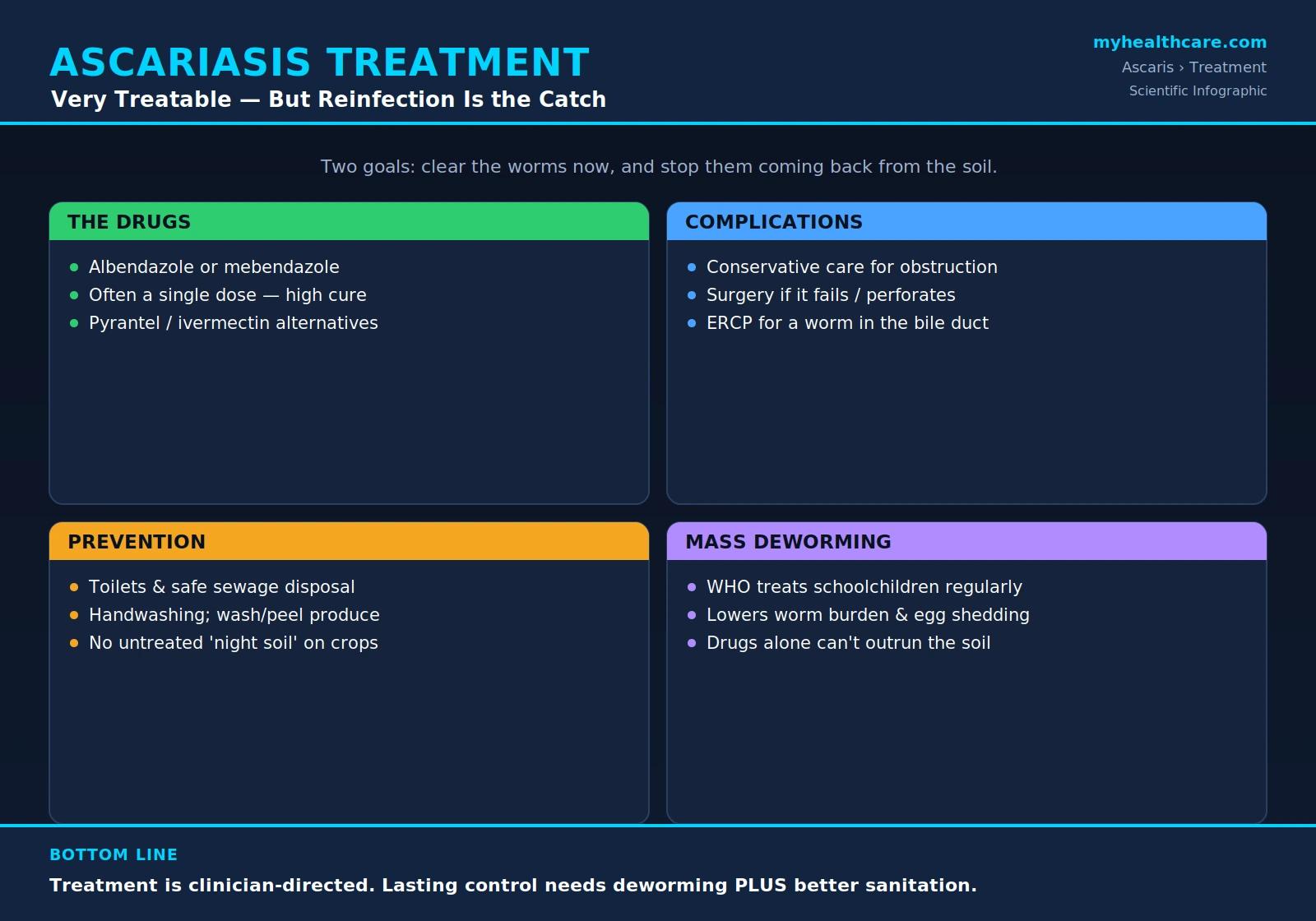
Read the deep dive →Here is the good news first: ascariasis is very treatable. The roundworm Ascaris lumbricoides — the large intestinal worm that infects hundreds of millions of people, mostly children in places where sanitation is limited — responds to safe, cheap, widely available deworming pills, usually in a single dose. For the great majority of people, a short course of treatment clears the worms with very few side effects. The harder problem is not killing the worms once; it is keeping them from coming straight back. Because the parasite's eggs survive in soil contaminated by human waste, a person who is cured today can swallow new eggs tomorrow and be reinfected within months. That is why effective control of ascariasis has two goals that must work together: clear the worms with medication, and break the cycle of reinfection with better sanitation, hygiene, and — where the disease is common — community-wide deworming programs. This page is an overview of the whole strategy; each part links to a detailed page of its own.
This page summarizes treatment and prevention as reported in the medical and public-health literature. Actual treatment — including drug choice, dose, and timing in pregnancy, in young children, or when complications are present — is clinician-directed.
Table of Contents
- Two Goals: Clear the Worms, Prevent Reinfection
- The Deworming Drugs (Overview)
- Managing the Serious Complications
- Prevention: Sanitation & Hygiene (Overview)
- Mass Deworming Programs (Overview)
- The Reinfection Problem
- Safety in Pregnancy and Young Children
- The Combined WHO Strategy: Deworming + WASH
- Key Research Papers
- Featured Videos
1. Two Goals: Clear the Worms, Prevent Reinfection
It helps to hold two separate ideas in mind, because confusing them is the single biggest reason ascariasis keeps coming back in a community.
Goal one is to clear the worms already inside a person. This is the medical, individual side of the problem, and it is the easy part. A few pills of a deworming drug paralyze or kill the adult roundworms living in the small intestine; the dead and dying worms then pass out in the stool over the following days. Cure rates for Ascaris with the standard drugs are high — commonly in the 90–99% range — and the treatment is inexpensive and well tolerated.
Goal two is to stop the person from swallowing new eggs. This is the public-health, environmental side, and it is the hard part. Ascaris spreads when eggs from an infected person's stool reach the soil — through open defecation, untreated waste, or the use of human waste (“night soil”) as fertilizer — and then return to a person's mouth on unwashed hands, on raw produce grown in that soil, or in contaminated water. The eggs are remarkably tough and can stay infectious in soil for years. So if the soil around a household stays contaminated, deworming alone is like bailing out a boat without patching the hole: it works for a while, then the water comes back.
The rest of this page walks through both goals — the drugs that achieve the first, and the sanitation, hygiene, and program-level measures that achieve the second — and explains why lasting control needs both.
2. The Deworming Drugs (Overview)
The drugs used against Ascaris are called anthelmintics (literally, “against worms”). They are among the safest and most cost-effective medicines in all of medicine — a single treatment often costs only pennies. Two drugs are the mainstays, with two more as alternatives.
- Albendazole — usually given as a single 400 mg dose for ascariasis. It is the most commonly used drug worldwide and is highly effective against the roundworm.
- Mebendazole — given either as a single 500 mg dose or as 100 mg twice daily for three days. Like albendazole, it belongs to the benzimidazole family and works extremely well against Ascaris.
- Pyrantel pamoate — an older alternative, dosed by body weight, that paralyzes the worm so it is passed alive. It is often used when a benzimidazole is to be avoided.
- Ivermectin — effective against Ascaris and useful in some situations, including when a person has more than one kind of worm; it is sometimes combined with albendazole.
How do the benzimidazoles work? They bind to a protein inside the worm called β-tubulin, the building block of the worm's internal “scaffolding” (its microtubules). By jamming this scaffolding, the drug starves the worm of the ability to take up glucose and maintain its cells, and the worm dies. Because human tubulin has a slightly different shape, the drug hits the worm far harder than it hits us — which is why these medicines are so safe.
One nuance worth knowing: a single dose reliably cures Ascaris, but the same single dose is less effective against some other soil-transmitted worms (notably hookworm and whipworm), which may need a longer course or a different drug. This matters because these worms often travel together, so a clinician treating one person — or a program treating a whole school — thinks about the whole mix, not just Ascaris. For the full picture of how each drug is dosed, how well it works, what the side effects are, and how scientists watch for emerging drug resistance, see the dedicated page on Anthelmintic Treatment: Albendazole and Mebendazole.
3. Managing the Serious Complications
Most ascariasis is mild, and many infections cause no symptoms at all. But because the worms are large — an adult female can be the length of a pencil — a heavy worm burden can occasionally cause a true medical emergency. The most important of these is intestinal obstruction, when a tangled mass of worms blocks the bowel, and biliary or pancreatic complications, when a worm migrates into the bile duct or pancreatic duct. These are most common in young children with many worms.
The general principle of management is conservative care first, surgery if needed. For an early or partial obstruction, doctors often start with non-surgical measures — resting the bowel (no food by mouth), giving fluids through a vein, and decompressing the stomach with a tube — and then giving a deworming drug once the situation is stable, so the worms relax and pass. Many obstructions settle this way. Surgery is reserved for cases that do not improve, or where there are danger signs such as a perforation (a hole in the bowel) or dead bowel tissue. When a worm lodges in the bile duct, a procedure called ERCP (endoscopic retrograde cholangiopancreatography) can sometimes be used to remove it without open surgery.
This page only sketches the complications, because they are covered in depth — including the warning signs, how doctors decide between waiting and operating, and what recovery looks like — on the dedicated page: Intestinal Obstruction and Biliary Complications. The key takeaway is reassuring: these emergencies are uncommon, they are treatable, and they become far rarer wherever deworming and sanitation keep worm burdens low.
4. Prevention: Sanitation & Hygiene (Overview)
If treatment is the cure, prevention is the protection — and for ascariasis, prevention ultimately means keeping human waste out of the environment and the environment out of people's mouths. The chain of transmission can be broken at several points, and the most important preventive measures are simple and well established:
- Sanitation — building and using proper toilets and latrines so that human feces (and the eggs they may contain) are safely contained instead of ending up in fields, yards, and water. This is the foundation; without it, the soil reservoir is constantly refilled.
- Handwashing — washing hands with soap after using the toilet and before preparing or eating food removes eggs picked up from contaminated soil or surfaces before they can be swallowed.
- Washing and cooking produce — thoroughly washing (and where appropriate, cooking) fruits and vegetables, especially those grown close to the ground or fertilized with untreated waste, removes eggs that cling to the surface.
- Safe water and food handling — using clean water and avoiding fertilizing food crops with untreated human waste cut off two more routes by which eggs reach people.
These measures are collectively known in public health as WASH — Water, Sanitation, and Hygiene. They are the only part of the strategy that addresses the root cause: the contaminated soil. The full detail — including how the eggs survive, which behaviors matter most, and the evidence that sanitation lowers infection — is on the dedicated page: Prevention: Sanitation and Hygiene.
5. Mass Deworming Programs (Overview)
In communities where ascariasis and other soil-transmitted worms are common, treating people one at a time as they fall ill is too slow and misses the many who have no symptoms. Instead, the World Health Organization recommends preventive chemotherapy — periodically giving a deworming drug to whole groups at risk, without testing each person first.
The logic is practical: the drugs are so safe and so cheap that it is more efficient to treat everyone in a high-risk group than to test each child and treat only the positives. The main target groups are school-age children (who tend to carry the heaviest worm burdens and contaminate the environment most), along with preschool children and women of reproductive age. Treatment is usually delivered once or twice a year, often right in schools, where it can reach large numbers of children cheaply and reliably.
These programs have measurably reduced worm burdens and the harm worms cause to children's growth and nutrition across many countries. But they have an important limit, which the next section explains: deworming clears today's worms but does not stop tomorrow's eggs. The full account — how the programs are run, what they achieve, the debate over how broadly to treat, and why reinfection keeps them from being a final cure on their own — is on the dedicated page: Mass Deworming Programs.
6. The Reinfection Problem
This is the central challenge of ascariasis control, and it is worth stating plainly: treatment without sanitation is temporary.
The reason lies in the parasite's eggs. When an infected person passes Ascaris eggs in their stool and that stool reaches the soil, the eggs do not die quickly. Protected by a tough shell, they can remain infectious in the soil for years, surviving cold, drought, and ordinary disinfectants. This persistent soil reservoir is what makes reinfection so relentless. A child can be perfectly dewormed in the morning and, by playing in contaminated soil and putting hands to mouth that afternoon, begin reacquiring the very worms that were just cleared.
Studies that follow communities after deworming show exactly this: worm infection rebounds within months, and within a year or so prevalence can return close to where it started if nothing else has changed. Deworming lowers the worm burden temporarily — which is genuinely valuable for a growing child — but it does not drain the reservoir. Only sanitation does that, by stopping fresh eggs from ever reaching the soil. The honest conclusion supported by the evidence is that deworming and sanitation are partners, not substitutes: drugs handle the worms inside people; sanitation handles the eggs in the environment; and durable control needs both at once.
7. Safety in Pregnancy and Young Children
Two groups deserve special mention because they are common, vulnerable, and the subject of frequent questions: pregnant women and young children.
Young children. Children are the heart of the ascariasis problem — they carry the most worms, suffer the most harm to growth and nutrition, and spread the most eggs. Deworming drugs are considered safe and are widely used in children, and the WHO recommends treating preschool and school-age children in endemic areas. Doses and formulations (for example, crushable or chewable tablets) are adjusted for small children, and there are practical age and weight thresholds that guide treatment in the very youngest. Treating children not only protects them but, because they shed so many eggs, helps protect the whole community.
Pregnancy. Worm infection in pregnancy matters because it can worsen anemia and nutrition at a time when both are critical. Because of this, the WHO supports deworming of pregnant women in endemic areas as part of routine antenatal care, generally after the first trimester. The first trimester is usually avoided as a precaution during the period of early organ development; from the second trimester onward, the benefits of clearing the worms (better maternal nutrition, less anemia) are considered to outweigh the risks with the standard drugs. The specifics — which drug, what dose, and the exact timing — are decided by the woman's clinician, and recommendations can differ between national programs and individual clinical care. The detailed drug-by-drug safety discussion lives on the Anthelmintic Treatment page.
8. The Combined WHO Strategy: Deworming + WASH
Everything on this page comes together in a single, deliberately combined strategy. After decades of experience, the global consensus — reflected in WHO policy — is that controlling and ultimately eliminating soil-transmitted worms like Ascaris requires two pillars working in parallel:
- Preventive chemotherapy (deworming) — regular, mass treatment of school-age children and other at-risk groups to keep worm burdens low and protect health now. This pillar buys immediate benefit, especially for children's growth, nutrition, and schooling.
- WASH — Water, Sanitation, and Hygiene — toilets, clean water, handwashing, and safe food and waste handling to cut transmission at its source and drain the soil reservoir over time. This pillar makes the gains last and is the only route to true elimination.
Deworming is the fast-acting medicine; WASH is the slow-acting cure. Programs that rely on drugs alone see worm levels rebound; communities that improve sanitation see infection fall and stay low. Used together, they reinforce each other — deworming protects this generation of children while sanitation infrastructure catches up, and improving sanitation steadily reduces how often, and how much, deworming is even needed. Health authorities have set goals to eliminate soil-transmitted helminths as a public-health problem, and the path to that goal runs through both pillars at once.
For an individual person, the message is simpler still: if you have ascariasis, it is very treatable — see a clinician, take the deworming course, and then protect yourself from getting it again with good hygiene and clean food and water. For the related topics, follow the links throughout this page, and see the Ascaris Overview for the parasite's biology and life cycle.
Key Research Papers
Peer-reviewed efficacy trials, meta-analyses, and public-health reviews on treating Ascaris lumbricoides and controlling soil-transmitted helminths through deworming and sanitation. Journal names appear as plain text; the year/volume/pages link opens the full citation via DOI.
- Keiser J, Utzinger J. Efficacy of Current Drugs Against Soil-Transmitted Helminth Infections: Systematic Review and Meta-analysis. JAMA. 2008;299(16):1937–1948. — doi:10.1001/jama.299.16.1937
- Moser W, Schindler C, Keiser J. Efficacy of recommended drugs against soil transmitted helminths: systematic review and network meta-analysis. BMJ. 2017;358:j4307. — doi:10.1136/bmj.j4307
- Bethony J, Brooker S, Albonico M, et al. Soil-transmitted helminth infections: ascariasis, trichuriasis, and hookworm. The Lancet. 2006;367(9521):1521–1532. — doi:10.1016/S0140-6736(06)68653-4
- Jourdan PM, Lamberton PHL, Fenwick A, Addiss DG. Soil-transmitted helminth infections. The Lancet. 2018;391(10117):252–265. — doi:10.1016/S0140-6736(17)31930-X
- Hotez PJ, Bottazzi ME, Franco-Paredes C, Ault SK, Periago MR. Control of Neglected Tropical Diseases. New England Journal of Medicine. 2007;357(10):1018–1027. — doi:10.1056/NEJMra064142
- Jia TW, Melville S, Utzinger J, King CH, Zhou XN. Soil-Transmitted Helminth Reinfection after Drug Treatment: A Systematic Review and Meta-Analysis. PLoS Neglected Tropical Diseases. 2012;6(5):e1621. — doi:10.1371/journal.pntd.0001621
- Strunz EC, Addiss DG, Stocks ME, Ogden S, Utzinger J, Freeman MC. Water, Sanitation, Hygiene, and Soil-Transmitted Helminth Infection: A Systematic Review and Meta-Analysis. PLoS Medicine. 2014;11(3):e1001620. — doi:10.1371/journal.pmed.1001620
- Taylor-Robinson DC, Maayan N, Soares-Weiser K, Donegan S, Garner P. Deworming drugs for soil-transmitted intestinal worms in children: effects on nutritional indicators, haemoglobin, and school performance. Cochrane Database of Systematic Reviews. 2015;(7):CD000371. — doi:10.1002/14651858.CD000371.pub6
- Albonico M, Allen H, Chitsulo L, Engels D, Gabrielli AF, Savioli L. Controlling Soil-Transmitted Helminthiasis in Pre-School-Age Children through Preventive Chemotherapy. PLoS Neglected Tropical Diseases. 2008;2(3):e126. — doi:10.1371/journal.pntd.0000126
- Anderson R, Truscott J, Hollingsworth TD. Should the Goal for the Treatment of Soil Transmitted Helminth (STH) Infections Be Changed from Morbidity Control in Children to Community-Wide Transmission Elimination? PLoS Neglected Tropical Diseases. 2015;9(8):e0003897. — doi:10.1371/journal.pntd.0003897
- Speich B, Croll D, Fürst T, Utzinger J, Keiser J. Effect of sanitation and water treatment on intestinal protozoa infection: a systematic review and meta-analysis. The Lancet Infectious Diseases. 2016;16(1):87–99. — doi:10.1016/S1473-3099(15)00349-7
- Diawara A, Halpenny CM, Churcher TS, et al. Association between Response to Albendazole Treatment and β-Tubulin Genotype Frequencies in Soil-transmitted Helminths. PLoS Neglected Tropical Diseases. 2013;7(5):e2247. — doi:10.1371/journal.pntd.0002247
PubMed Topic Searches
Each link opens a live PubMed query so results stay current as new papers are indexed.
- PubMed: Ascariasis treatment with albendazole
- PubMed: Ascaris lumbricoides mebendazole efficacy
- PubMed: Soil-transmitted helminth preventive chemotherapy
- PubMed: STH reinfection after treatment
- PubMed: WASH and sanitation for soil-transmitted helminths
- PubMed: Mass deworming in schoolchildren
- PubMed: Deworming in pregnancy and anemia
- PubMed: Ascaris intestinal obstruction management
Connections
- All Parasites
- Ascariasis Symptoms & Diagnosis
- Lung Phase (Löffler's Syndrome)
- Intestinal Obstruction & Biliary Complications
- Malnutrition & Childhood Growth
- Anthelmintic Treatment: Albendazole & Mebendazole
- Prevention: Sanitation & Hygiene
- Mass Deworming Programs
- Ascaris Overview
- Gastroenterology
- Infectious Disease
- All Conditions