Ascariasis, Malnutrition, and Childhood Growth
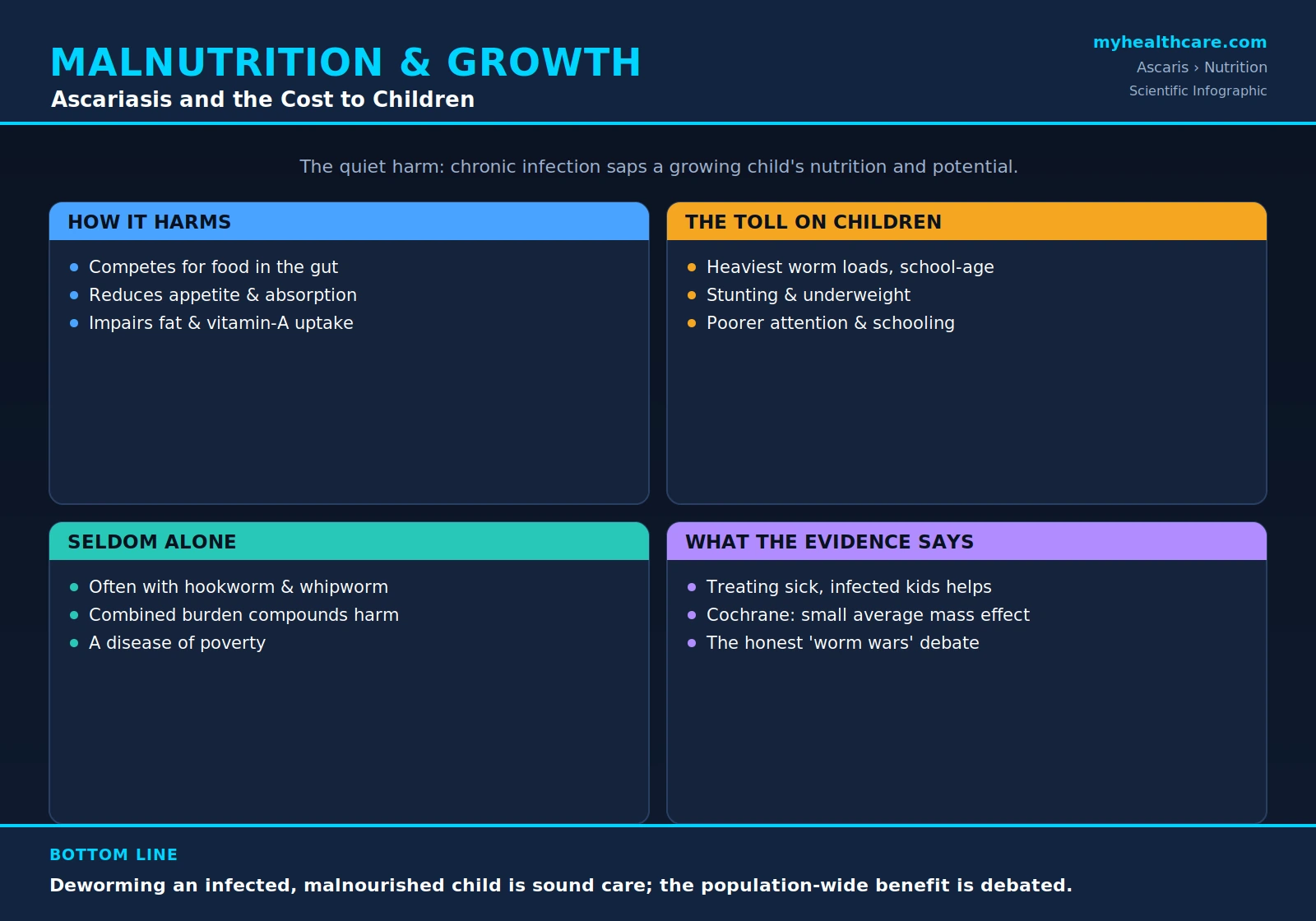
Most of the harm done by the giant roundworm Ascaris lumbricoides is not dramatic. It is quiet. A child with a modest load of worms rarely doubles over in pain or ends up in hospital; far more often, the worms simply sit in the small intestine, year after year, taking a small daily toll on a growing body. That toll — a little less food absorbed, a little less appetite, a slightly smaller frame, a slightly harder time concentrating at school — is easy to miss in any single child. But across the hundreds of millions of children who carry these worms, mostly in the poorest communities on earth, it adds up to one of the great hidden drags on childhood growth and development. This page explains, in plain language, how the worms harm a child's nutrition, why children bear the heaviest burden, and what the science actually shows about helping them. It also tackles a genuine scientific controversy — the “worm wars” debate over whether mass community-wide deworming meaningfully improves growth — honestly and even-handedly, without overstating what deworming has been proven to do.
Table of Contents
- How the Worms Harm Nutrition
- Why the Burden Falls on Children
- Growth Faltering: Stunting and Underweight
- Cognition, School, and Learning
- Vitamin A and Micronutrients
- Polyparasitism: Worms Rarely Travel Alone
- What Deworming Trials Actually Show
- The “Worm Wars”: Why the Evidence Is Debated
- Reversibility, Treatment, and Good Nutrition
- The Poverty and Equity Picture
- Key Research Papers
- Featured Videos
1. How the Worms Harm Nutrition
To understand the nutritional harm of ascariasis, picture where the worms live and what they do. Adult Ascaris are large — a grown female can reach 20–35 cm, roughly the length of a pencil — and they live coiled in the small intestine, exactly the stretch of gut where a child digests and absorbs most of the food they eat. A worm there is not a passive lodger; it competes with its host for nutrition and disrupts the machinery of digestion in several overlapping ways.
Competition for food in the gut. The worms feed on the semi-digested contents of the intestine — the very nutrients the child needs. A small number of worms takes only a tiny share, but a heavy load (a child can harbor dozens, occasionally well over a hundred) consumes a meaningful portion of a meal before the child's own body can absorb it. In effect, the child is feeding the worms as well as themselves.
Reduced appetite. One of the more important and underappreciated effects is on appetite. Children with heavier worm burdens often eat less. This is partly the low-grade, chronic inflammation that any persistent infection produces — the body's immune response releases signaling molecules that blunt hunger — and partly the vague abdominal discomfort and fullness that a belly full of worms can cause. A child who eats less takes in fewer calories and less protein from the start, compounding everything else. Trials in which children were dewormed have specifically measured improvements in appetite afterward, underlining how real this effect is.
Impaired digestion and absorption. The worms and the inflammation they provoke can damage and disturb the lining of the small intestine, where nutrients cross from the gut into the bloodstream. The result is malabsorption: even the food a child does eat is not fully taken up. Studies have documented reduced absorption of nitrogen (protein), fat, and carbohydrate in heavily infected children, and a partial recovery of that absorption after the worms are cleared.
Impaired fat and vitamin A absorption. Fat absorption is especially vulnerable, and this matters for more than just calories. The fat-soluble vitamins — A, D, E, and K — ride along with dietary fat to be absorbed. When fat absorption is impaired, the uptake of these vitamins suffers too. The clearest example is vitamin A: heavy ascariasis has been shown to reduce the absorption of vitamin A from food, which is a serious problem in exactly the regions where vitamin A deficiency already threatens children's eyesight and immune defenses (see the vitamin A section below).
Transient lactose intolerance. Heavy worm infection can also temporarily damage the brush-border enzymes of the small intestine, including lactase, the enzyme that digests the sugar in milk. The result can be a passing (transient) lactose intolerance: milk, which is often a key source of protein and calories for a young child, suddenly causes bloating and loose stools and may be avoided. Because this is driven by the infection, it tends to improve once the worms are treated and the gut lining recovers.
No single one of these effects is necessarily catastrophic on its own. The harm comes from the way they stack: a child eats a bit less, absorbs less of what they eat, loses some fat and vitamins, and may turn away from milk — all at once, all chronically, during the years when their body is supposed to be building bone, muscle, and brain.
2. Why the Burden Falls on Children
Ascariasis is found across all ages in endemic communities, but its weight does not fall evenly. Children — especially pre-school and school-age children — carry the heaviest worm burdens, and they are also the ones with the most to lose, because they are still growing.
A central, well-documented feature of Ascaris epidemiology is that the worms are not spread evenly across a population. Most infected people carry only a few worms, while a relatively small fraction of individuals harbor the great majority of all the worms in a community — a pattern epidemiologists call “overdispersion.” And those heavily-infected individuals are disproportionately children. School-age children typically show the highest intensity of infection (the most worms per child), with infection intensity rising through early childhood, peaking in the school years, and then declining in adults.
Several things drive this. Young children play in and put their hands in contaminated soil, and the infective Ascaris eggs persist in the environment for months to years, so exposure is heavy and repeated. Children are also re-infected quickly after treatment in a contaminated setting. The reasons the burden concentrates in children are partly behavioral (exposure) and partly immunological (the way partial immunity develops with age), but the practical consequence is clear and consistent across studies: the children who are growing the fastest are the ones carrying the most worms. That overlap — peak growth and peak worm burden in the same young bodies — is precisely why ascariasis is, above all, a threat to childhood growth and development rather than a disease of adults.
3. Growth Faltering: Stunting and Underweight
When a child's nutrition is chronically undermined, the visible result is growth faltering — the child grows more slowly than they should. Doctors track two distinct measures of this, and ascariasis can affect both:
- Stunting means low height-for-age — the child is short for their age. Stunting reflects long-term, chronic undernutrition, the cumulative effect of months or years of not getting enough. It is, in a sense, growth that was lost and not made up. Stunting in early childhood is strongly linked to worse outcomes later in life, and it is largely irreversible if it persists through the first few years.
- Being underweight means low weight-for-age. Weight responds more quickly than height — a child can lose or gain weight over weeks — so weight-for-age reflects a child's more recent nutritional state. Low weight-for-height (wasting/thinness) likewise signals acute, current undernutrition.
Why does the distinction matter here? Because it shapes what we should expect from treating the worms. Clearing a child's worms can plausibly improve weight relatively quickly — restore appetite, recover some absorption, and the child gains weight. Reversing stunting (height) is much harder, because it represents growth that was already missed during a critical window. This is one reason the deworming evidence (discussed below) tends to look more favorable for weight than for height, and why preventing chronic infection in the first place matters so much more than trying to undo its effects after the fact.
It is also important to be honest about attribution. Children with heavy worm burdens are usually poor, often eat a marginal diet, frequently carry other infections, and live in settings with unsafe water and sanitation. All of those factors independently stunt growth. So while ascariasis genuinely contributes to growth faltering, it is one thread in a tangled knot of poverty-related causes — not the sole culprit. Disentangling the worms' specific contribution from everything else around them is one of the things that makes the science genuinely difficult, and it is a theme we return to in the “worm wars” section.
4. Cognition, School, and Learning
The harm of chronic worm infection is not only physical. Nutrition and child development are deeply intertwined, and the same processes that slow a child's body can also blunt their learning.
The proposed pathways are intuitive. A child who is undernourished, mildly anemic, tired, and distracted by abdominal discomfort is not in a good state to concentrate, and may simply have less energy for the daily effort of school. Several effects have been studied or proposed:
- Reduced energy and attention. Chronic infection and undernutrition can leave a child listless and less able to focus, which directly affects learning in the classroom.
- School attendance. Some programs have reported that treating worms improves school attendance — children miss fewer days — though, as with growth, the strength and consistency of this finding is debated and varies between studies and settings.
- Cognitive performance. A few individual trials, particularly in heavily-infected children, have reported gains on tests of memory or cognition after treatment, plausibly through better nutrition and less anemia.
Here, though, balance is especially important, because cognition and school outcomes are where the population-level evidence is weakest and most contested. The large Cochrane systematic reviews of deworming found little or no evidence that routine mass deworming improves cognition or school performance when averaged across whole populations of children, even though particular studies in heavily-infected groups have shown benefits. We should therefore describe the plausible mechanism honestly — a well-nourished, worm-free child is in a better state to learn — while being careful not to claim that mass deworming has been proven to raise test scores across the board. It has not. The honest statement is: treating a sick, heavily-infected child is good for that child; whether deworming an entire population reliably lifts school performance is a separate, much weaker, and disputed claim.
5. Vitamin A and Micronutrients
Beyond calories and protein, ascariasis interferes with the small but vital nutrients a child needs — the micronutrients, especially the fat-soluble vitamins and minerals.
Vitamin A. This is the clearest and most consequential example. Vitamin A is essential for vision (it is the classic deficiency that causes night blindness and, untreated, can lead to permanent blindness in children) and for a working immune system. Because vitamin A is fat-soluble, it depends on healthy fat absorption — exactly what heavy Ascaris infection impairs. Studies have shown that heavily infected children absorb less vitamin A from their food, and that absorption improves after deworming. This is a cruel overlap: ascariasis is heaviest in precisely the impoverished, low-vitamin-A regions where children are already on the edge of deficiency. A child who is barely getting enough vitamin A, and who then absorbs even less of it because of worms, is pushed toward the blindness and weakened immunity that vitamin A deficiency causes.
Other micronutrients. The broader picture of malabsorption means other fat-soluble vitamins (D, E, K) and various minerals can also be affected when infection is heavy and absorption is disturbed. (Hookworm, which so often accompanies Ascaris — see the next section — is the great cause of iron-deficiency anemia among intestinal worms, because hookworms feed on blood; Ascaris itself is more a thief of calories, protein, fat, and vitamin A than a direct cause of blood loss.) The combined effect of polyparasitism on a child's micronutrient status can therefore be considerable, even though no single worm is responsible for all of it.
The takeaway is that ascariasis does not just make a child smaller; by stealing fat-soluble vitamins — vitamin A above all — it can specifically threaten a child's eyesight and immune defenses, in the very places least able to spare them.
6. Polyparasitism: Worms Rarely Travel Alone
A crucial fact for understanding the real-world harm of ascariasis is that Ascaris seldom infects a child by itself. The three major soil-transmitted helminths — Ascaris lumbricoides (roundworm), hookworm (Necator americanus and Ancylostoma duodenale), and Trichuris trichiura (whipworm) — share the same route of transmission (eggs or larvae in soil contaminated by human feces) and the same conditions of poverty and poor sanitation. As a result, the same children, in the same communities, are typically infected with two or three of them at once. This co-infection is called polyparasitism.
Polyparasitism matters because the harms compound. Each worm attacks the child's nutrition from a slightly different angle:
- Ascaris steals calories, protein, fat, and vitamin A, and blunts appetite.
- Hookworm feeds on blood from the intestinal wall and is the leading worm cause of iron-deficiency anemia in children — draining a different resource entirely.
- Whipworm, in heavy infection, causes chronic colitis and bloody, mucus-filled diarrhea, and is associated with growth retardation and, in its worst form, rectal prolapse.
A child carrying all three is being depleted on multiple fronts simultaneously — losing calories and vitamin A to roundworm, blood and iron to hookworm, and suffering gut inflammation and nutrient loss from whipworm. This is why studies of worms and child growth so often cannot cleanly isolate the effect of Ascaris alone, and why deworming trials usually treat (and report on) all the soil-transmitted helminths together. It is also a reason the public-health response is integrated: a single dose of a broad-spectrum medicine such as albendazole targets all of them at once.
7. What Deworming Trials Actually Show
If worms harm growth, then removing the worms should help children grow — and for an individual, heavily-infected, malnourished child, this is sound, uncontroversial clinical reasoning. But the evidence becomes genuinely complicated and contested once we ask a bigger question: does treating whole populations of children, most of whom are only lightly infected, measurably improve their growth, blood counts, and schooling? It is essential to present both halves of this honestly.
What individual studies of infected children show. A number of well-conducted trials — classically the work of Stephenson and colleagues among Kenyan schoolchildren — treated children who were actually infected with worms and then measured what happened. These studies reported real, measurable benefits: improvements in appetite, in physical activity and fitness, and in weight gain and growth after albendazole, with the largest gains in the children who started out most heavily infected. Other work has documented improved nutrient absorption (including vitamin A) after the worms are cleared. So at the level of the infected, malnourished child, the benefit of treatment is well supported. Removing a heavy worm burden helps that child eat better, absorb better, and grow.
What the systematic reviews of mass programs show. The picture changes when researchers pool all the trials — including very large studies that dewormed entire communities or whole school populations regardless of who was actually infected — to estimate the average effect across a population. The most influential and rigorous of these are the Cochrane systematic reviews by Taylor-Robinson and colleagues. Their central finding, sustained across successive updates, is sobering: when deworming is given routinely to communities (mass drug administration, screening little or not at all for actual infection), there is little to no average effect on weight, height, hemoglobin (blood-iron status), or school performance and cognition across the population as a whole. The reviews concluded that the evidence does not support an expectation of improved average nutrition or growth from routine community-wide deworming — even while acknowledging that treating known-infected children is a different matter.
How can both of these be true at once — individual infected children benefiting, yet little average effect across a population? That apparent paradox is the heart of the controversy, and it is explained in the next section.
(For the design, delivery, and policy of large treat-everyone campaigns, see Mass Deworming Programs.)
8. The “Worm Wars”: Why the Evidence Is Debated
The clash between “deworming infected children clearly helps” and “deworming whole populations shows little average benefit” produced one of the more heated debates in global health, sometimes nicknamed the “worm wars.” It is a real scientific disagreement, and a fair page should explain why thoughtful experts ended up on different sides rather than pretending the question is settled.
The key to the paradox: overdispersion and dilution. Recall that worms are overdispersed — a small minority of children carry most of the worms, while the majority carry few or none. Now imagine a deworming program that treats everyone in a school or village. The heavily-infected minority may genuinely benefit a great deal — better appetite, more weight, better growth. But that real benefit is then averaged together with a large majority of lightly-infected and uninfected children, for whom deworming does little because they had little to gain. When you compute the average effect across the whole group, the strong benefit in the few is diluted by the near-zero benefit in the many, and the population average shrinks toward nothing. So a small average effect across a population is entirely compatible with a large effect in the heavily-infected children inside that population. The average is not lying — it is just answering a different question from “does treating a sick child help?”
The two camps, fairly stated.
- The case for mass deworming. Treating individually is impractical and costly at scale: diagnosing every child to find the heavily infected ones is expensive, and the medicines are extremely cheap, safe, and simple to give. So, the argument goes, in genuinely high-burden settings it is reasonable to treat everyone periodically to make sure the heavily-infected children — who do benefit — are reached, accepting that most children gain little. The benefit, on this view, is concentrated but real, and the intervention is cheap and low-risk. The World Health Organization recommends periodic preventive deworming in high-prevalence areas on roughly this logic.
- The case the skeptics make. The Cochrane reviewers and others argue that the high-quality evidence simply does not show a reliable population-level benefit on the outcomes that matter most — growth, hemoglobin, cognition, school performance — and that some early, influential, optimistic studies had methodological weaknesses. They caution against overselling deworming as a proven engine of better nutrition or education, and against diverting attention and resources on the strength of effects that, averaged honestly, are small or absent. They do not argue against treating children who are known to be infected.
Where the two sides actually agree. It is worth stressing how much common ground there is. Almost no one disputes that an individual child sick with a heavy worm burden should be treated — the medicine is safe, cheap, and effective at clearing worms, and clearing them helps that child. The contested question is narrow and specific: how large is the average, population-level benefit of routinely deworming everybody, including the lightly-infected majority? On that question the honest answer, from the best systematic reviews, is that the average effect on growth, blood, and schooling is small or hard to detect — while individual heavily-infected children can still benefit substantially. Stating it any more strongly in either direction misrepresents the evidence.
9. Reversibility, Treatment, and Good Nutrition
There is genuine, encouraging news in all of this: much of the nutritional harm of ascariasis is reversible, particularly when treatment is paired with good nutrition.
Once the worms are cleared with a safe, inexpensive anthelmintic (typically a single dose of albendazole or mebendazole — see Anthelmintic Treatment), the drains on the child's nutrition stop. Appetite tends to recover. The inflamed, leaky gut lining can heal, restoring absorption of nitrogen, fat, and vitamin A, and the transient lactose intolerance fades as the brush-border enzymes regenerate. With the worms gone and enough food to eat, many children gain weight and catch up some of what they lost — the “catch-up growth” that the treatment studies measured.
Two honest caveats keep this realistic. First, treatment is not the same as a cure for poverty. Deworming removes the worms, but it does not put food on the table. A child who is dewormed and then still goes hungry, in a still-contaminated environment, will have only modest and temporary gains and will often be re-infected within months. The full benefit appears when treatment is combined with adequate nutrition and with the sanitation and hygiene that prevent re-infection (see Prevention: Sanitation and Hygiene). Second, height is harder to recover than weight. Weight responds; stunting that has set in during the early years may not be fully reversible, which is the strongest argument for preventing chronic infection rather than waiting to treat its consequences.
The balanced clinical bottom line is straightforward and worth repeating: treating an infected, malnourished child is good, sound medicine. It is the population-level magnitude of routine mass treatment that is debated, not the wisdom of helping a child who is actually sick with worms.
10. The Poverty and Equity Picture
Finally, ascariasis cannot be understood apart from poverty. It is a textbook neglected tropical disease — a condition that thrives where there is no safe water, no proper sanitation, dirt floors, contaminated soil, and crowded living. It is overwhelmingly a disease of the poorest people in the poorest places, and it both reflects and reinforces their poverty.
That last point — reinforcement — is what makes it an equity issue and not merely a medical one. The worms strike children in early life, the moment when bodies and brains are most plastic. By undermining growth, attention, school participation, and health during those critical years, chronic worm infection can quietly limit a child's physical and cognitive development, and so their schooling, their later productivity, and their earning potential. In this way the infection of a poor child today helps perpetuate poverty into the next generation — a self-reinforcing cycle that traps families and communities.
This framing also clarifies why the “worm wars” debate is, in the end, narrower than it can sound. The disagreement is about the measured size of one specific intervention's average effect — not about whether childhood poverty, poor sanitation, and parasitic worms harm children. They plainly do. And it does not change the most important and least controversial conclusion of all: the durable solution to ascariasis is not a pill alone but clean water, safe sanitation, and the end of the poverty that lets these ancient worms keep circulating through children's bodies. Treatment relieves the burden; development removes its cause.
Key Research Papers
Peer-reviewed trials, cohort studies, and systematic reviews on the nutritional impact of Ascaris and the other soil-transmitted helminths, child growth, and the contested effects of deworming. Author names and journals appear as plain text; only the year/volume/pages is a DOI link.
- Bethony J, Brooker S, Albonico M, Geiger SM, Loukas A, Diemert D, Hotez PJ. Soil-transmitted helminth infections: ascariasis, trichuriasis, and hookworm. The Lancet. 2006;367(9521):1521–1532.
- Jourdan PM, Lamberton PHL, Fenwick A, Addiss DG. Soil-transmitted helminth infections. The Lancet. 2018;391(10117):252–265.
- Taylor-Robinson DC, Maayan N, Soares-Weiser K, Donegan S, Garner P. Deworming drugs for soil-transmitted intestinal worms in children: effects on nutritional indicators, haemoglobin, and school performance. Cochrane Database of Systematic Reviews. 2015;(7):CD000371.
- Crompton DWT, Nesheim MC. Nutritional impact of intestinal helminthiasis during the human life cycle. Annual Review of Nutrition. 2002;22:35–59.
- Stephenson LS, Latham MC, Adams EJ, Kinoti SN, Pertet A. Physical fitness, growth and appetite of Kenyan school boys with hookworm, Trichuris trichiura and Ascaris lumbricoides infections are improved four months after a single dose of albendazole. The Journal of Nutrition. 1993;123(6):1036–1046.
- Adams EJ, Stephenson LS, Latham MC, Kinoti SN. Physical activity and growth of Kenyan school children with hookworm, Trichuris trichiura and Ascaris lumbricoides infections are improved after treatment with albendazole. The Journal of Nutrition. 1994;124(8):1199–1206.
- Stephenson LS, Latham MC, Adams EJ, Kinoti SN, Pertet A. Weight gain of Kenyan school children infected with hookworm, Trichuris trichiura and Ascaris lumbricoides is improved following once- and twice-yearly treatment with albendazole. Pediatrics. 1995;95(6):895.
- Holland CV, Crompton DWT, Taren DL, Nesheim MC, Sanjur D, Barbeau I, Tucker K. Ascaris lumbricoides infection in pre-school children from Chiriqui Province, Panama. Parasitology. 1987;95(3):615–622.
- Asaolu SO, Holland CV, Crompton DWT. Community control of Ascaris lumbricoides in rural Oyo State, Nigeria: mass, targeted and selective treatment with levamisole. Parasitology. 1991;103(2):291–298.
- MacRae JC. Metabolic consequences of intestinal parasitism. Proceedings of the Nutrition Society. 1993;52(1):121–130.
- Hotez PJ, Brindley PJ, Bethony JM, King CH, Pearce EJ, Jacobson J. Helminth infections: the great neglected tropical diseases. Journal of Clinical Investigation. 2008;118(4):1311–1321.
- Hall A, Hewitt G, Tuffrey V, de Silva N. A review and meta-analysis of the impact of intestinal worms on child growth and nutrition. Maternal & Child Nutrition, 2008;4(Suppl 1):118–236. (PubMed: 18289159)
Live PubMed Searches
Each link opens a live PubMed query so results stay current as new papers are indexed.
- Ascaris and child growth and nutrition
- Soil-transmitted helminths and stunting
- Deworming, weight and height meta-analysis
- Mass deworming, cognition and school performance
- Ascaris and vitamin A absorption
- Albendazole, appetite and growth trials
- Polyparasitism: hookworm, whipworm, roundworm
- Intestinal helminths and malabsorption
Connections
- All Parasites
- Ascaris Overview
- Symptoms & Diagnosis
- Pulmonary Ascariasis & Löffler's Syndrome
- Intestinal Obstruction & Biliary Complications
- Treatment & Prevention
- Anthelmintic Treatment (Albendazole & Mebendazole)
- Prevention: Sanitation & Hygiene
- Mass Deworming Programs
- Gastroenterology
- Infectious Disease
- All Conditions