Preventing Ascariasis: Sanitation and Hygiene
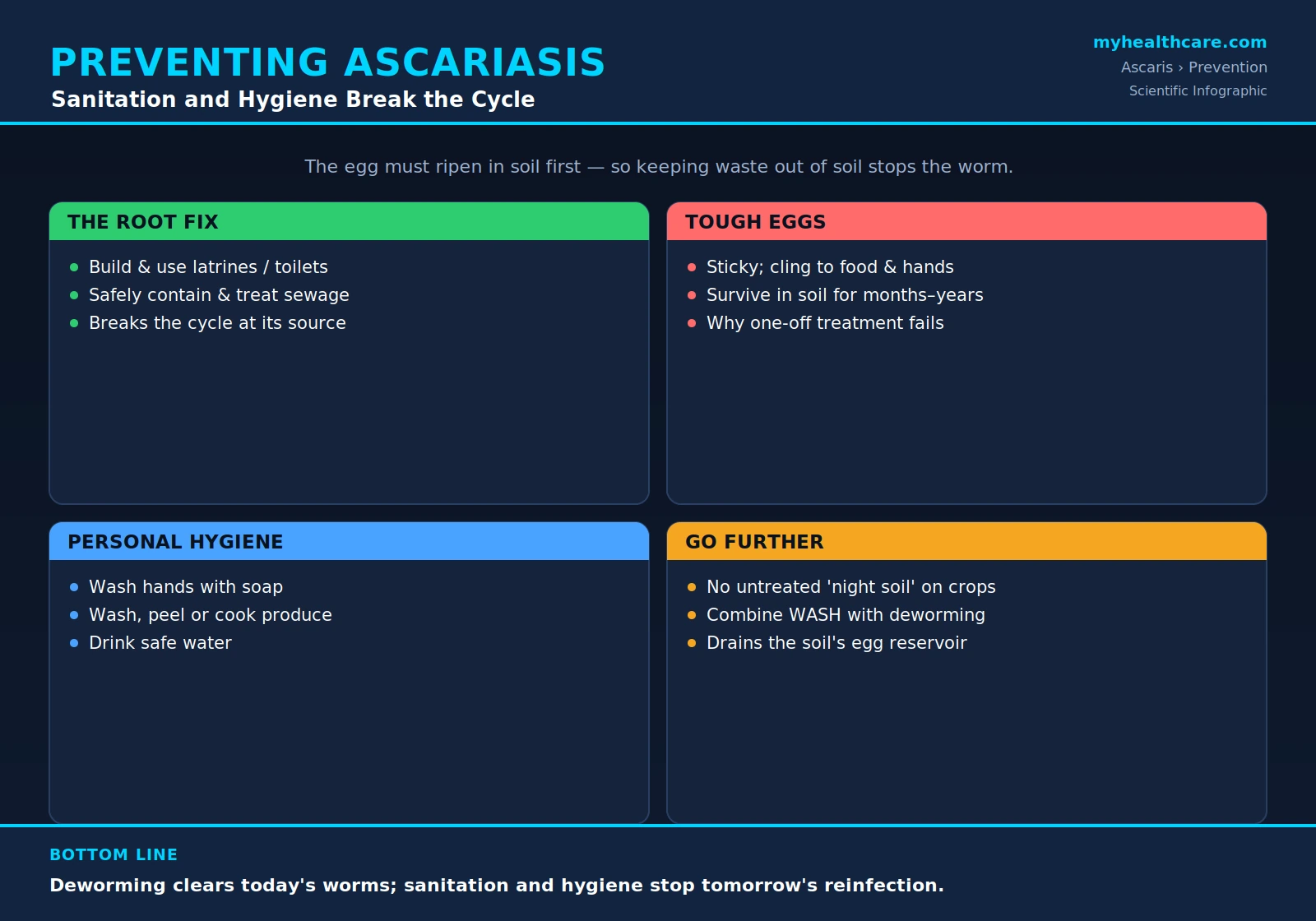
Ascaris lumbricoides, the giant roundworm, infects hundreds of millions of people — yet it has all but disappeared from wealthy countries with modern toilets and clean water. That contrast is the single most important fact about this parasite: ascariasis is a disease of inadequate sanitation, and improving sanitation makes it go away. Unlike many germs, Ascaris cannot spread by a cough, a handshake, or a kiss. Its eggs have to leave the body in feces, sit and ripen in soil for weeks, and then be swallowed — usually on unwashed hands, unwashed food, or in contaminated water. Break any link in that chain and the infection stops. This page explains why prevention is so powerful, how to do it, and why a single round of deworming pills, without cleaner conditions, never lasts.
Table of Contents
- Why Prevention Is So Powerful
- Sanitation: The Root Fix
- Why Tough Eggs Defeat Pills Alone
- Handwashing With Soap
- Safe Food and Safe Water
- No Untreated Human Waste on Crops
- Food Hygiene, Flies, and Health Education
- Integrating WASH With Deworming
- The Historical Decline of These Worms
- Key Research Papers
- Featured Videos
1. Why Prevention Is So Powerful
To understand why sanitation works so well against ascariasis, you have to understand one quirk of the parasite's life cycle: there is an obligatory pause in the soil. When an infected person passes a roundworm's eggs in their stool, those eggs are not yet infectious. A freshly passed Ascaris egg cannot make anyone sick. It must first sit in warm, moist soil for roughly two to four weeks while an infective larva develops inside it. Only after this ripening — called embryonation — can the egg infect a new person if it is swallowed.
This is profoundly different from infections like the flu, colds, or many stomach bugs, which pass directly and quickly from one person to the next. Because Ascaris requires that environmental detour, it does not spread by ordinary person-to-person contact. You cannot catch roundworm by hugging, sharing a cup, or sitting next to an infected person. There is no direct human-to-human transmission. Every single new infection has to run the full course: feces → soil → weeks of ripening → swallowed.
That mandatory environmental step is a gift to prevention. It means the transmission cycle has a built-in weak point that we can attack with simple, low-technology measures — keeping feces out of the soil, keeping ripened soil and contaminated food out of mouths. If human waste never reaches the soil, no eggs ever ripen. If hands and food are clean, ripened eggs never get swallowed. Either intervention, applied well, breaks the chain. This is why ascariasis — and its companion soil-transmitted worms, whipworm and hookworm — collapse in any community that gains proper toilets and clean water, and why public-health authorities treat sanitation, not medicine, as the true cure (Bethony et al., 2006; Else et al., 2020).
2. Sanitation: The Root Fix
If the parasite needs human feces in the soil to survive, then the most fundamental solution is obvious: keep human feces out of the soil. This is what sanitation means — the safe containment, disposal, and treatment of human waste. It is the root fix for ascariasis, the intervention that addresses the cause rather than just the symptom.
In practical terms, sanitation means building and consistently using latrines and toilets so that defecation does not happen in fields, yards, ditches, or waterways. Open defecation — relieving oneself on the ground — is the engine of soil-transmitted worm transmission, because it deposits eggs exactly where they need to be to ripen. A community where everyone uses a proper toilet starves the parasite of new soil to colonize. Equally important is what happens downstream: containing and treating sewage so that even waste that leaves homes through pipes or pits is processed and not simply released onto land or into rivers where it can re-contaminate soil, crops, and water.
It is worth being honest about what the research shows. The benefit of sanitation comes above all from using toilets, not merely owning them. A large meta-analysis of sanitation and soil-transmitted helminths found that access to and use of sanitation was associated with significantly lower odds of Ascaris infection — roughly halving the odds in pooled data — but the protective effect depends on coverage being high and on people actually using the facilities (Ziegelbauer et al., 2012). A latrine that is built but ignored, or used by only some households while neighbors continue open defecation, leaves the shared soil reservoir intact. Sanitation works best when it is near-universal in a community, which is why the goal is total coverage, not a scattering of toilets.
3. Why Tough Eggs Defeat Pills Alone
Here is the hard truth that explains why deworming campaigns, on their own, never finish the job: the eggs are extraordinarily durable, and the soil stays a reservoir.
Ascaris eggs are protected by a thick, sticky, multi-layered shell that makes them one of the most rugged structures in the parasite world. They resist drying, cold, many chemicals, and ordinary disinfectants. Most strikingly, they are long-lived in soil — surviving for many months, and often for several years, under the right conditions of moisture and shade. Their stickiness lets them cling to soil particles, to the skin of root vegetables, to fingers, and to the surfaces children touch. This combination of toughness and longevity is precisely what makes the soil a persistent reservoir of infection (Crompton, 2001; Else et al., 2020).
Now picture a deworming program that gives every child in a village a single dose of medicine. The pills do their job: they kill the adult worms living in the children's intestines, and for a while the children are worm-free. But the medicine does nothing to the eggs already lying in the soil. Those eggs — deposited by months of earlier open defecation — remain viable and infective in the ground all around the village. As soon as the children resume their normal play and eating, they swallow ripened eggs again and become re-infected. Within months, infection rates climb back toward where they started. This pattern of rapid reinfection after treatment is one of the best-documented findings in the field, and it is the central reason that deworming controls the disease but does not eliminate it (Jourdan et al., 2018).
The lesson is not that deworming is useless — it relieves the worm burden in the people who need it most, right now, which genuinely improves their health (see Anthelmintic Treatment and Mass Deworming Programs). The lesson is that medicine treats the people while sanitation treats the soil, and only by draining the soil reservoir — with toilets, clean water, and hygiene — can a community actually free itself of the parasite for good. Pills empty the pot; sanitation turns off the tap.
4. Handwashing With Soap
If sanitation is how we keep eggs out of the soil, handwashing is one of the main ways we keep ripened eggs out of our mouths. Because every Ascaris infection ends with a person swallowing eggs — and because those eggs travel on contaminated hands — washing hands with soap is a direct, powerful interruption of the cycle.
The two most important moments to wash are:
- Before eating and before preparing food — so that eggs picked up during the day are not transferred from fingers to the food going into your mouth.
- After any contact with soil — after gardening, farming, playing on the ground, or any work that puts hands in dirt, since soil is exactly where infective eggs accumulate. Washing after using the toilet and after cleaning a child are also basic, essential habits.
Plain soap and water are what matter here. The mechanical action of scrubbing and rinsing physically removes the sticky eggs from the skin and washes them away — you are dislodging and rinsing off particles, not chemically killing them, which is why thoroughness and clean water count. Hygiene behaviors like handwashing have been linked in systematic reviews to meaningfully lower odds of soil-transmitted helminth infection, including Ascaris (Strunz et al., 2014). For children, who put their hands in their mouths constantly and play close to the ground, supervised, routine handwashing is one of the highest-value habits a household and a school can build.
5. Safe Food and Safe Water
Hands are not the only vehicle. Ripened eggs in soil also reach us through contaminated food and water, so making both safe closes two more doors on the parasite.
Fruits and vegetables. Produce grown in or close to contaminated soil — especially low-growing leafy greens and root vegetables — can carry sticky Ascaris eggs on its surface. Three simple steps neutralize this risk:
- Wash produce thoroughly in clean water to physically remove eggs and soil clinging to the surface.
- Peel fruits and vegetables where practical, which removes the contaminated outer surface entirely.
- Cook when possible, since thorough cooking reliably destroys any eggs that remain. Raw salads and uncooked produce from areas with poor sanitation carry the highest risk and most need careful washing or peeling.
Drinking water. Water can become contaminated with eggs when human waste reaches wells, surface water, or supply systems — the very thing good sanitation is meant to prevent. Where the safety of the water is uncertain, using safe drinking water matters: water that has been properly treated, filtered, or boiled, and protected from fecal contamination at the source and in storage. Safe water is part of the same logic as safe food and clean hands — all three stop ripened eggs from completing the final step of the journey into a new host. Reviews of water, sanitation, and hygiene consistently find that improvements in water quality and supply are associated with lower worm infection (Strunz et al., 2014; Freeman et al., 2016).
6. No Untreated Human Waste on Crops
One traditional farming practice deserves a section of its own because it works directly against everything sanitation is trying to achieve: using untreated human waste — sometimes called "night soil" — as fertilizer.
Human feces are rich in nutrients, and in many parts of the world they have long been collected and spread on fields and gardens to fertilize crops. The problem is that untreated human waste is full of viable, infective worm eggs. Spreading it on farmland is, from the parasite's point of view, an ideal delivery service: it places huge numbers of eggs directly onto the soil where vegetables grow, where they ripen and then contaminate the very produce that people will eat. Night soil has been a classic driver of intense Ascaris transmission in agricultural communities, and it is one reason roundworm can reach extremely high prevalence in places that otherwise seem clean.
The preventive message is clear: do not use untreated human waste as fertilizer. Where human waste is to be recycled onto land — a reasonable goal for nutrient recovery — it must first be properly treated, composted, or stored long enough to destroy the eggs, because Ascaris eggs are so resistant that only sustained, deliberate treatment reliably kills them. Safe reuse is possible, but only after the eggs have been neutralized; raw application simply re-seeds the soil and undoes the benefit of every toilet in the community.
7. Food Hygiene, Flies, and Health Education
A few additional, everyday measures round out the practical toolkit.
Food hygiene and fly control. Keeping food covered and preparing it cleanly stops eggs from settling onto meals. Flies that have been in contact with exposed feces can carry sticky eggs on their bodies and legs and deposit them on uncovered food, so reducing fly breeding (by covering latrines and managing waste) and protecting food from flies adds another layer of defense. None of these is as decisive as sanitation, but together they reduce the many small opportunities for eggs to reach the table.
Health education and behavior change. Toilets, soap, and clean water only protect people if they are used — consistently, by everyone, every day. That makes health education the glue that holds prevention together. Communities benefit from understanding how the parasite spreads (the hidden detour through soil), why a freshly used latrine and washed hands matter even when no one feels sick, and how to make these behaviors routine for children. Programs that combine sanitation infrastructure with sustained education and community engagement — encouraging latrine use, handwashing, safe food handling, and an end to open defecation — achieve far more durable reductions in helminth infection than hardware alone (Asaolu & Ofoezie, 2003). Behavior change is not a soft add-on; it is what converts a built toilet into a working barrier.
8. Integrating WASH With Deworming
The modern consensus pulls these threads together under a single banner: WASH — Water, Sanitation, and Hygiene — delivered alongside deworming. Neither alone is enough for lasting control. Deworming rapidly reduces the worm burden in people but leaves the soil reservoir intact, so reinfection follows. WASH gradually drains that reservoir and blocks new transmission but acts more slowly and does not clear the worms already inside a heavily infected child. Used together, they are complementary: deworming gives the immediate health benefit and buys time, while WASH delivers the durable, eventual elimination of transmission.
The research supports this combined approach. The large meta-analysis by Ziegelbauer and colleagues found that sanitation alone was associated with roughly halved odds of Ascaris infection (Ziegelbauer et al., 2012), and the broader systematic review by Strunz and colleagues found that water, sanitation, and hygiene measures — particularly handwashing and access to clean water and sanitation — were each associated with significantly lower odds of soil-transmitted helminth infection (Strunz et al., 2014). A cluster-randomized trial of a school-based hygiene, water-quality, and sanitation program likewise showed reduced reinfection among schoolchildren (Freeman et al., 2013). The Cochrane review of WASH interventions found suggestive evidence of benefit while noting that the highest-quality randomized data remain limited, a fair reminder that good trials of plumbing are hard to run and that WASH works best as part of an integrated strategy rather than a single magic bullet (Freeman et al., 2016).
For this reason, global control programs no longer frame the choice as "pills or toilets." They pair regular preventive deworming of at-risk groups (described on the Mass Deworming Programs page) with steady investment in sanitation, safe water, and hygiene education — the deworming managing today's disease, the WASH dismantling tomorrow's transmission (Jourdan et al., 2018; Pullan et al., 2014).
9. The Historical Decline of These Worms
Perhaps the most encouraging evidence that prevention works is written into history. Ascariasis and the other soil-transmitted worms were once common in countries that are now nearly free of them — including the southern United States, much of Europe, Japan, and South Korea. They did not retreat because of a vaccine or a wonder drug. They retreated as those societies built sanitation: sewers and treatment plants, household toilets, protected water supplies, and the public-health habits that came with them.
The hookworm campaigns of the early twentieth-century American South, the post-war sanitation and deworming drives in Japan and Korea, and the long sweep of sewerage construction across industrializing Europe all tell the same story. As open defecation ended, as human waste was contained and treated, and as clean water and handwashing became normal, the soil reservoir dried up and the worms faded — first becoming uncommon, then rare, then a curiosity. This is the same trajectory that today's high-burden regions can follow, and it is the deepest reason for optimism: the disappearance of Ascaris from the wealthy world is a natural experiment proving that development of sanitation, not medicine alone, is what ultimately ends this disease (Hotez et al., 2007; Bethony et al., 2006). What looks today like a stubborn parasite of poverty is, in the long view, a solvable problem — and sanitation is the proven solution.
Key Research Papers
Peer-reviewed reviews, meta-analyses, and trials on the prevention and control of Ascaris and the other soil-transmitted helminths through sanitation, water, and hygiene. Journal names appear as plain text; the year/volume/pages link opens the full citation via DOI.
- Ziegelbauer K, Müller-Hauser AA, Speich B, et al. Effect of Sanitation on Soil-Transmitted Helminth Infection: Systematic Review and Meta-Analysis. PLoS Medicine. 2012;9(1):e1001162.
- Strunz EC, Addiss DG, Stocks ME, Ogden S, Utzinger J, Freeman MC. Water, Sanitation, Hygiene, and Soil-Transmitted Helminth Infection: A Systematic Review and Meta-Analysis. PLoS Medicine. 2014;11(3):e1001620.
- Freeman MC, Clasen T, Brooker SJ, Akoko DO, Rheingans R. The Impact of a School-Based Hygiene, Water Quality and Sanitation Intervention on Soil-Transmitted Helminth Reinfection: A Cluster-Randomized Trial. The American Journal of Tropical Medicine and Hygiene. 2013;89(5):875–883.
- Freeman MC, Garn JV, Sclar GD, et al. Interventions to Improve Water, Sanitation, and Hygiene for Preventing Soil-Transmitted Helminth Infection. Cochrane Database of Systematic Reviews. 2016;(5):CD012199.
- Asaolu SO, Ofoezie IE. The Role of Health Education and Sanitation in the Control of Helminth Infections. Acta Tropica. 2003;86(2–3):283–294.
- Bethony J, Brooker S, Albonico M, et al. Soil-Transmitted Helminth Infections: Ascariasis, Trichuriasis, and Hookworm. The Lancet. 2006;367(9521):1521–1532.
- Jourdan PM, Lamberton PHL, Fenwick A, Addiss DG. Soil-Transmitted Helminth Infections. The Lancet. 2018;391(10117):252–265.
- Hotez PJ, Molyneux DH, Fenwick A, et al. Control of Neglected Tropical Diseases. The New England Journal of Medicine. 2007;357(10):1018–1027.
- Pullan RL, Smith JL, Jasrasaria R, Brooker SJ. Global Numbers of Infection and Disease Burden of Soil Transmitted Helminth Infections in 2010. Parasites & Vectors. 2014;7:37.
- Else KJ, Keiser J, Holland CV, et al. Whipworm and Roundworm Infections. Nature Reviews Disease Primers. 2020;6(1):44.
- Crompton DWT. Ascaris and Ascariasis. Advances in Parasitology. 2001;48:285–375.
Live PubMed Searches
Each link opens a live PubMed query so results stay current as new papers are indexed.
- Ascaris sanitation and prevention
- WASH and soil-transmitted helminths
- Ascaris reinfection after treatment
- Handwashing with soap and intestinal parasites
- Ascaris egg survival in soil
- Night soil and wastewater reuse helminth eggs
- Latrines, open defecation, and STH
- Integrated deworming and WASH control
Connections
- All Parasites
- Ascaris Overview
- Symptoms & Diagnosis
- Pulmonary Ascariasis & Löffler's Syndrome
- Intestinal Obstruction & Biliary Complications
- Malnutrition & Childhood Growth
- Treatment & Prevention
- Anthelmintic Treatment (Albendazole & Mebendazole)
- Mass Deworming Programs
- Gastroenterology
- Infectious Disease
- All Conditions