Anthelmintic Treatment of Ascariasis: Albendazole and Mebendazole
If you or your child has been diagnosed with Ascaris lumbricoides — the large roundworm that lives in the human gut — there is good news worth holding onto: this is one of the easiest intestinal worms to cure. A single dose of a cheap, widely available tablet usually clears the infection. The medicines used are called anthelmintics (literally "anti-worm" drugs), and the two workhorses for ascariasis belong to a family known as the benzimidazoles: albendazole and mebendazole. This page explains, in plain language but without skipping the science, exactly how these drugs work, how well they work, what the alternatives are, when timing and special situations matter, and how safe they are. Everything here describes treatment as reported in the medical literature; the actual choice of drug, dose, and timing is directed by a clinician, and the doses given are typical reported ranges, not a prescription.
Table of Contents
- How the Benzimidazoles Work
- Albendazole
- Mebendazole
- How Well They Work: Cure Rate vs. Egg Reduction
- Alternative Drugs
- Piperazine: The Old Drug Still Useful in Obstruction
- Special Situations: Lung Phase and Obstruction
- Safety: Pregnancy, Young Children, Side Effects
- Reinfection and Repeat Treatment
- Key Research Papers
- Featured Videos
1. How the Benzimidazoles Work
To understand albendazole and mebendazole, it helps to picture the inside of a living cell as a busy construction site held up by scaffolding. That scaffolding is built from a protein called tubulin, which assembles into long, hollow rods called microtubules. Microtubules are not just structural beams; they are the cell's internal railway. The cell uses them to move packages of nutrients around, to pull chromosomes apart when it divides, and — crucially for a worm's gut — to ferry absorbed sugar (glucose) into its tissues.
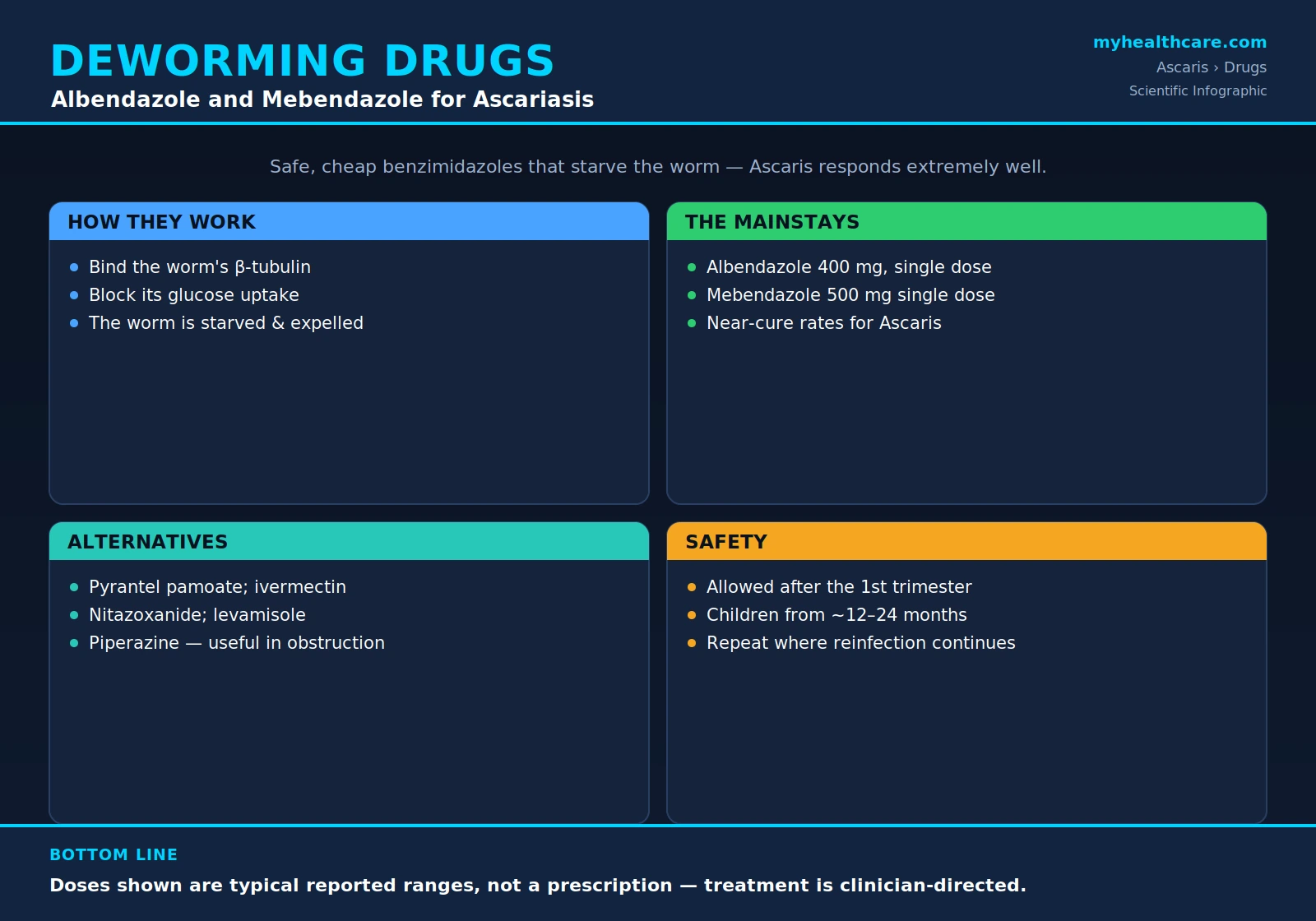
The benzimidazoles work by binding to the worm's β-tubulin — one of the two halves of the tubulin building block — at a specific pocket. Once a drug molecule plugs into that pocket, the tubulin can no longer snap together into intact microtubules. In effect, the drug blocks microtubule formation, and the existing scaffolding gradually falls apart. The consequences for the worm are slow but fatal:
- Glucose uptake is shut down. The worm depends on absorbing glucose from your gut to fuel itself. With the microtubule railway broken, it can no longer take up and use glucose efficiently. Its energy stores (glycogen) are progressively depleted.
- The worm is starved. Robbed of its fuel supply, the parasite literally runs out of energy over the following days.
- The worm is immobilized. As its energy fails and its cellular machinery degrades, the worm becomes paralyzed and unable to hold its position. It can then be swept out of the intestine and passed in the stool.
Two features of this mechanism explain why these drugs are so useful. First, it is relatively selective: the worm's β-tubulin has a slightly different shape from human β-tubulin, so the drugs bind tightly to the parasite's version and only weakly to ours — which is a large part of why they are so well tolerated by people. Second, because the drug works by slowly starving and immobilizing the worm rather than violently poisoning it, the parasite is not whipped into a frenzy of thrashing or migration — a point that becomes important when we get to obstruction below. The fine detail of benzimidazole binding to β-tubulin, and how worms that develop resistance carry small changes in that binding pocket, has been worked out in laboratory studies of helminth tubulin.
2. Albendazole
Albendazole is, for many clinicians worldwide, the first-choice deworming drug for ascariasis. The reported regimen for an uncomplicated Ascaris infection is strikingly simple: a single 400 mg oral dose, taken once. There is no multi-day course to remember and no need to keep taking pills for a week. For an adult or an older child with ordinary roundworm infection, that one tablet is typically the whole treatment.
Albendazole is favored partly because of this single-dose convenience and partly because, after it is absorbed, the body converts it into an active form (albendazole sulfoxide) that circulates and reaches tissues — which is one reason albendazole is also the drug of choice for several worm infections that live outside the gut. For ascariasis specifically, the worm lives in the intestine, and the single oral dose produces very high cure rates. Taking the tablet with a fatty meal increases how much drug is absorbed, which clinicians sometimes use to advantage for tissue-dwelling worms, though for simple intestinal Ascaris the single dose works well regardless.
It is worth pausing on just how favorable this is. Many serious infectious diseases require long, complicated, expensive treatment. Roundworm — one of the most common infections of humanity, carried by hundreds of millions of people — is usually undone by one inexpensive tablet. That combination of high efficacy, low cost, and single-dose simplicity is exactly why albendazole sits at the heart of global deworming efforts.
3. Mebendazole
Mebendazole is the close cousin of albendazole and works by the identical β-tubulin mechanism. It is equally well established against Ascaris, and in many countries it is the more familiar of the two. Mebendazole is reported in two common regimens:
- A single 500 mg dose — the one-tablet approach, mirroring albendazole's single-dose convenience and widely used in mass-treatment programs.
- 100 mg twice daily for 3 days — the older, traditional course (a total of six 100 mg doses over three days). This longer schedule has historically been used and tends to push cure rates a little higher, particularly for some other worms that share the gut.
Unlike albendazole, mebendazole is poorly absorbed from the gut — most of it stays inside the intestine. For a worm like Ascaris that lives in the intestinal lumen, that is perfectly fine; the drug is exactly where the worm is. (It does mean mebendazole is less suited to worms that burrow into deep tissues, where albendazole's better absorption gives it the edge.) For ordinary roundworm in the bowel, both drugs are highly effective, and the choice between them often comes down to local availability, cost, formulation, and clinician preference.
4. How Well They Work: Cure Rate vs. Egg Reduction
Ascaris is one of the most drug-responsive of all the human helminths. Among the common intestinal worms, roundworm is the one that most reliably surrenders to a single dose. This is genuinely reassuring for patients: a near-cure from one tablet is the usual expectation, not the lucky exception. To read the medical literature on this, though, it helps to understand the two different yardsticks researchers use to measure how well a deworming drug performs.
Cure rate (CR). This is the percentage of treated people who have no worm eggs at all in their stool when they are re-checked a few weeks after treatment — essentially, the proportion completely cleared of the infection. For single-dose albendazole or mebendazole against Ascaris, the reported cure rate is consistently very high — often well above 90%, and in many studies close to 95–100%. In plain terms, the great majority of people are entirely cleared by one dose.
Egg-reduction rate (ERR). This is a different and more sensitive measure: it asks by how much the number of eggs fell, comparing the egg count before and after treatment, averaged across everyone treated. A person who started with thousands of eggs and ends with only a handful is not "cured" by the strict cure-rate definition, but the drug clearly did most of its job. For Ascaris, the egg-reduction rate after a single benzimidazole dose is extremely high, routinely reported above 95% and frequently 98–99%+ — meaning the worm burden, and with it the parasite's egg output back into the environment, is slashed dramatically even in the few people not technically cured.
Why does the distinction matter? Because the two numbers answer two different questions. For the individual patient, cure rate is what counts — "Did the worms go away?" — and for roundworm the answer is usually yes. For a community program, egg-reduction rate is often the more meaningful figure, because driving down the total number of eggs shed into the soil is what interrupts transmission to other people, even if a handful of individuals still carry a few worms. Large multi-country field studies that measured both yardsticks have repeatedly confirmed that Ascaris responds better to single-dose benzimidazoles than the other major soil-transmitted worms (hookworm and whipworm), which are notably harder to clear. A useful way to remember it: against roundworm these drugs are excellent; against whipworm in particular they are much weaker, which is why Ascaris is singled out as the "easy" one.
5. Alternative Drugs
The benzimidazoles are the mainstay, but they are not the only effective option. Several alternative anthelmintics are used against Ascaris, each with its own way of disabling the worm. Understanding the different mechanisms is more than trivia — it explains why some drugs are preferred in particular situations (see the obstruction section below).
- Pyrantel pamoate. A well-established, over-the-counter option in many countries. Rather than starving the worm like the benzimidazoles, pyrantel acts on the worm's nerve–muscle junctions as a depolarizing neuromuscular blocker: it forces the muscles into a state of sustained contraction, producing spastic (rigid) paralysis. The stiffened, immobilized worm loses its grip on the gut wall and is passed in the stool. Pyrantel is poorly absorbed (so it stays in the gut, where the worm is) and is generally well tolerated; it is a common single-dose treatment for roundworm and pinworm.
- Ivermectin. Best known for other parasites, ivermectin also has activity against Ascaris and is sometimes used, including in combination regimens within mass-treatment programs. It works on parasite chloride channels in nerve and muscle, paralyzing the worm. It is not usually the first choice for roundworm alone but is valuable where co-infections or program logistics favor it.
- Nitazoxanide. A broad-spectrum antiparasitic and antiprotozoal drug that interferes with an energy-generating enzyme system the parasite relies on. It has reported activity against Ascaris and several other intestinal parasites and is an option particularly when mixed parasitic infections are suspected.
- Levamisole. An older anthelmintic that, like pyrantel, acts on the worm's nicotinic receptors to cause spastic paralysis. It has been widely used historically against roundworm and remains an effective single-dose alternative in some settings.
In everyday practice for simple ascariasis, albendazole or mebendazole is reached for first because of the unbeatable combination of efficacy, safety, low cost, and single-dose simplicity. The alternatives come into play for co-infections, drug availability, program design, or the special circumstances described next.
6. Piperazine: The Old Drug Still Useful in Obstruction
Piperazine is an older anthelmintic that has been largely overtaken by the benzimidazoles for routine deworming — yet it retains an important, almost paradoxical niche. The key is the kind of paralysis it causes. Piperazine works on the worm's muscle in essentially the opposite way to pyrantel: it acts like the worm's own natural "calm down" signal (it behaves as a GABA agonist at the worm's neuromuscular junction), relaxing the muscle and producing flaccid (limp) paralysis. The worm goes slack rather than rigid.
Why does that limpness matter? Consider a heavy infection in which a tangled bolus of roundworms is partly blocking a child's intestine, or a single worm has wriggled up into the bile duct. Now imagine giving a drug that makes the worms thrash, contract violently, and migrate. In that fragile situation, a stimulating or spastic-paralysis drug could, in principle, provoke the worms to move — potentially worsening an obstruction or driving a worm further into the biliary tree. Piperazine sidesteps this danger precisely because it does not make worms thrash or wander: it leaves them limp and quiet, so they can be passed (or removed) without being agitated into harmful movement.
For that reason, piperazine is still mentioned in the context of partial intestinal obstruction and biliary disease caused by Ascaris — the situations where a gently-paralyzing, non-stimulating drug is the safer way to deal with a dangerous worm mass. (It is also why management of obstruction is handled cautiously and is clinician-directed; see the next section and the dedicated Intestinal Obstruction and Biliary Complications page.)
7. Special Situations: Lung Phase and Obstruction
Two clinical situations highlight that when and how you deworm can matter as much as which drug you use.
The pulmonary (larval) phase — why timing matters. The Ascaris life cycle is not confined to the gut. After a person swallows the worm's eggs, the larvae hatch, burrow through the intestinal wall, travel in the bloodstream to the lungs, break into the air sacs, are coughed up and re-swallowed, and only then mature into adult worms in the intestine. The benzimidazoles (and most of the other drugs above) act chiefly on the adult worms living in the gut — they are far less effective against the migrating larvae passing through the lungs. This is why timing matters: a person in the middle of the lung-migration phase (which can cause a cough, wheeze, and a transient lung reaction known as Löffler syndrome) may have few or no adult worms in the bowel yet for the drug to kill, and a stool test may even be negative because the worms are not old enough to lay eggs. Treatment is generally aimed at the established intestinal adults, and in some cases deworming is timed or repeated to catch the worms once they have matured in the gut. The lung phase itself is discussed in detail on the Pulmonary Ascariasis and Löffler's Syndrome page.
Obstruction and biliary disease — deworm with care. In heavy infections, a knot of worms can physically block the bowel, or a worm can migrate into the bile or pancreatic ducts and cause biliary colic, cholangitis, or pancreatitis. Treating these emergencies is a careful, clinician-directed balancing act. As discussed above, there is a theoretical concern that drugs causing spastic paralysis or otherwise stimulating the worms could provoke harmful migration in this delicate setting — which is the historical rationale for favoring a non-stimulating, flaccid-paralysis agent such as piperazine when worms must be cleared from an obstructed bowel or biliary tree. Definitive management may also involve supportive care, endoscopic removal of a worm from the bile duct, or surgery, alongside (or before) antiparasitic drugs. The full picture of these complications is covered on the Intestinal Obstruction and Biliary Complications page.
8. Safety: Pregnancy, Young Children, Side Effects
One of the great virtues of the benzimidazoles is how safe and well tolerated they are for the vast majority of people. Because they target the worm's tubulin far more than our own, side effects are usually mild and short-lived — most commonly a bit of abdominal discomfort, nausea, mild diarrhea, or headache, often hard to separate from the gut upset of the infection itself. Serious reactions are uncommon with the short courses used for ascariasis.
Pregnancy. This is an area where careful, evidence-based guidance exists. The World Health Organization supports benzimidazole deworming of pregnant women after the first trimester in areas where soil-transmitted worm infection is common, because the benefits of removing a worm burden (improving the mother's nutrition and anemia, and supporting healthier pregnancies) are judged to outweigh the small theoretical risks. The first trimester — the period of major organ formation in the fetus — is generally avoided out of caution. In endemic regions, single-dose deworming in the second and third trimesters has become a standard public-health measure. Any deworming in pregnancy should, of course, be decided with a clinician.
Young children. Deworming is recommended and widely practiced in children, because they bear much of the worm burden and suffer most from its effects on growth and development. With dose adjustment, treatment is used in young children down to roughly 12–24 months of age (often with a reduced or half dose, and sometimes a crushed or chewable formulation for the very young), under guidance appropriate to local programs. The strong track record of single-dose benzimidazoles in preschool-aged children is precisely why mass deworming campaigns reach down into early childhood.
The overall message is that, for ordinary roundworm infection, these are among the safest drugs in medicine — which is exactly what allows them to be given to hundreds of millions of people, including children and (after the first trimester) pregnant women, in community programs.
9. Reinfection and Repeat Treatment
A single tablet cures the infection — but it does not make you immune, and it does nothing to the worm eggs still sitting in the surrounding environment. Ascaris is spread when its hardy eggs, shed in human feces, contaminate soil, food, and hands and are then swallowed. Where sanitation is poor and the soil is heavily seeded with eggs, a person who is cured today can simply pick the worm up again within weeks to months. This is not a failure of the drug; it is reinfection from an environment that is still contaminated.
The practical consequence is that, in places where transmission continues, deworming usually has to be repeated — which is the whole logic behind periodic mass-treatment campaigns that re-treat at-risk groups every several months to keep worm burdens low. But repeated dosing treats the symptom, not the root cause. The durable answer is to break the transmission cycle itself through sanitation, clean water, and hygiene — covered on the Prevention: Sanitation and Hygiene page — and through the organized programs described on the Mass Deworming Programs page. Drugs clear the worms you have; clean environments stop you getting them back. For the wider treatment-and-prevention picture, see the Treatment & Prevention hub.
Key Research Papers
Peer-reviewed mechanism studies, drug-efficacy field trials, meta-analyses, and clinical reviews on the anthelmintic treatment of ascariasis. Journal names appear as plain text; the year/volume/pages link opens the full citation via DOI.
- Lacey E. Mode of Action of Benzimidazoles. Parasitology Today. 1990;6(4):112–115.
- Lubega GW, Prichard RK. Specific Interaction of Benzimidazole Anthelmintics with Tubulin: High-Affinity Binding and Benzimidazole Resistance in Haemonchus contortus. Molecular and Biochemical Parasitology. 1990;38(2):221–232.
- Martin RJ. Modes of Action of Anthelmintic Drugs. The Veterinary Journal. 1997;154(1):11–34.
- Keiser J, Utzinger J. Efficacy of Current Drugs Against Soil-Transmitted Helminth Infections: Systematic Review and Meta-analysis. JAMA. 2008;299(16):1937–1948.
- Moser W, Schindler C, Keiser J. Efficacy of Recommended Drugs Against Soil Transmitted Helminths: Systematic Review and Network Meta-analysis. BMJ. 2017;358:j4307.
- Vercruysse J, Behnke JM, Albonico M, et al. Assessment of the Anthelmintic Efficacy of Albendazole in School Children in Seven Countries Where Soil-Transmitted Helminths Are Endemic. PLoS Neglected Tropical Diseases. 2011;5(3):e948.
- Levecke B, Montresor A, Albonico M, et al. Assessment of Anthelmintic Efficacy of Mebendazole in School Children in Six Countries Where Soil-Transmitted Helminths Are Endemic. PLoS Neglected Tropical Diseases. 2014;8(10):e3204.
- Lubis IND, Pasaribu S, Lubis CP. Current Status of the Efficacy and Effectiveness of Albendazole and Mebendazole for the Treatment of Ascaris lumbricoides in North-Western Indonesia. Asian Pacific Journal of Tropical Medicine. 2012;5(8):605–609.
- Aubry ML, Cowell P, Davey MJ, Shevde S. Aspects of the Pharmacology of a New Anthelmintic: Pyrantel. British Journal of Pharmacology. 1970;38(2):332–344.
- Bethony J, Brooker S, Albonico M, et al. Soil-Transmitted Helminth Infections: Ascariasis, Trichuriasis, and Hookworm. The Lancet. 2006;367(9521):1521–1532.
- Jourdan PM, Lamberton PHL, Fenwick A, Addiss DG. Soil-Transmitted Helminth Infections. The Lancet. 2018;391(10117):252–265.
- Wang Q, Liu Y. Biliary Ascariasis: Particular Cause of Biliary Tract Infection. Hepatobiliary Surgery and Nutrition. 2020;9(1):119–120.
- Savioli L, Albonico M, Daumerie D, et al. Review of the 2017 WHO Guideline: Preventive Chemotherapy to Control Soil-Transmitted Helminth Infections in At-Risk Population Groups. PLoS Neglected Tropical Diseases. 2018;12(4):e0006296.
Live PubMed Searches
Each link opens a live PubMed query so results stay current as new papers are indexed.
- Albendazole efficacy against Ascaris
- Mebendazole cure rate for Ascaris
- Benzimidazole β-tubulin mechanism
- Pyrantel pamoate for ascariasis
- Piperazine in Ascaris obstruction
- Deworming safety in pregnancy
- Deworming in preschool children
- Helminth reinfection after treatment
Connections
- All Parasites
- Ascaris (Roundworm) Overview
- Symptoms & Diagnosis
- Pulmonary Ascariasis & Löffler's Syndrome
- Intestinal Obstruction & Biliary Complications
- Malnutrition & Childhood Growth
- Treatment & Prevention
- Prevention: Sanitation & Hygiene
- Mass Deworming Programs
- Gastroenterology
- Infectious Disease
- All Conditions