Mass Deworming Programs for Ascariasis
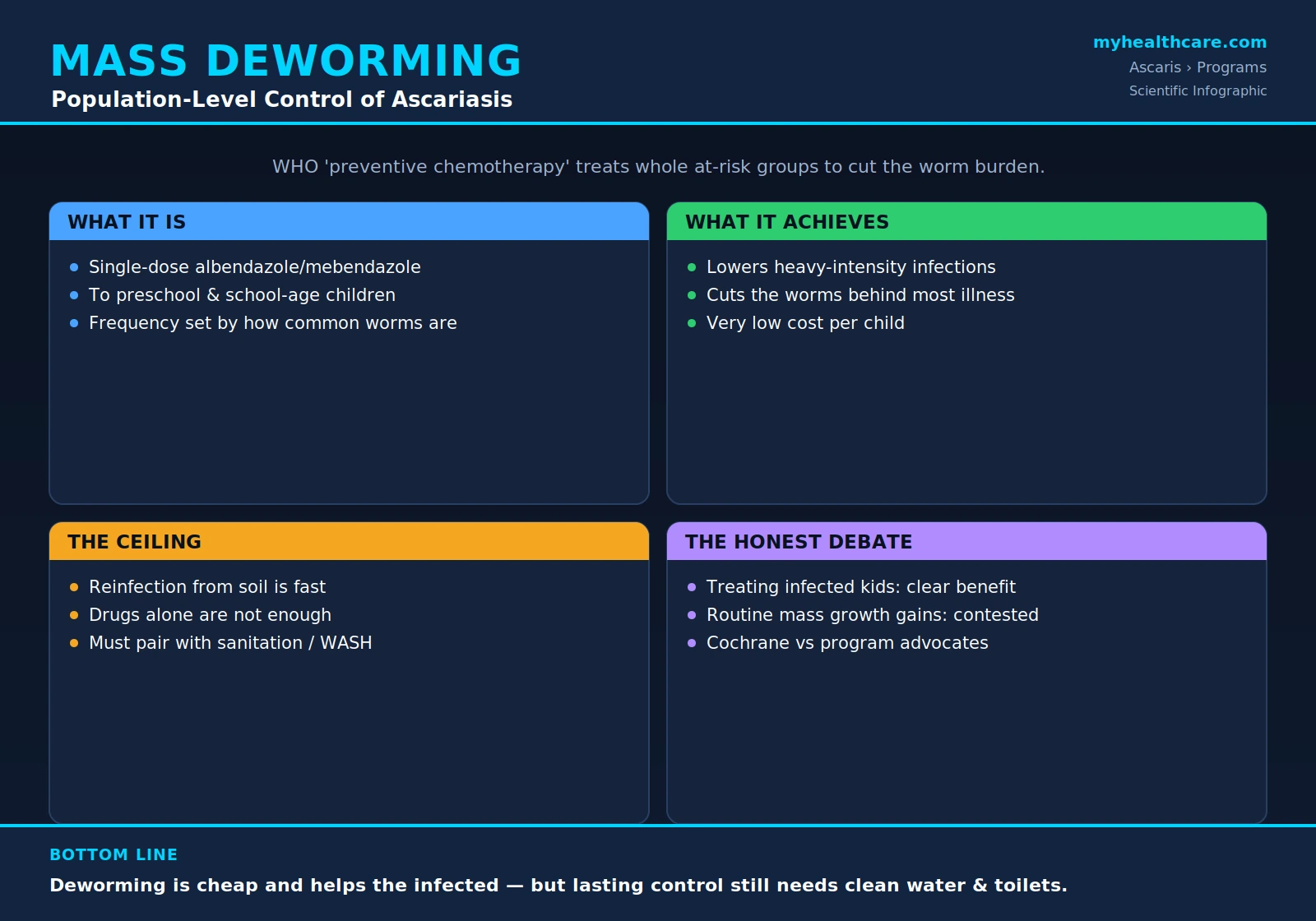
Treating one infected child at a time is the right thing to do for that child — but it can never clear Ascaris lumbricoides from a community where the soil itself is contaminated and reinfection is constant. For that, public-health systems turn to mass deworming: handing out a single, cheap, safe anti-worm tablet to entire groups of children — whole schools, whole villages — on a regular schedule, without testing each child first. The World Health Organization (WHO) calls this strategy preventive chemotherapy, and it is one of the largest public-health interventions on earth, reaching hundreds of millions of children every year. This page explains what mass deworming is, who gets treated and why, how astonishingly little it costs per child, what it does and does not achieve — and it presents, honestly and even-handedly, the genuine scientific argument known as the "worm wars": a serious, ongoing debate about exactly how much benefit community-wide deworming delivers beyond clearing the worms themselves.
Table of Contents
- What Preventive Chemotherapy Means
- The WHO Strategy and Target Groups
- School-Based Deworming and Its Low Cost
- The WHO 2030 NTD Road Map
- The Drugs and How Often to Treat
- What Mass Deworming Achieves
- The Reinfection Ceiling: Why Drugs Alone Are Not Enough
- The "Worm Wars": An Honest Look at the Debate
- Equity and the "Deworm the World" Movement
- Integration With Other NTD Programs
- Key Research Papers
- Featured Videos
1. What Preventive Chemotherapy Means
Preventive chemotherapy is the public-health term for giving anti-worm medicine to large groups of at-risk people on a fixed schedule — without first testing each person to see whether they are infected. When this is done across a whole population or a whole age-group, it is also called mass drug administration (MDA). The two phrases describe the same basic idea: treat everyone in the target group, because in a place where infection is common, the cost and delay of testing each person individually is far greater than the cost of simply giving a safe tablet to all.
This is a deliberate trade-off, and it rests on three facts about soil-transmitted helminths (STH) — the group of intestinal worms that includes Ascaris (roundworm), the two hookworms, and Trichuris (whipworm). First, in highly endemic areas a very large share of children carry worms, so most of the tablets go to someone who genuinely needs them. Second, the drugs used are extremely safe, with a long track record, so giving a dose to an uninfected child causes essentially no harm. Third, individual stool testing is slow, costly, and requires laboratories and trained staff that many endemic regions simply do not have. Skipping the test and treating everyone is what makes deworming cheap enough to reach hundreds of millions of children.
It is worth being clear about what preventive chemotherapy is for. Its primary, well-accepted goal is morbidity control — reducing the burden of heavy worm infection that causes disease — not eradication of the parasite. As long as the soil stays contaminated, children will be reinfected, so the strategy is to keep worm burdens low through repeated rounds of treatment while longer-term solutions (sanitation, clean water, hygiene) catch up. Understanding that distinction — control, not cure — is essential to making sense of both the impact data and the debate that follows.
2. The WHO Strategy and Target Groups
The WHO recommends large-scale preventive chemotherapy in any area where soil-transmitted helminths are common, and it focuses the treatment on the groups who carry the heaviest burdens and suffer the most harm. The priority target groups are:
- Preschool-age children (roughly 1–4 years) — usually reached through child-health days, immunization campaigns, or vitamin-A distribution.
- School-age children (roughly 5–14 years) — the group that typically carries the highest Ascaris and whipworm burdens, and the group most efficiently reached through schools.
- Women of reproductive age, including adolescent girls and pregnant women (after the first trimester) and lactating women — targeted especially because of hookworm-related iron-deficiency anemia, which harms both the woman and, in pregnancy, the developing baby.
These groups are chosen for sound biological reasons. Children playing in and around contaminated soil acquire the heaviest infections; school-age children in particular tend to harbor the largest number of worms, which is why they are the cornerstone of most programs. Women of reproductive age are prioritized because of the special danger that worm-related anemia poses around pregnancy. The aim throughout is to direct a limited resource at the people for whom it does the most good.
WHO sets coverage goals — for many years the headline target was to regularly treat at least 75% of school-age and preschool-age children in need — and tracks progress through national reporting. Achieving and sustaining high coverage, year after year, is one of the central operational challenges of the whole enterprise.
3. School-Based Deworming and Its Low Cost
The single most influential idea in modern deworming is to use schools as the delivery platform. The logic is simple and powerful: school-age children carry much of the worm burden, they are already gathered together in one place on most days, and teachers — with brief training — can safely hand out a single tablet to a whole classroom. No clinic visit, no laboratory, no doctor, no diagnosis is required. A national "deworming day" can sweep through tens of thousands of schools at once.
What makes this approach so attractive to health ministries is its remarkably low cost per child. Because the tablets themselves are donated or bought in bulk at a few cents each, and because the delivery rides on the existing school system rather than building a new health service, the all-in cost of deworming a child through a school-based program is routinely estimated at well under a dollar — often only a few tens of US cents per child per round. Few public-health interventions reach so many people for so little money.
This low cost is precisely why deworming became a flagship of cost-effectiveness arguments in global health, and why advocacy movements (discussed below) seized on it. It is also, fairly, why critics have scrutinized the program so hard: when an intervention is promoted as one of the most cost-effective ways to improve children's lives, the evidence behind every claimed benefit deserves careful examination. Both the enthusiasm and the scrutiny flow from the same striking economics.
4. The WHO 2030 NTD Road Map
Soil-transmitted helminthiasis is one of the neglected tropical diseases (NTDs) — a group of conditions of poverty that the global health community has committed to controlling and, where possible, eliminating. The WHO's road map for neglected tropical diseases 2021–2030 sets out the current targets, and it is important to read those targets carefully, because they describe what mass deworming is realistically expected to deliver.
For soil-transmitted helminths, the road map's central aim is the elimination of STH as a public-health problem — a carefully chosen phrase. It does not mean wiping the worms off the planet. It means driving the prevalence of moderate- and heavy-intensity infections — the heavy worm burdens that actually cause illness — down below a low threshold, so that the disease stops being a meaningful cause of harm in the population. The road map also emphasizes sustaining high treatment coverage in the priority groups and, crucially, integrating deworming with improvements in water, sanitation, and hygiene (WASH) so that gains are not lost to reinfection.
This framing matters for honesty. The official, agreed-upon goal is morbidity control measured by heavy-infection prevalence — an outcome the evidence supports robustly. It is a separate, harder, and more contested question whether routine community-wide deworming also reliably improves the broader outcomes people often hope for, such as average growth, blood iron, cognition, or schooling. Keeping the modest, well-supported official target distinct from the larger, debated hopes is the key to understanding the controversy in section 8.
5. The Drugs and How Often to Treat
The medicines used in mass deworming are the benzimidazole anthelmintics — almost always a single oral dose of albendazole (400 mg) or mebendazole (500 mg). They are inexpensive, can be given by a trained non-medical person, do not need to be taken with food in any complicated way, and have an excellent safety record across decades and billions of doses. Against Ascaris specifically, a single dose of either drug is highly effective, clearing the great majority of roundworm infections. (For how these drugs work and their effectiveness against the different worm species, see Anthelmintic Treatment: Albendazole and Mebendazole.)
How often a community is treated depends on how heavily infected it is. WHO ties the frequency of mass treatment to local prevalence:
- Where the prevalence of soil-transmitted helminths in the target group is at least 50% (high transmission), WHO recommends deworming twice a year.
- Where prevalence is between 20% and 50% (moderate transmission), once a year is recommended.
- Where prevalence falls below 20%, routine mass treatment of everyone is generally no longer recommended; the approach shifts toward treating identified cases and high-risk individuals.
This prevalence-keyed schedule is deliberate. Treating more frequently where worms are common keeps burdens low between rounds; stepping down or stopping where worms have become rare avoids treating large numbers of uninfected people unnecessarily and helps reduce the risk of drug resistance. The schedule is meant to be revisited as surveys show prevalence falling over the years — deworming should ratchet down as it succeeds.
6. What Mass Deworming Achieves
On the outcome it is designed for, the evidence for mass deworming is strong and consistent: it reduces the number of worms children carry, and it sharply cuts the share of children with heavy-intensity infections. This is the outcome that matters most clinically, because the harm from Ascaris and the other soil-transmitted helminths is overwhelmingly driven by worm burden — a child with a handful of roundworms is usually well, whereas a child carrying dozens or hundreds is the one at risk of intestinal blockage, nutritional damage, and the other serious complications.
Heavy infection is exactly what causes the most feared complications of ascariasis — the tangled mass of worms that can block a child's bowel or migrate into the bile ducts (see Intestinal Obstruction and Biliary Complications). By repeatedly knocking worm numbers down, mass deworming pushes children out of that dangerous heavy-burden zone. Regular treatment also reduces the amount of Ascaris eggs shed back into the environment, which over time can lower transmission across the whole community — a benefit that reaches even untreated people.
So the foundational claim is solid: mass deworming does what morbidity control is supposed to do. The genuine scientific argument — the subject of sections 7 and 8 — is not about whether deworming clears worms (it plainly does) but about how far the downstream benefits extend: whether routinely deworming entire communities, including the many children who are uninfected or only lightly infected, measurably improves average growth, hemoglobin, cognition, or school performance across the population.
7. The Reinfection Ceiling: Why Drugs Alone Are Not Enough
Mass deworming has a built-in limitation that every program must confront: the tablet kills the worms inside a child today, but it does nothing to the worm eggs waiting in the soil tomorrow. Ascaris eggs are extraordinarily hardy — they can survive in soil for years — and in a community without safe sanitation, a child who is dewormed in the morning can begin swallowing infective eggs again that same afternoon. Reinfection after treatment is the rule, not the exception.
The data on reinfection are striking. Systematic reviews have found that in highly endemic settings, Ascaris prevalence rebounds toward pre-treatment levels within months of a deworming round — in some studies returning to roughly half of baseline within about six months and approaching baseline within a year. This is the reinfection ceiling: no matter how effective the drug is at clearing today's worms, repeated chemotherapy alone cannot permanently lower infection in a contaminated environment. It can hold burdens down between rounds, but it cannot, by itself, end transmission.
This is why the WHO road map and essentially every serious analysis insist that deworming must be paired with sanitation, clean water, and hygiene (WASH) to achieve lasting change. Building and using latrines, providing safe water, and promoting handwashing and the avoidance of open defecation attack the source — they stop the eggs from reaching the soil and the soil from reaching children's mouths. Reviews of sanitation and STH have found that access to and use of sanitation is associated with substantially lower odds of infection. Deworming buys time and protects today's children; WASH is what eventually breaks the cycle. The two are partners, not alternatives — this is covered in depth on the Prevention: Sanitation and Hygiene page.
8. The "Worm Wars": An Honest Look at the Debate
No discussion of mass deworming is complete — or honest — without the scientific controversy that came to be known as the "worm wars." It is a real, unresolved debate among serious researchers, and the right way to present it is to be clear about what almost everyone agrees on, and what remains genuinely contested.
What is not in dispute. There is broad agreement that treating children who are known to be infected — and especially those with heavy infections — is beneficial. Clearing a heavy worm burden relieves real disease and prevents serious complications. No mainstream party to the debate argues against treating a child who has worms. The safety and the worm-clearing efficacy of the drugs are likewise not in question.
What is contested. The argument is about a different and bigger claim: that routinely deworming entire communities — including the large numbers of children who are uninfected or only lightly infected — produces measurable improvements in average outcomes across the population, such as height and weight gain, hemoglobin (anemia), cognitive test scores, and schooling and later economic success. The case for rests heavily on an influential study by economists Edward Miguel and Michael Kremer (the 2004 Econometrica paper, "Worms"), which reported that a school-based deworming program in Kenya reduced absenteeism and improved school participation, with effects that appeared to spill over even to untreated children and to persist into adulthood. That study became a foundation stone of the "deworm the world" argument.
Years later, however, that very study was re-examined. In 2015 a team led by epidemiologists published, alongside a statistical replication, a re-analysis in the International Journal of Epidemiology that re-coded and reanalyzed the original Kenya data. They reproduced some findings but found that other key results — particularly the claimed effects on school attendance — were sensitive to the analytic choices made and were weaker or less certain than the original had suggested. The original authors responded robustly, defending their work and their interpretation. The exchange was sharp, public, and is the episode from which the "worm wars" took its name. It is fair to say the re-analysis did not simply overturn the original; it showed the conclusions were more fragile and more dependent on methodology than the headline claims implied — which is itself an important scientific finding.
Meanwhile, the largest synthesis of the trial evidence comes from the Cochrane systematic review of public-health deworming programs (Taylor-Robinson and colleagues). Its conclusions are sobering for the broad-benefit case: pooling many randomized trials, the review found that routine community deworming of children probably has little or no effect on average weight, hemoglobin, cognition, school attendance, or school performance at the population level. Crucially, the Cochrane authors are careful to say this is a finding about mass, presumptive treatment of whole groups in which most children are not heavily infected — it is not an argument against treating children who are known to be infected, and it does not contradict the worm-clearing and heavy-infection benefits. A subsequent Lancet Global Health overview of the systematic-review evidence reached broadly similar, cautious conclusions about developmental and wellbeing outcomes.
How to hold both sides at once. The defenders of mass deworming make several reasonable points in reply: that averaging benefit across many uninfected children dilutes a real effect that is concentrated in the infected and heavily infected; that some long-term and economic outcomes are hard for short trials to capture; that the intervention is so cheap and so safe that even a modest average benefit can be highly cost-effective; and that reducing community-wide transmission is itself valuable. The skeptics reply, just as reasonably, that policy and funding claims should rest on the strongest trial evidence, that cost-effectiveness arguments collapse if the average benefit is near zero, and that scarce health dollars should not be justified by fragile or overstated results. A fair reading is this: mass deworming is a safe, cheap, well-established way to control worm morbidity and is firmly justified for that purpose; the stronger claims that it routinely and substantially boosts growth, blood counts, intelligence, and schooling across whole populations are genuinely uncertain and disputed, and honest communication should not present them as settled. Both the program rationale and the skeptical systematic reviews are real, and a reader is entitled to see both.
9. Equity and the "Deworm the World" Movement
Mass deworming has a strong equity dimension: intestinal worms are a disease of poverty, falling hardest on the poorest children in the poorest places — precisely those with the least access to clinics, diagnosis, and treatment. A school-based program that reaches every child in a region, rich or poor, delivers care to many who would otherwise never see a health worker. That universality — no diagnosis, no fee, no clinic visit required — is part of why advocates find it so compelling on fairness grounds, quite apart from the cost arguments.
This thinking gave rise to the "deworm the world" movement — a coalition of researchers, advocacy organizations, and donors who promoted school-based deworming as one of the most cost-effective interventions in all of global health and helped scale it up across Africa and South Asia, treating hundreds of millions of children. The movement was instrumental in turning deworming from a niche clinical activity into a mass program, and in mobilizing the donated drugs and funding that made it possible.
It is only fair to note that this same movement is what brought the evidence under such intense scrutiny. When an intervention is held up as a "best buy" in global health and used to direct large philanthropic flows, careful skeptics will — and should — press hard on whether the underlying benefits are as large as claimed. The "worm wars" of section 8 were, in part, a direct consequence of deworming's success as an advocacy cause. The equity case for reaching the poorest children with a safe, cheap treatment remains strong; the debate is about how much that treatment delivers beyond clearing worms, not about whether reaching poor children is worthwhile.
10. Integration With Other NTD Programs
One of the practical strengths of mass deworming is that it rarely travels alone. Soil-transmitted helminths share endemic geography with several other neglected tropical diseases that are also controlled through preventive chemotherapy, and the programs are increasingly integrated to share delivery, training, and cost.
The clearest partnerships are with the other helminth-control campaigns. Lymphatic filariasis elimination uses annual mass drug administration with albendazole (combined with other drugs) — and because that albendazole also kills Ascaris and the other intestinal worms, filariasis campaigns deliver soil-transmitted-helminth treatment as a bonus. Schistosomiasis control distributes praziquantel to the same school-age children, very often on the same deworming days, so a child may receive treatment for intestinal worms and for schistosomes in a single visit. Programs against trachoma and onchocerciasis (river blindness) share the same community-based mass-treatment machinery as well.
Integration makes the whole enterprise more efficient: one school day, one trained teacher, and one trip into a village can deliver several NTD treatments at once, spreading the fixed costs of reaching remote children across multiple diseases. This is exactly the kind of joined-up, platform-based delivery the WHO road map encourages — and it is part of why the per-child cost of deworming can be kept so low. For the broader picture of how these parasites and programs relate, see the Parasitic Diseases hub and the Infectious Disease section.
Key Research Papers
Peer-reviewed reviews, randomized trials, systematic reviews, and the key papers of the deworming debate. Author names and journal titles appear as plain text; only the year/volume/pages is a link that opens the full citation via DOI. Where a paper sits on a particular side of the "worm wars," that is noted plainly — both the program rationale and the skeptical re-analyses are included.
- Bethony J, Brooker S, Albonico M, et al. Soil-transmitted helminth infections: ascariasis, trichuriasis, and hookworm. The Lancet. 2006;367(9521):1521–1532.
- Jourdan PM, Lamberton PHL, Fenwick A, Addiss DG. Soil-transmitted helminth infections. The Lancet. 2018;391(10117):252–265.
- Hotez PJ, Molyneux DH, Fenwick A, et al. Control of Neglected Tropical Diseases. New England Journal of Medicine. 2007;357(10):1018–1027.
- Keiser J, Utzinger J. Efficacy of Current Drugs Against Soil-Transmitted Helminth Infections: Systematic Review and Meta-analysis. JAMA. 2008;299(16):1937–1948.
- Pullan RL, Smith JL, Jasrasaria R, Brooker SJ. Global numbers of infection and disease burden of soil transmitted helminth infections in 2010. Parasites & Vectors. 2014;7:37.
- Taylor-Robinson DC, Maayan N, Donegan S, Chaplin M, Garner P. Public health deworming programmes for soil-transmitted helminths in children living in endemic areas. Cochrane Database of Systematic Reviews. 2019;9(9):CD000371. (Key systematic review; finds little or no average population effect of mass treatment on growth, hemoglobin, cognition, and schooling.)
- Miguel E, Kremer M. Worms: Identifying Impacts on Education and Health in the Presence of Treatment Externalities. Econometrica. 2004;72(1):159–217. (The influential original study underpinning the "deworm the world" case; its findings were later re-examined and debated.)
- Aiken AM, Davey C, Hargreaves JR, Hayes RJ. Re-analysis of health and educational impacts of a school-based deworming programme in western Kenya: a pure replication. International Journal of Epidemiology. 2015;44(5):1572–1580. (Part of the "worm wars" re-examination of the Miguel & Kremer data.)
- Davey C, Aiken AM, Hayes RJ, Hargreaves JR. Re-analysis of health and educational impacts of a school-based deworming programme in western Kenya: a statistical replication of a cluster quasi-randomized stepped-wedge trial. International Journal of Epidemiology. 2015;44(5):1581–1592. (Companion re-analysis in the "worm wars" debate.)
- Welch VA, Ghogomu E, Hossain A, et al. Mass deworming to improve developmental health and wellbeing of children in low-income and middle-income countries: a systematic review and network meta-analysis. The Lancet Global Health. 2017;5(1):e40–e50.
- Ziegelbauer K, Speich B, Mäusezahl D, Bos R, Keiser J, Utzinger J. Effect of Sanitation on Soil-Transmitted Helminth Infection: Systematic Review and Meta-Analysis. PLoS Medicine. 2012;9(1):e1001162. (Evidence that sanitation lowers infection — the case for pairing deworming with WASH.)
- Jia TW, Melville S, Utzinger J, King CH, Zhou XN. Soil-Transmitted Helminth Reinfection after Drug Treatment: A Systematic Review and Meta-Analysis. PLoS Neglected Tropical Diseases. 2012;6(5):e1621. (Documents how quickly Ascaris and other worms return after treatment — the reinfection ceiling.)
Live PubMed Searches
Each link opens a live PubMed query so results stay current as new papers are indexed.
- Mass deworming and soil-transmitted helminths
- Preventive chemotherapy for STH
- School-based deworming with albendazole
- Deworming, growth and cognition trials
- Ascaris reinfection after treatment
- Sanitation, WASH and STH infection
- NTD road map 2030
- Integrated filariasis and deworming
Connections
- All Parasites
- Symptoms & Diagnosis
- Pulmonary Ascariasis & Löffler Syndrome
- Intestinal Obstruction & Biliary Complications
- Malnutrition & Childhood Growth
- Treatment & Prevention
- Anthelmintic Treatment: Albendazole & Mebendazole
- Prevention: Sanitation & Hygiene
- Ascaris Overview
- Gastroenterology
- Infectious Disease
- All Conditions