Hepatitis
What Hepatitis Is
Hepatitis means inflammation (swelling and irritation) of the liver. Viruses, toxins, alcohol, certain medicines and autoimmune diseases can all cause it. The liver processes nutrients, filters the blood and helps fight infections, so inflammation can disrupt these jobs.
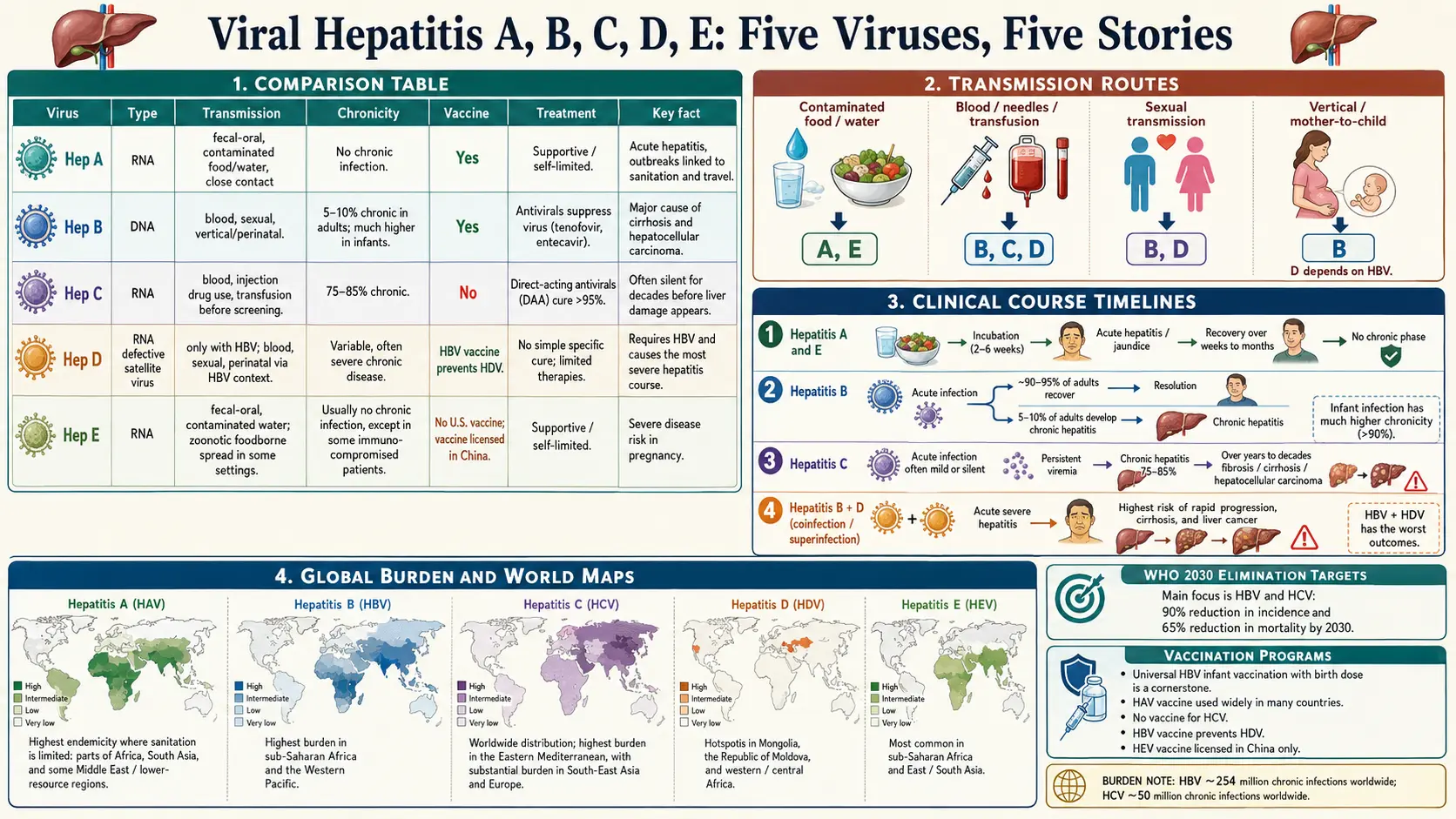
Five unrelated viruses — hepatitis A, B, C, D and E — cause most viral hepatitis worldwide. Hepatitis B and C cause most long-lasting (chronic) infections and most deaths from viral hepatitis; a 2019 review estimated that 257 million people were living with hepatitis B and 71 million with hepatitis C, and that most of them have no symptoms (Lanini 2019).
Types of Hepatitis
1. Hepatitis A
- Cause: Hepatitis A virus (HAV), typically spread through contaminated food or water.
- Symptoms: Fever, fatigue, nausea, abdominal pain, and jaundice.
- Prevention: A vaccine and good hygiene. Hepatitis A is a vaccine-preventable disease (see Vaccines below).
- Prognosis: Usually self-limiting and does not lead to chronic infection.
2. Hepatitis B
- Cause: Hepatitis B virus (HBV), spread through contact with infectious body fluids, such as blood or semen.
- Symptoms: Acute symptoms can include fever, joint pain, and jaundice. Chronic infection may lead to liver damage, cirrhosis, or liver cancer.
- Prevention: A vaccine (see Vaccines below). The virus also spreads through shared needles and unprotected sex.
- Prognosis: Can become chronic, especially when contracted at birth or in early childhood.
3. Hepatitis C
- Cause: Hepatitis C virus (HCV), spread through contact with infected blood.
- Symptoms: Often asymptomatic in the early stages but can lead to chronic liver disease over time.
- Prevention: No vaccine against hepatitis C exists (CDC 2020). The virus spreads mainly through infectious blood, most commonly through shared needles in injection drug use, and also through contaminated blood products and unprotected sex.
- Prognosis: Chronic infection can lead to serious liver complications, but modern antiviral treatments can often cure hepatitis C virus.
4. Hepatitis D
- Cause: Hepatitis D virus (HDV), which only occurs in people infected with hepatitis B.
- Symptoms: Similar to hepatitis B but more severe and can accelerate liver damage.
- Prognosis: Can lead to chronic liver disease and cirrhosis.
- Treatment research: Bulevirtide blocks hepatitis D virus from entering liver cells. In a phase 3 trial of 150 people with chronic hepatitis D (Wedemeyer 2023), the combined response at 48 weeks (virus undetectable or down at least 100-fold, plus a normal ALT liver enzyme level) occurred in 45% with 2 mg a day and 48% with 10 mg a day, against 2% in people not yet treated; the virus became undetectable in 12% and 20%. Headache, itching, fatigue and injection-site reactions were more common with the drug, and no treatment-related serious side effects occurred.
5. Hepatitis E
- Cause: Hepatitis E virus (HEV), usually spread through contaminated water.
- Symptoms: Jaundice, fatigue, nausea, and abdominal pain.
- Prevention: Safe drinking water and good hygiene.
- Prognosis: Usually self-limiting but can be severe in pregnant women and those with weakened immune systems.
Symptoms of Hepatitis
- Fatigue
- Jaundice: Yellowing of the skin and eyes.
- Dark urine
- Pale stool
- Abdominal pain or discomfort
- Nausea and vomiting
- Loss of appetite
- Joint pain
Diagnosis
- Blood tests: To detect liver enzymes and specific antibodies indicating the type of hepatitis.
- Imaging tests: Ultrasound, computed tomography (CT) scan, or magnetic resonance imaging (MRI) to assess liver damage.
- Liver biopsy: A sample of liver tissue may be taken to assess the extent of liver damage.
Treatment Options
- Hepatitis A and E: Typically require rest, hydration, and supportive care as the body clears the virus.
- Hepatitis B and D:
- Acute phase: May require only supportive care.
- Chronic phase: Antiviral medications can help reduce viral load and liver damage. For hepatitis D, see the bulevirtide trial above.
- Hepatitis C:
- Direct-acting antivirals (DAAs): Highly effective in curing chronic hepatitis C virus infection. According to the CDC, 8–12 weeks of all-oral direct-acting antiviral medicine cures most people (CDC 2020).
- Trial figures: In the ION-1 trial (865 previously untreated people with genotype 1 hepatitis C), a once-daily ledipasvir-sofosbuvir tablet for 12 weeks cured 99% (no virus detectable 12 weeks after the end of treatment, called a sustained virologic response). Across the trial's four groups — 12 or 24 weeks, with or without ribavirin — cure rates were 97–99% (Afdhal 2014).
- Screening: Since 2020 the CDC recommends hepatitis C screening at least once in a lifetime for all adults aged 18 and older, and during every pregnancy, except in settings where fewer than 0.1% of people are infected. More than half of people who catch the virus develop chronic infection (CDC 2020).
- Lifestyle adjustments: Reducing alcohol consumption and maintaining a healthy diet to protect the liver.
Prevention Strategies
- Good hygiene practices: Hand washing and safe food handling.
- Safe sexual practices: Using protection to reduce the risk of transmission.
- Not sharing needles: Shared needles spread hepatitis B and C.
- Vaccines: Hepatitis A and hepatitis B can be prevented by vaccines; there is no hepatitis C vaccine (see below).
- Safe drinking water: Essential to prevent hepatitis A and E.
Complications of Hepatitis
- Cirrhosis: Scarring of the liver that can lead to liver failure.
- Liver cancer: Increased risk, particularly with chronic hepatitis B and C.
- Liver failure: Severe cases can result in acute or chronic liver failure.
- Other systemic effects: Such as kidney problems and blood disorders.
Vaccines That Prevent Hepatitis A and B
- Hepatitis A: The U.S. Advisory Committee on Immunization Practices (ACIP) describes hepatitis A as a vaccine-preventable disease. Antibodies made after vaccination give long-term immunity. ACIP recommends routine vaccination of children aged 12–23 months, catch-up vaccination for children and teenagers aged 2–18 who have not had it, and vaccination for adults at risk of infection or severe disease and for any adult who asks for protection (Nelson 2020).
- Hepatitis B: Hepatitis B vaccines have shown safety, the ability to produce immunity, and effectiveness over the past 4 decades. In 2022 ACIP extended routine hepatitis B vaccination to all adults aged 19–59, removing the earlier step of asking about risk factors first, because vaccination rates in adults had stayed low (Weng 2022).
- Hepatitis C: No vaccine against hepatitis C exists, and no effective medicine is available to prevent infection before or after exposure (CDC 2020).
Historical Background
The concept of infectious hepatitis dates back to ancient times, but modern understanding began in the 1940s when researchers distinguished between "infectious hepatitis" (hepatitis A) and "serum hepatitis" (hepatitis B). Saul Krugman's studies at Willowbrook State School in the 1950s-1960s demonstrated two distinct forms of viral hepatitis. The identification of hepatitis A virus by Stephen Feinstone in 1973 and hepatitis B surface antigen by Baruch Blumberg in 1965 were pivotal milestones.
Key Research Papers
- Alter MJ. Epidemiology of hepatitis C in the West. Seminars in Liver Disease. 1995;15(1):5-14. — doi:10.1055/s-2007-1007259
- Dienstag JL. Hepatitis B virus infection. New England Journal of Medicine. 2008;359(14):1486-1500. — doi:10.1056/NEJMra0801644
- Lanini S, Ustianowski A, Pisapia R, Zumla A, Ippolito G. Viral Hepatitis: Etiology, Epidemiology, Transmission, Diagnostics, Treatment, and Prevention. Infectious Disease Clinics of North America. 2019;33(4):1045-1062. — PubMed PMID: 31668190
- Polaris Observatory Collaborators. Global prevalence, treatment, and prevention of hepatitis B virus infection in 2016: a modelling study. The Lancet Gastroenterology & Hepatology. 2018;3(6):383-403. — PubMed PMID: 29599078
- Feinstone SM, Kapikian AZ, Purcell RH. Hepatitis A: detection by immune electron microscopy of a viruslike antigen associated with acute illness. Science. 1973;182(4116):1026-1028. — doi:10.1126/science.182.4116.1026
- Choo QL, Kuo G, Weiner AJ, et al. Isolation of a cDNA clone derived from a blood-borne non-A, non-B viral hepatitis genome. Science. 1989;244(4902):359-362. — doi:10.1126/science.2523562
- Wedemeyer H, Manns MP. Epidemiology, pathogenesis, and management of hepatitis D: update and challenges ahead. Nature Reviews Gastroenterology & Hepatology. 2010;7(1):31-40. — doi:10.1038/nrgastro.2009.205
- Kamar N, Dalton HR, Abravanel F, Izopet J. Hepatitis E virus infection. Clinical Microbiology Reviews. 2014;27(1):116-138. — doi:10.1128/cmr.00057-13
- Afdhal N, Zeuzem S, Kwo P, et al. Ledipasvir and sofosbuvir for untreated HCV genotype 1 infection. New England Journal of Medicine. 2014;370(20):1889-1898. — doi:10.1056/NEJMoa1402454
- Terrault NA, Lok ASF, McMahon BJ, et al. Update on prevention, diagnosis, and treatment of chronic hepatitis B: AASLD 2018 hepatitis B guidance. Hepatology. 2018;67(4):1560-1599. — doi:10.1002/hep.29800
- Liang TJ, Ghany MG. Current and future therapies for hepatitis C virus infection. New England Journal of Medicine. 2013;368(20):1907-1917. — doi:10.1056/nejmra1213651
- Schillie S, Wester C, Osborne M, Wesolowski L, Ryerson AB. CDC Recommendations for Hepatitis C Screening Among Adults - United States, 2020. MMWR Recommendations and Reports. 2020;69(2):1-17. — PubMed PMID: 32271723
- Weng MK, Doshani M, Khan MA, et al. Universal Hepatitis B Vaccination in Adults Aged 19-59 Years: Updated Recommendations of the Advisory Committee on Immunization Practices - United States, 2022. MMWR Morbidity and Mortality Weekly Report. 2022;71(13):477-483. — PubMed PMID: 35358162
- Nelson NP, Weng MK, Hofmeister MG, et al. Prevention of Hepatitis A Virus Infection in the United States: Recommendations of the Advisory Committee on Immunization Practices, 2020. MMWR Recommendations and Reports. 2020;69(5):1-38. — PubMed PMID: 32614811
- Wedemeyer H, Aleman S, Brunetto MR, et al. A Phase 3, Randomized Trial of Bulevirtide in Chronic Hepatitis D. New England Journal of Medicine. 2023;389(1):22-32. — PubMed PMID: 37345876
PubMed Topic Searches
The following PubMed topic searches retrieve current peer-reviewed literature on Hepatitis. Each link opens a live PubMed query so you always see the most recent publications.
- PubMed: Viral hepatitis review
- PubMed: Hepatitis A epidemiology vaccine
- PubMed: Hepatitis B global burden
- PubMed: Hepatitis C direct acting antiviral
- PubMed: Hepatitis E pregnancy outcome
- PubMed: Autoimmune hepatitis diagnosis treatment
- PubMed: Alcoholic hepatitis corticosteroid
- PubMed: Drug induced liver injury hepatitis
- PubMed: Hepatitis cirrhosis progression
- PubMed: Hepatocellular carcinoma hepatitis
- PubMed: Milk thistle silymarin hepatitis
Connections
- Infectious Disease
- Hepatitis C
- Hepatitis B
- Jaundice
- Fatigue
- Abdominal Pain
- Cirrhosis
- Joint Pain
- Liver Disease
- Nausea and Vomiting
- Pale Stool
- Loss of Appetite
- Dark Urine
- Milk Thistle
- Non-Alcoholic Fatty Liver Disease
- Liver Cleansing
- Turmeric
- N-Acetylcysteine
- Vitamin D3
- Liver Cancer
- Mononucleosis
- Hepatitis Panel — the blood tests that confirm the diagnosis and distinguish acute, chronic, resolved, and vaccine-immune status.
- Hepatitis A
- Autoimmune Hepatitis
- Reishi Mushroom for Liver and Detoxification — the Gao 2002 chronic hepatitis B trial and reishi's anti-fibrotic mechanisms.
- Alcoholic Hepatitis — alcohol-induced liver inflammation, non-infectious but in the same differential; hepatitis C virus coinfection speeds its progression to cirrhosis.
- Herbs covered on this site that discuss this condition: Chanca Piedra (Phyllanthus niruri) · He Shou Wu (Fo-Ti) (Polygonum multiflorum / Reynoutria multiflora) · Licorice (Glycyrrhiza glabra) · Schisandra (Schisandra chinensis) · Andrographis (Andrographis paniculata) · Barberry (Berberis vulgaris)
- Discussed in depth on these pages: Tinospora and Liver Injury: The Autoimmune Hepatitis Reports · Noni Safety: Liver Case Reports, Potassium and Interactions · Arber, Nathans and Smith: The Molecular Scissors That Made Genetic Eng