Liver Disease
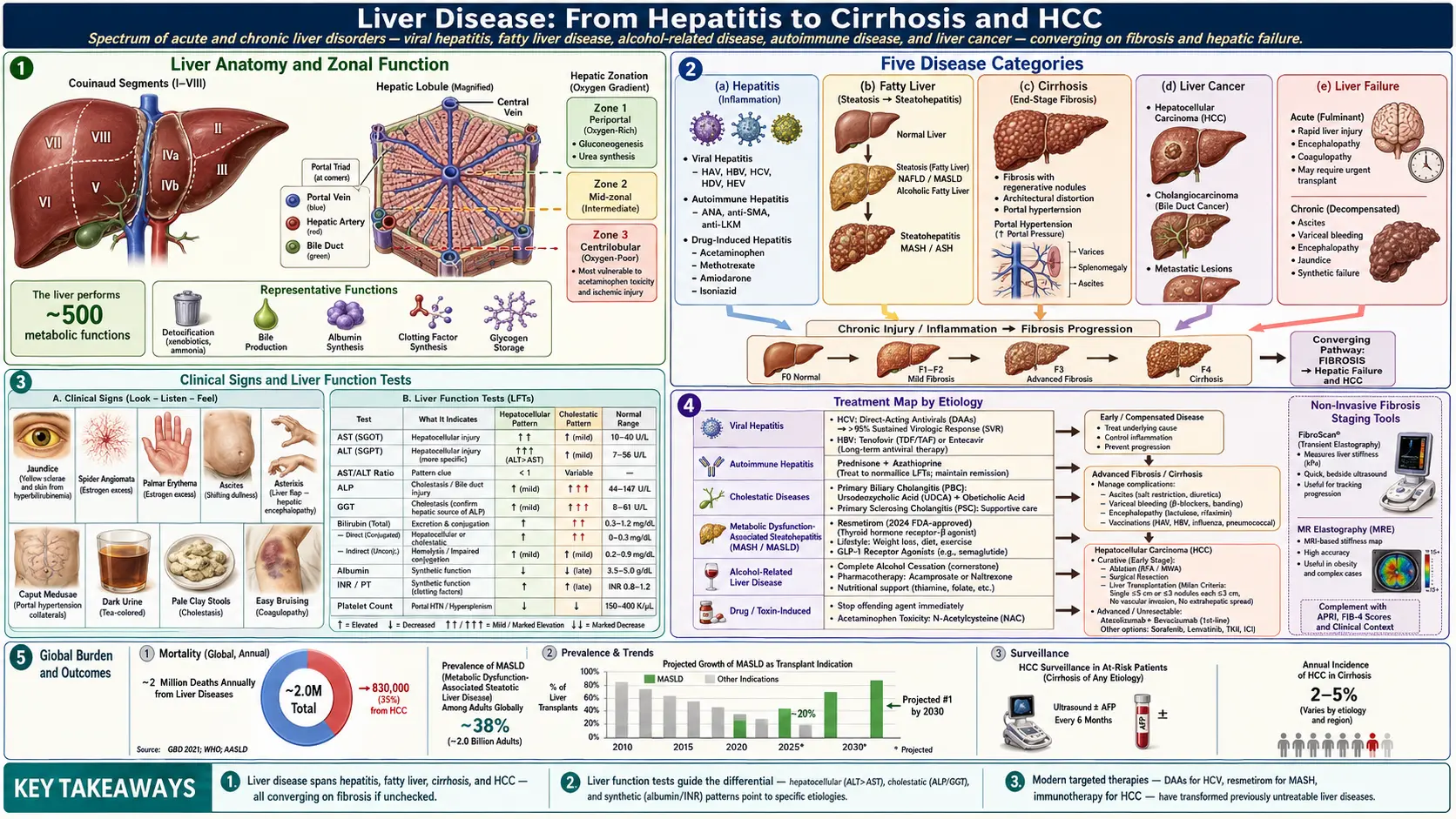
Table of Contents
What Liver Disease Is
Liver disease refers to any condition that damages the liver and affects its function. The liver plays a vital role in processing nutrients, filtering blood, and fighting infections. Liver diseases can be acute (short-term) or chronic (long-term) and can range from mild to severe, potentially leading to liver failure.
Types of Liver Disease
1. Hepatitis
- Inflammation of the liver caused by viruses (e.g., hepatitis A, B, C), alcohol use, or autoimmune conditions.
- Symptoms: Fatigue, jaundice, abdominal pain, and loss of appetite.
2. Fatty Liver Disease
- Metabolic dysfunction-associated steatotic liver disease (MASLD), formerly called non-alcoholic fatty liver disease (NAFLD): Fat buildup in the liver linked to metabolic problems rather than alcohol.
- Alcoholic fatty liver disease: Caused by excessive alcohol consumption.
Why the name changed in 2023. A consensus process led by three large liver associations, with 236 experts and patient advocates from 56 countries, replaced the name "non-alcoholic fatty liver disease" with "metabolic dysfunction-associated steatotic liver disease" (MASLD). "Steatotic" simply means fatty. Many respondents felt the words "non-alcoholic" and "fatty" were stigmatising. Under the new definition, a person has MASLD when there is fat in the liver plus at least one of five cardiometabolic risk factors (such as extra body weight, high blood sugar, high blood pressure, high triglycerides or low HDL cholesterol). The same consensus created a new group, metabolic and alcohol related/associated liver disease (MetALD), for people with MASLD who also drink more alcohol: 140–350 g a week for women and 210–420 g a week for men. A lab report or clinic letter that says "MASLD" describes the same disease older pages call NAFLD. More on this condition: Fatty Liver Disease (MASLD/NAFLD).
3. Cirrhosis
- Late stage of liver scarring (fibrosis) resulting from chronic liver damage.
- Causes: Chronic hepatitis, long-term alcohol abuse, and other liver diseases.
4. Liver Cancer
- Primary liver cancer: Begins in the liver cells, such as hepatocellular carcinoma (HCC).
- Secondary liver cancer: Cancer that spreads to the liver from other parts of the body.
5. Liver Failure
- Acute liver failure: Rapid loss of liver function, often due to drug overdose or viral hepatitis.
- Chronic liver failure: Develops gradually over time due to progressive damage.
Common Symptoms of Liver Disease
- Jaundice: Yellowing of the skin and eyes.
- Fatigue
- Swelling in the legs, ankles, or abdomen (ascites).
- Nausea and vomiting
- Dark urine
- Pale or clay-colored stools
- Abdominal pain, particularly in the upper right side.
- Bruising and bleeding easily
Causes and Risk Factors
- Chronic alcohol abuse
- Hepatitis infections: Hepatitis B and C are leading causes of chronic liver disease.
- Metabolic dysfunction-associated steatotic liver disease (MASLD), formerly called non-alcoholic fatty liver disease
- Genetic predisposition: Conditions like hemochromatosis and Wilson’s disease.
- Obesity and metabolic syndrome
- Exposure to toxins: Such as certain drugs and chemicals.
Diagnosis
- Physical examination: To check for signs like jaundice and liver enlargement.
- Blood tests: To measure liver enzymes, bilirubin, and other indicators of liver function.
- Imaging tests: Ultrasound, computed tomography (CT) scan, or magnetic resonance imaging (MRI) to assess liver structure and detect abnormalities.
- Liver biopsy: A sample of liver tissue is taken for detailed examination.
- FibroScan: A specialized ultrasound to assess liver stiffness (fibrosis).
Treatment Options
- Lifestyle changes:
- Less alcohol, or none: cutting down or stopping alcohol lowers alcohol-related liver damage.
- Body weight and diet: weight loss and a balanced diet are standard parts of care for fatty liver disease.
- Harmful substances: certain over-the-counter drugs and toxins can damage the liver.
- Medications:
- Antiviral drugs: For hepatitis B or C to reduce viral load and prevent liver damage.
- Medications to manage symptoms: Such as diuretics for fluid retention.
- Resmetirom: On 14 March 2024 the U.S. Food and Drug Administration (FDA) approved resmetirom, the first medicine for fatty-liver inflammation (steatohepatitis) with moderate to advanced scarring but not cirrhosis, to be used along with diet and exercise. It is a once-daily pill that acts on a thyroid hormone receptor in the liver. In its 966-person trial, the inflammation cleared without worse scarring in 25.9% (80 mg) and 29.9% (100 mg) of people on resmetirom versus 9.7% on placebo after 52 weeks, and scarring improved by at least one stage in 24.2% and 25.9% versus 14.2%. Diarrhea and nausea were more common on the drug; serious side effects were similar across groups.
- Semaglutide: In the ESSENCE trial (first 800 people with fatty-liver inflammation and moderate or advanced scarring), weekly semaglutide 2.4 mg injections cleared the inflammation without worse scarring in 62.9% versus 34.3% on placebo at 72 weeks, and reduced scarring in 36.8% versus 22.4%. Average weight change was −10.5% versus −2.0%. Stomach and bowel side effects were more common with semaglutide.
- Surgery:
- Liver transplant: For severe liver damage or failure.
- Partial liver resection: For localized liver cancer.
- Supportive therapies:
- Monitoring and regular follow-ups to assess liver health.
Prevention Strategies
- Lower alcohol intake lowers the risk of alcohol-related liver damage.
- A healthy diet and regular exercise lower the risk of fatty liver disease (MASLD).
- Safer sex lowers the risk of hepatitis B and C infection.
- Shared needles and unscreened blood transfusions spread hepatitis B and C; not sharing needles and screened blood lower that risk.
- Medicines and the liver: drug overdose is a common cause of acute liver failure. The over-the-counter acetaminophen (paracetamol) label carries a liver warning: severe liver damage may occur with more than the maximum daily amount, when it is taken with other acetaminophen-containing drugs, or with 3 or more alcoholic drinks a day.
Complications of Liver Disease
- Cirrhosis: Scar tissue formation that impairs liver function.
- Portal hypertension: Increased blood pressure in the veins that supply the liver.
- Ascites: Fluid accumulation in the abdomen.
- Liver cancer: Higher risk in chronic liver disease and cirrhosis patients.
- Liver failure: When the liver loses its ability to function properly.
- Kidney damage: Known as hepatorenal syndrome, which can occur in advanced liver disease.
Key Research Papers
- Schuppan D, Afdhal NH. Liver cirrhosis. The Lancet. 2008;371(9615):838-851. — doi:10.1016/s0140-6736(08)60383-9
- Younossi ZM, Koenig AB, Abdelatif D, et al. Global epidemiology of nonalcoholic fatty liver disease — meta-analytic assessment of prevalence, incidence, and outcomes. Hepatology. 2016;64(1):73-84. — doi:10.1002/hep.28431
- European Association for the Study of the Liver. EASL clinical practice guidelines: management of alcohol-related liver disease. Journal of Hepatology. 2018;69(1):154-181. — PubMed PMID: 29628280
- Rinella ME. Nonalcoholic fatty liver disease: a systematic review. JAMA. 2015;313(22):2263-2273. — doi:10.1001/jama.2015.5370
- Mokdad AA, Lopez AD, Shahraz S, et al. Liver cirrhosis mortality in 187 countries between 1980 and 2010: a systematic analysis. BMC Medicine. 2014;12:145. — doi:10.1186/s12916-014-0145-y
- Chalasani N, Younossi Z, Lavine JE, et al. The diagnosis and management of nonalcoholic fatty liver disease: practice guidance from AASLD. Hepatology. 2018;67(1):328-357. — doi:10.1002/hep.29367
- Singal AG, Lampertico P, Nahon P. Epidemiology and surveillance for hepatocellular carcinoma: new trends. Journal of Hepatology. 2020;72(2):250-261. — doi:10.1016/j.jhep.2019.08.025
- European Association for the Study of the Liver. EASL clinical practice guidelines on non-invasive tests for evaluation of liver disease severity and prognosis — 2021 update. Journal of Hepatology. 2021;75(3):659-689. — PubMed PMID: 34166721
- Bataller R, Brenner DA. Liver fibrosis. Journal of Clinical Investigation. 2005;115(2):209-218. — doi:10.1172/jci24282
- Martin P, DiMartini A, Feng S, Brown R Jr, Fallon M. Evaluation for liver transplantation in adults: 2013 practice guideline by the American Association for the Study of Liver Diseases and the American Society of Transplantation. Hepatology. 2014;59(3):1144-1165. — PubMed PMID: 24716201
- Friedman SL. Liver fibrosis — from bench to bedside. Journal of Hepatology. 2003;38(Suppl 1):S38-S53. — doi:10.1016/s0168-8278(02)00429-4
- Asrani SK, Devarbhavi H, Eaton J, Kamath PS. Burden of liver diseases in the world. Journal of Hepatology. 2019;70(1):151-171. — doi:10.1016/j.jhep.2018.09.014
- Rinella ME, Lazarus JV, Ratziu V, et al. A multisociety Delphi consensus statement on new fatty liver disease nomenclature. Hepatology. 2023;78(6):1966-1986. — PubMed PMID: 37363821
- Harrison SA, Bedossa P, Guy CD, et al. A Phase 3, Randomized, Controlled Trial of Resmetirom in NASH with Liver Fibrosis. New England Journal of Medicine. 2024;390(6):497-509. — PubMed PMID: 38324483
- Sanyal AJ, Newsome PN, Kliers I, et al. Phase 3 Trial of Semaglutide in Metabolic Dysfunction-Associated Steatohepatitis. New England Journal of Medicine. 2025;392(21):2089-2099. — PubMed PMID: 40305708
- U.S. Food and Drug Administration. FDA Approves First Treatment for Patients with Liver Scarring Due to Fatty Liver Disease. Press release, 14 March 2024. — fda.gov press release
Historical Background
The understanding of liver disease has evolved over centuries, from Hippocrates' descriptions of jaundice in ancient Greece to modern hepatology. Laennec first described cirrhosis in 1819, coining the term from the Greek word for "tawny" based on the liver's appearance. Thomas Starzl performed the first human liver transplant in 1963, and the procedure became a standard treatment for end-stage liver disease after the introduction of cyclosporine in the 1980s.
PubMed Topic Searches
Explore current literature on liver disease via PubMed topic searches. These links open live PubMed searches for the listed keywords — results update as new studies are indexed.
- Clinical trials on liver disease — PubMed search
- Clinical trials on non-alcoholic steatohepatitis NASH — PubMed search
- Clinical trials on viral hepatitis — PubMed search
- Clinical trials on autoimmune hepatitis — PubMed search
- Clinical trials on primary biliary cholangitis — PubMed search
- Clinical trials on hepatocellular carcinoma screening — PubMed search
- Clinical trials on liver transplantation — PubMed search
Connections
- Nephrology & Hepatology
- Cirrhosis
- Hepatitis
- Liver Cleansing — red flags that need a doctor — why pale stools and jaundice are not a "cleanse" problem
- Non-Alcoholic Fatty Liver Disease
- Hepatitis B
- Hemochromatosis
- Hepatitis C
- Gallbladder Disease
- Edema
- Jaundice
- Coffee and Liver Disease
- Resistant Starches for Fatty Liver
- Fatigue
- Abdominal Pain
- Obesity
- Metabolic Syndrome
- Hypertension
- Chanca Piedra: Liver Protection and Hepatitis B — hepatitis B virus-specific antiviral mechanism, niranthin vs nucleoside analogs, trial evidence on HBsAg/HBV-DNA, and adjunctive use with entecavir/tenofovir.
- Vitamin K
- Complete Blood Count
- Addiction
- Liver Cancer
- Methionine for Liver Health
- PT/INR — the clotting-time test built into the MELD and Child-Pugh prognostic scores.
- Herbs covered on this site that discuss this condition: Dandelion (Taraxacum officinale) · Skullcap · Uva Ursi · Chiretta (Swertia chirayita) · Coltsfoot · Black Ginger (Kaempferia parviflora)
- Discussed in depth on these pages: Hepatitis A · Javanese Turmeric and the Liver: Rich Rodent Evidence, No Human Trials · Ferritin Test: Iron Storage Protein and Reference Ranges
- Milk Thistle
- Toxins