Ulcerative Colitis
Interactive Visualization The Gut Barrier & Your Microbiome Watch fibre become butyrate and butyrate tighten the gut wall — then starve the microbes and see them eat your mucus layer instead. Launch →
Table of Contents
- What is Ulcerative Colitis?
- Common Symptoms of Ulcerative Colitis
- Extent and Severity
- Causes and Risk Factors
- Diagnosis
- Treatment Options
- Diet and Nutrition: What the Research Reports
- Probiotics, Faecal Transplants and Curcumin: What the Trials Show
- Long-Term Care: What the Guidelines Describe
- Complications of Ulcerative Colitis
- Key Research Papers
- Connections
- Featured Videos
What is Ulcerative Colitis?
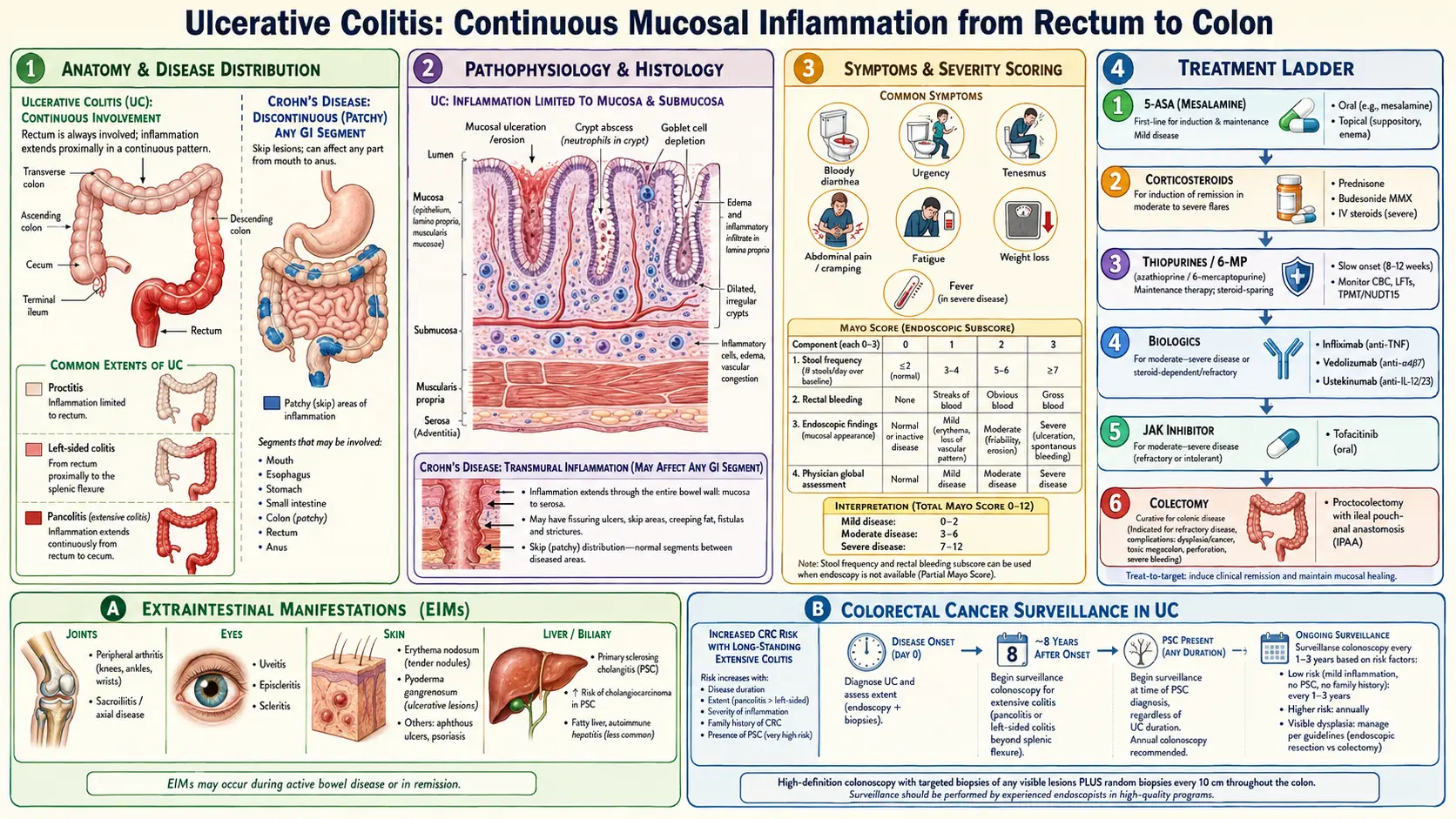
Ulcerative colitis is a chronic inflammatory bowel disease (IBD) of the large intestine. It inflames the inner lining (mucosa) of the colon, usually starting in the rectum and extending upward in a continuous stretch through part or all of the colon (Ordás 2012; Ungaro 2017). The 2025 American College of Gastroenterology (ACG) guideline describes it as a disease of unknown cause whose course is most often relapsing and remitting — flares alternating with periods of remission — while some people have persistent activity despite treatment and a small number present with a rapidly progressing, severe (fulminant) colitis (Rubin 2025). A 2017 Lancet review reports that up to 15% of patients first present with severe disease (Ungaro 2017).
How common it is. Using US commercial and public insurance data, the ACG guideline cites an incidence of 6.3 per 100,000 person-years and a prevalence of 305 per 100,000, extrapolated to about 1.25 million people living with ulcerative colitis in the United States in 2020 (Rubin 2025). A systematic review of population-based studies found the highest reported prevalence in Europe (505 per 100,000 in Norway) and North America (286 per 100,000 in the USA); 15 of 18 studies of ulcerative colitis in North America and Europe reported stable or decreasing incidence, while incidence has been rising since 1990 in newly industrialised countries in Africa, Asia and South America (Ng 2017).
Common Symptoms of Ulcerative Colitis
The ACG guideline states that ulcerative colitis should be suspected in people with blood in the stool, more frequent stools, or bowel urgency (Rubin 2025). Symptoms described in the guideline and in the Lancet review include:
- Bloody diarrhoea, often with mucus.
- Urgency, and sometimes incontinence.
- Tenesmus — a sense of rectal pressure or of needing to pass stool.
- Night-time bowel movements.
- Abdominal cramping — abdominal pain tends to be less of a hallmark than in Crohn’s disease (Ungaro 2017).
- Fatigue.
- Fever and weight loss, which can be present in severe disease.
The guideline also lists symptoms outside the bowel that a full history covers: joint pain or swelling, skin lesions, eye inflammation, mouth sores, and jaundice or itching that can point to liver or bile-duct involvement (Rubin 2025).
Extent and Severity
The ACG guideline groups ulcerative colitis by how much of the bowel is inflamed (Rubin 2025):
- Ulcerative proctitis: inflammation limited to the rectum.
- Left-sided colitis: inflammation extending from the sigmoid colon up to, but not beyond, the splenic flexure.
- Extensive colitis: inflammation beyond the splenic flexure, including pancolitis, which involves the entire colon and rectum.
The guideline’s figure of clinical patterns also shows proctosigmoiditis (rectum and sigmoid colon) as a traditional phenotype, along with a cecal-patch pattern and the relative rectal sparing seen with primary sclerosing cholangitis.
In population-based studies, 30–60% of patients have proctitis at presentation, 16–45% left-sided colitis and 14–35% extensive colitis; the disease extends further up the colon in 10–19% of patients after 5 years and in up to 28% at 10 years (Ungaro 2017). The guideline notes that the rectum is not involved in fewer than 5% of adults at diagnosis, but in up to a third of children with colitis onset (Rubin 2025).
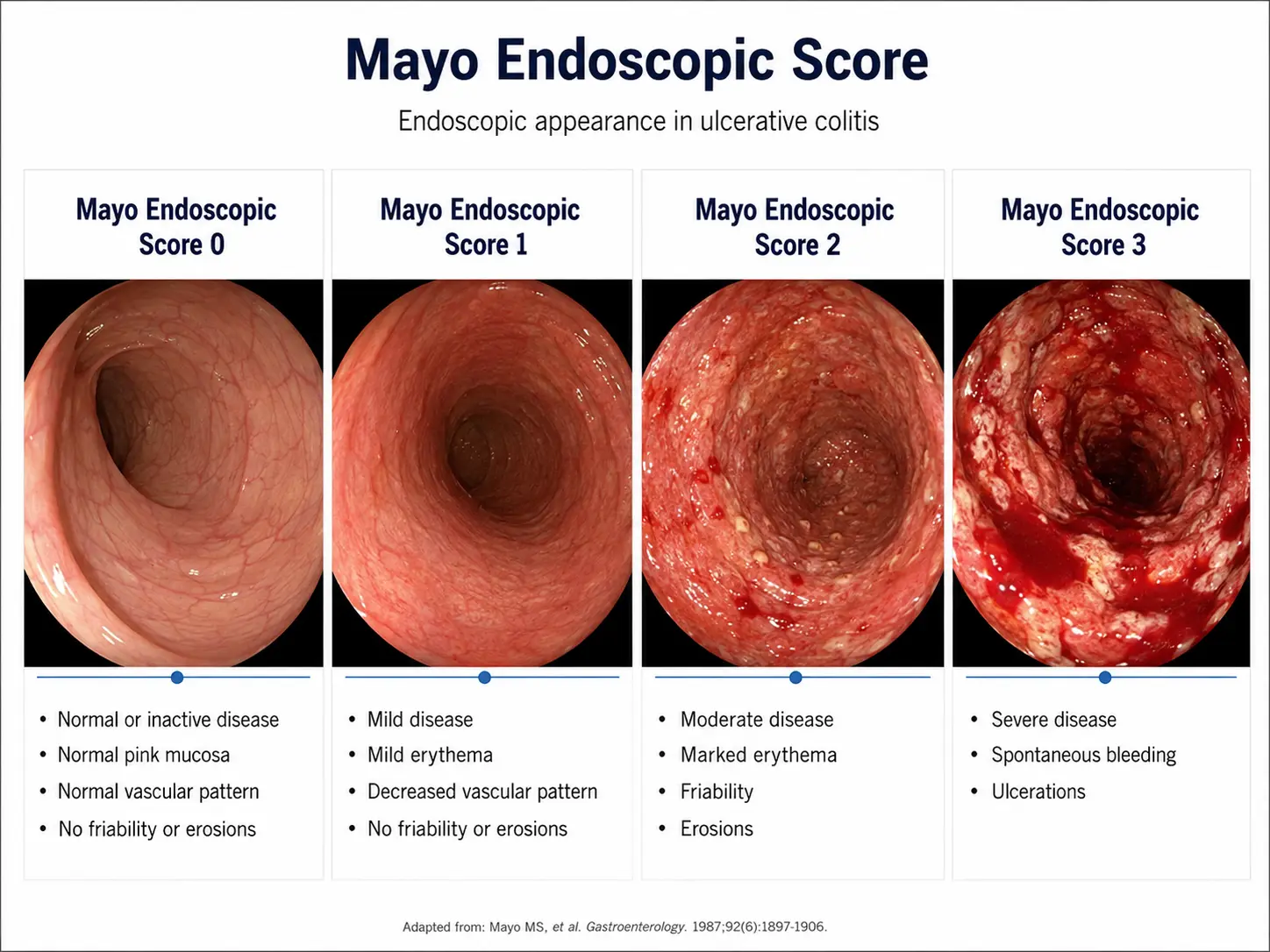
Severity is graded separately, as mild, moderate or severe, using symptoms, endoscopy (for example the Mayo endoscopic score, from 0 for normal or inactive mucosa to 3 for severely active disease), blood and stool markers, and the course of the disease. Acute severe ulcerative colitis is defined in the guideline as six or more bowel movements a day with at least one sign of systemic toxicity — a fast heart rate, fever, anaemia (haemoglobin below 10.5 g/dL) or a raised ESR (above 30 mm/hr). Historical cohorts cited by the guideline found that up to a quarter of people with ulcerative colitis may develop it and need hospital care, with colectomy in up to 40% of those patients (Rubin 2025).
Causes and Risk Factors
The ACG guideline states that the causes of ulcerative colitis remain complex and unknown (Rubin 2025). The Lancet review describes the disease as multifactorial, involving genetic predisposition, defects in the gut’s epithelial barrier, dysregulated immune responses and environmental factors (Ungaro 2017).
- Family history and genes: 8–14% of patients have a family history of IBD, and first-degree relatives have four times the risk (Ungaro 2017). A genome-wide meta-analysis of more than 75,000 cases and controls identified 163 IBD risk loci, most shared between Crohn’s disease and ulcerative colitis (Jostins 2012). The Lancet review notes that genetics explain only 7.5% of disease variance and are of limited clinical use.
- Age and sex: the disease can begin at any age. The ACG guideline describes onset as peaking in the third decade of life (Rubin 2025); the 2017 Lancet review gave a peak between ages 30 and 40 and reported no difference between the sexes (Ungaro 2017).
- Ethnicity: Jewish populations have higher rates of ulcerative colitis than other groups (Ungaro 2017).
- Smoking: former smoking is one of the strongest risk factors identified (odds ratio 1.79), while current smokers are less likely to develop ulcerative colitis (odds ratio 0.58) and have a milder course (Ungaro 2017); the ACG guideline lists recent smoking cessation among possible triggers of the first presentation or a relapse (Rubin 2025).
- Other associations reported in the Lancet review: appendectomy (especially for acute appendicitis in young people) with lower risk; a history of gastroenteritis; oral contraceptives, hormone replacement therapy and non-steroidal anti-inflammatory drugs (NSAIDs) with higher risk; breastfeeding with lower risk; urban living with higher risk. Pooled data from 11 European prospective studies found no association between stress and new-onset ulcerative colitis (Ungaro 2017).
- Diet: in a cohort of 116,087 adults in 21 countries, eating five or more servings of ultra-processed food a day, compared with less than one, was associated with a higher risk of developing IBD (hazard ratio 1.82, 95% CI 1.22–2.72), with consistent results for ulcerative colitis and Crohn’s disease; intakes of white meat, red meat, dairy, starch, fruit, vegetables and legumes were not associated with new IBD (Narula 2021).
Diagnosis
The ACG guideline describes diagnosis as resting on lower-bowel endoscopy with tissue confirmation (Rubin 2025):
- History and examination: stool frequency (including at night), the proportion of stools with visible blood, urgency, pain, weight loss and symptoms outside the bowel, plus possible triggers such as infection, NSAID use and recent smoking cessation.
- Stool tests: the guideline recommends testing for Clostridioides difficile in anyone suspected of having ulcerative colitis (strong recommendation, very low-quality evidence), and infections are excluded at diagnosis. Faecal calprotectin, a neutrophil protein that is stable in stool, had a pooled sensitivity of 0.88 and specificity of 0.79 for diagnosing ulcerative colitis and helps separate inflammatory disease from irritable bowel syndrome.
- Colonoscopy with examination of the end of the small bowel (terminal ileum) and biopsies of affected and unaffected areas confirms the diagnosis. In severe disease, complete colonoscopy may carry a greater risk of perforation, and the guideline describes a flexible sigmoidoscopy with biopsies as sufficient.
- Blood tests: C-reactive protein (CRP) and ESR often track endoscopic severity, although up to a quarter of people with endoscopically active disease have a normal CRP; haemoglobin and albumin help gauge severity and prognosis, and a low albumin is associated with a greater risk of hospitalisation and surgery. Anaemia, iron deficiency, raised white-cell or platelet counts can be present (Ungaro 2017).
- Antibody tests: the guideline recommends against serologic antibody testing (such as pANCA) to establish, rule out or predict the course of ulcerative colitis.
- Imaging: CT or MRI of the small bowel is not routinely needed when the terminal ileum looks normal, but may be useful when Crohn’s disease is suspected, when symptoms are not explained by endoscopy, or before surgery. The 2025 guideline adds intestinal ultrasound as a tool to measure activity and monitor response; in a meta-analysis of 16 IBD studies its pooled sensitivity was 85% and specificity 92%.
Treatment Options
The 2025 ACG guideline organises treatment by disease activity and prognosis, and separates treatment that induces remission from treatment that maintains it. It recommends treating to achieve endoscopic improvement (a Mayo endoscopic score of 0 or 1) to increase the likelihood of sustained steroid-free remission and to prevent hospitalisation and surgery (strong recommendation, moderate-quality evidence), and recommends faecal calprotectin to assess response, suspected relapse and maintenance (Rubin 2025). The figures below are those the guideline and the cited trials report.
Mildly to moderately active disease
- Aminosalicylates (5-ASA) — mesalamine, and the older sulfasalazine and olsalazine. The guideline recommends rectal 5-ASA 1 g daily for proctitis, suggests rectal plus oral 5-ASA over oral alone for left-sided disease, and recommends oral 5-ASA at least 2.0 g daily for extensive colitis. In mildly active disease it suggests 2.0–2.4 g a day rather than 4.8 g because remission rates did not differ, and it found once-daily and divided dosing equally effective. In a meta-analysis of 11 trials it cites, 60.3% of patients on 5-ASA failed to reach remission compared with 80.2% on placebo. For maintenance, it recommends rectal 5-ASA for proctitis and oral 5-ASA (at least 1.5 g a day) for left-sided or extensive disease.
- Corticosteroids — a colon-release oral budesonide formulation (9 mg a day) is recommended when 5-ASA does not work, and oral systemic corticosteroids are recommended for people of any disease extent who fail 5-ASA; the guideline gives typical prednisone starting doses of 40–60 mg a day and describes the duration as “as short as possible”. It recommends against systemic, colon-release or topical corticosteroids for maintaining remission (strong recommendation, moderate-quality evidence).
- Rectal tacrolimus or beclomethasone suppositories are suggested for proctitis that does not respond to topical 5-ASA (conditional recommendation, low-quality evidence).
- The guideline states that people with mildly to moderately active disease who also carry several poor-prognosis factors, or who do not respond to 5-ASA, are treated as having moderate-to-severe disease, and that response is reassessed within 8 weeks.
Moderately to severely active disease
For induction of remission the guideline recommends each of the following drug classes, and recommends continuing the same drug for maintenance in people who respond to it (Rubin 2025):
- Anti-TNF antibodies — infliximab (high-quality evidence), adalimumab and golimumab. The guideline describes infliximab as the preferred anti-TNF drug and recommends combining it with a thiopurine at induction. In the ACT 1 and ACT 2 trials, 69% and 61% of patients on infliximab 5 and 10 mg/kg had a clinical response at week 8 in ACT 1, compared with 37% on placebo, and 64% and 69% compared with 29% in ACT 2 (Rutgeerts 2005).
- Vedolizumab, an antibody against α4β7 integrin that the guideline describes as targeting the mucosal immune system of the gut. In GEMINI 1, the response rate at week 6 was 47.1% versus 25.5% on placebo, and at week 52, 41.8% of patients continuing vedolizumab every 8 weeks were in clinical remission versus 15.9% of those switched to placebo (Feagan 2013). The guideline recommends vedolizumab over adalimumab for induction and maintenance (strong recommendation, moderate-quality evidence).
- Interleukin-23 pathway antibodies — ustekinumab (which blocks the p40 subunit shared by IL-12 and IL-23) and guselkumab, mirikizumab and risankizumab (which block the p19 subunit of IL-23).
- Sphingosine-1-phosphate (S1P) receptor modulators — ozanimod and etrasimod, oral drugs that hold activated lymphocytes in the lymph nodes. In ozanimod’s phase 3 trial, 18.4% were in clinical remission at week 10 versus 6.0% on placebo. The guideline lists significant cardiovascular disease, severe untreated sleep apnoea, cardiac conduction defects and use of monoamine oxidase inhibitors as contraindications to ozanimod, and reports more transient bradycardia and liver-enzyme rises than with placebo.
- Janus kinase (JAK) inhibitors — tofacitinib (JAK 1, 2 and 3) and upadacitinib (selective JAK-1). In the OCTAVE induction trials, remission at week 8 was 18.5% and 16.6% with tofacitinib versus 8.2% and 3.6% with placebo, and herpes zoster and overall infections were more frequent with tofacitinib (Sandborn 2017). The guideline describes a safety trial in people with active rheumatoid arthritis and pre-existing cardiovascular disease (ORAL Surveillance) in which major cardiovascular events (3.4% vs 2.5%) and cancers (4.2% vs 2.9%) were more frequent with tofacitinib than with a TNF inhibitor; in the United States both tofacitinib and upadacitinib are labelled for use after an inadequate response to a TNF inhibitor and with caution in people with cardiovascular risk factors.
- Thiopurines (azathioprine, mercaptopurine) are slow-acting: the guideline recommends against thiopurine or methotrexate monotherapy for induction, suggests thiopurines for maintenance after steroid-induced remission, and suggests against methotrexate for maintenance.
The guideline notes that people respond better to their first advanced therapy than after one or more others have failed, and that no validated biomarker yet predicts which drug will work for a given person.
Acute severe ulcerative colitis
The guideline describes hospital care with intravenous corticosteroids, fluids and electrolytes; testing for C. difficile; a flexible sigmoidoscopy within 72 hours, with biopsies for cytomegalovirus; and assessment for toxic megacolon. It recommends rescue therapy with infliximab or cyclosporine, and surgical consultation, when there is not an adequate response to intravenous steroids by day 3. It states that NSAIDs, narcotics and drugs with anticholinergic effects should be avoided in acute severe colitis, and that hospitalised patients with acute colitis receive low-molecular-weight heparin to prevent blood clots (Rubin 2025).
Surgery
- Indications: the guideline lists acute severe colitis, chronic disease that does not respond to medical therapy (or steroid dependence), and dysplasia or cancer. Toxic megacolon, perforation, uncontrolled severe bleeding and multi-organ dysfunction are absolute indications, and delayed surgery for acute severe colitis is associated with more postoperative complications (Rubin 2025).
- Restorative proctocolectomy with ileal pouch-anal anastomosis (IPAA) removes the colon and rectum and builds a pouch from the small bowel so that stool passes through the anus; the guideline describes it as the surgical procedure of choice for refractory disease, often done in stages. Early postoperative complications occur in up to 33% of patients, later complications such as obstruction and strictures in up to 30%, and pouch failure rates are up to 5% (Ungaro 2017).
- Outcomes: a systematic review cited by the guideline found overall postoperative mortality of 1.0% after colectomy for ulcerative colitis (Rubin 2025). The chance of needing surgery has fallen over past decades but was 11.6% at 5 years and 15.6% at 10 years in the data the Lancet review cites (Ungaro 2017).
Diet and Nutrition: What the Research Reports
People with IBD often link symptoms to food. In a questionnaire of 400 consecutive IBD clinic patients (51% with ulcerative colitis), 57% felt diet could trigger a flare, 60% reported worse symptoms with certain foods, about two-thirds went without favourite foods to prevent relapse, and nearly half had never received formal dietary advice; the authors noted that whether the symptoms reflected active inflammation could not be determined (Limdi 2016). What studies of diet and disease activity report:
- No single diet prevents flares. The American Gastroenterological Association’s 2024 clinical practice update states that no diet has consistently been found to decrease the rate of flares in adults with IBD, and that a diet low in red and processed meat may reduce ulcerative colitis flares. Its first best-practice statement describes a Mediterranean diet rich in a variety of fresh fruits and vegetables, monounsaturated fats, complex carbohydrates and lean proteins, and low in ultra-processed foods, added sugar and salt, for overall health in people with IBD unless there is a contraindication (Hashash 2024).
- Meat and relapse. In a one-year cohort of 191 people with ulcerative colitis in remission, 52% relapsed; those in the top third of meat intake had higher odds of relapse than the bottom third (odds ratio 3.2), particularly for red and processed meat (odds ratio 5.19), as did high protein and alcohol intake. The authors called for studies of whether reducing these foods reduces relapse (Jowett 2004).
- Fibre. A systematic review of 23 randomised trials of fibre in IBD found that 3 of 10 trials in ulcerative colitis reported a benefit on disease outcomes, judged the evidence limited and weak, and found no evidence that fibre intake needs to be restricted in IBD, excluding overt bowel obstruction (Wedlake 2014). The AGA update notes that people with symptomatic intestinal strictures may not tolerate fibrous raw fruits and vegetables because of their texture, and that cooking or processing them to a soft consistency may allow a wider variety of plant foods and fibre (Hashash 2024).
- Expert guidance on specific foods. The International Organization for the Study of IBD (IOIBD) issued expert-opinion guidance on dietary components, food groups and food additives to increase or decrease in IBD; its summary states that in ulcerative colitis specific dietary components have been associated with flares (Levine 2020).
- Nutritional status. The AGA update describes regular screening for malnutrition in everyone with IBD, monitoring for vitamin D and iron deficiency, and access to a registered dietitian for newly diagnosed patients (Hashash 2024).
Probiotics, Faecal Transplants and Curcumin: What the Trials Show
- Probiotics to induce remission. A 2020 Cochrane review of 14 studies (865 participants) with mild-to-moderate ulcerative colitis found low-certainty evidence that probiotics may induce clinical remission compared with placebo (risk ratio 1.73, 95% CI 1.19–2.54; 9 studies), with high risk of bias in all but two studies and no evidence on severe or extensive disease or on whether any preparation is better than another (Kaur 2020). The ACG guideline states there is not sufficient evidence for routine use of probiotics, prebiotics or other alternative therapies as primary induction therapy; for one 8-strain probiotic used as an add-on to 5-ASA, it judged the evidence too low in quality to recommend for or against (Rubin 2025).
- Probiotics to maintain remission. A 2020 Cochrane review of 12 studies (1,473 participants) found it uncertain whether probiotics change relapse compared with placebo (risk ratio 0.87, 95% CI 0.63–1.18; very low certainty) and little or no difference compared with 5-ASA; it concluded that their effectiveness for maintenance remains unclear (Iheozor-Ejiofor 2020). The ACG guideline likewise finds insufficient evidence for probiotics as primary or add-on maintenance therapy.
- Faecal microbiota transplantation (FMT). The 2023 Cochrane review found that FMT may increase clinical remission in active ulcerative colitis compared with control (risk ratio 1.79, 95% CI 1.13–2.84; 10 studies, 468 participants; low-certainty evidence); the estimate for endoscopic remission included no effect, the evidence on serious adverse events was very uncertain, and the evidence for maintaining remission was very uncertain (Imdad 2023). The ACG guideline describes the trials as differing in donors, delivery and endpoints, states that FMT is not currently a recommended treatment option for ulcerative colitis, and notes that stringent donor testing and ongoing safety scrutiny further limit it (Rubin 2025).
- Curcumin. In a 50-patient trial in mild-to-moderate ulcerative colitis not responding to maximal mesalamine, adding curcumin 3 g a day for one month produced clinical remission at week 4 in 53.8% versus none on placebo, and endoscopic remission in 8 of 22 evaluated patients versus none of 16 (Lang 2015). A trial of a lower dose, 450 mg a day for 8 weeks with mesalamine, found no significant difference from placebo (remission 31.3% vs 27.3%) (Kedia 2017). In a 42-patient placebo-controlled trial of a combination of curcumin and the herbal preparation QingDai at 3 g a day for 8 weeks, the co-primary outcome was reached by 43% versus 8% (Ben-Horin 2024); the ACG guideline notes that other studies have linked higher doses of QingDai to rare pulmonary hypertension and states that further data are needed (Rubin 2025).
Long-Term Care: What the Guidelines Describe
- Monitoring. The ACG guideline describes routine visits to monitor for relapse, faecal calprotectin to track response and relapse, and objective tests (calprotectin, CRP, endoscopy or intestinal ultrasound) when a relapse is suspected, because symptoms alone can lag behind or miss inflammation (Rubin 2025).
- Relapse triggers. The guideline lists enteric infections (particularly C. difficile), NSAID use and recent smoking cessation, and notes that not taking medicines as prescribed is common — about 40% in the community — and is associated with relapse (Rubin 2025).
- Mental health. The guideline states that people with ulcerative colitis should be screened for coexisting anxiety and depression, which are more common during active disease (Rubin 2025).
- Colorectal cancer surveillance. The ACG guideline describes longstanding ulcerative colitis as carrying a defined risk of dysplasia and colorectal cancer, related mainly to more extensive and longstanding inflammation, states that control of mucosal inflammation may reduce dysplasia risk, and leaves surveillance to a separate ACG document (Rubin 2025). The 2017 Lancet review reports that this risk has fallen over time but remains raised with long disease duration, primary sclerosing cholangitis and uncontrolled inflammation; it describes surveillance colonoscopy every 1–2 years starting 8 years after diagnosis for extensive and left-sided colitis, standard screening for proctitis alone (which carries no increased risk), and yearly surveillance from diagnosis for people with primary sclerosing cholangitis, whose colorectal cancer risk is up to five times that of other patients; it notes that guidelines on surveillance vary between societies (Ungaro 2017).
- Vaccines, bones and skin. The Lancet review describes regular review of vaccination status, with live vaccines contraindicated during immunosuppression and hepatitis B status checked before anti-TNF treatment; osteoporosis screening after at least 3 months of corticosteroids; and skin checks, because thiopurines are associated with non-melanoma skin cancer (hazard ratio 5.9) and biological drugs with melanoma (odds ratio 1.88) (Ungaro 2017).
- Decisions about medicines, diet and monitoring belong with the clinician who knows the person’s disease.
Complications of Ulcerative Colitis
- Severe bleeding, perforation and toxic megacolon: absolute indications for surgery in acute severe colitis. Toxic megacolon develops in fewer than 5% of patients with acute severe colitis; on a plain X-ray, colonic dilation with a transverse colon wider than 5.5 cm predicts a worse outcome (Rubin 2025).
- Colorectal cancer and dysplasia: risk is linked to the extent and duration of inflammation and is higher with primary sclerosing cholangitis (see Long-Term Care above).
- Infections: C. difficile infection complicates a significant proportion of patients and is associated with hospitalisation, colectomy and death; cytomegalovirus colitis may affect up to a third of patients with acute severe colitis that does not respond to steroids (Rubin 2025).
- Extraintestinal manifestations: about a third of patients have them, and up to a quarter before their IBD is diagnosed. Peripheral arthritis is the most common; primary sclerosing cholangitis and pyoderma gangrenosum are more common in ulcerative colitis than in Crohn’s disease (Ungaro 2017).
- Blood clots: the risk of venous thromboembolism in IBD is increased three to four times, more so during a flare, in hospital or on corticosteroids (Ungaro 2017).
- Bone loss: osteoporosis screening is described after at least 3 months of corticosteroid treatment, in malnutrition, and with other risk factors (Ungaro 2017).
- Structural damage: benign strictures, poor colonic motility and anorectal dysfunction; in 5–10% of patients the diagnosis is later changed to Crohn’s disease (Ungaro 2017).
- Treatment complications: corticosteroid toxicity, infections on immunosuppressive drugs, herpes zoster on JAK inhibitors, and skin cancers on thiopurines and biologics (see Treatment Options and Long-Term Care).
- Mortality and work: the Lancet review reports no overall increase in mortality compared with the general population, but more disability that prevents work (Ungaro 2017); the ACG guideline describes significant morbidity with a low mortality (Rubin 2025).
Key Research Papers
Historical Background
Samuel Wilks is credited with first describing ulcerative colitis, in 1859 (Gajendran 2019); a historical review lists his account among the careful early descriptions of then-obscure intestinal inflammation and notes that the early history of the disease is entangled with infectious colitis (Kirsner 1988). Sulfasalazine, the first drug of the aminosalicylate family, was developed by Nanna Svartz, whose 1942 report in Acta Medica Scandinavica included therapeutic results in ulcerative colitis (Svartz 1942); she later described its discovery and development (Svartz 1988). The History of Ulcerative Colitis page covers this in more detail.
- Ordas I, Eckmann L, Talamini M, Baumgart DC, Sandborn WJ. Ulcerative colitis. The Lancet. 2012;380(9853):1606-1619. — doi:10.1016/S0140-6736(12)60150-0
- Danese S, Fiocchi C. Ulcerative colitis. N Engl J Med. 2011;365(18):1713-1725. — doi:10.1056/NEJMra1102942
- Rubin DT, Ananthakrishnan AN, Siegel CA, et al. ACG clinical guideline: ulcerative colitis in adults. Am J Gastroenterol. 2019;114(3):384-413. — doi:10.14309/ajg.0000000000000152 (updated by the 2025 guideline below)
- Feagan BG, Rutgeerts P, Sands BE, et al. Vedolizumab as induction and maintenance therapy for ulcerative colitis (GEMINI 1). N Engl J Med. 2013;369(8):699-710. — doi:10.1056/NEJMoa1215734
- Sandborn WJ, Su C, Sands BE, et al. Tofacitinib as induction and maintenance therapy for ulcerative colitis (OCTAVE). N Engl J Med. 2017;376(18):1723-1736. — doi:10.1056/NEJMoa1606910
- Rutgeerts P, Sandborn WJ, Feagan BG, et al. Infliximab for induction and maintenance therapy for ulcerative colitis (ACT trials). N Engl J Med. 2005;353(23):2462-2476. — doi:10.1056/nejmoa050516
- Ng SC, Shi HY, Hamidi N, et al. Worldwide incidence and prevalence of inflammatory bowel disease in the 21st century. The Lancet. 2017;390(10114):2769-2778. — doi:10.1016/S0140-6736(17)32448-0
- Harbord M, Eliakim R, Bettenworth D, et al. Third European evidence-based consensus on diagnosis and management of ulcerative colitis. Part 2: current management (ECCO). J Crohns Colitis. 2017;11(7):769-784. — doi:10.1093/ecco-jcc/jjx009 — carries a 2022 correction notice, amended in 2024, concerning cited studies of a multi-strain probiotic whose commercial formulation changed after 2016; an earlier expression of concern was withdrawn (correction notice: PubMed PMID: 35971821)
- Jostins L, Ripke S, Weersma RK, et al. Host-microbe interactions have shaped the genetic architecture of inflammatory bowel disease. Nature. 2012;491(7422):119-124. — doi:10.1038/nature11582
- Kornbluth A, Sachar DB. Ulcerative colitis practice guidelines in adults: American College of Gastroenterology Practice Parameters Committee. Am J Gastroenterol. 2010;105(3):501-523. — doi:10.1038/ajg.2009.727 (superseded by the 2019 and 2025 ACG guidelines)
- Ungaro R, Mehandru S, Allen PB, Peyrin-Biroulet L, Colombel JF. Ulcerative colitis. The Lancet. 2017;389(10080):1756-1770. — doi:10.1016/s0140-6736(16)32126-2
- Kaplan GG. The global burden of IBD: from 2015 to 2025. Nat Rev Gastroenterol Hepatol. 2015;12(12):720-727. — doi:10.1038/nrgastro.2015.150
- Rubin DT, Ananthakrishnan AN, Siegel CA, Barnes EL, Long MD. ACG clinical guideline update: ulcerative colitis in adults. Am J Gastroenterol. 2025;120(6):1187-1224. — PubMed PMID: 40701556 (correction published 2026: PubMed PMID: 41384833)
- Hashash JG, Elkins J, Lewis JD, Binion DG. AGA clinical practice update on diet and nutritional therapies in patients with inflammatory bowel disease: expert review. Gastroenterology. 2024;166(3):521-532. — PubMed PMID: 38276922
- Levine A, Rhodes JM, Lindsay JO, et al. Dietary guidance from the International Organization for the Study of Inflammatory Bowel Diseases. Clin Gastroenterol Hepatol. 2020;18(6):1381-1392. — PubMed PMID: 32068150
- Jowett SL, Seal CJ, Pearce MS, Phillips E, Gregory W, Barton JR, Welfare MR. Influence of dietary factors on the clinical course of ulcerative colitis: a prospective cohort study. Gut. 2004;53(10):1479-1484. — PubMed PMID: 15361498
- Wedlake L, Slack N, Andreyev HJ, Whelan K. Fiber in the treatment and maintenance of inflammatory bowel disease: a systematic review of randomized controlled trials. Inflamm Bowel Dis. 2014;20(3):576-586. — PubMed PMID: 24445775
- Limdi JK, Aggarwal D, McLaughlin JT. Dietary practices and beliefs in patients with inflammatory bowel disease. Inflamm Bowel Dis. 2016;22(1):164-170. — PubMed PMID: 26383912
- Narula N, Wong ECL, Dehghan M, et al. Association of ultra-processed food intake with risk of inflammatory bowel disease: prospective cohort study. BMJ. 2021;374:n1554. — PubMed PMID: 34261638
- Kaur L, Gordon M, Baines PA, et al. Probiotics for induction of remission in ulcerative colitis. Cochrane Database Syst Rev. 2020;3(3):CD005573. — PubMed PMID: 32128795
- Iheozor-Ejiofor Z, Kaur L, Gordon M, et al. Probiotics for maintenance of remission in ulcerative colitis. Cochrane Database Syst Rev. 2020;3(3):CD007443. — PubMed PMID: 32128794
- Imdad A, Pandit NG, Zaman M, et al. Fecal transplantation for treatment of inflammatory bowel disease. Cochrane Database Syst Rev. 2023;4(4):CD012774. — PubMed PMID: 37094824
- Lang A, Salomon N, Wu JC, et al. Curcumin in combination with mesalamine induces remission in patients with mild-to-moderate ulcerative colitis in a randomized controlled trial. Clin Gastroenterol Hepatol. 2015;13(8):1444-1449.e1. — PubMed PMID: 25724700
- Kedia S, Bhatia V, Thareja S, et al. Low dose oral curcumin is not effective in induction of remission in mild to moderate ulcerative colitis: results from a randomized double blind placebo controlled trial. World J Gastrointest Pharmacol Ther. 2017;8(2):147-154. — PubMed PMID: 28533925
- Ben-Horin S, Salomon N, Karampekos G, et al. Curcumin-QingDai combination for patients with active ulcerative colitis: a randomized, double-blinded, placebo-controlled trial. Clin Gastroenterol Hepatol. 2024;22(2):347-356.e6. — PubMed PMID: 37302449
- Gajendran M, Loganathan P, Jimenez G, et al. A comprehensive review and update on ulcerative colitis. Dis Mon. 2019;65(12):100851. — PubMed PMID: 30837080
- Kirsner JB. Historical aspects of inflammatory bowel disease. J Clin Gastroenterol. 1988;10(3):286-297. — PubMed PMID: 2980764
- Svartz N. Salazopyrin, a new sulfanilamide preparation. A. Therapeutic results in rheumatic polyarthritis. B. Therapeutic results in ulcerative colitis. C. Toxic manifestations in treatment with sulfanilamide preparations. Acta Med Scand. 1942;110(6):577-598. — doi:10.1111/j.0954-6820.1942.tb06841.x
- Svartz N. Sulfasalazine: II. Some notes on the discovery and development of salazopyrin. Am J Gastroenterol. 1988;83(5):497-503. — PubMed PMID: 2896459
PubMed Topic Searches
Curated PubMed topic searches of peer-reviewed literature on Ulcerative Colitis. Each link opens a live PubMed query so you always see the most current studies.
- PubMed: UC treatment guidelines
- PubMed: Mesalamine in UC
- PubMed: Biologic therapy in UC
- PubMed: Vedolizumab in UC
- PubMed: Tofacitinib in UC
- PubMed: Colectomy and IPAA
- PubMed: CRC surveillance
- PubMed: FMT in UC
- PubMed: Acute severe UC
- PubMed: Pediatric UC
- PubMed: UC and PSC
- PubMed: Quality of life in UC
Connections
- Gastroenterology
- The Gut Barrier & Your Microbiome — interactive animation
- Inflammatory Bowel Disease
- Crohn's Disease
- Irritable Bowel Syndrome
- Celiac Disease
- Crohn's vs Ulcerative Colitis
- Ankylosing Spondylitis
- AS and IBD Overlap
- Gut Healing
- Elimination Diet
- Turmeric
- Vitamin D3
- Zinc
- Diverticulitis
- Anemia
- Abdominal Pain
- Fatigue
- Osteoporosis
- Cancer
- Colorectal Cancer
- Herbs covered on this site that discuss this condition: Aloe Vera · Andrographis (Andrographis paniculata) · Boswellia · Wormwood · Chamomile (Matricaria chamomilla) · Elderberry (Sambucus nigra)
- Dr. Bryan Ardis: Nicotine and Ulcerative Colitis
- Probiotics