Rifaximin for SIBO: Doses Studied, Evidence and Safety
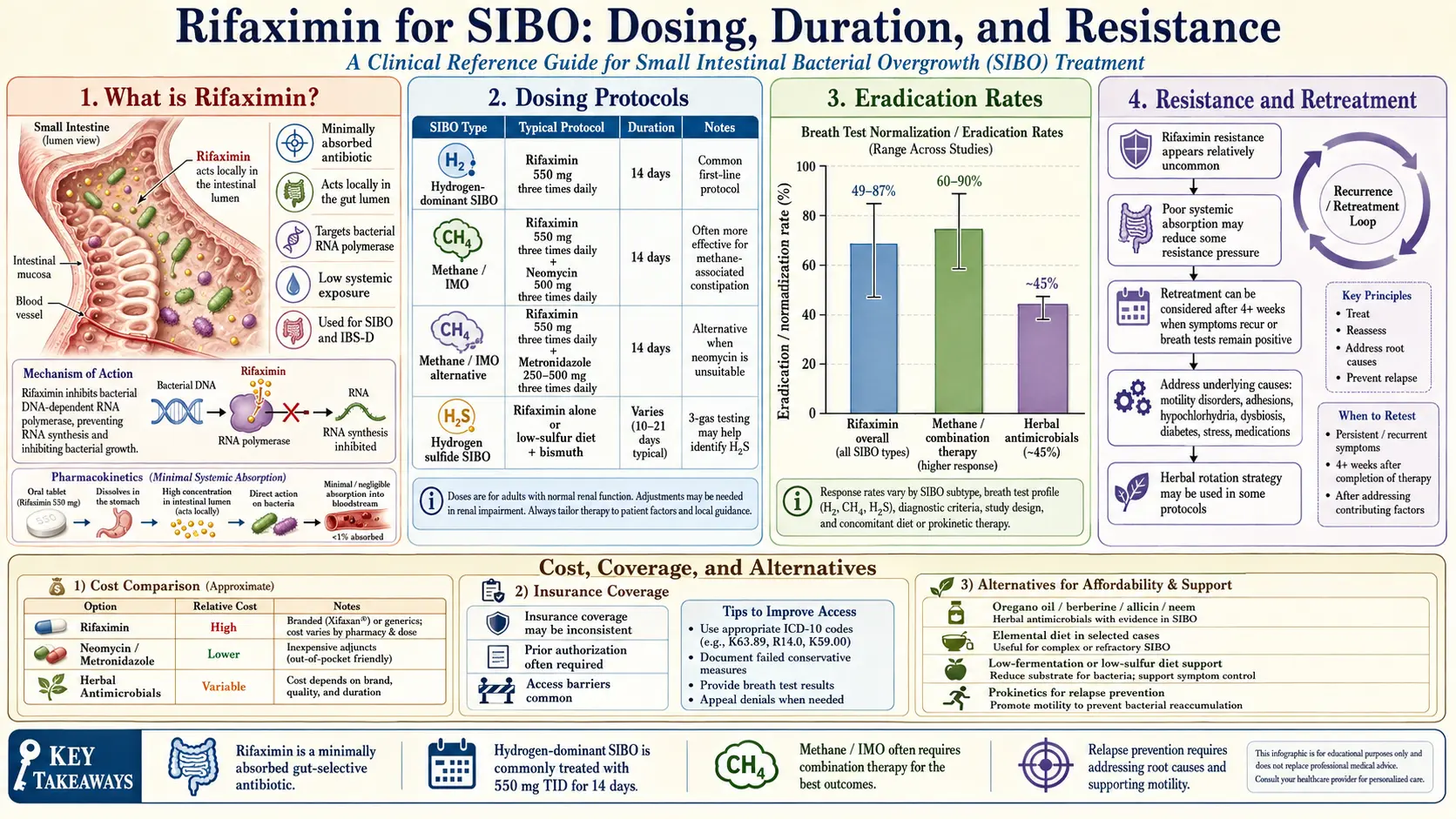
Table of Contents
- What Rifaximin Is
- Doses on the Label and in Studies
- How Effective It Has Been in Studies
- Methane-Positive Tests and Combination Therapy
- Hydrogen Sulfide Overgrowth
- Approved Uses, Cost and Coverage
- Retreatment
- Side Effects and Safety
- When a First Course Does Not Work
- Other Antibiotics Studied
- Prokinetics and Relapse
- Key Research Papers
- Connections
- Featured Videos
1. What Rifaximin Is
Rifaximin is an antibiotic of the rifamycin class, the family that also includes rifampin, used against tuberculosis. It is sold under different trade names in different countries; this page uses the generic name only.
Rifaximin is minimally absorbed from the gut. In the mass-balance study described on the US prescribing information, after a single 400 mg radiolabelled dose in healthy volunteers, 96.62% of the radioactivity was recovered in the feces, mostly as unchanged drug, and 0.32% in the urine (FDA label). The same label notes that systemic exposure is markedly higher in people with hepatic impairment than in healthy subjects. Because so little is absorbed, the drug acts mainly inside the gut lumen.
2. Doses on the Label and in Studies
The US prescribing information lists three approved uses, none of which is SIBO (FDA label):
- Travelers’ diarrhea caused by noninvasive strains of E. coli, in people aged 12 and older — 200 mg three times a day for 3 days
- Reduction in risk of overt hepatic encephalopathy recurrence in adults — 550 mg twice a day
- Irritable bowel syndrome with diarrhea (IBS-D) in adults — 550 mg three times a day for 14 days, with up to 2 retreatments with the same regimen for recurrence
The label states that the tablets can be taken with or without food. Use for SIBO is off-label, and the doses in SIBO studies vary:
- 1,200 mg a day for 4 weeks in the Chedid 2014 chart review (Chedid 2014)
- 1,200 mg a day for 1 week in an Italian recurrence cohort (Lauritano 2008)
- 400 mg three times daily for 10 days in a chart review of methane-positive IBS patients (Low 2010)
- 550 mg three times daily for 14 days in the IBS-D trials (Pimentel 2011), which selected patients by IBS symptoms rather than by breath test
A 2017 meta-analysis found that drug dose was one of three factors independently associated with a higher eradication rate across studies, and concluded that well-designed randomized trials are needed to establish the optimal regimen (Gatta 2017).
3. How Effective It Has Been in Studies
SIBO studies. A 2017 meta-analysis of 32 studies (1,331 patients) found an overall breath-test eradication rate of 70.8% by intention to treat (95% CI 61.4–78.2) and 72.9% per protocol, with adverse events in 4.6%. In the 10 studies that allowed the analysis, symptoms improved or resolved in 67.7% of patients whose SIBO was eradicated. The authors describe the quality of the available studies as generally poor (Gatta 2017). The 2020 ACG guideline describes the antibiotic data for SIBO as “small clinical trials of poor to modest quality”, and its suggestion of antibiotics for symptomatic SIBO is a conditional recommendation based on low-quality evidence (Pimentel 2020).
IBS trials. The TARGET 1 and TARGET 2 trials enrolled people with IBS without constipation and measured symptom relief rather than breath-test results. With rifaximin 550 mg three times daily for 2 weeks, 40.7% had adequate relief of global IBS symptoms in the first 4 weeks after treatment, against 31.7% with placebo in the two trials combined (P < 0.001); patients were followed for 10 weeks after treatment (Pimentel 2011). In an earlier randomized trial in 87 people with IBS, rifaximin 400 mg three times daily for 10 days gave greater improvement in IBS symptoms than placebo over 10 weeks of follow-up (Pimentel 2006).
Response lasting after treatment. In the TARGET 3 trial, 1,074 patients (44.1%) responded to an open-label course; of these responders, 382 (35.6%) did not relapse during an observation phase of up to 18 weeks and 692 (64.4%) did (Lembo 2016).
4. Methane-Positive Tests and Combination Therapy
Methane on a breath test is made by archaea, chiefly Methanobrevibacter smithii, rather than by bacteria. The 2020 ACG guideline proposed the term intestinal methanogen overgrowth (IMO) for this pattern (Pimentel 2020).
The main data on rifaximin in methane-positive patients come from a 2010 retrospective chart review of IBS patients with methane on their lactulose breath test (defined there as ≥3 ppm). Patients had received one of three 10-day regimens (Low 2010):
- Rifaximin 400 mg three times daily alone (39 patients) — methane cleared in 28%; clinical response in 56%
- Neomycin 500 mg twice daily alone (8 patients) — methane cleared in 33%; clinical response in 63%
- Rifaximin plus neomycin (27 patients) — methane cleared in 87%; clinical response in 85%
Of the patients whose methane did not clear on rifaximin alone, 66% normalized their breath test after a subsequent course of rifaximin plus neomycin. Neomycin is an aminoglycoside antibiotic; hearing and kidney toxicity are known effects of the aminoglycoside class, and the abstract of the chart review does not report adverse effects. The design was retrospective and the groups were small. Other approaches to methane, including statin-based research, are covered on the IMO page and in Hydrogen vs. Methane vs. Hydrogen Sulfide.
5. Hydrogen Sulfide Overgrowth
A third breath gas, hydrogen sulfide, can be measured with newer three-gas devices. In a 2022 study combining breath testing with stool sequencing in IBS patients, breath hydrogen sulfide was higher in diarrhea-predominant IBS and correlated with hydrogen-sulfide-producing bacteria in stool, including Fusobacterium and Desulfovibrio (Villanueva-Millan 2022). No trial-tested rifaximin regimen for hydrogen sulfide overgrowth is cited on this page.
Some practitioners combine rifaximin with bismuth subsalicylate, which binds hydrogen sulfide. The data behind the bismuth reasoning come from a 1998 study in 10 healthy volunteers, in which bismuth subsalicylate (524 mg four times a day for 3–7 days) reduced fecal hydrogen sulfide release by more than 95% (Suarez 1998). That study did not involve SIBO, and the combination has not been tested in a published trial cited here.
6. Approved Uses, Cost and Coverage
Because SIBO is not among the drug’s approved indications in the US (travelers’ diarrhea, hepatic encephalopathy and IBS-D), its use for SIBO is off-label, and insurance coverage for that use varies (FDA label). The Chedid authors described rifaximin in 2014 as expensive and not routinely covered by many commercial health plans in the United States, and reported a retail price of $1,247.39 for a month’s supply at that time (Chedid 2014). Prices and coverage change over time and differ between countries and insurers.
The 2020 ACG guideline’s statement on treatment suggests antibiotics for symptomatic SIBO as a conditional recommendation based on low-quality evidence (Pimentel 2020). Questions about prescriptions and coverage are handled between the prescriber, the pharmacy and the insurer.
7. Retreatment
For IBS-D, the US label allows up to 2 retreatments with the same 14-day regimen for patients who experience recurrence (FDA label). This rests on the TARGET 3 trial, in which patients who responded to an open-label course and then relapsed were randomized to repeat courses of rifaximin 550 mg or placebo three times daily for 2 weeks: 38.1% on rifaximin and 31.5% on placebo were responders after the first repeat course (P = 0.03), and adverse event rates were low and similar between groups (Lembo 2016).
In IBS patients treated for presumed bacterial overgrowth, a retrospective chart review recorded 16 occasions on which rifaximin was used as retreatment, and all of those patients improved (Yang 2008). Some practitioners describe repeated or scheduled courses for people whose underlying cause, such as systemic sclerosis or a surgical blind loop, cannot be corrected; that approach has not been tested in a trial cited here, and the studies cited did not measure long-term resistance.
8. Side Effects and Safety
The US prescribing information reports these adverse reactions in placebo-controlled trials (FDA label):
- IBS-D trials 1 and 2: nausea in 3% with rifaximin and 2% with placebo
- IBS-D retreatment trial: raised ALT (a liver enzyme) in 2% versus 1%, and nausea in 2% versus 1%
- Travelers’ diarrhea trials: headache is listed among reactions in 2% or more
- Hepatic encephalopathy trial (people with cirrhosis): peripheral edema, nausea, constipation, dizziness, fatigue, urinary tract infection, insomnia, anemia, pruritus and ascites were each reported in 10% or more
The label’s warnings and precautions include:
- Hypersensitivity — rifaximin is contraindicated in people hypersensitive to rifaximin or other rifamycins; reported reactions include exfoliative dermatitis, angioneurotic edema and anaphylaxis
- Clostridioides difficile-associated diarrhea
- Severe (Child-Pugh C) hepatic impairment — increased systemic exposure
- P-glycoprotein inhibitors such as cyclosporine — can substantially increase systemic exposure to rifaximin
- Warfarin — changes in INR have been reported after marketing in people taking both drugs
- Pregnancy — there are no human data, and teratogenic effects were seen in rats and rabbits
In the Chedid chart review, adverse effects in the rifaximin group were 1 case of anaphylaxis, 2 of hives, 2 of diarrhea and 1 of C. difficile infection among 67 patients (Chedid 2014). Rifaximin is also approved for reducing the risk of overt hepatic encephalopathy recurrence: in the 2010 trial in 299 people with cirrhosis in remission from recurrent encephalopathy, 550 mg twice daily for 6 months reduced breakthrough episodes (22.1% versus 45.9% with placebo), with adverse event rates similar to placebo (Bass 2010).
9. When a First Course Does Not Work
A first course does not clear SIBO in everyone: the 2017 meta-analysis put the overall eradication rate at 70.8% (Gatta 2017), and in the Chedid review the follow-up breath test was negative in 23 of 67 (34%) after rifaximin (Chedid 2014). Approaches described in the studies after a first course fails include:
- Checking the dose and strength. The label lists 200 mg tablets for travelers’ diarrhea and 550 mg tablets for hepatic encephalopathy and IBS-D (FDA label).
- Testing for other gases. Methane and hydrogen sulfide are discussed in sections 4 and 5; in the 2010 chart review, 66% of methane-positive patients whose methane did not clear on rifaximin alone normalized their breath test after rifaximin plus neomycin (Low 2010).
- Rescue with other treatments. In the Chedid review, 8 of 14 rifaximin non-responders (57.1%) had a negative breath test after the herbal blends, and 6 of 10 (60%) after triple antibiotics — clindamycin 300 mg, metronidazole 250 mg and neomycin 500 mg, each three times daily (Chedid 2014). The herbal evidence is set out in Herbal Antimicrobials.
- An elemental diet. In a 2004 study of 93 IBS patients with an abnormal lactulose breath test, 80% had a normal test after 14 days of an exclusive elemental diet and 85% after up to 21 days (Pimentel 2004) — see Elemental Diet.
- Looking for an underlying cause — migrating motor complex dysfunction, ileocecal valve problems, adhesions, post-infectious anti-vinculin antibodies, hypothyroidism and long-term proton-pump-inhibitor use are discussed in Root Causes. Older age, a past appendectomy and long-term proton-pump-inhibitor use were associated with recurrence after rifaximin in the Italian cohort (Lauritano 2008).
10. Other Antibiotics Studied
Other antibiotics have been used for SIBO. A table in the Chedid paper, drawn from an earlier review, lists these regimens: amoxicillin-clavulanate 500 mg three times a day, cephalexin 250 mg four times a day, chloramphenicol 250 mg four times a day, ciprofloxacin 500 mg twice daily, doxycycline 100 mg twice daily, metronidazole 250 mg three times a day, neomycin 500 mg twice daily, norfloxacin 400 mg twice daily, rifaximin 400 mg three times a day, tetracycline 250 mg four times a day and trimethoprim-sulfamethoxazole one double-strength tablet twice daily (Chedid 2014).
Head-to-head data are limited. In a retrospective chart review of IBS patients treated for presumed bacterial overgrowth, 69% (58 of 84) had a clinical response to rifaximin, compared with 38% (9 of 24) with neomycin and 44% (27 of 61) with all non-rifaximin antibiotics (neomycin, doxycycline, amoxicillin/clavulanate and ciprofloxacin) (Yang 2008).
Unlike rifaximin, these drugs are absorbed into the bloodstream, and each carries its own label warnings — for example, the fluoroquinolones (ciprofloxacin, norfloxacin) carry a boxed warning that includes tendinitis and tendon rupture, metronidazole labels warn of a reaction with alcohol, and trimethoprim-sulfamethoxazole is contraindicated in people with sulfonamide hypersensitivity. Systemic antibiotics are also associated with C. difficile infection.
11. Prokinetics and Relapse
Recurrence after rifaximin is common. In the Italian cohort, 12.6% of patients were breath-test positive again at 3 months, 27.5% at 6 months and 43.7% at 9 months (Lauritano 2008).
Prokinetic drugs, which stimulate the fasting motor activity of the small intestine (the migrating motor complex), are used to try to delay relapse. In a 2009 chart review of 64 IBS patients whose symptoms and breath tests had resolved after antibiotics, those given no preventive treatment (6 patients) had symptoms return after an average of 59.7 days; with low-dose erythromycin 50 mg at bedtime (42 patients) the average was 138.5 symptom-free days, a difference that was not statistically significant (P = 0.08), and with tegaserod (16 patients) it was 241.6 days (P = 0.003 versus no prevention) (Pimentel 2009). Other prokinetics, including low-dose naltrexone, prucalopride and ginger, and the evidence for each are covered in Prokinetics & Relapse Prevention.
Key Research Papers
Trials, reviews and the prescribing information on rifaximin's efficacy, doses and safety in SIBO and IBS, including the TARGET program and combination regimens. Each citation links to the full text via DOI.
- Pimentel M, Lembo A, Chey WD, et al. Rifaximin Therapy for Patients with Irritable Bowel Syndrome without Constipation (TARGET 1 and TARGET 2). New England Journal of Medicine. 2011;364(1):22–32. — doi:10.1056/NEJMoa1004409
- Lembo A, Pimentel M, Rao SS, et al. Repeat Treatment with Rifaximin Is Safe and Effective in Patients with Diarrhea-Predominant Irritable Bowel Syndrome (TARGET 3). Gastroenterology. 2016;151(6):1113–1121. — doi:10.1053/j.gastro.2016.08.003
- Pimentel M, Park S, Mirocha J, Kane SV, Kong Y. The Effect of a Nonabsorbed Oral Antibiotic (Rifaximin) on the Symptoms of the Irritable Bowel Syndrome: A Randomized Trial. Annals of Internal Medicine. 2006;145(8):557–563. — doi:10.7326/0003-4819-145-8-200610170-00004
- Pimentel M, Saad RJ, Long MD, Rao SSC. ACG Clinical Guideline: Small Intestinal Bacterial Overgrowth. American Journal of Gastroenterology. 2020;115(2):165–178. — doi:10.14309/ajg.0000000000000501
- Rezaie A, Buresi M, Lembo A, et al. Hydrogen and Methane-Based Breath Testing in Gastrointestinal Disorders: The North American Consensus. American Journal of Gastroenterology. 2017;112(5):775–784. — doi:10.1038/ajg.2017.46
- Low K, Hwang L, Hua J, Zhu A, Morales W, Pimentel M. A Combination of Rifaximin and Neomycin Is Most Effective in Treating Irritable Bowel Syndrome Patients with Methane on Lactulose Breath Test. Journal of Clinical Gastroenterology. 2010;44(8):547–550. — doi:10.1097/mcg.0b013e3181c64c90
- Lauritano EC, Gabrielli M, Scarpellini E, et al. Small Intestinal Bacterial Overgrowth Recurrence after Antibiotic Therapy. American Journal of Gastroenterology. 2008;103(8):2031–2035. — doi:10.1111/j.1572-0241.2008.02030.x
- Yang J, Lee HR, Low K, Chatterjee S, Pimentel M. Rifaximin versus Other Antibiotics in the Primary Treatment and Retreatment of Bacterial Overgrowth in IBS. Digestive Diseases and Sciences. 2008;53(1):169–174. — doi:10.1007/s10620-007-9839-8
- Gatta L, Scarpignato C. Systematic Review with Meta-Analysis: Rifaximin Is Effective and Safe for the Treatment of Small Intestinal Bacterial Overgrowth. Alimentary Pharmacology & Therapeutics. 2017;45(5):604–616. — doi:10.1111/apt.13928
- Bass NM, Mullen KD, Sanyal A, et al. Rifaximin Treatment in Hepatic Encephalopathy. New England Journal of Medicine. 2010;362(12):1071–1081. — doi:10.1056/NEJMoa0907893
- Pimentel M, Chow EJ, Lin HC. Eradication of Small Intestinal Bacterial Overgrowth Reduces Symptoms of Irritable Bowel Syndrome. American Journal of Gastroenterology. 2000;95(12):3503–3506. — doi:10.1111/j.1572-0241.2000.03368.x
- Chedid V, Dhalla S, Clarke JO, et al. Herbal Therapy Is Equivalent to Rifaximin for the Treatment of Small Intestinal Bacterial Overgrowth. Global Advances in Health and Medicine. 2014;3(3):16–24. — doi:10.7453/gahmj.2014.019
- Pimentel M, Morales W, Lezcano S, et al. Low-dose nocturnal tegaserod or erythromycin delays symptom recurrence after treatment of irritable bowel syndrome based on presumed bacterial overgrowth. Gastroenterology & Hepatology (N Y). 2009;5(6):435–442. — PubMed PMID: 20574504
- Pimentel M, Constantino T, Kong Y, et al. A 14-day elemental diet is highly effective in normalizing the lactulose breath test. Digestive Diseases and Sciences. 2004;49(1):73–77. — PubMed PMID: 14992438
- Villanueva-Millan MJ, Leite G, Wang J, et al. Methanogens and hydrogen sulfide producing bacteria guide distinct gut microbe profiles and irritable bowel syndrome subtypes. American Journal of Gastroenterology. 2022;117(12):2055–2066. — PubMed PMID: 36114762
- Suarez FL, Furne JK, Springfield J, Levitt MD. Bismuth subsalicylate markedly decreases hydrogen sulfide release in the human colon. Gastroenterology. 1998;114(5):923–929. — PubMed PMID: 9558280
- US Food and Drug Administration. Rifaximin tablets: US prescribing information (FDA-approved label), DailyMed, version published January 2026. — DailyMed setid c5e8e2fd-7087-4b78-9181-cc259c0be2f1
PubMed Topic Searches
Live PubMed queries that update as new papers are indexed.
Connections
- Gastroenterology
- The Gut Barrier & Your Microbiome — interactive animation
- SIBO Overview
- Elemental Diet
- Root Causes
- Herbal Antimicrobials
- Prokinetics and Relapse Prevention
- Hydrogen vs Methane vs Hydrogen Sulfide
- Low-FODMAP Diet
- Breath Test Guide
- IMO and Constipation
- Irritable Bowel Syndrome
- Gut Healing
- Probiotics
- Berberine
- Bloating
- Constipation
- IBS Medications Guide
- GERD
- Liver Disease