SIBO Breath Test Guide
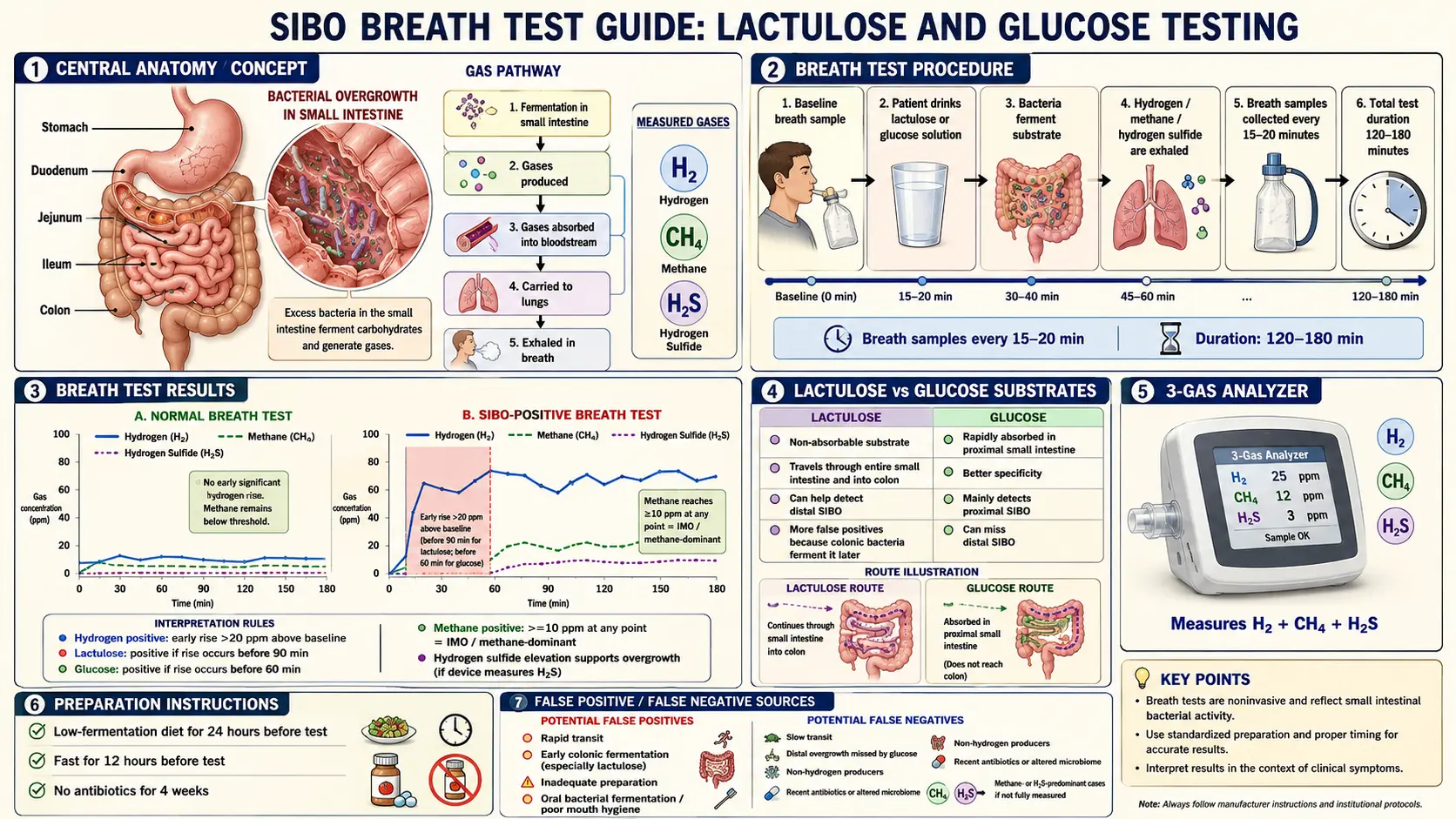
Table of Contents
- What a Breath Test Is Actually Measuring
- The Three Tests: Lactulose, Glucose and Three-Gas
- Test Preparation
- How Results Are Read
- False Negatives and False Positives
- Where Breath Tests Are Done
- After a Positive Test
- When the Test Is Negative but Symptoms Continue
- Key Research Papers
- Connections
- Featured Videos
1. What a Breath Test Is Actually Measuring
A SIBO breath test does not look at the gut directly. It measures gases in exhaled breath. The sequence is:
- The patient drinks a sugar solution — lactulose or glucose for SIBO.
- The sugar travels through the small intestine.
- If bacteria are present there in large numbers, they ferment the sugar.
- Fermentation produces hydrogen (H2), and some microbes convert hydrogen into methane (CH4) or hydrogen sulfide (H2S).
- Part of the gas diffuses into the blood, travels to the lungs and is breathed out.
- Breath samples are collected at intervals and the gas concentration is measured in parts per million (ppm).
The 2017 North American Consensus notes that hydrogen and methane in the gut are produced only by microbial fermentation, which is the principle behind breath testing (Rezaie 2017). (Hydrogen sulfide is different: human tissues also make small amounts of it.) The test is built around timing. Lactulose normally reaches the colon, where fermentation is expected, so a rise early in the test is read as fermentation in the small intestine. The consensus considers a hydrogen rise of ≥20 ppm by 90 minutes positive for SIBO (Rezaie 2017).
2. The Three Tests: Lactulose, Glucose and Three-Gas
Two substrates, lactulose and glucose, are used for SIBO breath testing; the consensus describes them as the least invasive ways to diagnose SIBO (Rezaie 2017). Standard devices measure hydrogen and methane; newer three-gas devices also measure hydrogen sulfide.
| Feature | Lactulose (LBT) | Glucose (GBT) | Three-gas test |
|---|---|---|---|
| Substrate dose | 10 g lactulose (consensus dose) | 75 g glucose (consensus dose) | Lactulose or glucose |
| Gases measured | H2, CH4 | H2, CH4 | H2, CH4, H2S |
| Positive H2 criterion (consensus) | Rise of ≥20 ppm from baseline by 90 min | Rise of ≥20 ppm from baseline by 90 min | Same as the substrate used |
| Positive CH4 criterion (consensus) | ≥10 ppm | ≥10 ppm | ≥10 ppm |
| H2S cut-off | Not measured | Not measured | Not set by the 2017 consensus; studies have used different cut-offs |
| Sensitivity (validation studies) | 31–68% | 20–93% | Not established in the studies cited here |
| Specificity (validation studies) | 44–100% | 30–86% | Not established in the studies cited here |
| Reach | Entire small bowel (distal reach) | Proximal only | Depends on the substrate |
The consensus doses, criteria and sensitivity ranges come from the 2017 North American Consensus, which cites a systematic review of the 11 studies that had tried to validate breath testing against culture (Rezaie 2017; Khoshini 2008). That review concluded that there is no validated diagnostic test or gold standard for SIBO (Khoshini 2008).
Lactulose Breath Test (LBT)
Lactulose is a synthetic sugar that humans do not absorb, so it travels the full length of the small intestine and into the colon. That allows it to reach bacteria in the distal small bowel, near the ileocecal valve. Because lactulose is always fermented once it reaches the colon, the timing of the rise matters: the consensus counts a hydrogen rise of ≥20 ppm by 90 minutes as positive for SIBO (Rezaie 2017). A 2011 review notes that the early-peak criterion on lactulose testing is often falsely positive (Ghoshal 2011).
Glucose Breath Test (GBT)
Glucose is absorbed in the upper small intestine, so a glucose test can only detect overgrowth that the glucose meets before it is absorbed. A 2014 review describes glucose as arguably the more accurate substrate (Saad 2014), and a 2011 review describes it as the more acceptable test for SIBO (Ghoshal 2011). In a 2026 nationwide study of 3,004 people having three-gas home breath tests, the SIBO criterion was met in 27% of lactulose tests and 7.3% of glucose tests, and the authors suggest glucose may miss some symptomatic patients (Pimentel 2026). Glucose tests can also be falsely positive: in a study that combined glucose breath tests with scintigraphy in 139 patients, 22 of the 46 positive results (48%) were caused by glucose reaching the colon, not by small-bowel bacteria; this was more common after upper gastrointestinal surgery (Lin 2016).
Three-Gas Testing
Three-gas devices measure hydrogen, methane and hydrogen sulfide on the same breath samples. The 2017 consensus noted that the meaning of a test with no methane and a low, flat hydrogen line was unclear, and that such tests had been suggested to reflect hydrogen-sulfide-producing bacteria, which the devices of the time could not detect (Rezaie 2017). In later research, breath hydrogen sulfide was higher in diarrhea-predominant IBS and correlated with hydrogen-sulfide-producing bacteria such as Fusobacterium and Desulfovibrio in stool (Villanueva-Millan 2022), and higher levels correlated with more severe diarrhea, urgency and abdominal pain (Pimentel 2026). Cut-offs differ between studies: one used ≥2 ppm (Pimentel 2026), another compared levels above and below 1.5 ppm (Villanueva-Millan 2025).
3. Test Preparation
Preparation affects the result because the test depends on how much fermentable material, and how many microbes, are in the gut at the time. The 2017 North American Consensus made these statements on preparation (Rezaie 2017):
- Antibiotics: it recommends that antibiotics be avoided for 4 weeks before the test.
- Probiotics and prebiotics: no firm position could be reached on stopping or continuing them.
- Promotility drugs and laxatives: it suggests stopping them at least 1 week before the test, if the patient can tolerate it. Faster transit delivers the substrate to the colon earlier and increases the chance of a false-positive result.
- Diet: it suggests avoiding fermentable foods such as complex carbohydrates on the day before the test; the text adds that meat and rice do not appear to affect the result.
- Fasting: it suggests a fasting period of 8–12 hours.
- Smoking: it recommends no smoking on the day of the test, because smoking raises exhaled hydrogen.
- Exercise: it recommends limiting physical activity during the test, because changes in breathing affect hydrogen levels.
- Proton-pump inhibitors: it suggests that stopping them before the test is not necessary.
Testing laboratories often add their own rules — a specific list of foods for the preparation day, or instructions about mouthwash, toothpaste or sleeping during the test. The consensus statements do not address those.
4. How Results Are Read
A breath test report lists gas readings in ppm at a baseline and at intervals afterwards, usually with a graph of each gas.
Hydrogen (H2) — a rise from baseline
For hydrogen, the consensus criterion for SIBO is a rise of ≥20 ppm from baseline by 90 minutes (Rezaie 2017). The consensus notes that the meaning of a high baseline hydrogen (above 20 ppm) is unclear: it may reflect incomplete fasting or diet preparation, or a variant of SIBO.
Methane (CH4) — a level, not a rise
For methane, the consensus suggests that a level of ≥10 ppm be considered positive (Rezaie 2017). It explains that people with excessive methane production often already have a raised methane level at baseline, and that methane rises less sharply than hydrogen, so the hydrogen-style cut-off is not used for methane. Methane on a breath test has been associated with constipation (Pimentel 2003).
Hydrogen Sulfide (H2S) — three-gas tests only
There is no consensus cut-off for hydrogen sulfide in the 2017 statements; the studies described in section 2 used their own thresholds. A 2018 meeting abstract reporting results from a new four-gas breath test machine describes competition for hydrogen between methane producers and hydrogen-sulfide producers, which is one explanation offered for a flat hydrogen curve when hydrogen sulfide is raised (Singer-Englar 2018).
The “Double Peak” Curve
An older way of reading lactulose tests looked for two peaks — an early one from the small intestine and a later one from the colon. The 2017 consensus suggests that two peaks are not required for the diagnosis of SIBO and states that, on current evidence, a double peak should not be used to diagnose SIBO and has no validity (Rezaie 2017). A 2011 review also describes the double-peak criterion as very insensitive (Ghoshal 2011).
5. False Negatives and False Positives
Breath tests miss some cases and flag some people without SIBO. Across validation studies, sensitivity ranged from 31% to 68% for lactulose and from 20% to 93% for glucose (Rezaie 2017; Khoshini 2008). Causes of misleading results described in the literature include:
- Recent antibiotics, which change hydrogen and methane output; the consensus recommends a 4-week gap (Rezaie 2017).
- Diet and fasting that leave fermentable material in the gut, which can raise the baseline (Rezaie 2017).
- Fast transit, from promotility drugs, laxatives or surgery, which can carry the substrate to the colon early and produce a false positive (Rezaie 2017; Lin 2016).
- Hydrogen sulfide producers on a two-gas test — the consensus noted that a flat test with no methane had been suggested to reflect hydrogen-sulfide-producing bacteria (Rezaie 2017). See Hydrogen vs. Methane vs. Hydrogen Sulfide.
- Glucose and distal overgrowth — glucose is absorbed in the upper small intestine, so overgrowth further down may not be reached.
- Smoking and exercise during or on the day of the test, which alter breath hydrogen (Rezaie 2017).
6. Where Breath Tests Are Done
Breath tests are done either in a clinic, where staff collect samples at set times over the 2–3 hours of the test, or with an at-home kit, in which the person collects breath samples into bags at set times and returns them for analysis. In the 2026 nationwide study, three-gas tests were done at home, and the choice of substrate was left to the ordering physician (Pimentel 2026). Prices, ordering rules and insurance coverage vary between laboratories, insurers and countries.
7. After a Positive Test
A positive breath test indicates fermentation where it is not expected; it does not show why the overgrowth developed. The treatments studied are covered on these pages:
- Antibiotics and herbal antimicrobials. Rifaximin is the most studied antibiotic, and in methane-positive patients a 2010 chart review found higher methane clearance with rifaximin plus neomycin than with either alone (Low 2010). The evidence for herbal antimicrobials rests mainly on the Chedid 2014 retrospective chart review, in which patients chose their treatment: the follow-up breath test was negative in 17 of 37 (46%) on commercial herbal blends and 23 of 67 (34%) on rifaximin (P = 0.24), a difference that was not statistically significant; the paper reported no non-inferiority margin, so it did not establish equivalence (Chedid 2014).
- Diet during treatment. A low-FODMAP diet is used for symptom relief, and an elemental diet has been studied as a treatment in itself.
- Relapse. In an Italian cohort, 43.7% of patients were breath-test positive again 9 months after successful rifaximin treatment (Lauritano 2008). See Prokinetics & Relapse Prevention and root causes.
The consensus lists the role of breath testing after therapy as a gap in knowledge (Rezaie 2017).
8. When the Test Is Negative but Symptoms Continue
A negative test does not rule SIBO out, because breath tests miss some cases (section 5). Approaches described in the literature include:
- Measuring a third gas. A two-gas test cannot detect hydrogen sulfide; three-gas testing is described in section 2.
- Reviewing the preparation. Recent antibiotics, promotility drugs, diet and fasting all affect the result (section 3).
- Antibody testing. Antibodies to cytolethal distending toxin B and to vinculin have been proposed as markers of post-infectious IBS; the vinculin link comes from work in a rat model of Campylobacter jejuni infection (Pimentel 2015). See Root Causes.
- Treatment trials. Because there is no validated gold standard, a 2008 systematic review concluded that the most practical way to evaluate SIBO in studies was a test, treat and outcome approach (Khoshini 2008).
- Small-bowel aspirate and culture. Fluid is taken from the small intestine during upper endoscopy and cultured. The consensus suggests a threshold of >103 colony-forming units per mL if culture is used, and notes that the mid and distal small bowel are beyond the reach of standard endoscopes, so aspirates can be falsely negative (Rezaie 2017).
- Other diagnoses with similar symptoms, including bile acid malabsorption, sucrase-isomaltase deficiency, pancreatic insufficiency, visceral hypersensitivity and pelvic floor dysfunction.
Key Research Papers
Foundational peer-reviewed literature on the diagnostic accuracy, methodology, and interpretation of breath testing for SIBO and intestinal methanogen overgrowth. Each citation links to the full text via DOI.
- Pimentel M, Saad RJ, Long MD, Rao SSC. ACG Clinical Guideline: Small Intestinal Bacterial Overgrowth. American Journal of Gastroenterology. 2020;115(2):165–178. — doi:10.14309/ajg.0000000000000501
- Rezaie A, Buresi M, Lembo A, et al. Hydrogen and Methane-Based Breath Testing in Gastrointestinal Disorders: The North American Consensus. American Journal of Gastroenterology. 2017;112(5):775–784. — doi:10.1038/ajg.2017.46
- Saad RJ, Chey WD. Breath Testing for Small Intestinal Bacterial Overgrowth: Maximizing Test Accuracy. Clinical Gastroenterology and Hepatology. 2014;12(12):1964–1972. — doi:10.1016/j.cgh.2013.09.055
- Khoshini R, Dai SC, Lezcano S, Pimentel M. A Systematic Review of Diagnostic Tests for Small Intestinal Bacterial Overgrowth. Digestive Diseases and Sciences. 2008;53(6):1443–1454. — doi:10.1007/s10620-007-0065-1
- Pimentel M, Chow EJ, Lin HC. Eradication of Small Intestinal Bacterial Overgrowth Reduces Symptoms of Irritable Bowel Syndrome. American Journal of Gastroenterology. 2000;95(12):3503–3506. — doi:10.1111/j.1572-0241.2000.03368.x
- Ghoshal UC. How to Interpret Hydrogen Breath Tests. Journal of Neurogastroenterology and Motility. 2011;17(3):312–317. — doi:10.5056/jnm.2011.17.3.312
- Pimentel M, Mayer AG, Park S, Chow EJ, Hasan A, Kong Y. Methane Production During Lactulose Breath Test Is Associated with Gastrointestinal Disease Presentation. Digestive Diseases and Sciences. 2003;48(1):86–92. — doi:10.1023/a:1021738515885
- Singer-Englar T, Rezaie A, Gupta K, et al. Competitive Hydrogen Gas Utilization by Methane- and Hydrogen Sulfide-Producing Microorganisms and Associated Symptoms: Results of a Novel 4-Gas Breath Test Machine. Gastroenterology. 2018;154(6 Suppl 1):S-47 (meeting abstract 182). — doi:10.1016/s0016-5085(18)30625-5
- Pimentel M, Constantino T, Kong Y, Bajwa M, Rezaei A, Park S. A 14-Day Elemental Diet Is Highly Effective in Normalizing the Lactulose Breath Test. Digestive Diseases and Sciences. 2004;49(1):73–77. — doi:10.1023/B:DDAS.0000011605.43979.e1
- Gasbarrini A, Corazza GR, Gasbarrini G, et al. Methodology and Indications of H2-Breath Testing in Gastrointestinal Diseases: The Rome Consensus Conference. Alimentary Pharmacology & Therapeutics. 2009;29(Suppl 1):1–49. — doi:10.1111/j.1365-2036.2009.03951.x
- Lin EC, Massey BT. Scintigraphy Demonstrates High Rate of False-Positive Results from Glucose Breath Tests for Small Bowel Bacterial Overgrowth. Clinical Gastroenterology and Hepatology. 2016;14(2):203–208. — doi:10.1016/j.cgh.2015.07.032
- Bures J, Cyrany J, Kohoutova D, et al. Small Intestinal Bacterial Overgrowth Syndrome. World Journal of Gastroenterology. 2010;16(24):2978–2990. — doi:10.3748/wjg.v16.i24.2978
- Villanueva-Millan MJ, Leite G, Wang J, et al. Methanogens and hydrogen sulfide producing bacteria guide distinct gut microbe profiles and irritable bowel syndrome subtypes. American Journal of Gastroenterology. 2022;117(12):2055–2066. — PubMed PMID: 36114762
- Villanueva-Millan MJ, Leite G, Mathur R, et al. Hydrogen sulfide and methane on breath test correlate with human small intestinal hydrogen sulfide producers and methanogens. Digestive Diseases and Sciences. 2025;70(11):3846–3856. — PubMed PMID: 40569514
- Pimentel M, Leite G, Joo L, et al. Real-world study of three-gas breath testing nationwide and the association with symptoms. Journal of Clinical Gastroenterology. 2026;60(5):406–417. — PubMed PMID: 41671534
- Chedid V, Dhalla S, Clarke JO, et al. Herbal therapy is equivalent to rifaximin for the treatment of small intestinal bacterial overgrowth. Global Advances in Health and Medicine. 2014;3(3):16–24. — PubMed PMID: 24891990
- Low K, Hwang L, Hua J, et al. A combination of rifaximin and neomycin is most effective in treating irritable bowel syndrome patients with methane on lactulose breath test. Journal of Clinical Gastroenterology. 2010;44(8):547–550. — PubMed PMID: 19996983
- Lauritano EC, Gabrielli M, Scarpellini E, et al. Small intestinal bacterial overgrowth recurrence after antibiotic therapy. American Journal of Gastroenterology. 2008;103(8):2031–2035. — PubMed PMID: 18802998
- Pimentel M, Morales W, Pokkunuri V, et al. Autoimmunity links vinculin to the pathophysiology of chronic functional bowel changes following Campylobacter jejuni infection in a rat model. Digestive Diseases and Sciences. 2015;60(5):1195–1205. — PubMed PMID: 25424202
PubMed Topic Searches
Live PubMed queries that update as new papers are indexed.
Connections
- Gastroenterology
- The Gut Barrier & Your Microbiome — interactive animation
- SIBO Overview
- Elemental Diet
- Root Causes
- Herbal Antimicrobials
- Prokinetics and Relapse Prevention
- Rifaximin Protocols
- Low-FODMAP Diet
- Hydrogen vs Methane vs Hydrogen Sulfide
- IMO and Constipation
- Irritable Bowel Syndrome
- Celiac Disease
- Post-Infectious IBS
- Bloating
- Constipation
- Gut Healing
- Magnesium
- Gut Microbiome
- IBS and SIBO Overlap
- Lactulose — the non-absorbable sugar used as the substrate in the standard SIBO breath test.