Herbal Antimicrobials for SIBO
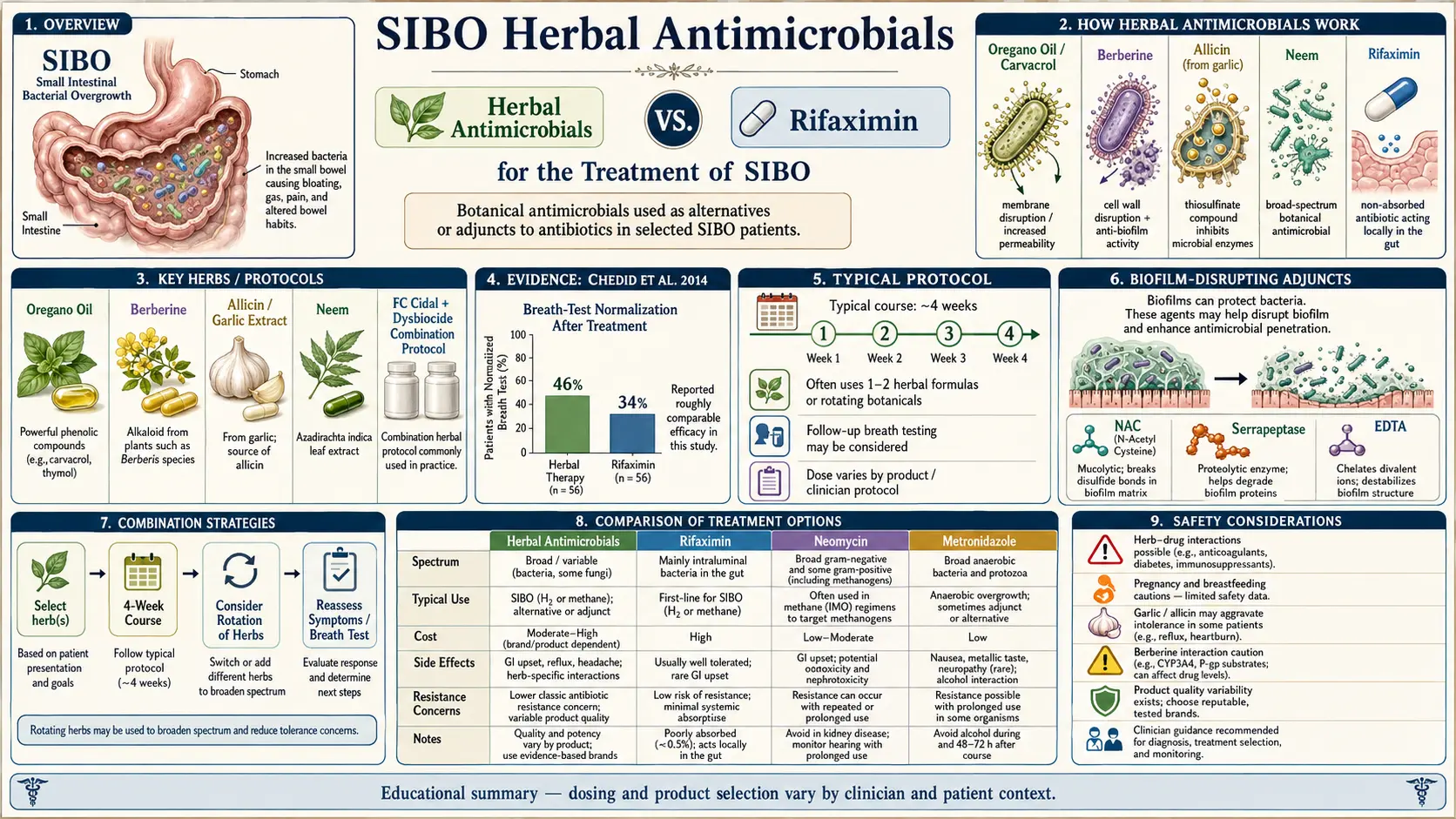
Table of Contents
- The Chedid 2014 Chart Review
- How Herbal Antimicrobials Work
- The Main Herbs and What the Research Reports
- The Commercial Blends in the Chedid Review
- Combinations Described by Practitioners
- Treatment Length in the Studies
- Herxheimer (Die-Off) Reactions
- Rotating Herbs After a Relapse
- Who the Research Raises Concerns For
- Herbs + Rifaximin Combined?
- Cost Comparison
- Other Parts of SIBO Care
- Key Research Papers
- Connections
- Featured Videos
1. The Chedid 2014 Chart Review
The study most often cited for herbal antimicrobials in SIBO is a retrospective chart review published in 2014 in Global Advances in Health and Medicine by Victor Chedid and colleagues from a tertiary-care gastroenterology practice at Johns Hopkins (Chedid 2014). In the paper’s limitations section the authors describe it as a retrospective chart review, not a prospective randomized controlled trial.
The analysis included 104 patients with newly diagnosed SIBO on a lactulose breath test who were treated and had a follow-up breath test. Patients chose, by individual preference, between two open-label options, each taken for 4 weeks and followed immediately by a repeat breath test:
- Rifaximin 1,200 mg a day (two 200 mg tablets three times daily) for 4 weeks — 67 patients.
- Herbal therapy — 2 capsules twice daily of one of two pairs of commercial multi-ingredient blends, for 4 weeks — 37 patients.
The results:
- The follow-up breath test was negative in 17 of 37 (46%) on herbal therapy and 23 of 67 (34%) on rifaximin (P = 0.24), a difference that was not statistically significant.
- Adjusted for age, sex, SIBO risk factors and IBS status, the odds ratio for a negative test with herbal therapy rather than rifaximin was 1.85 (95% CI 0.77–4.41, P = 0.17).
- Of 44 rifaximin non-responders, 14 were offered herbal rescue therapy and 8 of the 14 (57.1%) then had a negative breath test; 10 were offered triple antibiotics and 6 responded (60%, P = 0.89).
The authors concluded that herbal therapies “are at least as effective as rifaximin for resolution of SIBO by LBT” and called for prospective studies. The paper reports a P value for the difference and no non-inferiority margin, so it was not a formal non-inferiority or equivalence trial, despite the word “equivalent” in its title. Because patients chose their own treatment, the two groups may have differed in ways the analysis did not capture; diet was not controlled and symptoms were not assessed with a standardized questionnaire. The paper states that the authors completed the ICMJE conflict-of-interest form and that no conflicts were reported. The 2020 American College of Gastroenterology (ACG) guideline describes the antibiotic data for SIBO as “small clinical trials of poor to modest quality”, and its suggestion of antibiotics for symptomatic SIBO is a conditional recommendation based on low-quality evidence (Pimentel 2020).
2. How Herbal Antimicrobials Work
Prescription antibiotics are usually single compounds with a defined target — rifaximin binds bacterial RNA polymerase, metronidazole damages microbial DNA, and neomycin acts on the bacterial ribosome.
Plant extracts are mixtures of many compounds — volatile oils (carvacrol, thymol), alkaloids (berberine), organosulfur compounds (allicin, diallyl sulfides), flavonoids, tannins and saponins. Laboratory studies of individual compounds describe several mechanisms:
- Membrane disruption — phenolics such as carvacrol insert into bacterial lipid membranes, which then leak their contents
- Quorum-sensing interference — some plant compounds interfere with the chemical signals bacteria use to coordinate behaviour
- Effects on biofilms — some essential oils reduce biofilm formation in culture
- Efflux-pump inhibition — some plant alkaloids block the pumps bacteria use to expel antibiotics
Proponents argue that acting on several targets at once makes resistance harder to develop. That reasoning comes from laboratory work; it has not been tested in people with SIBO, and the Chedid review did not measure resistance. These are test-tube mechanisms, and they do not show what concentration of any compound reaches the small intestine after a capsule is swallowed.
3. The Main Herbs and What the Research Reports
No randomized trial has established a dose of any single herb for SIBO. The doses below are those used in the studies named; where no SIBO study exists, that is stated.
Oregano Oil
Oregano oil (Origanum vulgare) contains the phenolic monoterpenoids carvacrol and thymol. In the Chedid review, oregano oil (stated as providing 55% to 75% carvacrol) was one ingredient of one of the four commercial blends, alongside many other herbs, so the result applies to the blends rather than to oregano oil on its own (Chedid 2014). The only other human study usually cited is an uncontrolled 2000 study in 14 adults with intestinal parasites (not SIBO), which gave 600 mg a day of emulsified oregano oil for 6 weeks (Force 2000). Undiluted oregano essential oil is caustic to the lining of the mouth and gut. Both studies are set out on the Oregano for Antiparasitic Use and SIBO page.
Berberine
Berberine is a yellow alkaloid found in Hydrastis canadensis (goldenseal), Mahonia aquifolium (Oregon grape), Berberis vulgaris (barberry), Coptis chinensis and Phellodendron amurense. Berberine-containing extracts (coptis, Indian barberry and berberine sulfate) were among the Chedid blends’ ingredients (Chedid 2014). No trial of berberine alone in SIBO is cited on this page. In a randomized, double-blind, placebo-controlled trial in 132 people with diarrhea-predominant IBS (IBS-D, a different diagnosis from SIBO), berberine hydrochloride 400 mg a day, given in two doses for 8 weeks, reduced the frequency of diarrhea, abdominal pain and urgency compared with placebo (Chen 2015). In healthy men, berberine 300 mg three times daily for 2 weeks decreased the activity of the drug-metabolizing enzymes CYP2D6, CYP2C9 and CYP3A4 (Guo 2012). Berberine’s effects on blood glucose and cholesterol are covered on the Berberine page.
Allicin (Garlic)
Allicin is the organosulfur compound formed when garlic (Allium sativum) is crushed. It was not an ingredient of the Chedid blends. Practitioners use it for methane-positive SIBO (intestinal methanogen overgrowth, IMO) on the reasoning that it acts on methane-producing archaea. The evidence for that comes from livestock research rather than human trials: in a 2016 study in ewes, adding 2 g of allicin a day to the diet reduced methane emissions scaled to metabolic body weight by 5.95% (Ma 2016). No randomized trial of allicin in people with SIBO or IMO is cited on this page.
Neem
Neem (Azadirachta indica) is a traditional Ayurvedic antimicrobial. It was not an ingredient of the Chedid blends, and no human SIBO trial of neem is cited on this page.
Other Herbs in Combination Formulas
Several other herbs appear in commercial combination formulas:
- Goldenseal (Hydrastis canadensis) — a berberine source that also contains hydrastine; in healthy volunteers, 28 days of a goldenseal extract inhibited CYP2D6 and CYP3A4/5 activity by about 40% (Gurley 2005)
- Wormwood (Artemisia absinthium) — a traditional antiparasitic herb; an A. absinthium extract is listed among the Chedid blends’ ingredients
- Olive leaf extract (Olea europaea, source of oleuropein) — also listed among the Chedid blends’ ingredients
- Thyme oil (Thymus vulgaris, source of thymol) — red thyme oil is listed among the Chedid blends’ ingredients
- Uva ursi (Arctostaphylos uva-ursi, source of arbutin) and black walnut hull (Juglans nigra, source of juglone) — used in some practitioner formulas; no SIBO study of either is cited on this page
- Enteric-coated peppermint oil — a 2002 case report describes one patient with SIBO whose IBS-like symptoms improved and whose breath hydrogen fell after treatment (Logan 2002)
4. The Commercial Blends in the Chedid Review
The herbal group in the Chedid review took one of two pairs of commercial multi-ingredient blends, each pair from a different supplement company, at 2 capsules of each blend twice daily for 4 weeks (Chedid 2014). The paper’s ingredient table lists, across the four products, oregano oil, red thyme oil, sage and lemon balm extracts, berberine-containing extracts (coptis, Indian barberry and berberine sulfate), wormwood, olive leaf and more than a dozen other herbs. Oregano oil appears in one of the four products.
The paper reports results for the herbal group as a whole and does not compare the two pairs of blends with each other, so it does not show whether either pair, or any single ingredient, accounts for the result. The authors suggest that future studies consolidate the herbal regimen to a single agent so that randomization and blinding become possible.
5. Combinations Described by Practitioners
Integrative practitioners describe combining herbs according to the gas pattern on the breath test — for example berberine with oregano oil when hydrogen is raised, allicin-based combinations when methane is raised, and the addition of bismuth subsalicylate when hydrogen sulfide is raised. These combinations, and the doses used with them, come from practitioners rather than from trials; none has been compared with rifaximin, with placebo or with another combination in a published trial cited on this page.
The bismuth reasoning rests on a 1998 study in which bismuth subsalicylate (524 mg four times a day for 3–7 days) reduced the release of hydrogen sulfide from the feces of 10 healthy volunteers by more than 95% (Suarez 1998). That study measured fecal gas in healthy people; it did not study SIBO.
6. Treatment Length in the Studies
In the Chedid review, both the herbal blends and rifaximin (1,200 mg a day) were given for 4 weeks, followed immediately by a repeat breath test (Chedid 2014). The rifaximin courses in other studies were shorter: 1 week at 1,200 mg a day in an Italian recurrence cohort (Lauritano 2008), and 2 weeks at 550 mg three times daily in the IBS trials behind the drug’s approval for IBS with diarrhea (covered on the rifaximin page).
Practitioners give several reasons for longer herbal courses — lower antimicrobial potency per dose than a prescription drug, and the time needed to reach organisms in different growth states. These are explanations, not findings: no study cited here compared a 2-week with a 4-week herbal course.
7. Herxheimer (Die-Off) Reactions
The Jarisch–Herxheimer reaction was first described in the treatment of syphilis: a short-lived flare of fever, chills and aches after treatment begins. Practitioners use the term “die-off” for symptoms reported early in SIBO treatment, including:
- Flu-like fatigue
- Headache
- Brain fog
- Temporarily worse bloating, gas and bowel symptoms
- Body aches and night sweats
The explanation usually given is the release of bacterial endotoxins, such as lipopolysaccharide, as bacteria die. No study cited on this page measured such reactions in SIBO, and the only adverse effect recorded with the herbal blends in the Chedid review was 1 case of diarrhea (Chedid 2014). The use of binders such as activated charcoal, zeolite or chlorella during treatment is described by practitioners and has not been tested in SIBO trials. Worsening symptoms during treatment can also have other causes, including side effects of the treatment itself.
8. Rotating Herbs After a Relapse
SIBO often returns. In an Italian cohort of 80 patients whose glucose breath test normalized after rifaximin (1,200 mg a day for 1 week), 12.6% were positive again at 3 months, 27.5% at 6 months and 43.7% at 9 months; older age, a past appendectomy and long-term proton-pump-inhibitor use were associated with recurrence (Lauritano 2008). No comparable recurrence study after herbal treatment is cited on this page.
Practitioners describe rotating to a different herbal combination for each new course, on the reasoning borrowed from antibiotic stewardship that varying the selective pressure makes adaptation less likely. This has not been tested in a trial. Measures aimed at the underlying cause and at gut motility are covered on the Root Causes and Prokinetics and Relapse Prevention pages.
9. Who the Research Raises Concerns For
Herbal products are not automatically safer than prescription drugs, and the Chedid review is too small to rule out uncommon harms. The concerns raised in the research include:
- People taking other medicines. In healthy men, 2 weeks of berberine decreased CYP2D6, CYP2C9 and CYP3A4 activity, and the authors concluded that drug–drug interactions need to be considered when berberine is given (Guo 2012). In healthy volunteers, a goldenseal extract inhibited CYP2D6 and CYP3A4/5 activity by about 40% (Gurley 2005). These findings matter most for people taking drugs cleared by those enzymes.
- Pregnancy and breastfeeding. The Chedid review reports no data on pregnancy or breastfeeding, and there is no good safety data on these concentrated herbal blends in pregnancy.
- Children. The studies cited here were in adults; there is no good safety data on these blends in children.
- People with severe malabsorption or weight loss. The Chedid review did not report results by nutritional status, and no study cited here compared herbal treatment with other options in this group.
- People with plant allergies. Oregano, thyme, sage and lemon balm, all ingredients of the Chedid blends, belong to the mint family (Lamiaceae).
Decisions about supplements and medicines belong with a clinician.
10. Herbs + Rifaximin Combined?
Some integrative practitioners describe giving rifaximin and herbal antimicrobials together, or one after the other, for SIBO that has not responded to either alone. No randomized trial of this approach is cited on this page. The closest data are the Chedid review’s rescue results, in which 8 of 14 rifaximin non-responders had a negative breath test after a 4-week course of the herbal blends; the two treatments were given in sequence, not together (Chedid 2014).
11. Cost Comparison
The Chedid authors give these figures, from 2014:
- Herbal blends: the herbal therapy cost no more than $120 for a 30-day supply, and the authors note that it is traditionally not covered by commercial insurance.
- Rifaximin: the authors describe it as expensive and not routinely covered by many commercial health plans in the United States, and report a retail price of $1,247.39 for a month’s supply at the time; they also note that it was not approved by the US Food and Drug Administration for SIBO.
Prices and coverage change over time and differ between countries and insurers. The drug’s approved uses and the off-label status of SIBO treatment are covered on the rifaximin page.
12. Other Parts of SIBO Care
Clearing an overgrowth with antimicrobials is one part of SIBO care described in the literature. The others are covered on these pages:
- Prokinetics — drugs and herbs that stimulate gut motility, studied for delaying relapse after treatment — see Prokinetics & Relapse Prevention.
- Diet during treatment — a low-FODMAP diet reduces fermentable carbohydrate and is used for symptom relief; it is not a treatment that clears the overgrowth — see Low-FODMAP Diet.
- Underlying causes — hypothyroidism, adhesions, ileocecal valve dysfunction, post-infectious antibodies, proton-pump inhibitors and opioid effects on motility — see Root Causes.
Key Research Papers
- Chedid V, Dhalla S, Clarke JO, et al. Herbal therapy is equivalent to rifaximin for the treatment of small intestinal bacterial overgrowth. Global Advances in Health and Medicine. 2014;3(3):16–24. — doi:10.7453/gahmj.2014.019
- Pimentel M, Saad RJ, Long MD, Rao SSC. ACG Clinical Guideline: Small Intestinal Bacterial Overgrowth. American Journal of Gastroenterology. 2020;115(2):165–178. — doi:10.14309/ajg.0000000000000501
- Logan AC, Beaulne TM. The treatment of small intestinal bacterial overgrowth with enteric-coated peppermint oil: a case report. Alternative Medicine Review. 2002;7(5):410–417. — PubMed PMID: 12410625
- Chen C, Tao C, Liu Z, et al. A randomized clinical trial of berberine hydrochloride in patients with diarrhea-predominant irritable bowel syndrome. Phytotherapy Research. 2015;29(11):1822–1827. — doi:10.1002/ptr.5475
- Force M, Sparks WS, Ronzio RA. Inhibition of enteric parasites by emulsified oil of oregano in vivo. Phytotherapy Research. 2000;14(3):213–214. — PubMed PMID: 10815019
- Guo Y, Chen Y, Tan ZR, Klaassen CD, Zhou HH. Repeated administration of berberine inhibits cytochromes P450 in humans. European Journal of Clinical Pharmacology. 2012;68(2):213–217. — PubMed PMID: 21870106
- Gurley BJ, Gardner SF, Hubbard MA, et al. In vivo effects of goldenseal, kava kava, black cohosh, and valerian on human cytochrome P450 1A2, 2D6, 2E1, and 3A4/5 phenotypes. Clinical Pharmacology and Therapeutics. 2005;77(5):415–426. — PubMed PMID: 15900287
- Ma T, Chen D, Tu Y, et al. Effect of supplementation of allicin on methanogenesis and ruminal microbial flora in Dorper crossbred ewes. Journal of Animal Science and Biotechnology. 2016;7:1. — PubMed PMID: 26779340
- Suarez FL, Furne JK, Springfield J, Levitt MD. Bismuth subsalicylate markedly decreases hydrogen sulfide release in the human colon. Gastroenterology. 1998;114(5):923–929. — PubMed PMID: 9558280
- Lauritano EC, Gabrielli M, Scarpellini E, et al. Small intestinal bacterial overgrowth recurrence after antibiotic therapy. American Journal of Gastroenterology. 2008;103(8):2031–2035. — PubMed PMID: 18802998
PubMed Topic Searches
Live PubMed searches for the peer-reviewed literature on herbal antimicrobial therapy in SIBO and related gut conditions.
Connections
- Gastroenterology
- The Gut Barrier & Your Microbiome — interactive animation
- SIBO Overview
- Root Causes
- Low-FODMAP Diet
- Prokinetics and Relapse Prevention
- Rifaximin Protocols
- Hydrogen vs Methane vs Hydrogen Sulfide
- Breath Test Guide
- Elemental Diet
- IMO and Constipation
- Oregano
- Berberine
- Peppermint
- Neem
- Goldenseal
- Garlic
- Irritable Bowel Syndrome
- Celiac Disease
- Probiotics