Hydrogen vs. Methane vs. Hydrogen Sulfide SIBO
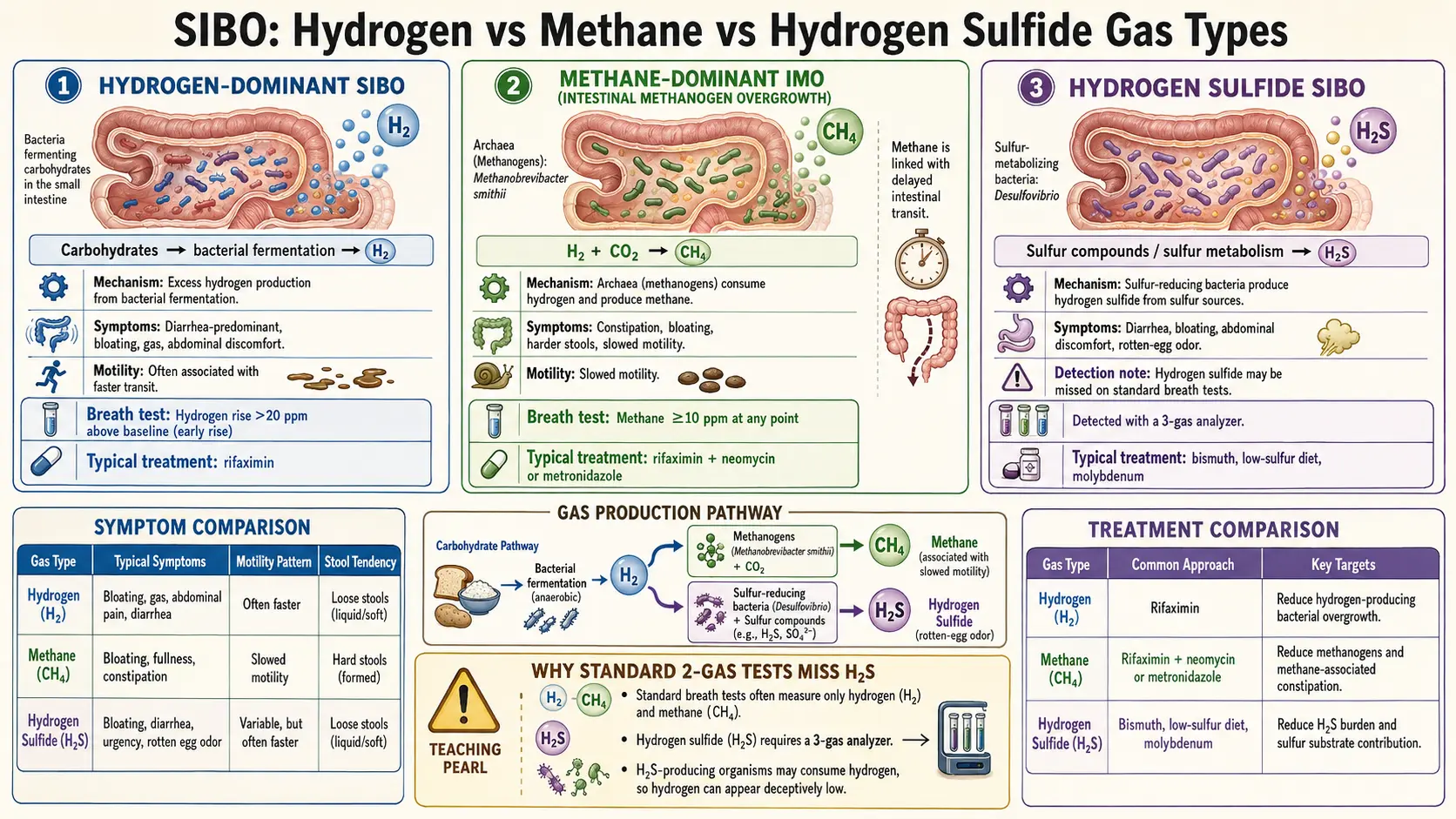
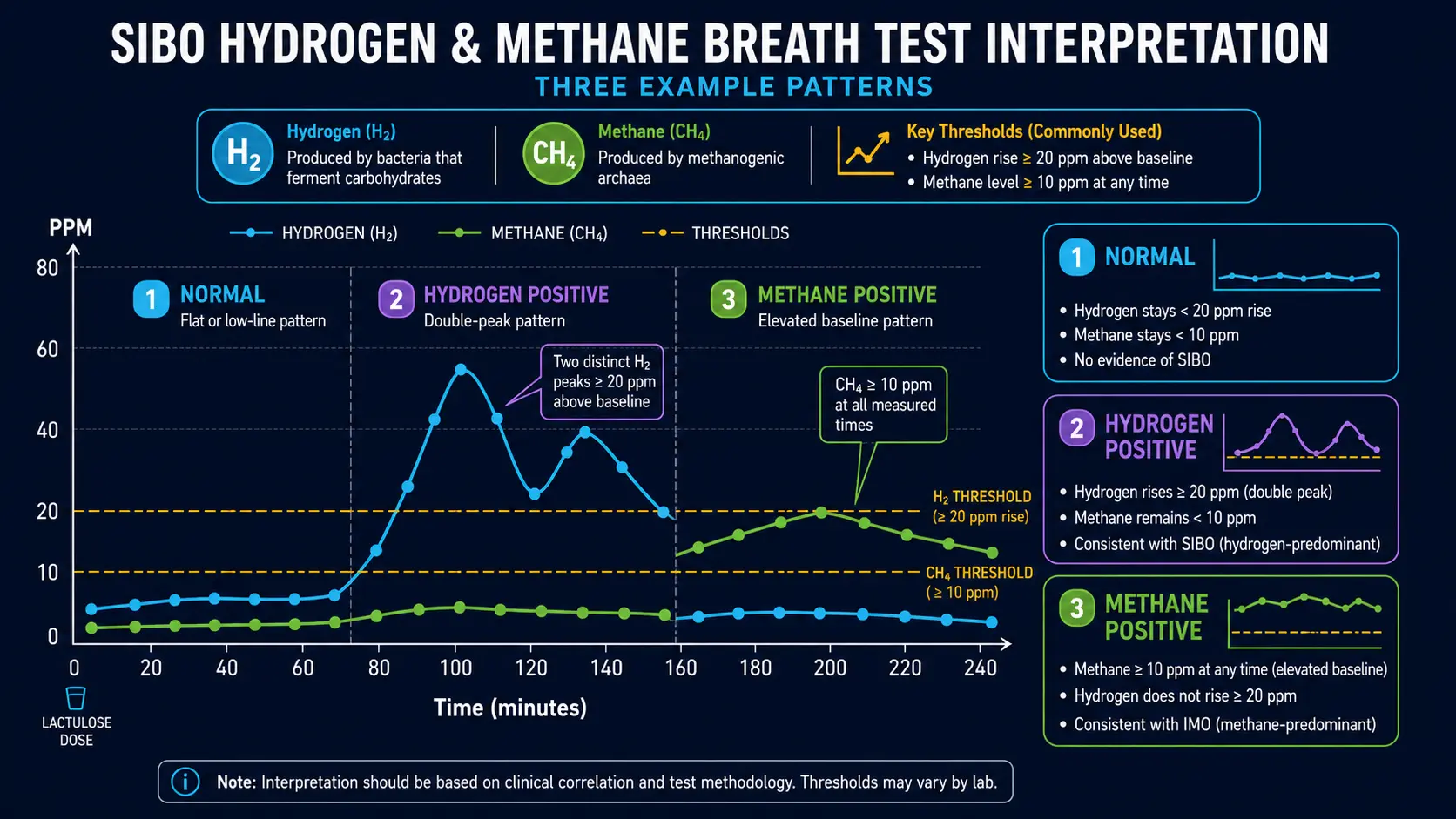
Table of Contents
- What the Three Gas Subtypes Mean for You
- Hydrogen-Dominant SIBO (the diarrhea one)
- Methane-Dominant SIBO / IMO (the constipation one)
- Hydrogen Sulfide SIBO (the rotten-egg one)
- How Breath Tests Tell the Subtypes Apart
- Why Treatment Differs by Gas
- Can You Have More Than One Subtype?
- Key Research Papers
- Connections
- Featured Videos
1. What the Three Gas Subtypes Mean for You
A SIBO breath test can measure up to three gases, and which gas is raised points to different microbes, different typical symptoms and different treatment data. A test that measures hydrogen alone cannot show a raised methane or hydrogen sulfide level.
SIBO is not a single disease. The 2020 American College of Gastroenterology (ACG) guideline defines it as excessive numbers of bacteria in the small bowel, causing gastrointestinal symptoms. Gut microbes ferment food and release gases, and the gas depends on which microbes are present. Three are measured:
- Hydrogen — made by ordinary gut bacteria fermenting carbohydrates. Higher breath hydrogen has been linked with diarrhea and with diarrhea-predominant IBS (IBS-D).
- Methane — made mainly by an archaeon (a non-bacterial microbe) called Methanobrevibacter smithii. Methane on breath testing is associated with constipation. The 2020 ACG guideline proposed calling this pattern IMO (intestinal methanogen overgrowth) instead of SIBO.
- Hydrogen sulfide — made by hydrogen sulfide-producing bacteria such as Desulfovibrio and Fusobacterium. The gas smells of rotten eggs; on breath testing it has been linked with diarrhea, urgency and abdominal pain. Studies from the research group that developed the three-gas test call a raised level ISO (intestinal sulfide overproduction).
Relapse after a course of antibiotics is common (section 7), and the published treatment data differ by gas (section 6). The rest of this article walks through each subtype and what the research reports about it.
2. Hydrogen-Dominant SIBO (the diarrhea one)
Hydrogen-dominant SIBO is the "classic" picture: hydrogen was the gas the original SIBO breath tests measured, and methane was added later. Organisms reported to be increased in SIBO include E. coli, Klebsiella and Enterococcus. When they reach carbohydrates before the body has absorbed them, they ferment them and release hydrogen gas.
What it feels like
- Bloating, gas and distension — the ACG guideline lists abdominal pain, bloating, gas, distension, flatulence and diarrhea as the most common SIBO symptoms, present in more than two-thirds of patients.
- Diarrhea — in a 2026 study of 3,004 people having three-gas breath tests, higher breath hydrogen correlated with more severe diarrhea.
- Abdominal cramping and gurgling (borborygmi).
- Fermentable carbohydrates (FODMAPs), found in wheat, onions, garlic, apples, dairy and beans, are the main fuel for this fermentation; in a study cited by the ACG guideline, daily hydrogen output was far higher when FODMAPs were eaten.
- In severe cases, mainly with surgical blind loops or scleroderma, fat in the stool (steatorrhea), weight loss, anemia and fat-soluble vitamin deficiencies; the malabsorption is attributed to bacteria deconjugating bile acids in the upper small intestine.
The IBS-D overlap
SIBO and IBS-D (diarrhea-predominant irritable bowel syndrome) overlap, but estimates of how much vary widely. A 2020 meta-analysis of 25 case-control studies found SIBO by breath testing in 35.5% of people with IBS versus 29.7% of controls (odds ratio 3.7 overall), with higher odds in IBS-D than in IBS-C (odds ratio 1.86); the authors rated the overall quality of the evidence as low. In 2015 the FDA approved rifaximin for IBS-D on the strength of the TARGET trials, an approval the ACG guideline describes as resting on the understanding that one possible cause of IBS is a disturbed gut microbiome.
What the breath test looks like
The 2017 North American Consensus defines a positive glucose or lactulose breath test for SIBO as a rise in hydrogen of at least 20 ppm above baseline by 90 minutes. The 90-minute limit is meant to separate fermentation in the small intestine from the normal fermentation that starts once the test sugar reaches the colon; the ACG guideline adds that a second, later peak is not required. Rapid transit can carry the sugar to the colon early and produce a false positive.
3. Methane-Dominant SIBO / IMO (the constipation one)
The microbe behind methane-dominant SIBO is not a bacterium. The ACG guideline names Methanobrevibacter smithii, the predominant methanogen in the human gut, as the apparent cause of excess methane. It belongs to the archaea, the third domain of life alongside bacteria and eukaryotes (organisms with nucleated cells, from fungi to people). Archaea look similar to bacteria under a microscope but differ in their ribosomal RNA and cell walls.
This matters because most antibiotics are designed against bacteria. In laboratory testing, M. smithii strains were resistant to ampicillin, gentamicin, tetracycline and rifampicin (a rifamycin, the same drug family as rifaximin), but susceptible to metronidazole. In a retrospective review of methane-positive patients, rifaximin alone cleared methane in only 28% (section 6).
Because the organism is an archaeon, and because people with positive methane tests also carry more methanogens in stool (suggesting overgrowth beyond the small intestine), the authors of the 2020 ACG guideline proposed the term IMO (intestinal methanogen overgrowth) in place of "methane SIBO."
Methane and slower transit
In a 2006 study, Pimentel and colleagues infused methane into the small intestine of dogs and found that it slowed transit in every animal, by an average of 59%. In guinea-pig intestine in an organ bath, methane increased contractile activity, and among people with IBS who had a small-bowel motility study, methane producers had a higher motility index than hydrogen producers. The authors concluded that methane slows small-intestinal transit, apparently by augmenting contractile activity.
The amount matters as well as the presence: in a 2007 study of 87 people with IBS, the quantity of methane on the breath test was directly proportional to the reported degree of constipation (r = 0.60), and greater methane production went with fewer bowel movements and harder stools.
What it feels like
- Constipation — a 2011 meta-analysis of nine studies (1,277 people) found methane on breath testing associated with constipation (odds ratio 3.51).
- Hard, dry, pellet-like stools (Bristol type 1 or 2) and fewer bowel movements.
- Incomplete evacuation — the feeling that something is still up there.
- Bloating and distension.
- Weight — in a 2013 study of 792 people having breath tests, those positive for both methane and hydrogen had a higher BMI and body-fat percentage; the authors hypothesize that M. smithii changes how much energy the host gets from food. In germ-free mice, adding M. smithii to a gut bacterium increased the animals' body fat (an animal study).
The IBS-C link
Methane is more common in IBS-C than in IBS-D: the 2020 meta-analysis found methane-positive breath tests more prevalent in IBS with constipation (odds ratio 2.3), and a 2022 study combining breath testing with stool sequencing found higher breath methane and more M. smithii in stool in IBS-C. The ACG guideline suggests methane testing to diagnose IMO in people with constipation (a conditional recommendation based on very low-quality evidence).
4. Hydrogen Sulfide SIBO (the rotten-egg one)
Some people with SIBO-type symptoms have breath tests with flat lines on both hydrogen and methane. The research group that developed the three-gas test proposes that some of these "flat-line" results reflect hydrogen sulfide production: hydrogen is consumed to make hydrogen sulfide, so little reaches the breath. Until recently there was no commercial test for the gas — the 2020 ACG guideline noted that none was yet available and that a hydrogen sulfide cutoff still needed to be validated.
The organisms involved are hydrogen sulfide-producing bacteria. A 2022 study linked higher breath H2S in IBS-D with more Fusobacterium and Desulfovibrio in stool, and a 2025 study of duodenal fluid linked it with small-bowel H2S producers such as Proteus mirabilis and the sulfate-reducing Desulfobulbus and Desulfosarcina. Sulfate-reducing bacteria use hydrogen made by other microbes to produce hydrogen sulfide (H2S) — the gas that gives rotten eggs their smell.
What it feels like
- Diarrhea and urgency — in the 2026 study of 3,004 people, higher breath H2S correlated with more severe diarrhea (P < 0.0001) and urgency (P = 0.003).
- Abdominal pain — also correlated with higher H2S (P = 0.01); people with raised H2S alone had the highest pain and overall severity scores of any breath-test group.
- Gas with a sulfur (rotten-egg) smell — hydrogen sulfide is one of the main malodorous compounds in human flatus.
- Practitioner accounts describe a wider cluster, including sulfurous belching, bladder urgency, skin flushing, brain fog and intolerance of sulfur-rich foods (eggs, garlic, cruciferous vegetables, red wine); these associations come from clinical description rather than from the published breath-test studies.
Why two-gas tests miss it
A two-gas breath test measures only hydrogen and methane, so it cannot detect hydrogen sulfide. According to the three-gas test's developers, the hydrogen curve can be flat because sulfate-reducing bacteria consume the hydrogen to make H2S, and methane is flat when methanogens are absent. Such a "flat-line" test reads as negative on hydrogen and methane criteria.
A three-gas breath test that adds hydrogen sulfide is now available as an at-home kit in the United States. No guideline has set an H2S cutoff: the 2026 nationwide study defined a positive result as ≥2 ppm (with 1.5 ppm in a sensitivity analysis), and a 2025 duodenal-aspirate study used 1.5 ppm. Most published three-gas studies come from the research group that developed the test.
The bismuth angle
Bismuth subsalicylate, an over-the-counter antidiarrheal, binds hydrogen sulfide. In a 1998 study of 10 healthy volunteers, bismuth subsalicylate (524 mg four times a day for 3–7 days) cut fecal H2S release by more than 95%. No published trial has tested it in people with raised breath H2S; its use alongside antibiotics for hydrogen sulfide is a practitioner approach rather than a trial result.
5. How Breath Tests Tell the Subtypes Apart
The ACG guideline suggests glucose or lactulose breath testing to diagnose SIBO, and methane testing to diagnose IMO in people with constipation (conditional recommendations based on very low-quality evidence). The patterns, using the 2017 North American Consensus cutoffs for hydrogen and methane:
- Hydrogen-dominant: H2 rises at least 20 ppm above baseline by 90 minutes. Methane stays below 10 ppm.
- Methane-dominant (IMO): Methane reaches ≥10 ppm at any point during the test.
- Hydrogen sulfide (ISO): no guideline cutoff; the largest study counted 2 ppm or more as positive. Hydrogen may be flat or low, which the test's developers attribute to H2S producers consuming hydrogen.
- Mixed: Two or three gases elevated together — about 18% of positive tests in the 2026 nationwide study (section 7).
Test preparation, reading the curves and the causes of false results are covered in the Breath Test Guide.
6. Why Treatment Differs by Gas
The published response to the same antibiotic differs by gas. Most of the evidence is weak: the ACG guideline describes the antibiotic data for SIBO as "small clinical trials of poor to modest quality," and its suggestion of antibiotics for symptomatic SIBO is a conditional recommendation based on low-quality evidence.
Hydrogen-dominant: rifaximin studies
Rifaximin is a minimally absorbed antibiotic, so it acts mainly inside the gut. The TARGET 1 and 2 trials, in people with IBS without constipation (not selected for SIBO), used 550 mg three times daily for 14 days: adequate relief of global IBS symptoms was reported by 40.7% on rifaximin versus 31.7% on placebo, with similar adverse-event rates. Those trials did not measure SIBO eradication. For SIBO itself, a 2017 meta-analysis of 32 studies (1,331 patients; doses of 600–1,600 mg a day for 5–28 days) found an overall eradication rate of 70.8% (95% CI 61.4–78.2%) and adverse events in 4.6%, while rating the quality of the studies as generally poor.
Methane-dominant (IMO): rifaximin with neomycin
The first data came from a 2010 retrospective chart review of 74 methane-positive IBS patients (methane ≥3 ppm, a lower cutoff than today's 10 ppm). Methane was cleared in 28% of those given rifaximin alone (400 mg three times daily for 10 days), 33% with neomycin alone (500 mg twice daily for 10 days) and 87% with the two combined for 10 days; clinical response was 56%, 63% and 85%. A 2014 double-blind randomized trial in 31 methane-positive people with IBS-C then compared 14 days of neomycin plus rifaximin with neomycin plus placebo: the combination improved constipation, straining and bloating more (but not abdominal pain), and the benefit tracked with methane falling below 3 ppm. Other approaches under study:
- Allicin (a compound from garlic) is used by some practitioners for methane. Published evidence that it reduces methane production comes from livestock research (sheep and cattle); no controlled human trial in IMO has been published, and the dose figures quoted for it come from practitioners rather than trials.
- Metronidazole inhibited M. smithii in laboratory testing, and in a 2025 double-blind randomized trial in 97 people with IBS and SIBO, 10 days of metronidazole lowered breath methane more than rifaximin or ciprofloxacin (SIBO eradication 79%, versus 59% with rifaximin); rifaximin produced the largest fall in abdominal pain and bloating, with fewer adverse events.
- Lovastatin lactone, in a modified-release form meant to act on methanogens in the gut, was in a phase 2 trial in IBS with constipation according to a 2016 review; statins appear to inhibit methane production by archaea without reducing bacterial numbers.
The doses used in rifaximin trials are covered on the Rifaximin Protocols page.
Hydrogen sulfide: no tested regimen yet
No guideline names a treatment for raised hydrogen sulfide, and the authors of the 2026 nationwide study wrote that human trials had not yet been published; the supporting work they cite is in animals (in a rat model of post-infection IBS, rifaximin combined with N-acetylcysteine improved diarrhea-like features in step with a fall in H2S producers). Approaches described in practitioner accounts, none tested for this purpose in a published trial, include:
- Rifaximin combined with bismuth subsalicylate.
- A short low-sulfur diet, which cuts back on eggs, garlic, onions, cruciferous vegetables, red meat and sulfite-containing wine.
- Molybdenum, reasoned from its role as a cofactor of sulfite oxidase, the enzyme that converts sulfite to sulfate.
Herbal antimicrobials
A 2014 retrospective chart review from Johns Hopkins (Chedid and colleagues) followed 104 patients with a positive lactulose breath test who were treated with either rifaximin 1,200 mg a day or commercial herbal preparations for 4 weeks. The follow-up test was negative in 46% (17/37) of the herbal group and 34% (23/67) of the rifaximin group, a difference that was not statistically significant (P = 0.24). The authors concluded the herbs were at least as effective and called for prospective studies; the comparison was not randomized. The herbs are covered on the Herbal Antimicrobials page.
7. Can You Have More Than One Subtype?
Yes, though in the largest published series it was the minority pattern. In the 2026 nationwide study of 3,004 at-home three-gas tests, 267 of the 1,497 positive tests (about 18%) showed two or more gases above threshold (H2S counted as positive from 2 ppm; counts from the study's Table 2), and high hydrogen and high methane rarely occurred together. What the study reported for each combination:
- Hydrogen + methane: the lowest symptom scores of any group except for constipation.
- Hydrogen sulfide with hydrogen or methane: higher diarrhea and urgency scores, as in every H2S-positive group.
- All three elevated: the lowest constipation scores of any group, with raised diarrhea and urgency scores. The highest pain and overall severity scores were in people with raised H2S alone.
How treatment sequencing is described
No guideline or trial sets an order for treating mixed results. Practitioner accounts describe two approaches: treating methane first, on the reasoning that methane slows transit, then hydrogen and hydrogen sulfide in a second course; or combining drugs (for example rifaximin, neomycin and bismuth) in a single course.
Relapse is common. In an Italian cohort of 80 people whose glucose breath test had normalized after rifaximin, 12.6%, 27.5% and 43.7% tested positive again at 3, 6 and 9 months; older age, previous appendectomy and long-term proton-pump-inhibitor use were associated with recurrence. Prokinetic drugs, which stimulate gut motility, have been studied for relapse prevention mainly in a retrospective review: among 64 IBS patients whose SIBO had resolved, low-dose bedtime tegaserod was followed by a longer symptom-free interval than erythromycin or no prevention. More is covered on the Prokinetics & Relapse Prevention and Root Causes pages.
Key Research Papers
- Pimentel M, et al. Methane, a gas produced by enteric bacteria, slows intestinal transit and augments small intestinal contractile activity. Am J Physiol Gastrointest Liver Physiol. 2006;290(6):G1089-G1095. — doi:10.1152/ajpgi.00574.2004
- Pimentel M, Leite G, Joo L, et al. Real-world Study of Three-gas Breath Testing Nationwide and the Association With Symptoms. J Clin Gastroenterol. 2026;60(5):406-417. — PubMed PMID: 41671534
- Takakura W, Pimentel M. Small intestinal bacterial overgrowth and irritable bowel syndrome: an update. Frontiers in Psychiatry. 2020;11:664. — doi:10.3389/fpsyt.2020.00664
- Pimentel M, Saad RJ, Long MD, Rao SSC. ACG Clinical Guideline: Small Intestinal Bacterial Overgrowth. Am J Gastroenterol. 2020;115(2):165-178. — doi:10.14309/ajg.0000000000000501
- Rezaie A, Buresi M, Lembo A, et al. Hydrogen and Methane-Based Breath Testing in Gastrointestinal Disorders: The North American Consensus. Am J Gastroenterol. 2017;112(5):775-784. — PubMed PMID: 28323273
- Shah A, Talley NJ, Jones M, et al. Small Intestinal Bacterial Overgrowth in Irritable Bowel Syndrome: A Systematic Review and Meta-Analysis of Case-Control Studies. Am J Gastroenterol. 2020;115(2):190-201. — PubMed PMID: 31913194
- Schiller LR. Evaluation of small bowel bacterial overgrowth. Curr Gastroenterol Rep. 2007;9(5):373-377. — PubMed PMID: 17991337
- Kunkel D, Basseri RJ, Makhani MD, et al. Methane on breath testing is associated with constipation: a systematic review and meta-analysis. Dig Dis Sci. 2011;56(6):1612-1618. — PubMed PMID: 21286935
- Chatterjee S, Park S, Low K, et al. The degree of breath methane production in IBS correlates with the severity of constipation. Am J Gastroenterol. 2007;102(4):837-841. — PubMed PMID: 17397408
- Mathur R, Amichai M, Chua KS, et al. Methane and hydrogen positivity on breath test is associated with greater body mass index and body fat. J Clin Endocrinol Metab. 2013;98(4):E698-E702. — PubMed PMID: 23533244
- Samuel BS, Gordon JI. A humanized gnotobiotic mouse model of host-archaeal-bacterial mutualism. Proc Natl Acad Sci U S A. 2006;103(26):10011-10016. — PubMed PMID: 16782812
- Dridi B, Fardeau ML, Ollivier B, et al. The antimicrobial resistance pattern of cultured human methanogens reflects the unique phylogenetic position of archaea. J Antimicrob Chemother. 2011;66(9):2038-2044. — PubMed PMID: 21680581
- Villanueva-Millan MJ, Leite G, Wang J, et al. Methanogens and Hydrogen Sulfide Producing Bacteria Guide Distinct Gut Microbe Profiles and Irritable Bowel Syndrome Subtypes. Am J Gastroenterol. 2022;117(12):2055-2066. — PubMed PMID: 36114762
- Villanueva-Millan MJ, Leite G, Mathur R, et al. Hydrogen Sulfide and Methane on Breath Test Correlate with Human Small Intestinal Hydrogen Sulfide Producers and Methanogens. Dig Dis Sci. 2025;70(11):3846-3856. — PubMed PMID: 40569514
- Suarez FL, Furne JK, Springfield J, Levitt MD. Bismuth subsalicylate markedly decreases hydrogen sulfide release in the human colon. Gastroenterology. 1998;114(5):923-929. — PubMed PMID: 9558280
- Pimentel M, Lembo A, Chey WD, et al. Rifaximin therapy for patients with irritable bowel syndrome without constipation. N Engl J Med. 2011;364(1):22-32. — PubMed PMID: 21208106
- Gatta L, Scarpignato C. Systematic review with meta-analysis: rifaximin is effective and safe for the treatment of small intestine bacterial overgrowth. Aliment Pharmacol Ther. 2017;45(5):604-616. — PubMed PMID: 28078798
- Low K, Hwang L, Hua J, et al. A combination of rifaximin and neomycin is most effective in treating irritable bowel syndrome patients with methane on lactulose breath test. J Clin Gastroenterol. 2010;44(8):547-550. — PubMed PMID: 19996983
- Pimentel M, Chang C, Chua KS, et al. Antibiotic treatment of constipation-predominant irritable bowel syndrome. Dig Dis Sci. 2014;59(6):1278-1285. — PubMed PMID: 24788320
- von Muhlenbrock C, Landskron G, Madrid AM. Treatment of small intestinal bacterial overgrowth in Chilean patients with irritable bowel syndrome: A prospective and comparative study. Rev Gastroenterol Mex (Engl Ed). 2025;90(1):54-62. — PubMed PMID: 40240267
- Gottlieb K, Wacher V, Sliman J, Pimentel M. Review article: inhibition of methanogenic archaea by statins as a targeted management strategy for constipation and related disorders. Aliment Pharmacol Ther. 2016;43(2):197-212. — PubMed PMID: 26559904
- Chedid V, Dhalla S, Clarke JO, et al. Herbal therapy is equivalent to rifaximin for the treatment of small intestinal bacterial overgrowth. Glob Adv Health Med. 2014;3(3):16-24. — PubMed PMID: 24891990
- Lauritano EC, Gabrielli M, Scarpellini E, et al. Small intestinal bacterial overgrowth recurrence after antibiotic therapy. Am J Gastroenterol. 2008;103(8):2031-2035. — PubMed PMID: 18802998
- Pimentel M, Morales W, Lezcano S, et al. Low-dose nocturnal tegaserod or erythromycin delays symptom recurrence after treatment of irritable bowel syndrome based on presumed bacterial overgrowth. Gastroenterol Hepatol (N Y). 2009;5(6):435-442. — PubMed PMID: 20574504
PubMed Topic Searches
Live PubMed searches on the specific microbes and mechanisms discussed in this article. Each link opens a fresh query, so the results stay current.
- PubMed: Intestinal methanogen overgrowth (IMO)
- PubMed: Hydrogen sulfide SIBO
- PubMed: Methanobrevibacter smithii and constipation
- PubMed: Desulfovibrio and IBS
- PubMed: Rifaximin + neomycin for methane
- PubMed: Allicin and methanogens
- PubMed: Bismuth subsalicylate and hydrogen sulfide
- PubMed: Hydrogen sulfide (three-gas) breath testing
Connections
- Gastroenterology
- The Gut Barrier & Your Microbiome — interactive animation
- SIBO Overview
- Rifaximin Protocols
- Root Causes
- Herbal Antimicrobials
- Breath Test Guide
- Prokinetics and Relapse Prevention
- Elemental Diet
- Low-FODMAP Diet
- IMO and Constipation
- Irritable Bowel Syndrome
- Oregano
- Berberine
- Probiotics
- POTS
- Constipation
- Sulfur
- Bloating
- Gut Microbiome