Prokinetics and SIBO Relapse Prevention
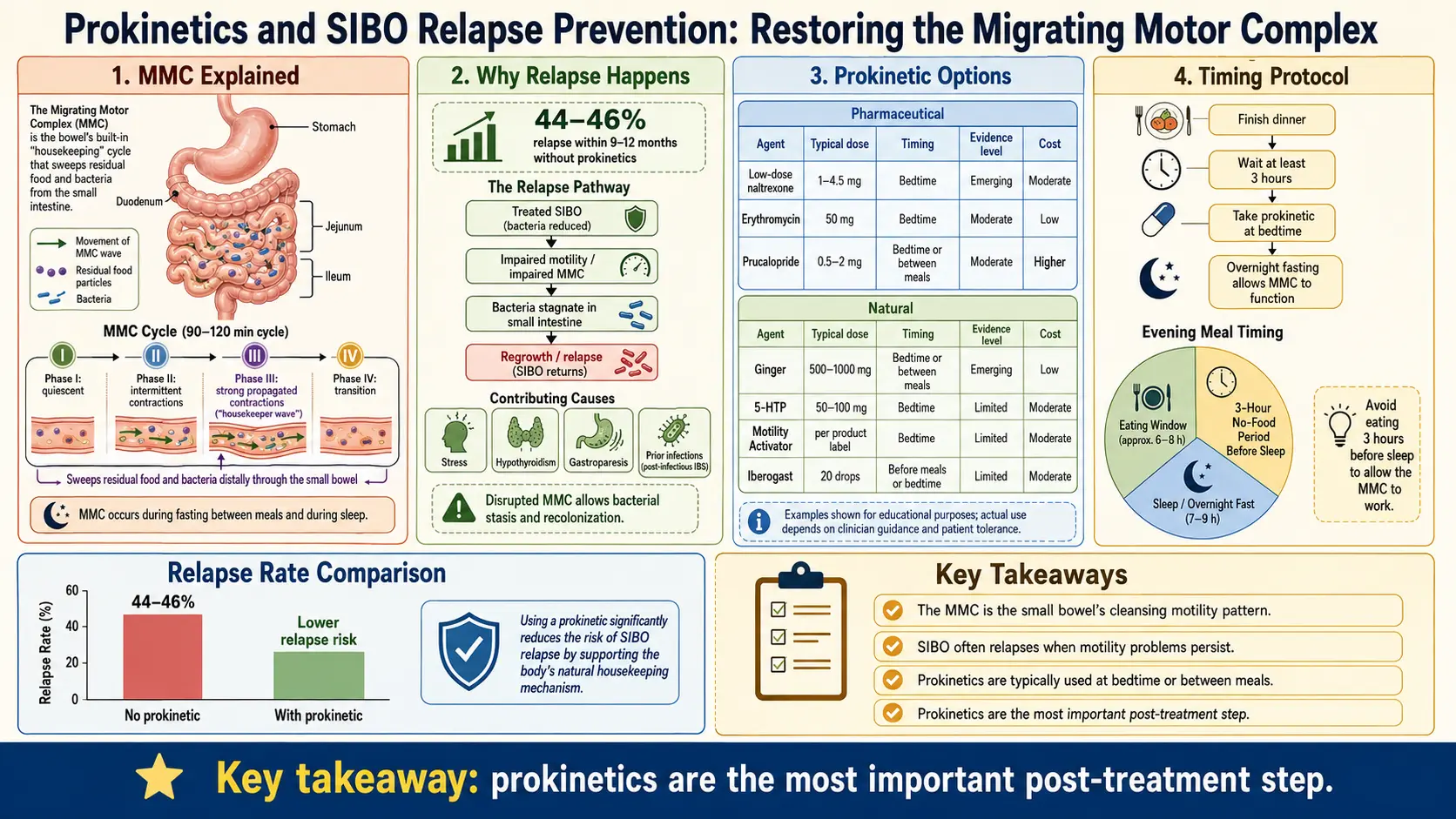
Table of Contents
- How Often SIBO Comes Back
- Meet the Migrating Motor Complex (MMC)
- What Breaks the MMC
- Meal Spacing and the MMC
- Prescription Prokinetics
- Herbal Products Studied for Motility
- How Practitioners Time Prokinetics After SIBO Treatment
- Lifestyle Factors and the Evidence
- Root Causes and Relapse
- What the Research Shows
- Key Research Papers
- Featured Videos
1. How Often SIBO Comes Back
SIBO treatment usually means a course of rifaximin, an elemental diet, or several weeks of herbal antimicrobials such as berberine and oregano oil. For many people the breath test then comes back clean and the bloating eases.
In many cases SIBO then returns. In one follow-up study, 80 patients whose glucose breath test had normalized after one week of rifaximin were retested over 9 months: 12.6% were positive again at 3 months, 27.5% at 6 months and 43.7% at 9 months (Lauritano 2008).
The factors linked to recurrence in that study were older age, a past appendectomy and long-term use of proton pump inhibitors (PPIs). In patients whose breath test turned positive again, gastrointestinal symptoms returned as well.
A common way of putting this in SIBO care is that clearing the bacteria without addressing why they accumulated is like mopping the floor while the faucet still runs. This article covers one part of that picture: the small intestine's fasting cleaning wave, the migrating motor complex, and the drugs and habits proposed to support it.
2. Meet the Migrating Motor Complex (MMC)
The small intestine has a cleaning cycle. During fasting, a wave of coordinated muscular contractions starts in the stomach or duodenum and migrates down the small intestine toward the ileocecal valve. This is the migrating motor complex (MMC). It recurs at roughly 90-120 minute intervals during fasting and is interrupted by eating (Deloose 2012; Mondal 2017).
The MMC is described in four phases. Phase III is the most active: a burst of strong contractions that begins in the stomach or duodenum and travels down the gut (Deloose 2012). The pattern has long been called the gut's “housekeeper”, sweeping residual food and bacteria onward toward the colon, and disturbances in it have been associated with small intestinal bacterial overgrowth (Deloose 2016).
A rough analogy is a dishwasher rinse cycle: if it never runs, the dishes pile up. Reviews link an absent MMC with gastroparesis, intestinal pseudo-obstruction and small intestinal bacterial overgrowth (Deloose 2012).
Human recordings support the link. In a manometry study from Pimentel's group at Cedars-Sinai, 68 people with IBS and an abnormal lactulose breath test averaged 0.7 phase III events during 4 hours of fasting, against 2.2 in 30 controls, and those whose overgrowth was still present at the time of testing had fewer phase III events than those whose overgrowth had been eradicated (Pimentel 2002). The MMC is one of several defences usually listed against overgrowth, alongside gastric acid, the ileocecal valve and intestinal immunity.
3. What Breaks the MMC
The small-bowel MMC is run mainly by the gut's own nervous system, the interstitial cells of Cajal (the intestinal “pacemaker” cells) and signals such as motilin and serotonin. The vagus nerve's role appears limited to the stomach: cutting it abolishes the stomach's MMC activity but leaves the periodic activity of the small bowel intact (Deloose 2012). Conditions linked to disturbed motility or to SIBO include:
- Post-infectious IBS — in a rat model of Campylobacter jejuni food poisoning, antibodies against the bacterial toxin CdtB cross-reacted with vinculin, a protein in the interstitial cells of Cajal and the gut's nerve ganglia, and higher antibody levels and lower vinculin went with SIBO (Pimentel 2015, rat study). CdtB is produced by the bacteria that cause acute gastroenteritis, and in 2,375 people with diarrhea-predominant IBS, anti-CdtB and anti-vinculin antibodies were higher than in people with inflammatory bowel disease, celiac disease or healthy controls (Pimentel 2015, PLoS One).
- Diabetic autonomic neuropathy — nerve damage from long-standing high blood glucose can impair gut motility.
- Hypothyroidism — in 50 patients with a history of overt autoimmune hypothyroidism, 54% had a positive glucose breath test, against 5% of 40 controls (Lauritano 2007).
- Opioid medications — drugs such as oxycodone, hydrocodone and tramadol act on opioid receptors in the gut. In healthy volunteers, even very low intravenous doses of morphine set off out-of-sequence, phase III-like bursts in the duodenum, disturbing the normal fasting sequence (Lewis 1999).
- Stress — in conscious dogs, acoustic stress weakened the stomach's phase III through reduced vagal activity without affecting phase III in the intestine, and a subset of people with functional dyspepsia show reduced vagal activity and impaired gastric phase III (Takahashi 2013, review).
- Scleroderma / systemic sclerosis — smooth muscle fibrosis impairs intestinal contractility; a systematic review puts SIBO at 30-60% of patients with systemic sclerosis (Pittman 2018).
- Ehlers-Danlos syndrome and joint hypermobility — gut symptoms are common, but the link to SIBO is unsettled: in a tertiary-centre series of 1,062 hydrogen breath tests, none of the patients with hypermobile Ehlers-Danlos syndrome tested positive (Dervin 2023), and a manometry study found small-bowel dysmotility less often in hypermobility patients than in other patients with gut symptoms (13% vs 34%; Sweerts 2025).
- Parkinson's disease — gastrointestinal motility abnormalities are common; on glucose breath testing, 54% of 48 patients had SIBO against 8% of 36 controls, and SIBO was more likely at more advanced disease stages (Gabrielli 2011).
- Aging — among independently living older adults in Germany, 15.6% of those aged 61 and over had a positive glucose breath test, against 5.9% of adults aged 24-59, with acid-suppressing drugs contributing (Parlesak 2003). The MMC itself appears largely preserved with age: in healthy people aged 81-91, MMCs recurred at the same intervals as in young adults, with normal phase III contraction amplitude and frequency but slower propagation (Husebye 1992).
Eating is the everyday interruption. The MMC runs only in the fasting state, and a meal switches the small bowel into its fed pattern (Deloose 2012). In healthy volunteers, even a 220 kcal meal kept the small bowel in its fed pattern for nearly 3 hours (Schönfeld 1997).
4. Meal Spacing and the MMC
Meal spacing is a staple of practitioner advice for SIBO relapse prevention. It rests on motility physiology rather than on trials that measured SIBO relapse.
The usual version is three meals a day, spaced 4-5 hours apart, with no snacks between them.
The physiology behind it: after a meal the small bowel stays in its fed pattern for hours, and longer the more calories the meal holds. In eight healthy men, fed activity lasted about 2.8 hours after a 220 kcal lunch, about 5 hours after 440-660 kcal and about 6.6 hours after 1,100 kcal, with no difference between day and night (Schönfeld 1997). Only after that does the fasting cycle resume. On a day of breakfast at 7, a snack at 10, lunch at 12, another snack at 3, dinner at 6 and crackers at 9, the small bowel can spend nearly all its waking hours in the fed pattern, leaving little or no time for a daytime phase III sweep. By the same figures, a 4-5 hour gap after a larger meal may close before the fed pattern has ended, which leaves the overnight fast as the main fasting window for many people.
Practitioner lists of what fits between meals usually include water, plain black coffee and unsweetened tea, on the reasoning that anything with calories, even cream in coffee or a splash of juice, starts a new fed period. Chewing gum is often listed as a problem too, but chewing alone has been tested: in eight healthy people, sham feeding (chewing and tasting food without swallowing it) raised gastrin and neurotensin levels but did not disrupt the MMC (Soffer 1992).
Overnight is the longest fast of the day, and ambulatory recordings capture MMC cycles through the night (Husebye 1992; Scott 2006). A 12-14 hour overnight fast, a common practitioner target, leaves several hours of fasting cycles once the evening meal's fed pattern has ended; the number of cycles depends on the size of that meal and varies considerably even within the same person (Scott 2006).
5. Prescription Prokinetics
Prokinetics are drugs that stimulate gut contractions; some, such as erythromycin, can trigger a phase III burst directly. They differ from laxatives, which act mainly on the colon and stool. Practitioners use them after SIBO treatment on the reasoning that stronger fasting motility lowers the chance of relapse; the evidence for that is summarized in section 10.
Low-Dose Erythromycin
Erythromycin is a macrolide antibiotic that also acts as a motilin receptor agonist. Motilin levels rise and fall with the MMC, and motilin induces phase III contractions that start in the stomach (Deloose 2016); intravenous erythromycin does the same in humans (Deloose 2012). In healthy volunteers, a low intravenous dose induced a phase III in the stomach in every subject within about 13 minutes, while a higher dose produced strong antral pressure waves instead of a phase III (Björnsson 1995). The SIBO relapse study described in section 10 used 50 mg by mouth at bedtime (Pimentel 2009), and a gastroparesis study used 50-100 mg doses (Dhir 2004), well below antibiotic doses.
In that SIBO study, erythromycin's result did not reach statistical significance against no prevention (section 10). Tachyphylaxis, a loss of effect with continued use, is a recognized issue in other conditions: in a gastroparesis study using antibiotic-range oral doses, 48% of a solid meal remained in the stomach at 2 hours after 4 weeks of treatment, against 20% after a single intravenous dose and 85% at baseline (Richards 1993), and a low-dose gastroparesis study found long-term responses weaker than short-term ones, possibly from tachyphylaxis (Dhir 2004). Some practitioners cycle erythromycin on and off for this reason; such schedules are practitioner conventions rather than trial-tested regimens.
Erythromycin also prolongs cardiac repolarization. In a large Tennessee Medicaid cohort, current users of oral erythromycin had twice the rate of sudden cardiac death of non-users, and five times the rate when it was taken together with drugs that block its breakdown by the CYP3A enzyme, such as diltiazem, verapamil or certain antifungals (Ray 2004). That cohort involved antibiotic courses, at higher doses than motility regimens.
Prucalopride
Prucalopride is a selective, high-affinity 5-HT4 receptor agonist (Tack 2009). In 40 people with constipation, 7 days of prucalopride accelerated gastric emptying and small-bowel transit, with significantly faster colonic transit at the 4 mg dose (Bouras 2001). The FDA approved it in 2018 for chronic idiopathic constipation in adults (US prescribing information). It is discussed for methane-dominant overgrowth (IMO) because methane slows transit: in dogs, methane infused into the small intestine slowed transit by an average of 59% (Pimentel 2006, animal study). Its use in SIBO or IMO rests on this motility rationale rather than on SIBO trials.
Older 5-HT4 drugs ran into heart problems: cisapride was restricted or withdrawn over QT prolongation (Keller 2010), and tegaserod was withdrawn in 2007 over cardiovascular events (Sayuk 2022). In a 4-week safety trial in 89 nursing-home residents (mean age 83, 88% with a history of cardiovascular disease), prucalopride at up to 2 mg a day showed no differences from placebo in the ECG QT interval or in arrhythmias on Holter monitoring (Camilleri 2009).
The US label dose for adults is 2 mg once daily, or 1 mg once daily with severe kidney impairment. The main constipation trial tested 2 mg and 4 mg once daily for 12 weeks; headache and diarrhoea were the most frequent treatment-related side effects (Tack 2009).
Low-Dose Naltrexone (LDN)
Naltrexone at full dose (50 mg) is an opioid receptor blocker used in addiction medicine. “Low-dose” use in the published gastrointestinal studies ranges from 0.5 mg to 4.5 mg a day (Kariv 2006; Ploesser 2010). The proposed mechanisms come mainly from preclinical work and remain hypotheses: a very low dose blocking excitatory opioid signalling without affecting inhibitory signalling (Kariv 2006), and dampening of microglia, the nervous system's immune cells (Younger 2009).
Low doses are not sold as a standard tablet, so LDN is usually prepared by a compounding pharmacy. The evidence in gut disorders comes from uncontrolled studies. In an open-label pilot, 42 people with IBS took 0.5 mg a day for 4 weeks; 76% improved on a global assessment and there were no significant adverse reactions (Kariv 2006). In a mailed survey of one gastroenterologist's patients (121 responders), 61% reported side effects, most often neurological, 27% of those with side effects stopped the drug, and 15 of 85 patients with IBS and SIBO reported marked improvement (Ploesser 2010). In a fibromyalgia pilot, side effects including insomnia and vivid dreams were rare, minor and transient (Younger 2009).
Tegaserod
Tegaserod is a 5-HT4 agonist. It was withdrawn from the US market in 2007 over concerns about cardiovascular events and re-approved in April 2019 with a narrower label: IBS with constipation in women under 65 without heart disease or additional cardiovascular risk factors (Sayuk 2022). The FDA's Drugs@FDA database now lists the product as discontinued. Tegaserod produced the strongest result in the retrospective SIBO relapse study described in section 10 (Pimentel 2009).
Metoclopramide / Domperidone
Older prokinetics. Metoclopramide, a dopamine receptor antagonist that crosses the blood-brain barrier, can cause tardive dyskinesia, a movement disorder that can be irreversible; in 2009 the FDA added a boxed warning about long-term or high-dose use, and a review estimated the risk as likely under 1% (Rao 2010). Domperidone is not approved for human use in the United States. The FDA states that it cannot be legally compounded, that US access has been limited to an expanded-access program for severe gastrointestinal conditions, which it said would end when its supplier's stock ran out in September 2025, and that its serious risks include cardiac arrhythmias, cardiac arrest and sudden death, linked to its blood level. Neither drug has been studied in trials of SIBO relapse prevention.
6. Herbal Products Studied for Motility
Several herbal products are used by people who cannot access or tolerate prescription prokinetics. Their evidence comes mainly from functional dyspepsia and IBS trials and short gastric-emptying studies; none of the trials below measured SIBO relapse.
STW 5 (Nine-Herb Liquid Preparation)
STW 5 is a German liquid herbal preparation combining nine botanicals: Iberis amara (bitter candytuft), peppermint, chamomile, caraway, lemon balm, angelica, greater celandine, milk thistle and licorice. A meta-analysis of three placebo-controlled functional dyspepsia trials found it more effective than placebo on the most bothersome symptom (Melzer 2004), and in a 208-patient IBS trial it reduced abdominal pain and IBS symptom scores more than placebo at 4 weeks (Madisch 2004). Its measured motility effects are in the stomach: in healthy men, a single dose relaxed the upper stomach and increased antral contractions without changing pyloric or duodenal pressures or the emptying of solids (Pilichiewicz 2007). Some integrative practitioners use it after SIBO treatment.
One of its herbs, greater celandine, has been linked to liver injury: a 2012 review of 16 published European cases of liver injury attributed to greater celandine extracts found jaundice with high liver enzymes in virtually all of them, and a favourable outcome despite a severe course (Teschke 2012).
Ginger
Ginger (Zingiber officinale) speeds stomach emptying in small studies. In 24 healthy volunteers, 1.2 g of ginger taken an hour before a test meal gave a stomach half-emptying time of 13.1 minutes against 26.7 minutes with placebo and increased antral contractions, without changing symptoms (Wu 2008). The same dose in 11 people with functional dyspepsia gave a median half-emptying time of 12.3 minutes against 16.1 minutes with placebo, with no change in symptoms or in motilin and ghrelin levels (Hu 2011). In laboratory tests, ginger's gingerols and shogaols weakly blocked 5-HT3 receptors and showed no 5-HT4 activity (Pertz 2011). These studies measured the stomach, not the small-bowel MMC.
Berberine
Berberine is used in herbal SIBO antimicrobial protocols, but the human motility data point away from a prokinetic effect: in 20 healthy volunteers, a 1.2 g dose slowed small-intestinal transit from about 71 to 98 minutes, which the authors linked to its antidiarrheal action (Yuan 1994). In a pair of diabetes studies, 0.5 g three times a day for 3 months lowered blood glucose about as much as metformin in the randomized comparison, and about a third of patients taking it had transient gastrointestinal side effects (Yin 2008), which raises a concern for people already taking glucose-lowering drugs.
Triphala
Triphala is an Ayurvedic formula of three fruits, amalaki, bibhitaki and haritaki, traditionally used for digestive complaints. Its use as a bedtime “prokinetic” comes from practitioner practice rather than motility studies; controlled human research is small, such as a 4-week pilot in which healthy adults took 2,000 mg a day and the outcome was gut bacterial composition, not motility (Peterson 2020).
Ginger and Artichoke Combinations
Combination capsules sold for MMC support often pair ginger with artichoke leaf extract, sometimes with other ingredients. A standardized ginger-plus-artichoke extract has two small trials. In 126 people with functional dyspepsia, two capsules a day before lunch and dinner for 4 weeks improved nausea, epigastric fullness, epigastric pain and bloating more than placebo (Giacosa 2015). In 11 healthy volunteers, one capsule before a meal left the stomach about 24% smaller than with placebo an hour later, which the authors read as faster emptying (Lazzini 2016). Both studies included authors from the extract manufacturer's research unit, and neither looked at SIBO.
7. How Practitioners Time Prokinetics After SIBO Treatment
SIBO-focused practitioners commonly describe the following timing. Apart from the retrospective study in section 10, these are practitioner conventions rather than trial-tested regimens.
- Starting right after treatment — the prokinetic is typically started the night the antimicrobial course ends, whether that was rifaximin, herbal antimicrobials or the return to food after an elemental diet. In the retrospective study, prevention followed the resolution of symptoms and breath test after antibiotics (Pimentel 2009).
- Duration — practitioners describe at least 3 months and often 6-12 months. In the retrospective study, the average symptom-free stretch was about 4.5 months on erythromycin and about 8 months on tegaserod (Pimentel 2009).
- Long-term use — open-ended use is described when the underlying cause is permanent, such as scleroderma, diabetic autonomic neuropathy, prior bowel resection, Parkinson's disease or long-standing post-infectious IBS.
- Retesting — some practitioners repeat the breath test at 3 and 6 months, two of the intervals at which the Lauritano cohort was retested. In that cohort, patients whose breath test turned positive again also had their gastrointestinal symptoms return (Lauritano 2008).
- Meal spacing alongside — practitioners pair prokinetics with meal spacing from the start, reasoning that a phase III stimulus has little room to work in a day spent in the fed pattern.
8. Lifestyle Factors and the Evidence
The evidence behind these ranges from direct measurements of stomach emptying to practitioner reasoning; none of the studies below measured SIBO relapse.
- Meal spacing. Three meals, 4-5 hours apart, as described in section 4.
- Overnight fast. A 12-14 hour overnight fast is the longest fasting window of the day; how many MMC cycles fit in it depends on the evening meal and the person.
- Snacks. Any snack with calories, including an apple, a few almonds or a protein shake, starts a new fed period. A bigger meal in turn lengthens the fed pattern that follows it (Schönfeld 1997), so moving snack calories into meals trades several short interruptions for one longer one.
- Post-meal walking. In 10 healthy men, slow treadmill walking after a 576 kcal meal gave a stomach half-emptying time of about 107 minutes, against 123 minutes without the walk, roughly 13% faster (Franke 2008). The study measured the stomach, not the MMC.
- Sleeping position. Lying on the left side is sometimes suggested for transit, but the stomach data point the other way: liquids emptied faster lying on the right side than sitting in 8 healthy men (Sanaka 2013), and slower lying on the left side than sitting in 7 volunteers (Anvari 1995). These studies measured liquid emptying from the stomach, not the small intestine.
- Vagal tone and stress. Practitioners suggest slow diaphragmatic breathing (for example, a 4-second inhale and an 8-second exhale) before meals, cold-water face immersion, humming, gargling, singing, meditation, yoga and adequate sleep to raise vagal activity. The motility research points to a narrower role for the vagus nerve, mainly in the stomach (Deloose 2012); in dogs, stress weakened gastric but not intestinal phase III (Takahashi 2013).
- Meal size. Larger meals keep the small bowel in its fed pattern longer, up to about 6.6 hours after 1,100 kcal in healthy men (Schönfeld 1997), which shortens the fasting window that follows.
9. Root Causes and Relapse
Prokinetics act on motility; they do not remove the underlying reason motility failed. Root-cause workups described by SIBO-focused clinicians may include:
- Blood tests for anti-CdtB and anti-vinculin antibodies. In the validation study, both were higher in diarrhea-predominant IBS than in inflammatory bowel disease, celiac disease or healthy controls; against inflammatory bowel disease, specificity was 91.6% for anti-CdtB and 83.8% for anti-vinculin, with sensitivity of 43.7% and 32.6%, and both tests were less specific in separating IBS from celiac disease (Pimentel 2015, PLoS One).
- Thyroid testing for hypothyroidism, given the SIBO rate reported in people with a history of it (Lauritano 2007).
- A review of proton pump inhibitor (PPI) use. A meta-analysis of 11 studies (3,134 people) found about twice the odds of SIBO in PPI users (OR 2.28), an association seen when SIBO was diagnosed by small-bowel aspirate culture but not with the glucose breath test (Lo 2013); chronic PPI use was also linked to recurrence in the Lauritano cohort.
- Investigation of ileocecal valve dysfunction, adhesions from prior surgery or other structural problems; a past appendectomy was linked to recurrence in the Lauritano cohort (OR 5.9).
- Assessment for Ehlers-Danlos / hypermobility spectrum disorders is sometimes included where joint laxity, POTS or mast cell activation symptoms overlap, although the breath-test and motility studies cited in section 3 did not find more SIBO or more small-bowel dysmotility in hypermobile patients.
The Root Causes article covers the workup in more detail.
10. What the Research Shows
Two studies are usually cited, and they answer different questions. The relapse figures come from an Italian cohort: of 80 patients whose glucose breath test normalized after one week of rifaximin (1,200 mg a day), 12.6% were positive again at 3 months, 27.5% at 6 months and 43.7% at 9 months. No prokinetic was studied (Lauritano 2008).
The prokinetic figures come from a retrospective chart review by Pimentel's group at Cedars-Sinai of 64 people with IBS and presumed SIBO whose symptoms and breath tests had resolved after antibiotics (Pimentel 2009). The 6 who received no preventive drug had symptoms return after an average of about 60 days. The 42 on erythromycin 50 mg at bedtime stayed symptom-free for about 139 days, a difference from no prevention that was not statistically significant (P=0.08). The 16 on tegaserod 2-6 mg at bedtime stayed symptom-free for about 242 days (P=0.003 against no prevention; P=0.004 against erythromycin), and 20 patients switched from erythromycin to tegaserod went from about 106 to about 200 symptom-free days.
These results support a possible role for prokinetics but are limited: the study was not randomized, the comparison group had six people, it measured the return of symptoms rather than repeat breath tests, and its best-performing drug, tegaserod, is now listed as discontinued in the US. Neither study reports a relapse rate for patients on erythromycin.
Randomized trials of prokinetics for preventing SIBO relapse, and head-to-head comparisons between them, are lacking. Choices among erythromycin, prucalopride, LDN and herbal products are described as resting on cost, access, tolerance, IBS subtype (constipation vs. diarrhea) and individual response; decisions about these medicines and supplements belong with a clinician.
Key Research Papers
Peer-reviewed literature on the migrating motor complex, prokinetic pharmacology, and SIBO relapse prevention. Each citation links to its DOI or PubMed record.
- Pimentel M, Saad RJ, Long MD, Rao SSC. ACG Clinical Guideline: Small Intestinal Bacterial Overgrowth. American Journal of Gastroenterology. 2020;115(2):165–178. — doi:10.14309/ajg.0000000000000501
- Pimentel M, Soffer EE, Chow EJ, Kong Y, Lin HC. Lower Frequency of MMC Is Found in IBS Subjects with Abnormal Lactulose Breath Test, Suggesting Bacterial Overgrowth. Digestive Diseases and Sciences. 2002;47(12):2639–2643. — doi:10.1023/A:1021039032413
- Pimentel M, Morales W, Pokkunuri V, et al. Autoimmunity Links Vinculin to the Pathophysiology of Chronic Functional Bowel Changes Following Campylobacter jejuni Infection in a Rat Model. Digestive Diseases and Sciences. 2015;60(5):1195–1205. — doi:10.1007/s10620-014-3435-5
- Pimentel M, Lin HC, Enayati P, et al. Methane, a Gas Produced by Enteric Bacteria, Slows Intestinal Transit and Augments Small Intestinal Contractile Activity. American Journal of Physiology — Gastrointestinal and Liver Physiology. 2006;290(6):G1089–G1095. — doi:10.1152/ajpgi.00574.2004
- Pimentel M, Morales W, Lezcano S, Sun-Chuan D, Low K, Yang J. Low-Dose Nocturnal Tegaserod or Erythromycin Delays Symptom Recurrence after Treatment of Irritable Bowel Syndrome Based on Presumed Bacterial Overgrowth. Gastroenterology & Hepatology (N Y). 2009;5(6):435–442. — PubMed PMID: 20574504
- Tack J, van Outryve M, Beyens G, Kerstens R, Vandeplassche L. Prucalopride (Resolor) in the Treatment of Severe Chronic Constipation in Patients Dissatisfied with Laxatives. Gut. 2009;58(3):357–365. — doi:10.1136/gut.2008.162404
- Camilleri M, Beyens G, Kerstens R, Robinson P, Vandeplassche L. Safety Assessment of Prucalopride in Elderly Patients with Constipation: A Double-Blind, Placebo-Controlled Study. Neurogastroenterology & Motility. 2009;21(12):1256–e117. — doi:10.1111/j.1365-2982.2009.01398.x
- Lauritano EC, Gabrielli M, Scarpellini E, et al. Small Intestinal Bacterial Overgrowth Recurrence after Antibiotic Therapy. American Journal of Gastroenterology. 2008;103(8):2031–2035. — doi:10.1111/j.1572-0241.2008.02030.x
- Chedid V, Dhalla S, Clarke JO, et al. Herbal Therapy Is Equivalent to Rifaximin for the Treatment of Small Intestinal Bacterial Overgrowth. Global Advances in Health and Medicine. 2014;3(3):16–24. — doi:10.7453/gahmj.2014.019
- Pittman N, Rawn SM, Wang M, Masetto A, Beattie KA, Larché M. Treatment of Small Intestinal Bacterial Overgrowth in Systemic Sclerosis: A Systematic Review. Rheumatology. 2018;57(10):1802–1811. — doi:10.1093/rheumatology/key175
- Madisch A, Holtmann G, Plein K, Hotz J. Treatment of Irritable Bowel Syndrome with Herbal Preparations: Results of a Double-Blind, Randomized, Placebo-Controlled, Multi-Centre Trial. Alimentary Pharmacology & Therapeutics. 2004;19(3):271–279. — doi:10.1111/j.1365-2036.2004.01859.x
- Deloose E, Janssen P, Depoortere I, Tack J. The migrating motor complex: control mechanisms and its role in health and disease. Nature Reviews Gastroenterology & Hepatology. 2012;9(5):271–285. — PubMed PMID: 22450306
- Mondal A, Koyama K, Mikami T, et al. Underlying mechanism of the cyclic migrating motor complex in Suncus murinus: a change in gastrointestinal pH is the key regulator. Physiological Reports. 2017;5(1):e13105. — PubMed PMID: 28082431
- Deloose E, Tack J. Redefining the functional roles of the gastrointestinal migrating motor complex and motilin in small bacterial overgrowth and hunger signaling. American Journal of Physiology — Gastrointestinal and Liver Physiology. 2016;310(4):G228–G233. — PubMed PMID: 26660537
- Lauritano EC, Bilotta AL, Gabrielli M, et al. Association between hypothyroidism and small intestinal bacterial overgrowth. Journal of Clinical Endocrinology and Metabolism. 2007;92(11):4180–4184. — PubMed PMID: 17698907
- Lewis TD. Morphine and gastroduodenal motility. Digestive Diseases and Sciences. 1999;44(11):2178–2186. — PubMed PMID: 10573360
- Takahashi T. Interdigestive migrating motor complex -its mechanism and clinical importance. Journal of Smooth Muscle Research. 2013;49:99–111. — PubMed PMID: 24662475
- Pimentel M, Morales W, Rezaie A, et al. Development and validation of a biomarker for diarrhea-predominant irritable bowel syndrome in human subjects. PLoS One. 2015;10(5):e0126438. — PubMed PMID: 25970536
- Dervin H, Zarate-Lopez N, Sweis R, et al. Low prevalence of positive hydrogen breath tests in patients with functional gastrointestinal conditions and hypermobile Ehlers-Danlos syndrome. Neurogastroenterology & Motility. 2023;35(9):e14570. — PubMed PMID: 36989174
- Sweerts KWE, Mujagic Z, Keszthelyi D, Conchillo JM. Analysis of Antroduodenal Motility in Patients With Hypermobility Spectrum Disorders/Hypermobile Ehlers-Danlos Syndrome. Alimentary Pharmacology & Therapeutics. 2025;61(4):702–705. — PubMed PMID: 39745483
- Gabrielli M, Bonazzi P, Scarpellini E, et al. Prevalence of small intestinal bacterial overgrowth in Parkinson's disease. Movement Disorders. 2011;26(5):889–892. — PubMed PMID: 21520278
- Parlesak A, Klein B, Schecher K, Bode JC, Bode C. Prevalence of small bowel bacterial overgrowth and its association with nutrition intake in nonhospitalized older adults. Journal of the American Geriatrics Society. 2003;51(6):768–773. — PubMed PMID: 12757562
- Husebye E, Engedal K. The patterns of motility are maintained in the human small intestine throughout the process of aging. Scandinavian Journal of Gastroenterology. 1992;27(5):397–404. — PubMed PMID: 1529275
- Schönfeld J, Evans DF, Wingate DL. Daytime and night time motor activity of the small bowel after solid meals of different caloric value in humans. Gut. 1997;40(5):614–618. — PubMed PMID: 9203939
- Soffer EE, Adrian TE. Effect of meal composition and sham feeding on duodenojejunal motility in humans. Digestive Diseases and Sciences. 1992;37(7):1009–1014. — PubMed PMID: 1618049
- Scott SM, Knowles CH, Wang D, et al. The nocturnal jejunal migrating motor complex: defining normal ranges by study of 51 healthy adult volunteers and meta-analysis. Neurogastroenterology & Motility. 2006;18(10):927–935. — PubMed PMID: 16961696
- Björnsson ES, Abrahamsson H. Comparison between physiologic and erythromycin-induced interdigestive motility. Scandinavian Journal of Gastroenterology. 1995;30(2):139–145. — PubMed PMID: 7732336
- Dhir R, Richter JE. Erythromycin in the short- and long-term control of dyspepsia symptoms in patients with gastroparesis. Journal of Clinical Gastroenterology. 2004;38(3):237–242. — PubMed PMID: 15128069
- Richards RD, Davenport K, McCallum RW. The treatment of idiopathic and diabetic gastroparesis with acute intravenous and chronic oral erythromycin. American Journal of Gastroenterology. 1993;88(2):203–207. — PubMed PMID: 8424421
- Ray WA, Murray KT, Meredith S, Narasimhulu SS, Hall K, Stein CM. Oral erythromycin and the risk of sudden death from cardiac causes. New England Journal of Medicine. 2004;351(11):1089–1096. — PubMed PMID: 15356306
- Bouras EP, Camilleri M, Burton DD, Thomforde G, McKinzie S, Zinsmeister AR. Prucalopride accelerates gastrointestinal and colonic transit in patients with constipation without a rectal evacuation disorder. Gastroenterology. 2001;120(2):354–360. — PubMed PMID: 11159875
- Keller GA, Di Girolamo G. Prokinetic agents and QT prolongation: a familiar scene with new actors. Current Drug Safety. 2010;5(1):73–78. — PubMed PMID: 20210722
- Sayuk GS, Tack J. Tegaserod: What's Old Is New Again. Clinical Gastroenterology and Hepatology. 2022;20(10):2175–2184.e19. — PubMed PMID: 35123085
- Kariv R, Tiomny E, Grenshpon R, et al. Low-dose naltreoxone for the treatment of irritable bowel syndrome: a pilot study. Digestive Diseases and Sciences. 2006;51(12):2128–2133. — PubMed PMID: 17080248
- Ploesser J, Weinstock LB, Thomas E. Low dose naltrexone: side effects and efficacy in gastrointestinal disorders. International Journal of Pharmaceutical Compounding. 2010;14(2):171–173. — PubMed PMID: 23965429
- Younger J, Mackey S. Fibromyalgia symptoms are reduced by low-dose naltrexone: a pilot study. Pain Medicine. 2009;10(4):663–672. — PubMed PMID: 19453963
- Rao AS, Camilleri M. Review article: metoclopramide and tardive dyskinesia. Alimentary Pharmacology & Therapeutics. 2010;31(1):11–19. — PubMed PMID: 19886950
- Melzer J, Rösch W, Reichling J, Brignoli R, Saller R. Meta-analysis: phytotherapy of functional dyspepsia with the herbal drug preparation STW 5 (Iberogast). Alimentary Pharmacology & Therapeutics. 2004;20(11-12):1279–1287. — PubMed PMID: 15606389
- Pilichiewicz AN, Horowitz M, Russo A, et al. Effects of Iberogast on proximal gastric volume, antropyloroduodenal motility and gastric emptying in healthy men. American Journal of Gastroenterology. 2007;102(6):1276–1283. — PubMed PMID: 17378904
- Teschke R, Frenzel C, Glass X, Schulze J, Eickhoff A. Greater Celandine hepatotoxicity: a clinical review. Annals of Hepatology. 2012;11(6):838–848. — PubMed PMID: 23109446
- Wu KL, Rayner CK, Chuah SK, et al. Effects of ginger on gastric emptying and motility in healthy humans. European Journal of Gastroenterology & Hepatology. 2008;20(5):436–440. — PubMed PMID: 18403946
- Hu ML, Rayner CK, Wu KL, et al. Effect of ginger on gastric motility and symptoms of functional dyspepsia. World Journal of Gastroenterology. 2011;17(1):105–110. — PubMed PMID: 21218090
- Pertz HH, Lehmann J, Roth-Ehrang R, Elz S. Effects of ginger constituents on the gastrointestinal tract: role of cholinergic M3 and serotonergic 5-HT3 and 5-HT4 receptors. Planta Medica. 2011;77(10):973–978. — PubMed PMID: 21305447
- Yuan J, Shen XZ, Zhu XS. [Effect of berberine on transit time of human small intestine]. Zhongguo Zhong Xi Yi Jie He Za Zhi. 1994;14(12):718–720. [Article in Chinese.] — PubMed PMID: 7719104
- Yin J, Xing H, Ye J. Efficacy of berberine in patients with type 2 diabetes mellitus. Metabolism. 2008;57(5):712–717. — PubMed PMID: 18442638
- Peterson CT, Pourang A, Dhaliwal S, et al. Modulatory Effects of Triphala and Manjistha Dietary Supplementation on Human Gut Microbiota: A Double-Blind, Randomized, Placebo-Controlled Pilot Study. Journal of Alternative and Complementary Medicine. 2020;26(11):1015–1024. — PubMed PMID: 32955913
- Giacosa A, Guido D, Grassi M, et al. The Effect of Ginger (Zingiber officinalis) and Artichoke (Cynara cardunculus) Extract Supplementation on Functional Dyspepsia: A Randomised, Double-Blind, and Placebo-Controlled Clinical Trial. Evidence-Based Complementary and Alternative Medicine. 2015;2015:915087. — PubMed PMID: 25954317
- Lazzini S, Polinelli W, Riva A, Morazzoni P, Bombardelli E. The effect of ginger (Zingiber officinalis) and artichoke (Cynara cardunculus) extract supplementation on gastric motility: a pilot randomized study in healthy volunteers. European Review for Medical and Pharmacological Sciences. 2016;20(1):146–149. — PubMed PMID: 26813467
- Franke A, Harder H, Orth AK, Zitzmann S, Singer MV. Postprandial walking but not consumption of alcoholic digestifs or espresso accelerates gastric emptying in healthy volunteers. Journal of Gastrointestinal and Liver Diseases. 2008;17(1):27–31. — PubMed PMID: 18392240
- Sanaka M, Urita Y, Yamamoto T, et al. Right recumbent position on gastric emptying of water evidenced by (13)C breath testing. World Journal of Gastroenterology. 2013;19(3):362–365. — PubMed PMID: 23372358
- Anvari M, Horowitz M, Fraser R, et al. Effects of posture on gastric emptying of nonnutrient liquids and antropyloroduodenal motility. American Journal of Physiology. 1995;268(5 Pt 1):G868–G871. — PubMed PMID: 7762670
- Lo WK, Chan WW. Proton pump inhibitor use and the risk of small intestinal bacterial overgrowth: a meta-analysis. Clinical Gastroenterology and Hepatology. 2013;11(5):483–490. — PubMed PMID: 23270866
PubMed Topic Searches
Live PubMed queries that update as new papers are indexed.
Connections
- Gastroenterology
- The Gut Barrier & Your Microbiome — interactive animation
- SIBO Overview
- Root Causes
- Elemental Diet
- Rifaximin Protocols
- Low-FODMAP Diet
- Herbal Antimicrobials
- Hydrogen vs Methane vs Hydrogen Sulfide
- Breath Test Guide
- IMO and Constipation
- Irritable Bowel Syndrome
- Thyroid Disorders
- POTS
- Post-Infectious IBS
- Ginger
- Berberine
- Constipation
- Gut Healing
- Bloating