Gynecomastia
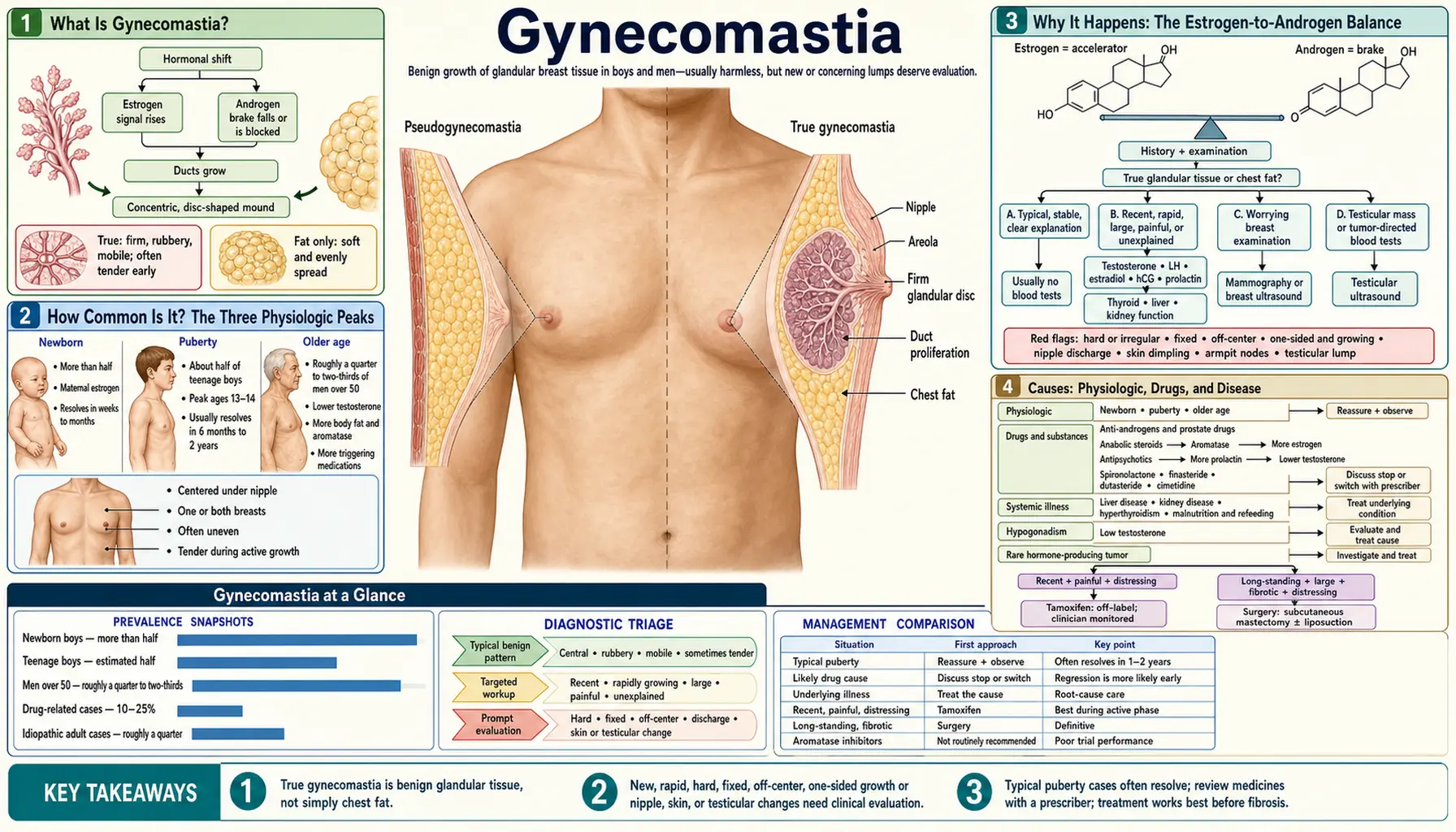
Gynecomastia is the benign enlargement of the glandular breast tissue in boys and men. However alarming it can feel, it is one of the most common and least dangerous findings in male medicine — at some point in life the majority of males develop at least a small amount of it. The word simply joins the Greek gyne (woman) and mastos (breast), and for centuries it carried needless shame. In reality most cases are a normal, temporary response to the shifting balance of hormones at birth, during puberty, and again in later life. The medical task is rarely dramatic: tell true glandular tissue apart from ordinary chest fat, rule out the small number of cases driven by a medication or an underlying illness, and reassure the large majority whose gynecomastia is harmless and often resolves on its own. This page explains what gynecomastia is, why it happens, when it needs a closer look, and what can be done about it.
Table of Contents
- What Is Gynecomastia?
- How Common Is It? The Three Physiologic Peaks
- Why It Happens: The Estrogen-to-Androgen Balance
- Causes: Physiologic, Drugs, and Disease
- Symptoms and When It Is Concerning
- Diagnosis
- Treatment
- Psychological Impact
- When to See a Doctor
- Key Research Papers
- Connections
- Featured Videos
What Is Gynecomastia?
Gynecomastia is the growth of true glandular breast tissue — the same ductal tissue that all humans are born with, male and female alike. Under a hormonal signal, the small network of ducts beneath the nipple proliferates, and a firm, rubbery button of tissue develops. On examination it feels like a concentric, disc-shaped mound centered under the areola, often mobile and sometimes tender to the touch, especially early on. It may involve one breast or both, and when both are involved they are frequently uneven in size.
The single most important distinction — and the one that changes everything about the workup and treatment — is between true gynecomastia and pseudogynecomastia (sometimes called lipomastia). Pseudogynecomastia is simply fat deposited over the chest without any growth of glandular tissue. It is soft and evenly spread, with no discrete disc under the nipple, and it is extremely common in men who carry extra weight. A clinician can usually tell the two apart by feel: pinching the tissue between thumb and forefinger and working toward the nipple, true glandular tissue offers firm resistance as a defined ridge, while fat feels uniform all the way. The two can also coexist, particularly in obesity, where extra fat both adds bulk and fuels the hormonal shift that grows real glandular tissue. Getting this distinction right matters because pseudogynecomastia responds to weight loss, whereas established glandular tissue does not shrink with diet and may need medication or surgery if it is bothersome.
How Common Is It? The Three Physiologic Peaks
Gynecomastia is not one disease with one cause; it is a physical finding that appears predictably at three stages of a man's life, driven by normal hormonal transitions. Between these peaks it is uncommon in a healthy male, which is why gynecomastia arising in a man aged roughly 20–50 deserves a little more curiosity than gynecomastia in a pubertal teenager.
1. The Newborn Peak
More than half of newborn boys have palpable breast tissue at birth. This is caused by the high levels of estrogen that crossed the placenta from the mother during pregnancy. It is entirely benign and resolves on its own within a few weeks to a few months as those maternal hormones clear from the baby's system.
2. The Pubertal Peak
Adolescent gynecomastia is remarkably common, affecting an estimated half of teenage boys, with a peak around ages 13–14. At the start of puberty, estradiol (the main estrogen) tends to rise before testosterone production fully catches up, creating a temporary window in which the estrogen-to-androgen balance favors breast growth. In the great majority of boys it is mild, and it resolves spontaneously — usually within six months to two years — as testosterone rises and reasserts the balance. Reassurance and watchful waiting, not testing, are the right first response for a typical pubertal case.
3. The Older-Age Peak
A third wave appears in older men, reported in roughly a quarter to two-thirds of men over 50. Several age-related changes stack on top of one another: testosterone production gradually declines, body fat increases (and fat is where the enzyme aromatase converts androgens into estrogen), sex hormone–binding globulin rises and mops up more of the remaining free testosterone, and older men simply take more of the medications known to trigger gynecomastia. The result is a slow drift of the hormonal balance toward estrogen.
Why It Happens: The Estrogen-to-Androgen Balance
Breast tissue responds to two opposing hormonal signals. Estrogens stimulate the ducts to grow; androgens such as testosterone oppose that growth. In a healthy adult male the androgen signal dominates and the breast stays flat. Gynecomastia develops whenever that ratio tips toward estrogen — and there are three ways for the ratio to tip:
- More estrogen. The body may make or absorb more estrogen — from an estrogen-secreting tumor, from taking anabolic steroids that the body converts to estrogen, or from increased activity of aromatase (which is why extra body fat and some drugs raise estrogen levels).
- Less androgen. Testosterone may fall — from testicular failure, from hypogonadism, or from drugs that block androgen production or action.
- Blocked androgen action. Some medications block the androgen receptor directly, so even normal testosterone levels cannot deliver their “keep the breast flat” message.
A useful way to picture it: androgen is the brake and estrogen is the accelerator on breast-tissue growth. Anything that eases off the brake or presses the accelerator can produce gynecomastia. This single framework explains almost every cause listed below.
Causes: Physiologic, Drugs, and Disease
Broadly, gynecomastia falls into four buckets: normal physiology, medications and substances, systemic illness, and (rarely) hormone-producing tumors. In a large share of adult cases — roughly a quarter — no specific cause is ever identified, and the gynecomastia is labeled idiopathic. That is a reassuring category, not a failure of the workup.
Physiologic
The three life-stage peaks described above — newborn, pubertal, and older-age — account for the large majority of all gynecomastia. These cases are benign by definition.
Medications and Substances
Drugs are a leading and eminently reversible cause, implicated in an estimated 10–25% of cases. The mechanisms vary — some raise estrogen, some lower or block testosterone, some raise prolactin — but the practical point is the same: an offending drug caught early can often be stopped or swapped, and the gynecomastia may regress. Commonly implicated agents include:
- Anti-androgens and prostate drugs: spironolactone, bicalutamide, flutamide, cyproterone, and cimetidine block androgen action; the 5-alpha-reductase inhibitors finasteride and dutasteride (used for hair loss and enlarged prostate) are also implicated.
- Anabolic-androgenic steroids: a classic cause in bodybuilders and athletes. The body converts the excess androgen into estrogen via aromatase, tipping the balance despite — indeed because of — the steroid use.
- Antipsychotics and some other psychiatric drugs: risperidone, haloperidol, and others raise prolactin, which suppresses the body's own testosterone production.
- Cardiovascular drugs: spironolactone (again), digoxin, and the calcium-channel blockers verapamil, nifedipine, and diltiazem, among others.
- Acid-reducing and gastrointestinal drugs: cimetidine most notably, and metoclopramide (via prolactin).
- Others: some HIV antiretroviral regimens, ketoconazole, certain chemotherapy agents, opioids, and heavy use of alcohol or cannabis have all been linked, with varying strength of evidence.
The strength of the evidence differs a great deal from drug to drug — spironolactone and anabolic steroids are well established, while some other associations rest on case reports — so a suspected drug cause is worth discussing with the prescriber rather than assuming.
Systemic Illness
- Liver disease, especially cirrhosis: the damaged liver handles hormones poorly, increasing the conversion of androgens to estrogen and the level of binding globulin, both of which favor estrogen. Alcohol contributes independently.
- Chronic kidney disease and dialysis: disrupt the hormonal axis and are a recognized cause.
- Hyperthyroidism: an overactive thyroid raises binding globulin and aromatase activity, again shifting the balance toward estrogen.
- Malnutrition and refeeding: gynecomastia can appear when a starved person begins eating again and the hormonal machinery restarts — a phenomenon first widely noted in returning prisoners of war.
Hypogonadism
Any condition that lowers testosterone can cause gynecomastia. This includes primary testicular failure (as in Klinefelter syndrome, a genetic condition that also raises the risk of male breast cancer) and secondary hypogonadism from disorders of the pituitary or hypothalamus. Because low testosterone has many other consequences, gynecomastia here is often a signpost to a broader hormonal evaluation.
Rare but Important: Tumors
A small minority of cases signal a hormone-producing tumor, which is exactly why an unexplained, rapidly growing gynecomastia in an adult warrants investigation. Possibilities include testicular tumors (Leydig-cell, Sertoli-cell, or germ-cell tumors that make estrogen or hCG), hCG-secreting tumors elsewhere (lung or gastrointestinal), estrogen-secreting adrenal tumors, and prolactinomas (which cause gynecomastia indirectly by suppressing testosterone). These are uncommon, but they are the reason clinicians examine the testicles and, when indicated, check hormone levels.
Symptoms and When It Is Concerning
Typical, benign gynecomastia presents as a soft-to-firm, rubbery, movable disc of tissue centered directly beneath the nipple, often on both sides (though rarely perfectly symmetric). It can be tender or mildly painful, particularly during a phase of active growth, and the tenderness often settles as the tissue matures. This picture — central, mobile, sometimes sore — is overwhelmingly reassuring.
Certain features, by contrast, are red flags that call for prompt evaluation, chiefly to exclude the rare possibility of male breast cancer or a hormone-producing tumor:
- A hard or irregular lump, rather than a soft rubbery disc.
- A mass that is fixed to the skin or chest wall and does not move freely.
- A lump that is off-center (eccentric) rather than symmetrically under the nipple.
- Strictly one-sided enlargement that is firm and growing.
- Rapid growth, a large size, or an ulcer or dimpling of the overlying skin.
- Nipple discharge, especially if bloody.
- Swollen lymph nodes in the armpit, or a lump felt in a testicle.
None of these guarantees anything serious, but any of them should prompt a visit and, usually, imaging. Male breast cancer is rare — it makes up about 1% of all breast cancers — but it is treatable, and the point of the workup is to catch the uncommon case early while reassuring the many.
Diagnosis
The evaluation of gynecomastia is mostly a good history and a careful examination; testing is targeted, not routine.
- History: How long has it been present, and is it growing? Is it painful? What medications, supplements, or substances (including anabolic steroids, alcohol, and recreational drugs) are in use? Are there symptoms of low testosterone, thyroid, liver, or kidney disease? A recent, rapidly enlarging breast in an otherwise well adult is the profile that most warrants a workup.
- Examination: The clinician distinguishes true glandular tissue from fat, checks for the red-flag features above, and — importantly — examines the testicles for masses and looks for signs of liver, kidney, or thyroid disease and for features of hypogonadism.
- When to test: Long-standing, stable, non-tender gynecomastia in a teenager or an older man with an obvious explanation usually needs no blood tests. Recent-onset, rapidly growing, large, painful, or unexplained gynecomastia does. A typical panel includes testosterone, LH, estradiol, hCG, prolactin, thyroid function (see the thyroid panel), and liver and kidney function via a comprehensive metabolic panel.
- Imaging: When the examination is worrying, mammography or ultrasound of the breast helps separate benign gynecomastia from cancer. Ultrasound of the testicles is used when a testicular mass is felt or when blood tests point to a hormone-producing tumor.
The overarching diagnostic goal is simple: confirm it is true glandular tissue, rule out male breast cancer and the rare tumor, and identify any reversible drug or disease cause.
Treatment
Treatment depends on the cause, how long the tissue has been present, and how much it bothers the person. A crucial biological point governs everything: gynecomastia passes through an early, active, cellular phase in which the tissue can still shrink, and a later, fibrotic, scarred phase in which it generally cannot. Medications work best in the first year; after that, surgery becomes the main option.
- Reassurance and observation. For typical pubertal gynecomastia, the best treatment is usually none at all — reassurance plus a re-check every few months, since most cases resolve within one to two years. The same watchful approach suits mild, stable, long-standing gynecomastia in adults.
- Stop or switch the offending drug. If a medication is the likely trigger, stopping or substituting it — in consultation with the prescriber — often leads to regression, especially if done within the first several months.
- Treat the underlying condition. Correcting hyperthyroidism, replacing testosterone in a man with genuine hypogonadism, or treating a tumor addresses the root cause.
- Medications. When gynecomastia is recent, painful, and distressing, a selective estrogen-receptor modulator — most often tamoxifen, used off-label — has the best evidence for reducing pain and size during the active phase. Aromatase inhibitors such as anastrozole have generally performed poorly in trials and are not routinely recommended. Any drug treatment should be prescribed and monitored by a clinician.
- Surgery. For gynecomastia that is long-standing, large, fibrotic, or causing significant distress, surgery is definitive. Options include removal of the glandular tissue (subcutaneous mastectomy), often combined with liposuction to address any fatty component.
Men undergoing anti-androgen therapy for prostate cancer are a special case: because gynecomastia is a predictable side effect, doctors sometimes use preventive tamoxifen or a single dose of radiation to the breast before treatment begins.
Psychological Impact
It would be a mistake to treat gynecomastia as a purely cosmetic footnote. For many boys and men — adolescents especially — visible breast tissue is a real source of embarrassment, anxiety, and low self-esteem. It can drive people to avoid swimming, sports, locker rooms, dating, and even routine situations like removing a shirt, and it has been linked to symptoms of social anxiety and depression. Teenagers, already navigating a sensitive stage of body image, can be hit hard by a change they did not choose and cannot hide.
Two things help most. The first is honest reassurance: for the large majority, gynecomastia is benign and, in adolescents, usually temporary — naming that clearly can lift a real weight. The second is taking the distress seriously rather than dismissing it. When gynecomastia persists and continues to affect quality of life, that psychological toll is itself a legitimate reason to pursue medical or surgical treatment, not merely a “vanity” concern.
When to See a Doctor
See a clinician for any new breast enlargement or lump, if only to confirm that it is benign gynecomastia. It is worth making the appointment sooner rather than later when any of the following are present:
- The lump is hard, fixed, one-sided, or rapidly growing.
- There is nipple discharge, skin dimpling, or an ulcer.
- You have noticed a lump or change in a testicle, or unexplained weight loss and other systemic symptoms.
- The breast tissue appeared soon after starting a new medication or supplement.
- It is painful, or it is causing meaningful distress or affecting daily life.
Early evaluation does two good things at once: it catches the small number of cases that need treatment while it reassures the many whose gynecomastia is harmless. Do not attempt to self-treat with over-the-counter “estrogen-blocker” supplements — they are unproven, and they can delay the identification of a treatable cause.
Key Research Papers
- Braunstein GD. Gynecomastia. New England Journal of Medicine. 2007;357(12):1229-1237.
- Narula HS, Carlson HE. Gynaecomastia—pathophysiology, diagnosis and treatment. Nature Reviews Endocrinology. 2014;10(11):684-698.
- Johnson RE, Murad MH. Gynecomastia: pathophysiology, evaluation, and management. Mayo Clinic Proceedings. 2009;84(11):1010-1015.
- Kanakis GA, Nordkap L, Bang AK, et al. EAA clinical practice guidelines—gynecomastia evaluation and management. Andrology. 2019;7(6):778-793.
- Cuhaci N, Polat SB, Evranos B, et al. Gynecomastia: clinical evaluation and management. Indian Journal of Endocrinology and Metabolism. 2014;18(2):150-158.
- Sansone A, Romanelli F, Sansone M, Lenzi A, Di Luigi L. Gynecomastia and hormones. Endocrine. 2017;55(1):37-44.
- Ladizinski B, Lee KC, Nutan F, et al. Gynecomastia: etiologies, clinical presentations, diagnosis, and management. Southern Medical Journal. 2014;107(1):44-49.
- Bowman JD, Kim H, Bustamante JJ. Drug-induced gynecomastia. Pharmacotherapy. 2012;32(12):1123-1140.
- Deepinder F, Braunstein GD. Drug-induced gynecomastia: an evidence-based review. Expert Opinion on Drug Safety. 2012;11(5):779-795.
- Nuttall FQ. Gynecomastia as a physical finding in normal men. Journal of Clinical Endocrinology & Metabolism. 1979;48(2):338-340.
- Lawrence SE, Faught KA, Vethamuthu J, Lawson ML. Beneficial effects of raloxifene and tamoxifen in the treatment of pubertal gynecomastia. The Journal of Pediatrics. 2004;145(1):71-76.
- Mieritz MG, Rakêt LL, Hagen CP, et al. A longitudinal study of growth, sex steroids, and IGF-1 in boys with physiological gynecomastia. Journal of Clinical Endocrinology & Metabolism. 2015;100(10):3752-3759.
Live PubMed Searches
These links open live PubMed searches for the listed keywords — results update as new studies are indexed.
- Gynecomastia — PubMed search
- Drug-induced gynecomastia — PubMed search
- Pubertal gynecomastia — PubMed search
- Gynecomastia treatment with tamoxifen — PubMed search
- Gynecomastia surgery — PubMed search
- Estrogen-to-androgen ratio in gynecomastia — PubMed search
- Male breast cancer vs gynecomastia — PubMed search
Connections
- Endocrinology
- Male Hypogonadism
- Testosterone Test
- Obesity
- Metabolic Syndrome
- Cirrhosis
- Liver Disease
- Kidney Disease
- Hyperthyroidism
- Hypothyroidism
- Prolactinoma
- Cushing's Syndrome
- Breast Cancer
- Testicular Cancer
- Thyroid Panel
- Zinc