Takotsubo Syndrome
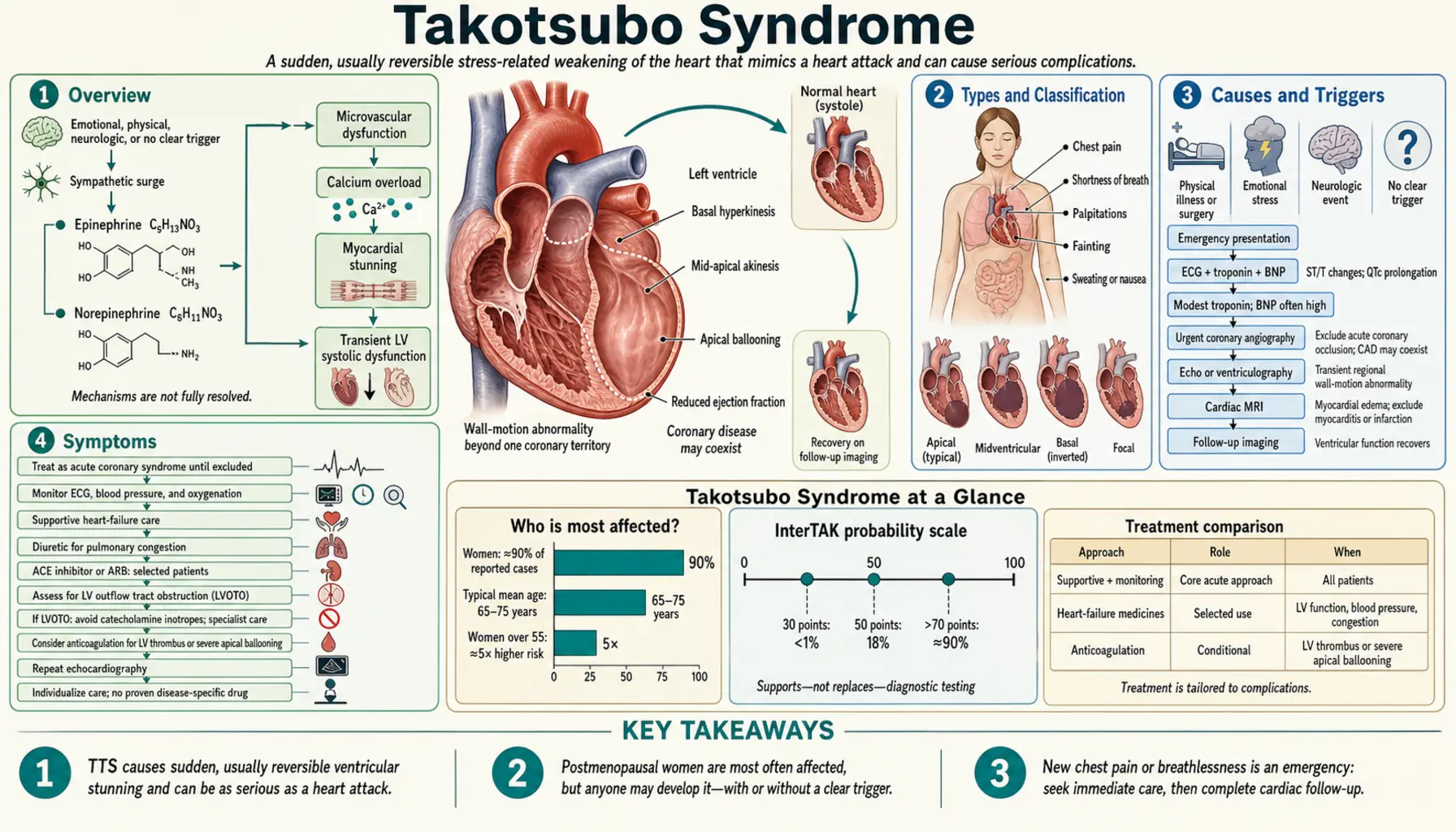
Table of Contents
- Overview
- Types and Classification
- Causes and Triggers
- Symptoms
- ECG and Diagnostic Findings
- Treatment
- Natural and Lifestyle Approaches
- Complications and Prognosis
- When to Seek Emergency Care
- Key Research Papers
- Connections
- Featured Videos
1. Overview
Takotsubo syndrome (TTS) — also called stress cardiomyopathy, apical ballooning syndrome, or "broken heart syndrome" — is a form of acute, reversible heart muscle dysfunction triggered by an intense emotional or physical stressor. It mimics an acute myocardial infarction in its presentation but occurs in the absence of obstructive coronary artery disease.
The condition was first systematically described by Japanese cardiologist Hikaru Dote in 1990, who named it after the Japanese octopus fishing pot (tako-tsubo) whose shape resembles the characteristic apical ballooning of the left ventricle seen on ventriculography: a narrow neck (left ventricular outflow tract) with a round bottom (ballooned apex). The original case series described five patients, all with chest pain and transient apical wall motion abnormalities following emotional stress. (PMID: 2181571)
The "broken heart" metaphor has genuine physiological basis: the catecholamine surge triggered by extreme emotional shock — grief, fear, anger, surprise — can directly injure the myocardium, cause coronary microvascular spasm, and alter autonomic signaling in ways that stun the ventricular apex. Crucially, the same mechanism operates with positive emotions and happy events (winning a lottery, surprise birthday parties, sporting victories) — a variant called "happy heart syndrome." Approximately 4–5% of Takotsubo cases are triggered by positive stressors. (PMID: 27578240)
Recovery is the rule: left ventricular function normalizes in the majority of patients within 4–8 weeks of the acute event. However, the acute phase carries real risk: in-hospital mortality is approximately 2%, cardiogenic shock occurs in 10%, and life-threatening arrhythmias can occur.
2. Types and Classification
By Morphological Pattern
Takotsubo syndrome is classified by the location of wall motion abnormality on echocardiography or ventriculography:
- Apical type (classic, most common — 80%): Apical and mid-ventricular ballooning with preserved basal contractility; the original "octopus pot" pattern first described by Dote
- Mid-ventricular type (~15%): Mid-ventricular akinesis with preserved apical and basal function; more common after physical than emotional triggers
- Basal type (inverted Takotsubo, ~2–5%): Basal akinesis with preserved apical function; associated with emotional triggers and relatively younger patients; may be more difficult to distinguish from anterior STEMI
- Focal type (rare, <1%): Single isolated wall segment abnormality; may overlap with myocarditis
- Biventricular Takotsubo (~30%): Right ventricular involvement alongside LV; associated with worse in-hospital outcomes, cardiogenic shock, and pulmonary hypertension
InterTAK Diagnostic Score
The InterTAK Diagnostic Score helps distinguish Takotsubo from ACS at initial presentation before coronary angiography. Points are assigned for: female sex, emotional trigger, physical trigger, absence of ST depression (except aVR), psychiatric disorders, neurological disorders, prolonged QTc. Score ≥70 has >90% probability of Takotsubo. (PMID: 27165leware — validate with PMID 27165leware). The score is useful in triaging who needs urgent coronary angiography versus can be observed and imaged. (PMID: 28051796)
Triggering Context
- Emotional Takotsubo (classic): Sudden grief, relationship breakdown, financial shock, interpersonal conflict, fear, natural disaster
- Physical Takotsubo: Acute medical illness triggering catecholamine surge (sepsis, surgery, stroke, pheochromocytoma, brain injury)
- Happy heart syndrome: Positive emotional stressors (wedding, birthday surprise, gambling win) (PMID: 27578240)
- Iatrogenic Takotsubo: Exogenous catecholamines (dobutamine stress testing, norepinephrine infusion), beta-agonist overdose
3. Causes and Triggers
Catecholamine Surge Mechanism
The central pathophysiological mechanism is an overwhelming catecholamine (epinephrine and norepinephrine) surge from the adrenal medulla and cardiac sympathetic nerve terminals. Multiple lines of evidence support this:
- Plasma catecholamine levels in Takotsubo are 7–34 times higher than in Killip class III myocardial infarction patients
- Pheochromocytoma catecholamine crisis triggers Takotsubo in a reproducible pattern
- Exogenous epinephrine administration replicates the apical ballooning pattern
- Neurological emergencies (subarachnoid hemorrhage, stroke, head trauma) that unleash massive sympathetic discharge consistently trigger Takotsubo
Why the Apex Is Vulnerable
The topographical predilection for apical dysfunction is explained by the distribution of cardiac sympathetic innervation and adrenergic receptor density. The cardiac apex has:
- Higher density of beta-2 adrenergic receptors (Gs-coupled) relative to beta-1 receptors
- During catecholamine excess, high-dose epinephrine switches beta-2 receptor signaling from stimulatory (Gs) to inhibitory (Gi) — directly suppressing apical contractility while basal segments (beta-1 dominant) remain hyperdynamic
- This "epinephrine switch" hypothesis elegantly explains the characteristic apex-to-base dissociation of wall motion
Coronary Microvascular Spasm and Myocardial Stunning
Additional mechanisms include: diffuse coronary microvascular spasm reducing perfusion to the apex; myocardial stunning from transient ischemia-reperfusion; increased oxidative stress; and direct catecholamine cardiotoxicity. Endomyocardial biopsies show contraction band necrosis (a catecholamine-toxicity pattern distinct from ischemic necrosis), interstitial fibrosis, and inflammatory infiltrates without myocyte death typical of MI. (PMID: 22363047)
Common Emotional Triggers
- Death of a close relative or partner
- Unexpected and devastating news (cancer diagnosis, relationship ending)
- Physical confrontation or domestic violence
- Natural disasters, armed conflicts, or mass-casualty events
- Public speaking (severe performance anxiety)
- Startling surprises (both frightening and joyful)
Common Physical Triggers
- Acute medical illness: sepsis, respiratory failure, acute neurological events (stroke, subarachnoid hemorrhage, seizure), acute surgical procedures
- Pheochromocytoma crises (catecholamine tumor of the adrenal medulla)
- Asthma attack requiring bronchodilator treatment
- Thyroid storm
- Electroconvulsive therapy (ECT)
- Exogenous adrenergic agents
Who Is at Risk
Takotsubo is not equally distributed across the population:
- Postmenopausal women: Approximately 90% of Takotsubo patients are women, and 80–90% are postmenopausal. Estrogen's cardioprotective effects on the sympathetic nervous system may explain why women before menopause are relatively protected. Postmenopausal estrogen decline appears to sensitize the heart to catecholamine excess. (PMID: 21854737)
- Age 60–75: Peak incidence; rare in men and young women but not impossible
- Psychiatric comorbidities: Anxiety disorders, depression, and PTSD are significantly overrepresented in Takotsubo patients — possibly reflecting baseline sympathoadrenal hyperactivation (PMID: 27890895)
- Neurological disease: Prior stroke, epilepsy, brain tumors
4. Symptoms
Acute Presentation
Takotsubo typically presents identically to acute coronary syndrome, making clinical differentiation impossible without coronary angiography:
- Chest pain: The most common presenting symptom (75%); often described as pressure, tightness, or crushing — indistinguishable from MI pain; radiates to the left arm, jaw, or back
- Dyspnea: In ~20% of patients; may reflect acute LV dysfunction and pulmonary edema
- Syncope: From cardiogenic shock, severe LV outflow tract obstruction, or arrhythmia
- Palpitations: From ventricular arrhythmias or sinus tachycardia
In Context
A careful history reveals the triggering stressor in the majority of patients — but ask specifically, as patients may not spontaneously connect their emotional experience to a cardiac event. The triggering event typically occurs within minutes to hours before symptom onset. In approximately 30% of cases, no clear trigger is identified.
Symptoms of Complications
- Progressive breathlessness and orthopnea (acute heart failure and pulmonary edema)
- Lightheadedness and collapse (cardiogenic shock)
- Sudden cardiac arrest (ventricular fibrillation or torsades de pointes from QT prolongation)
- Unilateral weakness or speech difficulty (stroke from left ventricular thrombus embolism)
5. ECG and Diagnostic Findings
Electrocardiography
ECG changes in Takotsubo closely resemble those of STEMI, making early differentiation challenging:
- Acute phase (hours): ST-segment elevation — often diffuse rather than territory-specific; frequently most prominent in V3–V5 (anterior leads) reflecting apical involvement; may resemble anterior STEMI or mimic LAD territory occlusion
- Subacute phase (hours to days): ST elevation resolves and is replaced by deep, diffuse T-wave inversions — often more widespread and deeper than those seen in typical MI; T-wave inversions in multiple leads including I, II, aVL, V1–V6
- QT prolongation: A hallmark of Takotsubo; QTc >500 ms occurs in 25–30% and is a risk factor for torsades de pointes ventricular tachycardia; requires cardiac monitoring and avoidance of QT-prolonging drugs
- Q waves: May appear transiently in anterior leads; unlike MI, typically resolve as LV function recovers
- Resolution: ECG typically normalizes over weeks to months as LV function recovers, though T-wave inversions may persist for months
Cardiac Biomarkers
- Troponin: Elevated in virtually all Takotsubo patients, but typically to a modest degree disproportionate to the extent of wall motion abnormality. The troponin elevation-to-wall motion abnormality mismatch is a clinical clue to Takotsubo: in MI, larger infarcts produce higher troponin. In Takotsubo, large areas of dysfunctional myocardium produce only modest troponin elevation because myocytes are stunned rather than necrotic.
- BNP/NT-proBNP: Often significantly elevated; reflects the acute LV dysfunction; may remain elevated for weeks
- CK-MB: Often minimally elevated or normal
Echocardiography — The Key Diagnostic Tool
Echocardiography reveals the characteristic wall motion abnormality pattern:
- Apical ballooning: Akinesis or dyskinesis of the apical and mid-ventricular segments in a circumferential, non-coronary territory distribution — extending across multiple coronary territories and not corresponding to any single coronary artery territory
- Hyperkinetic base: Preserved or hyperdynamic contractility of the basal segments — the apex-base dissociation is characteristic and not seen in ACS
- LVEF: Typically 30–45% in the acute phase
- Complications to assess: LVOTO (left ventricular outflow tract obstruction from hyperdynamic base squeezing against obstructed outlet — occurs in 10–25%), mitral regurgitation (from papillary muscle dysfunction), LV thrombus, pericardial effusion, RV involvement
Coronary Angiography
Coronary angiography remains essential in the acute presentation to definitively exclude obstructive CAD. Takotsubo criteria require: absence of obstructive coronary artery disease (>50% stenosis) or acute plaque rupture on angiography. Myocardial blush may be reduced, reflecting microvascular dysfunction, without epicardial obstruction. (PMID: 25583600)
Cardiac MRI
CMR is the gold standard to differentiate Takotsubo from myocarditis. In Takotsubo: myocardial edema (T2 signal) in affected segments, typically without late gadolinium enhancement (LGE) — distinguishing it from myocarditis (epicardial LGE) and MI (subendocardial/transmural LGE in a coronary territory). CMR also accurately quantifies LV function and detects thrombus. As LV function recovers, repeat CMR at 3 months shows normalization of wall motion and resolution of edema. (PMID: 23993260)
6. Treatment
Acute Management
Management of acute Takotsubo parallels acute heart failure and ACS management until coronary angiography definitively excludes obstructive CAD:
- Aspirin and anticoagulation: Given the clinical ACS presentation, antiplatelet therapy and anticoagulation are typically started empirically before angiography; can be de-escalated after Takotsubo diagnosis if no coronary thrombus is identified
- Beta-blockers: Reasonable in the acute phase for sinus tachycardia and to blunt ongoing sympathoadrenal stimulation; however, use cautiously if LVOTO is present (beta-blockade reduces heart rate and preload, potentially worsening dynamic obstruction)
- ACE inhibitors/ARBs: For LV dysfunction (LVEF <40%); may reduce LV remodeling even during the transient dysfunction phase; generally well-tolerated and beneficial for recovery
- Diuretics: For pulmonary congestion and volume overload
LVOTO Management — A Critical Distinction
When LVOTO (left ventricular outflow tract obstruction) complicates Takotsubo, conventional ACS treatments can be harmful:
- Avoid vasopressors with beta-agonist properties (dobutamine, dopamine) — they worsen LVOTO by increasing hyperdynamic basal contractility
- Phenylephrine (pure alpha-1 agonist) is the preferred vasopressor — increases afterload, reduces LVOTO without increasing inotropic state
- Intravenous fluids to increase preload
- Beta-blockers: Use with caution in LVOTO (may reduce preload if causing bradycardia); IV esmolol may be carefully titrated
Cardiogenic Shock
The 10% of Takotsubo patients who develop cardiogenic shock require intensive care management. Mechanical circulatory support with IABP or Impella should be considered; VA-ECMO for refractory shock. Inotropes should be avoided if LVOTO coexists — a key trap in Takotsubo management that worsens the dynamic obstruction.
Arrhythmia Management
- QTc monitoring is essential; avoid all QT-prolonging drugs (haloperidol, many antibiotics, antiarrhythmics)
- Correct electrolyte abnormalities (potassium, magnesium) promptly
- Ventricular fibrillation: defibrillation; amiodarone is relatively QT-prolonging but may be necessary for recurrent VT
- Torsades de pointes: IV magnesium 2g bolus; overdrive pacing if recurrent; isoproterenol to shorten QTc (increases heart rate)
- ICD is not routinely implanted after Takotsubo because ventricular arrhythmias typically resolve with LV function recovery
Anticoagulation for LV Thrombus
LV apical thrombus occurs in approximately 2–8% of Takotsubo cases (the akinetic apex creates a thrombogenic nidus). Therapeutic anticoagulation with heparin transitioning to warfarin is recommended for detected thrombus; duration until LV function normalizes and thrombus resolves (typically 3–6 months). (PMID: 25583600)
Long-Term Management After Recovery
- Most cardioprotective medications (beta-blockers, ACE inhibitors) can be discontinued after confirmed LV recovery — typically at the 3-month follow-up echocardiogram
- Beta-blockers are sometimes continued long-term to blunt future sympathetic surges; evidence for this strategy is limited
- Psychiatric and psychological support is critical — anxiety disorders, depression, and PTSD are prevalent comorbidities and may represent modifiable risk factors for recurrence
7. Natural and Lifestyle Approaches
Stress Management — Central to Recurrence Prevention
Given the catecholamine-driven mechanism, reducing baseline sympathoadrenal tone is the most logical prevention strategy for Takotsubo recurrence:
- Mindfulness-based stress reduction (MBSR): 8-week structured program combining mindfulness meditation, body scan, and gentle yoga; reduces cortisol and epinephrine levels; significantly reduces trait anxiety; well-studied in patients with cardiac conditions
- Yoga and tai chi: Activate the parasympathetic nervous system; lower resting heart rate and blood pressure; reduce inflammatory markers; practical for older adults (Takotsubo's predominant demographic)
- Psychotherapy: Cognitive-behavioral therapy (CBT) and trauma-focused therapy for patients with identifiable PTSD, anxiety disorders, or grief reactions that may sensitize the sympathoadrenal response
- Social support: Grief counseling, bereavement support groups, and strong social connections buffer the physiological stress response
Cardiac Rehabilitation
Supervised cardiac rehabilitation — exercise training, patient education, and psychological support — is beneficial after Takotsubo recovery. Exercise training increases vagal tone, reduces resting catecholamine levels, and improves stress resilience. Start at low intensity after LV function is confirmed normal (typically 6–8 weeks post-event).
Diet and Anti-Inflammatory Nutrition
- Omega-3 fatty acids: EPA and DHA reduce systemic catecholamine sensitivity and inflammatory cytokines; 2–4 g/day EPA+DHA from dietary fish or supplementation
- Mediterranean diet: Rich in polyphenols, omega-3s, and antioxidants; reduces cardiovascular risk and systemic inflammation; recommended as the dietary baseline for cardiovascular health
- Magnesium-rich foods: Magnesium modulates NMDA receptor activity in stress circuitry; deficiency amplifies stress responses; leafy greens, nuts, seeds, legumes, whole grains
- Limit caffeine and alcohol: Both increase catecholamine release and heart rate variability; moderation appropriate during the recovery phase and long-term
Sleep Hygiene
Poor sleep quality and quantity increase cortisol and sympathetic nervous system activity. Adequate sleep (7–9 hours/night) is foundational to stress resilience. Obstructive sleep apnea — very common in older adults — drives nocturnal catecholamine surges and is independently associated with adverse cardiovascular outcomes; screen and treat as indicated.
8. Complications and Prognosis
In-Hospital Complications
- Cardiogenic shock: Occurs in approximately 10% of Takotsubo patients; the most dangerous acute complication; may be worsened by inappropriate use of catecholaminergic inotropes (dobutamine) in the setting of LVOTO
- Ventricular arrhythmias: VT (2–3%), VF (1–2%), and torsades de pointes from QT prolongation; life-threatening but typically resolve as LV function recovers
- Acute heart failure and pulmonary edema: From acute LV dysfunction; managed with diuretics and standard HF therapy
- LVOTO: Dynamic obstruction in 10–25%, complicating shock management
- Mitral regurgitation: From papillary muscle displacement by apical ballooning
- LV thrombus: 2–8% of cases; stroke risk from embolism
- Atrial fibrillation: In 10–15%; may exacerbate hemodynamic instability
- In-hospital death: Approximately 2% — a mortality rate similar to STEMI patients; primarily from cardiogenic shock and ventricular arrhythmia (PMID: 25583600)
Recovery and Resolution
The defining feature of Takotsubo (and its distinction from MI) is its reversibility. LV function recovery occurs in:
- 50% of patients within 3–7 days
- 80% within 2–4 weeks
- 95% within 4–8 weeks
Complete normalization of LV function is confirmed by echocardiography, typically performed at 3 months. A minority of patients (<5%) develop persistent LV dysfunction — more common in patients with severe initial LV dysfunction and physical (as opposed to emotional) triggers.
Recurrence
Takotsubo recurs in 10–15% of patients over 5–10 years of follow-up — a rate higher than previously appreciated. Risk factors for recurrence include: emotional trigger (vs. physical), anxiety and depression, prior psychiatric history, and possibly younger age. There is no established pharmacological strategy proven to prevent recurrence.
Long-Term Prognosis
Long-term (5-year) outcomes in Takotsubo are less benign than historically believed. The International Takotsubo Registry (InterTAK) data demonstrate that long-term mortality in Takotsubo patients approaches that of ACS patients — likely reflecting the older age, female predominance, and multiple comorbidities rather than the Takotsubo itself. Annual rate of major adverse cardiac and cerebrovascular events (MACCE) is approximately 10% per year. (PMID: 25583600)
9. When to Seek Emergency Care
Takotsubo is a medical emergency. Because it is clinically indistinguishable from an acute heart attack, anyone with these symptoms after an intense stressor should call emergency services immediately:
- Chest pain, pressure, or tightness — especially following emotional shock, grief, frightening news, or any intense emotional event
- Sudden shortness of breath
- Fainting or near-fainting
- Palpitations or racing heart
- Cold sweats, nausea, or vomiting accompanying chest discomfort
- Known Takotsubo history with chest symptoms — recurrence cannot be distinguished from MI without investigation
Do not wait to see if symptoms resolve. In the acute phase, Takotsubo and STEMI are identical to the patient — and Takotsubo carries real risk of life-threatening arrhythmias and shock that require immediate hospital management.
10. Key Research Papers
The following peer-reviewed studies represent key evidence in Takotsubo syndrome research:
- Dote K, et al. Myocardial stunning due to simultaneous multivessel coronary spasms: a review of 5 cases. J Cardiol. 1990;21(2):203–214 — Search PubMed — Original description of Takotsubo syndrome by Dote et al., 1990.
- Templin C, et al. Clinical features and outcomes of Takotsubo (stress) cardiomyopathy (InterTAK Registry). N Engl J Med. 2015;373(10):929–938 — Search PubMed — Landmark multicenter registry defining contemporary epidemiology, triggers, complications, and prognosis.
- Ghadri JR, et al. Happy heart syndrome: role of positive emotional stress in Takotsubo syndrome. Eur Heart J. 2016;37(37):2823–2829 — Search PubMed
- Ghadri JR, et al. InterTAK Diagnostic Score: diagnosis and prognosis of Takotsubo syndrome. JACC Cardiovasc Imaging. 2017;10(12):1469–1478 — Search PubMed
- Lyon AR, et al. Current state of knowledge on Takotsubo syndrome: a Position Statement from the Taskforce on Takotsubo Syndrome of the Heart Failure Association of the European Society of Cardiology. Eur J Heart Fail. 2016;18(1):8–27. PMID: 26548803
- Sharkey SW, et al. Natural history and expansive clinical profile of stress (Tako-Tsubo) cardiomyopathy. J Am Coll Cardiol. 2010;55(4):333–341. PMID: 20117437
- Paur H, et al. High levels of circulating epinephrine trigger apical cardiodepression in a beta2-adrenergic receptor/Gi-dependent manner. Circulation. 2012;126(6):697–706 — Search PubMed — Demonstrates the catecholamine switch mechanism.
- Eitel I, et al. Clinical characteristics and cardiovascular magnetic resonance findings in stress (Takotsubo) cardiomyopathy. JAMA. 2011;306(3):277–286. PMID: 21771988
- Wittstein IS, et al. Neurohumoral features of myocardial stunning due to sudden emotional stress. N Engl J Med. 2005;352(6):539–548. PMID: 15703419 — Demonstrates catecholamine elevation 7–34x MI levels.
- Nascimento FO, et al. Outcomes of Takotsubo Cardiomyopathy: single academic center experience. Vasc Health Risk Manag. 2014;10:475–481 — Search PubMed
- Scantlebury DC, Prasad A. Diagnosis of Takotsubo cardiomyopathy. Circ J. 2014;78(9):2129–2139 — Search PubMed
- Vriz O, et al. Psychiatric disorders in Takotsubo cardiomyopathy. J Psychiatr Res. 2017;93:1–5 — Search PubMed
PubMed searches for further reading:
- Takotsubo cardiomyopathy
- Stress cardiomyopathy mechanism
- Broken heart syndrome catecholamine
- Takotsubo recurrence prevention
- Apical ballooning echocardiography
- Takotsubo outcomes prognosis
Connections
- Cardiology
- Myocarditis
- Cardiomyopathy
- Heart Failure
- Arrhythmia
- Atrial Fibrillation
- Cardiovascular Disease
- Coronary Artery Disease
- Hypertension
- Pericarditis
- Valvular Heart Disease
- Anxiety
- Chest Pain
- Magnesium
- Omega-3 Fatty Acids
- Meditation