Astaxanthin for Eye Health & Vision
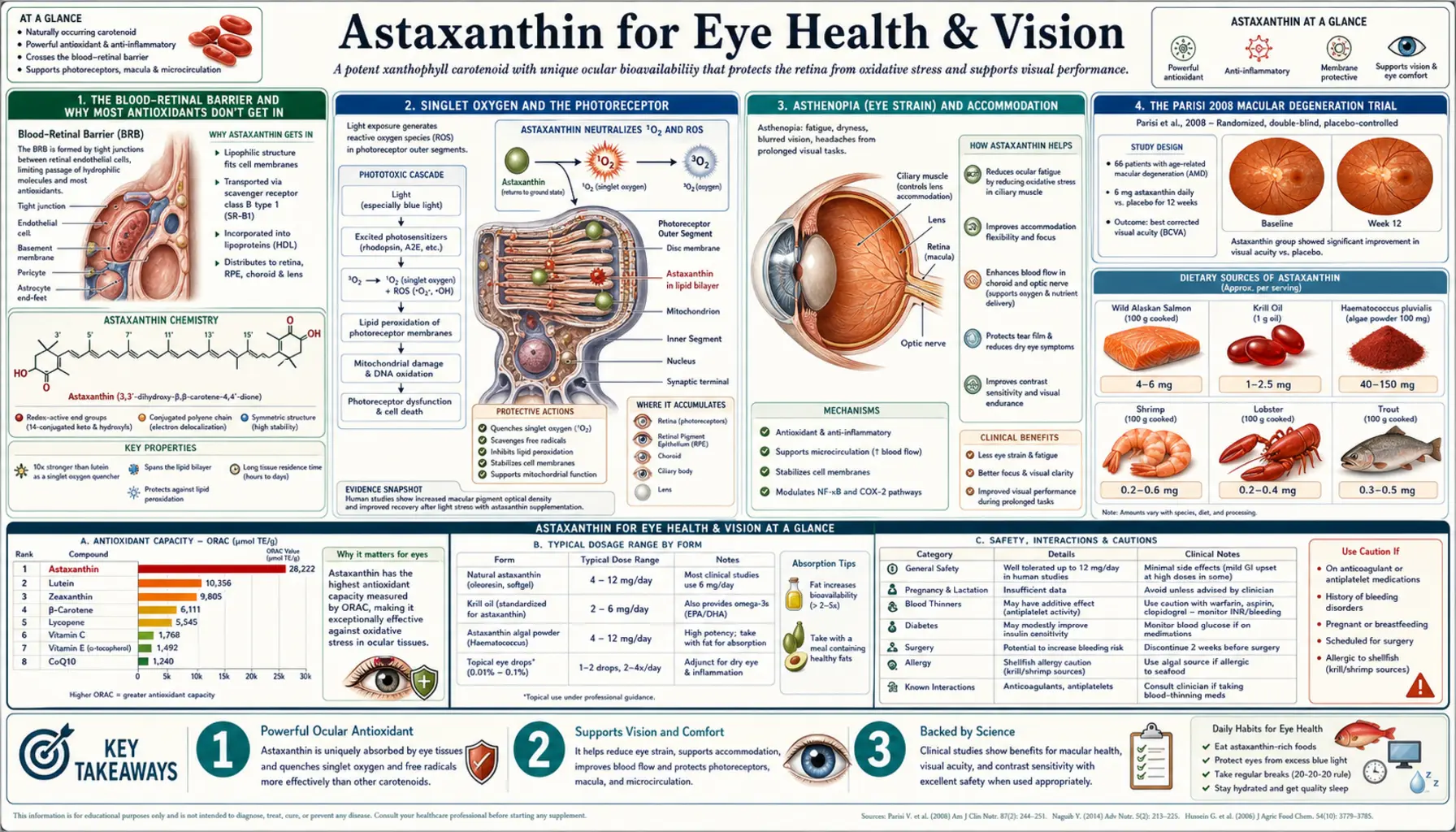
Astaxanthin is studied for the eye because of its light-related antioxidant chemistry; the human trials so far are small and short. In 60 healthy adults, 9 mg/day for 6 weeks preserved corrected visual acuity after screen work in those aged 40 and over but not in younger participants (Sekikawa 2023). In early age-related macular degeneration, the CARMIS trials gave astaxanthin 4 mg/day inside a seven-ingredient combination, so its own contribution cannot be separated (Parisi 2008; Piermarocchi 2012). In cataract patients, 6 mg/day for 2 weeks raised antioxidant activity in the fluid at the front of the eye (Hashimoto 2013). The widely repeated "6,000 times vitamin C" figure comes from one solvent-based laboratory assay, not from studies in people.
Table of Contents
- The Blood-Retinal Barrier: What Is Known About Astaxanthin Reaching the Eye
- Singlet Oxygen and the Photoreceptor
- Asthenopia (Eye Strain) and Screen Work
- The CARMIS Macular Degeneration Trials (Parisi 2008, Piermarocchi 2012)
- Blue Light and Screen Exposure: What Has Been Studied
- Diabetic Retinopathy: Laboratory and Animal Data
- Dry Eye: Uncontrolled and Combination Studies
- Choroidal Blood Flow and Glaucoma Research
- Lutein, Zeaxanthin and Astaxanthin in Combination Trials
- Doses Used in Eye Studies and Intake Limits
- Safety Findings Relevant to Eye Research
- Key Research Papers
- Connections
- Featured Videos
The Blood-Retinal Barrier: What Is Known About Astaxanthin Reaching the Eye
The blood-retinal barrier is the eye's counterpart of the blood-brain barrier — a tight-junction structure formed by the retinal capillary endothelium (the inner barrier) and the retinal pigment epithelium (the outer barrier) that controls what reaches retinal tissue. It protects the retina from circulating pathogens, toxins and inflammatory mediators, and it also limits which nutrients get in.
The macula concentrates two dietary carotenoids, lutein and zeaxanthin, which form the macular pigment. Whether, and how much, astaxanthin reaches the human retina after oral intake has not been measured in people. The human measurement available is from the front of the eye: in 35 patients having cataract surgery on both eyes, the second eye was operated on after 6 mg/day astaxanthin for 2 weeks, and the fluid taken from the front of the eye (aqueous humor) then showed higher superoxide-scavenging activity and lower total hydroperoxides (Hashimoto 2013). That measured the aqueous humor, not the retina. Brain uptake has been shown in rats, not people (Manabe 2018).
Claims that astaxanthin is "the only carotenoid" that crosses both the blood-retinal and blood-brain barriers, or that it distributes throughout the whole human retina at a stated dose, were not supported by any study found for this page. For the broader retinal disease context, see Macular Degeneration and the Ophthalmology landing page.
Singlet Oxygen and the Photoreceptor
The retina is exposed to focused light, has a very high oxygen consumption, and its photoreceptor outer segments are rich in polyunsaturated fatty acids, especially DHA, which are vulnerable to oxidation. Light energy transferred to oxygen by light-absorbing molecules produces singlet oxygen (¹O&sub2;), an excited, highly reactive form of oxygen. The enzymes superoxide dismutase and catalase act on superoxide and hydrogen peroxide, not on singlet oxygen; carotenoids deactivate ("quench") it mainly by absorbing its excess energy.
The widely repeated "6,000 times vitamin C" figure traces to a 2007 chemiluminescence assay that measured how fast each compound quenched singlet oxygen in a laboratory solvent mixture. A 2023 review led by the same first author tabulates that assay's rate constants, in units of 10⁹ per molar per second (Nishida 2023):
- Astaxanthin — 5.4
- Beta-carotene — 1.1
- Alpha-tocopherol (vitamin E) — 0.049
- Coenzyme Q10 — 0.0068
- Vitamin C — 0.00089
An earlier comparison of marine carotenoids by Shimidzu, Goto and Miki (1996) is also commonly cited. In other assays listed in the 2023 review, the gap between astaxanthin and beta-carotene ranged from none to large, and in phospholipid membrane models astaxanthin sometimes showed a lower rate than beta-carotene. These numbers are reaction speeds in a test tube; they do not show how much astaxanthin reaches the eye or whether vision changes. Other multiples often quoted (550 times vitamin E, 11 times beta-carotene, 800 times CoQ10, 5 times lutein) were not supported by the sources found for this page.
Asthenopia (Eye Strain) and Screen Work
Asthenopia is the medical term for eye strain — tired eyes, blurred vision, headache, dryness and difficulty focusing after prolonged close work, especially screen use. Proposed contributors include fatigue of the ciliary muscle that focuses the lens, a lower blink rate, and oxidative stress.
Randomized trials indexed in PubMed:
- Sekikawa 2023 — 60 healthy adults, 9 mg/day astaxanthin or placebo for 6 weeks. Corrected visual acuity after screen work was preserved in participants aged 40 and over; there was no difference in those under 40, and none in functional visual acuity or pupil constriction. The trial was sponsored by a supplement maker and had employee authors.
- Kizawa 2021 — a combination of anthocyanins, astaxanthin and lutein improved some accommodation and symptom measures after 6 weeks; the effect of astaxanthin alone cannot be separated.
Earlier Japanese accommodation trials (Nagaki 2002, Iwasaki 2006, Nakamura 2004) are often cited for eye strain. They appeared in Japanese-language journals that are not indexed in PubMed, and their methods and results could not be checked for this page, so their reported doses and findings are not repeated here.
The CARMIS Macular Degeneration Trials (Parisi 2008, Piermarocchi 2012)
Age-related macular degeneration (AMD) is a leading cause of irreversible vision loss in older adults. The AREDS and AREDS2 trials tested antioxidant-plus-zinc combinations in AMD; astaxanthin was not part of either formula. The Italian CARMIS study tested a combination that included it.
Parisi 2008 (12 months). 27 patients with non-advanced AMD were randomized to a daily combination of vitamin C 180 mg, vitamin E 30 mg, zinc 22.5 mg, copper 1 mg, lutein 10 mg, zeaxanthin 1 mg and astaxanthin 4 mg for 12 months, or no supplement. Central retinal responses on multifocal electroretinography (0–5 degrees) improved in the treated group; the more peripheral areas did not change.
Piermarocchi 2012 (24 months). In an open-label randomized study of 145 patients with AMD given the same type of combination (lutein 10 mg, zeaxanthin 1 mg, astaxanthin 4 mg plus antioxidant vitamins) or no supplement for 2 years, the treated group had better visual acuity scores at 24 months (81.4 vs 76.8), better contrast sensitivity and higher visual-function questionnaire scores. The authors called for larger and longer studies.
Because seven ingredients were given together, neither trial shows what astaxanthin itself contributed, and the control groups received no placebo.
Blue Light and Screen Exposure: What Has Been Studied
Blue light (roughly 400–490 nm) is the highest-energy part of the visible spectrum. It reaches the photoreceptors and retinal pigment epithelium, where laboratory studies show it can generate reactive oxygen species. LED screens and LED lighting have increased everyday exposure to it.
No human trial of astaxanthin against a measured blue-light load was found for this page; a frequently cited "Hashimoto 2018 blue-light trial" could not be located in PubMed. The Hashimoto group's published human work measured the aqueous humor of cataract patients (Hashimoto 2013). The human trial that involved screen work is the Sekikawa 2023 study described above, which measured visual acuity after a screen task, not blue-light damage.
Diabetic Retinopathy: Laboratory and Animal Data
Diabetic retinopathy is one of the classic microvascular complications of diabetes. Chronic high blood glucose damages retinal capillaries through several pathways, including the polyol (aldose reductase) pathway, advanced glycation end products and oxidative stress.
No human trial of astaxanthin in diabetic retinopathy was found for this page. The published evidence is laboratory and animal work: in retinal pigment epithelial cells under high-glucose or low-oxygen conditions and in diabetic rats, astaxanthin lowered VEGF expression and its upstream signals HIF1α and XBP1 (Janani 2021); and in a gerbil model of type 2 diabetes, astaxanthin given for one week lowered red-cell aldose reductase activity (Benlarbi-Ben Khedher 2019). These do not show an effect in people. Alpha lipoic acid has its own page on this site.
Dry Eye: Uncontrolled and Combination Studies
Dry eye disease involves deficient tear production, an unstable tear film, increased evaporation and inflammation of the eye's surface. It is common with heavy screen use, after menopause and in autoimmune conditions such as Sjögren's syndrome.
- Tian 2021 — 60 middle-aged and older patients with mild-to-moderate dry eye took 6 mg astaxanthin twice daily for about 30 days in a single-group study with no control arm. Symptom scores, tear break-up time, corneal staining and several eyelid and meibomian-gland measures improved from baseline; tear volume (Schirmer test), tear meniscus height and lipid-layer thickness did not change.
- Huang 2016 — a randomized, placebo-controlled trial of an 8-week multi-ingredient antioxidant supplement (anthocyanosides, astaxanthin, vitamins A, C and E and herbal extracts) in 43 completers. Tear break-up time and Schirmer scores improved, but dry-eye symptom scores did not differ from placebo. The contribution of astaxanthin cannot be separated.
No controlled trial of astaxanthin alone, or of astaxanthin combined with krill oil or omega-3, for dry eye was found for this page.
Choroidal Blood Flow and Glaucoma Research
The choroid is the blood-vessel layer behind the retina that supplies oxygen and nutrients to the outer retina and photoreceptors.
Saito 2012 — 20 healthy volunteers were randomized to 12 mg/day astaxanthin or placebo for 4 weeks. Laser speckle flowgraphy showed a significant rise in macular blood-flow velocity from baseline in the astaxanthin group and no change in the placebo group; the comparison reported was within each group, and the study was small.
In glaucoma, the research is in animals: in mice lacking a glutamate transporter, a model of normal-tension glaucoma, astaxanthin reduced thinning of the retinal ganglion cell layer measured by optical coherence tomography (Tanaka-Gonome 2020). No human trial of astaxanthin with glaucoma outcomes was found for this page.
Lutein, Zeaxanthin and Astaxanthin in Combination Trials
The three carotenoids have been given together in eye trials, but they have not been compared head to head:
- Lutein and zeaxanthin — concentrate in the macular pigment and absorb blue light. The AREDS2 formula used lutein 10 mg and zeaxanthin 2 mg per day.
- Astaxanthin — is not a component of the macular pigment. In the CARMIS trials it was given at 4 mg/day with lutein 10 mg, zeaxanthin 1 mg and antioxidant vitamins and minerals (Parisi 2008; Piermarocchi 2012); in the Kizawa 2021 trial it was combined with anthocyanins and lutein.
Because the combinations were tested as wholes, these trials do not show whether adding astaxanthin changes the effect of lutein and zeaxanthin.
Doses Used in Eye Studies and Intake Limits
There is no official recommended intake for astaxanthin. The figures below are the doses used in studies and the limits agencies have reported, not instructions.
- Screen work and visual acuity — 9 mg/day for 6 weeks (Sekikawa 2023).
- Aqueous humor antioxidant activity — 6 mg/day for 2 weeks before cataract surgery (Hashimoto 2013).
- Choroidal blood flow — 12 mg/day for 4 weeks (Saito 2012).
- Macular degeneration — 4 mg/day within a seven-ingredient combination for 12 months (Parisi 2008) and 24 months (Piermarocchi 2012).
- Dry eye — 6 mg twice daily for about 30 days, uncontrolled (Tian 2021).
Intake limits. In 2020 the European Food Safety Authority concluded that 8 mg/day from food supplements, added to the astaxanthin people get from fish and crustaceans, is safe for adults, using an acceptable daily intake of 0.2 mg per kg of body weight (EFSA 2020). In the United States, the FDA has not approved astaxanthin as a dietary supplement — it does not approve supplements before they are marketed — and its listings for astaxanthin are as color additives in the feed of salmonid fish (21 CFR 73.35, 73.185 and 73.355).
Safety Findings Relevant to Eye Research
- Adverse events in trials — a 2019 review of 87 human studies of natural astaxanthin found none that reported safety concerns (Brendler 2019). The eye trials cited here lasted from 2 weeks to 24 months; no adverse events were found in the 12 mg/day choroidal-flow study (Saito 2012).
- Blood pressure — pooled trials did not show a consistent effect on systolic or diastolic blood pressure (Xia 2020).
- Blood clotting and eye surgery — in rats, astaxanthin reduced platelet aggregation and prolonged bleeding time (Satti 2021). No clinical trial of astaxanthin taken with anticoagulant or antiplatelet drugs, or around eye surgery, was found for this page, so the interaction is unstudied rather than known to be absent. In the Hashimoto 2013 study, patients took astaxanthin for 2 weeks before cataract surgery. Decisions about supplements around surgery or with these medicines belong with a clinician.
- Synthetic astaxanthin — synthetic astaxanthin is a mixture of the 3S,3'S, meso and 3R,3'R stereoisomers, while algal astaxanthin is mainly 3S,3'S (Ambati 2014). A 2019 safety review notes that few safety studies in humans or animals have used the synthetic form (Brendler 2019).
- Source and shellfish allergy — astaxanthin extracted from the freshwater microalga Haematococcus pluvialis is not of crustacean origin, whereas krill-oil products contain crustacean material. No study of cross-reaction in people with shellfish allergy was found for this page.
- Pregnancy and breastfeeding — none of the trials cited on this page studied pregnant or breastfeeding women, and the EFSA conclusion is stated for adults without addressing pregnancy.
- Blood glucose — a 2015 meta-analysis observed a slight glucose-lowering effect (Ursoniu 2015), while a 2020 meta-analysis found no change in fasting glucose or HbA1c (Xia 2020).
Key Research Papers
- Sekikawa T, Kizawa Y, Li Y, et al. (2023). Effects of diet containing astaxanthin on visual function in healthy individuals: a randomized, double-blind, placebo-controlled, parallel study. Journal of Clinical Biochemistry and Nutrition — PubMed PMID: 36777084
- Kizawa Y, Sekikawa T, Kageyama M, et al. (2021). Effects of anthocyanin, astaxanthin, and lutein on eye functions: a randomized, double-blind, placebo-controlled study. Journal of Clinical Biochemistry and Nutrition — PubMed PMID: 34376917
- Parisi V, Tedeschi M, Gallinaro G, et al. (2008). Carotenoids and antioxidants in age-related maculopathy italian study: multifocal electroretinogram modifications after 1 year. Ophthalmology — PubMed PMID: 17716735
- Piermarocchi S, Saviano S, Parisi V, et al. (2012). Carotenoids in Age-related Maculopathy Italian Study (CARMIS): two-year results of a randomized study. European Journal of Ophthalmology — PubMed PMID: 22009916
- Hashimoto H, Arai K, Hayashi S, et al. (2013). Effects of astaxanthin on antioxidation in human aqueous humor. Journal of Clinical Biochemistry and Nutrition — PubMed PMID: 23874063
- Saito M, Yoshida K, Saito W, et al. (2012). Astaxanthin increases choroidal blood flow velocity. Graefe's Archive for Clinical and Experimental Ophthalmology — PubMed PMID: 22072378
- Tian L, Wen Y, Li S, et al. (2021). Benefits and Safety of Astaxanthin in the Treatment of Mild-To-Moderate Dry Eye Disease. Frontiers in Nutrition — PubMed PMID: 35096941
- Huang JY, Yeh PT, Hou YC (2016). A randomized, double-blind, placebo-controlled study of oral antioxidant supplement therapy in patients with dry eye syndrome. Clinical Ophthalmology — PubMed PMID: 27274185
- Janani R, Anitha RE, Perumal MK, et al. (2021). Astaxanthin mediated regulation of VEGF through HIF1α and XBP1 signaling pathway: An insight from ARPE-19 cell and streptozotocin mediated diabetic rat model. Experimental Eye Research — PubMed PMID: 33789142
- Benlarbi-Ben Khedher M, Hajri K, Dellaa A, et al. (2019). Astaxanthin inhibits aldose reductase activity in Psammomys obesus, a model of type 2 diabetes and diabetic retinopathy. Food Science & Nutrition — PubMed PMID: 31890176
- Tanaka-Gonome T, Xie Y, Yamauchi K, et al. (2020). The protective effect of astaxanthin on the ganglion cell complex in glutamate/aspartate transporter deficient mice, a model of normal tension glaucoma, analyzed by spectral domain-optical coherence tomography. Biochemistry and Biophysics Reports — PubMed PMID: 32637659
- Giannaccare G, Pellegrini M, Senni C, et al. (2020). Clinical Applications of Astaxanthin in the Treatment of Ocular Diseases: Emerging Insights. Marine Drugs — PubMed PMID: 32370045
- Nishida Y, Berg PC, Shakersain B, et al. (2023). Astaxanthin: Past, Present, and Future. Marine Drugs — PubMed PMID: 37888449
- Shimidzu N, Goto M, Miki W (1996). Carotenoids as Singlet Oxygen Quenchers in Marine Organisms. Fisheries Science 62(1):134–137 — doi:10.2331/fishsci.62.134
- Manabe Y, Komatsu T, Seki S, et al. (2018). Dietary astaxanthin can accumulate in the brain of rats. Bioscience, Biotechnology, and Biochemistry — PubMed PMID: 29625535
- Ambati RR, Phang SM, Ravi S, et al. (2014). Astaxanthin: sources, extraction, stability, biological activities and its commercial applications--a review. Marine Drugs — PubMed PMID: 24402174
- Satti HH, Khaleel EF, Badi RM, et al. (2021). Antiplatelet activity of astaxanthin in control- and high cholesterol-fed rats mediated by down-regulation of P2Y12, inhibition of NF-κB, and increasing intracellular levels of cAMP. Platelets — PubMed PMID: 32379559
- Ursoniu S, Sahebkar A, Serban MC, et al. (2015). Lipid profile and glucose changes after supplementation with astaxanthin: a systematic review and meta-analysis of randomized controlled trials. Archives of Medical Science — PubMed PMID: 25995739
- Xia W, Tang N, Kord-Varkaneh H, et al. (2020). The effects of astaxanthin supplementation on obesity, blood pressure, CRP, glycemic biomarkers, and lipid profile: A meta-analysis of randomized controlled trials. Pharmacological Research — PubMed PMID: 32755613
- Brendler T, Williamson EM (2019). Astaxanthin: How much is too much? A safety review. Phytotherapy Research — PubMed PMID: 31788888
- EFSA Panel on Nutrition, Novel Foods and Food Allergens (NDA), Turck D, Castenmiller J, et al. (2020). Safety of astaxanthin for its use as a novel food in food supplements. EFSA Journal — PubMed PMID: 32874213
PubMed Topic Searches
Connections
- Astaxanthin Overview
- Astaxanthin Benefits Hub
- Astaxanthin for Skin
- Astaxanthin for Exercise
- Astaxanthin for Cardiovascular
- Alpha Lipoic Acid Benefits
- CoQ10
- Glutathione
- Vitamin A (Carotenoids)
- Vitamin E
- Vitamin C
- Zinc
- Omega-3 (Krill Oil)
- Salmon
- Ophthalmology
- Macular Degeneration
- Cataracts
- Glaucoma
- Diabetes
- Oxidative Stress
- History