Coenzyme Q10 (CoQ10 / Ubiquinone / Ubiquinol)
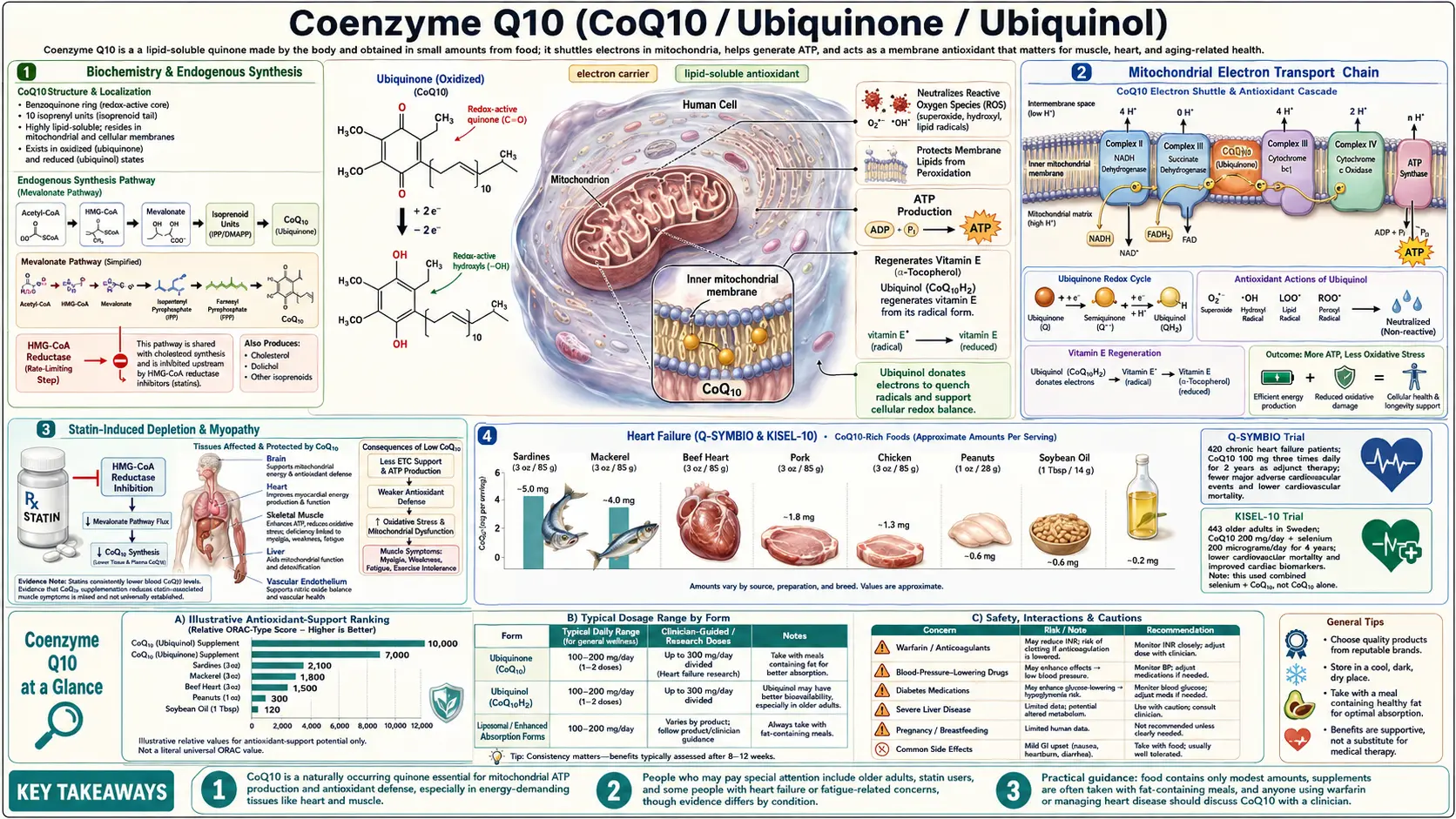
Coenzyme Q10 (CoQ10) is a fat-soluble benzoquinone in the inner mitochondrial membrane that carries electrons from Complexes I and II to Complex III of the electron transport chain, a central step in cellular ATP production. The body makes its own CoQ10 through the mevalonate pathway — the pathway statins block — and a meta-analysis of placebo-controlled trials found that statins lower plasma CoQ10. In most human organs, CoQ10 content peaks around age 20 and then declines. The largest outcome trial, Q-SYMBIO (420 people with heart failure), reported fewer major cardiovascular events and deaths with CoQ10, though it was small and a Cochrane review called the overall evidence inconclusive; trials in statin muscle symptoms, migraine and blood pressure have given mixed or modest results, and large trials in Parkinson's and Huntington's disease found no benefit.
Interactive Visualization Mitochondria & ATP — watch your cells make energy Follow electrons through the transport chain and watch the ATP-synthase motor spin — then block Complex IV and see the chain stall. Launch → Interactive Visualization Free Radicals & Your Antioxidant Network Follow one superoxide radical down the whole relay — SOD, catalase, glutathione, vitamin E, vitamin C, NADPH — then release free iron and watch a membrane tear itself apart. Launch →
Table of Contents
- Biochemistry & Endogenous Synthesis
- Mitochondrial Electron Transport Chain
- Statin-Induced Depletion & Myopathy
- Heart Failure (Q-SYMBIO & KiSel-10)
- Blood Pressure & LDL Oxidation
- Migraine Prevention
- Mitochondrial Diseases & Primary CoQ10 Deficiency
- Fertility, Sperm & Egg Quality
- Parkinson's Disease & Neurodegeneration
- Periodontal Disease & Gum Health
- Skin Health
- Forms: Ubiquinone, Ubiquinol and Formulations
- Doses Used in Studies
- Safety, Interactions and Cautions
- Key Research Papers
- Connections
- Featured Videos
Biochemistry & Endogenous Synthesis
Coenzyme Q10 (also called ubiquinone, ubidecarenone, or coenzyme Q) is a fat-soluble quinone with a benzoquinone head and an isoprenoid tail of 10 isoprene units (hence "Q10"). The benzoquinone ring is the redox-active center, accepting and donating electrons in a two-step cycle; the long lipophilic tail anchors the molecule in the inner mitochondrial membrane and allows it to diffuse laterally to shuttle electrons between membrane-bound enzyme complexes.
CoQ10 exists in three interconvertible redox states:
- Ubiquinone (CoQ) — the fully oxidized form; can accept one electron to become the semiquinone radical, or two electrons plus two protons to become ubiquinol
- Semiquinone (CoQH·) — the partially reduced one-electron intermediate; key in the Q-cycle at Complex III
- Ubiquinol (CoQH&sub2;) — the fully reduced form; the antioxidant-active form that quenches lipid peroxyl radicals in membranes and lipoproteins
The body synthesizes CoQ10 through a long biochemical pathway that begins with acetyl-CoA, runs through HMG-CoA and the mevalonate pathway (the same pathway that makes cholesterol), and ends with the assembly of the benzoquinone head and the 10-isoprene tail. The benzoquinone ring is derived from tyrosine; the methyl groups come from S-adenosylmethionine (SAMe). Drugs that inhibit this pathway, such as statins, reduce CoQ10 synthesis (see below).
In a study of human organs from newborns to people aged 81 (Kalén et al. 1989), ubiquinone content in most organs, including the heart, peaked at about 20 years of age and then fell continuously with further aging; in the pancreas and adrenal gland the peak came at one year of age.
Dietary CoQ10 is modest. A Danish analysis based on a national dietary survey (Weber et al. 1997) estimated average intake at 3-5 mg/day, 64% of it from meat and poultry, with cereals, fruit, fats and vegetables contributing little; frying destroyed 14-32% of the CoQ10 in foods, while boiling caused no detectable loss. That intake is far below the doses of 100 mg/day and more used in the trials described below.
Mitochondrial Electron Transport Chain
CoQ10's primary function is electron transport. The inner mitochondrial membrane houses five protein complexes (I through V) that together transfer electrons from food-derived NADH and FADH&sub2; to molecular oxygen, generating the proton gradient that drives ATP synthesis. CoQ10 sits between the first stages and the later ones — it is the membrane-soluble electron carrier that connects them.
- Complex I (NADH:ubiquinone oxidoreductase) — oxidizes NADH from glycolysis and the TCA cycle, passing two electrons to ubiquinone to make ubiquinol
- Complex II (succinate dehydrogenase) — oxidizes succinate (from the TCA cycle), passing electrons via FADH&sub2; to ubiquinone
- Complex III (cytochrome bc1) — takes electrons from ubiquinol and passes them to cytochrome c; this is where the "Q-cycle" runs
- Complex IV (cytochrome c oxidase) — transfers electrons from cytochrome c to molecular oxygen, generating water
- Complex V (ATP synthase) — uses the proton gradient to synthesize ATP
Without CoQ10, electrons cannot flow from Complexes I/II to Complex III, and ATP synthesis is impaired. The inherited CoQ10 deficiencies described further down this page show the consequences in energy-demanding tissues such as the kidney, brain and muscle.
Beyond electron transport, CoQ10 has other proposed mitochondrial roles. A 2000 laboratory study (Echtay et al., Nature) reported that CoQ was an obligatory cofactor for proton transport by uncoupling protein 1 in reconstituted membranes; a 2004 study in yeast mitochondria lacking CoQ (Esteves et al.) found that it was neither obligatory nor an activator, so this role remains disputed. As ubiquinol it also scavenges lipid peroxyl radicals generated within the inner mitochondrial membrane.
There is a biochemical link with alpha lipoic acid: in a laboratory study (Kozlov et al. 1999), its reduced form, dihydrolipoic acid (DHLA), reduced ubiquinone to ubiquinol and removed the ubisemiquinone radical, and the two together protected biomembranes against peroxidation more than either alone. This was shown in isolated membrane systems, not in people.
Statin-Induced Depletion & Myopathy
Statin drugs (atorvastatin, simvastatin, rosuvastatin, pravastatin, etc.) lower LDL cholesterol by inhibiting HMG-CoA reductase — the rate-limiting enzyme of the mevalonate pathway. Because CoQ10 synthesis branches off the same mevalonate pathway downstream of HMG-CoA reductase, statins inhibit CoQ10 synthesis as a consequence of their mechanism.
Studies that measured the effect:
- In 34 people given atorvastatin 80 mg/day (Rundek et al. 2004), mean blood CoQ10 fell from 1.26 to 0.62 µg/mL after 30 days; a significant decrease was already present at 14 days.
- A 2015 meta-analysis of placebo-controlled trials (Banach et al., Pharmacological Research) found a significant reduction in plasma CoQ10 with statins (weighted mean difference −0.44 µmol/L). The reduction was significant for all four statins studied (atorvastatin, simvastatin, rosuvastatin, pravastatin), with no difference between lipophilic and hydrophilic statins.
- Muscle levels are less consistent. In a randomized trial (Päivä et al. 2005), simvastatin 80 mg/day for 8 weeks lowered muscle ubiquinone from 39.7 to 26.4 nmol/g, while atorvastatin 40 mg/day did not. In muscle biopsies from 18 people with statin-related myopathy (Lamperti et al. 2005), average muscle CoQ10 was not statistically different from controls, although it was more than 2 standard deviations below the normal mean in 3 patients.
Statin-associated muscle symptoms (SAMS) — pain or aching, weakness, cramps — are reported by 7-29% of statin users in registries and observational studies, according to the 2015 European Atherosclerosis Society consensus statement; statin myopathy with a marked creatine kinase rise is rare, at 1 per 1,000 to 1 per 10,000 people on standard doses. The same statement notes that preclinical studies show statins can reduce mitochondrial function and energy production, a potential link to muscle symptoms that controlled human studies have yet to confirm.
Whether CoQ10 supplementation relieves statin muscle symptoms is contested, and the meta-analyses point in opposite directions:
- No benefit: Banach et al. 2015 (Mayo Clinic Proceedings; 6 trials, 302 patients) found no significant effect on muscle pain or creatine kinase. Kennedy et al. 2020 (7 trials, 321 patients with statin-associated myalgia) found no benefit on myalgia (weighted mean difference −0.42; 95% CI −1.47 to 0.62) and no improvement in the proportion who stayed on a statin (RR 0.99).
- Benefit: Qu et al. 2018 (Journal of the American Heart Association; 12 trials, 575 patients) reported reductions in muscle pain (weighted mean difference −1.60), weakness (−2.28), cramps (−1.78) and tiredness (−1.75), with no change in creatine kinase.
Individual trials also disagree. In Skarlovnik et al. 2014, 50 patients with mild-to-moderate symptoms took CoQ10 50 mg twice daily or placebo for 30 days; pain severity fell in the CoQ10 group and not in the placebo group. In Taylor et al. 2015, only 36% of 120 people with reported statin myalgia developed symptoms on simvastatin but not on placebo in a blinded crossover; the 41 confirmed cases then received ubiquinol 600 mg/day or placebo for 8 weeks, and CoQ10 did not reduce muscle pain (marginally more reported pain with CoQ10: 14 of 20 vs 7 of 18). The statin myopathy deep-dive covers these trials in detail.
Some practitioners describe routine CoQ10 use alongside long-term statin therapy, on the rationale that statins lower CoQ10 synthesis; the randomized trials above tested CoQ10 in people who already had muscle symptoms, not as routine prevention.
Heart Failure (Q-SYMBIO & KiSel-10)
Heart failure is the condition in which CoQ10 has its largest outcome trial. In endomyocardial biopsies from 43 people with cardiomyopathy (Folkers et al. 1985), heart-muscle CoQ10 was lower in New York Heart Association (NYHA) class III-IV than in class I-II; biopsies from healthy hearts were not available for comparison.
Q-SYMBIO trial (Mortensen et al., 2014, JACC Heart Failure)
Patients with moderate to severe heart failure on standard therapy were randomized to CoQ10 100 mg three times daily or placebo for 2 years; 420 were enrolled. Results reported in the abstract:
- Short-term primary endpoints at 16 weeks (NYHA class, 6-minute walk test, NT-proBNP) — no significant changes
- Long-term primary endpoint at 2 years (major adverse cardiovascular events) — reached by 15% of the CoQ10 group vs 26% of the placebo group (hazard ratio 0.50; 95% CI 0.32 to 0.80; p = 0.003)
- Cardiovascular mortality — 9% vs 16% (p = 0.026)
- All-cause mortality — 10% vs 18% (p = 0.018)
- Hospital stays for heart failure lower with CoQ10 (p = 0.033), and NYHA class improved after 2 years (p = 0.028)
- The authors concluded that long-term CoQ10 treatment was safe
Limits of the evidence. Q-SYMBIO is small for a mortality trial. Its 2003 design paper planned 550 patients in NYHA class III-IV, with a short-term phase and a 2-year morbidity-and-mortality endpoint; the published trial enrolled 420, and its abstract does not report why enrolment ended below the planned size. A 2016 state-of-the-art review (Sharma et al., Circulation: Heart Failure) described the trial as "having limitations" and called for adequately powered randomized trials. The 2021 Cochrane review (Al Saadi et al.; 11 studies, 1,573 participants) found that CoQ10 probably reduces all-cause mortality (RR 0.58; 95% CI 0.35 to 0.95) and heart-failure hospitalisation (RR 0.62) — the mortality estimate rests on this one 420-patient trial — judged every included study to have unclear or high risk of bias in at least one domain, and concluded that there is "currently no convincing evidence to support or refute" CoQ10 for heart failure. Q-SYMBIO tested CoQ10 alongside standard heart-failure therapy, not as a replacement for it.
KiSel-10 trial (Alehagen et al., 2013, International Journal of Cardiology)
443 Swedish citizens aged 70-88 from a rural municipality, described in the follow-up papers as healthy elderly people, were randomized to combined CoQ10 (200 mg/day) and selenium yeast (200 µg/day) or placebo for four years. Over 5.2 years of follow-up, cardiovascular mortality was 5.9% in the active group vs 12.6% with placebo (P = 0.015), and NT-proBNP was lower (214 vs 302 ng/L at 48 months). The authors' later analyses reported that the difference persisted after the supplements stopped: at 10 years, hazard ratio 0.51 (95% CI 0.36-0.74); at 12 years, cardiovascular mortality 28.1% vs 38.7% (HR 0.59; 95% CI 0.42-0.81). The authors state that, since this was a small study, the observations "should be regarded as hypothesis-generating." Because CoQ10 and selenium were given together, the trial cannot separate the effect of one from the other. The 2018 paper discloses that the trial tablets were supplied by a supplement manufacturer.
Both Q-SYMBIO and KiSel-10 used the ubiquinone (oxidized) form, according to a 2020 review of CoQ10 bioavailability (Mantle & Dybring); the forms are compared in the Forms section below.
Blood Pressure & LDL Oxidation
The blood-pressure evidence depends on which trials are counted. A 2007 meta-analysis (Rosenfeldt et al., Journal of Human Hypertension) pooled 12 studies with 362 patients — three randomized controlled trials, one crossover study and eight open-label studies. In the three randomized trials (120 patients), systolic pressure fell by 16.6 mmHg and diastolic by 8.2 mmHg with CoQ10, with no significant change on placebo; the authors concluded that CoQ10 has "the potential" to lower systolic pressure by up to 17 mmHg and diastolic by up to 10 mmHg.
The Cochrane review (Ho et al. 2016) applied stricter criteria (double-blind, placebo-controlled trials of at least three weeks in primary hypertension). It found three eligible trials, excluded one for an unacceptably high risk of bias, and pooled two (50 participants): CoQ10 did not significantly change systolic (−3.68 mmHg; 95% CI −8.86 to 1.49) or diastolic pressure (−2.03 mmHg). It concluded, with moderate-quality evidence, that CoQ10 "does not have a clinically significant effect on blood pressure," and that more well-conducted trials are needed.
CoQ10 has also been studied as an antioxidant in LDL particles. In a laboratory study of isolated human LDL (Stocker et al. 1991), ubiquinol-10 was the first of the lipid-phase antioxidants to be consumed under oxidizing conditions, lipid peroxidation rose quickly once it was gone even though most alpha-tocopherol remained, and the authors found ubiquinol-10 much more efficient at inhibiting LDL oxidation than lycopene, beta-carotene or alpha-tocopherol. Whether this laboratory effect matters clinically for people with raised ApoB or Lipoprotein(a) has not been tested in the trials described on this page.
Migraine Prevention
CoQ10 is one of the more-studied supplements for migraine prevention, with small trials and two meta-analyses:
- Sandor et al. (2005, Neurology) — a double-blind randomized trial in 42 people with migraine, comparing CoQ10 100 mg three times daily with placebo. CoQ10 was superior for attack frequency, headache days and days with nausea in the third treatment month; the 50%-responder rate for attack frequency was 47.6% with CoQ10 vs 14.4% with placebo (number needed to treat: 3).
- Hershey et al. (2007, Headache) — not a randomized trial. CoQ10 was measured in 1,550 children and adolescents at a headache center; 32.9% were below the reference range, and those with low levels were advised to start 1-3 mg/kg/day as part of multidisciplinary treatment. In the subset seen again after a mean of 97 days, headache frequency fell from 19.2 to 12.5 and the PedMIDAS disability score from 47.4 to 22.8. The authors called for more rigorous trials.
- Slater et al. (2011, Cephalalgia) — the randomized, placebo-controlled crossover follow-up in 120 children and adolescents (CoQ10 100 mg/day added to standard treatment). Both groups improved over time, and there was no difference in headache outcomes between CoQ10 and placebo at day 224.
The meta-analyses agree on attack frequency but not on the other outcomes. Parohan et al. 2020 (4 trials, 221 participants) found fewer attacks per month (−1.87) but no significant effect on attack severity or duration. Sazali et al. 2021 (6 trials, 371 adults) found reductions in frequency (−1.52) and duration, but not in severity.
The 2012 American Academy of Neurology / American Headache Society guideline on complementary treatments for episodic migraine prevention in adults graded CoQ10 "possibly effective" (Level C), together with cyproheptadine, estrogen, mefenamic acid and flurbiprofen. In the same guideline, butterbur (Petasites) was graded Level A, and magnesium, riboflavin and feverfew Level B. The AAN retired this guideline on 16 September 2015, citing serious safety concerns with butterbur.
The proposed mechanism is mitochondrial: one hypothesis holds that migraine reflects a reduced energy reserve in brain cells, and Sandor's trial was designed on the reasoning that riboflavin, which improves energy metabolism in a similar way, had been effective. Riboflavin supplies the FMN cofactor of Complex I and the FAD cofactor of Complex II. The migraine deep-dive covers these trials in more detail.
Mitochondrial Diseases & Primary CoQ10 Deficiency
Primary CoQ10 deficiency is a rare group of inherited disorders caused by mutations in the genes of the CoQ10 biosynthesis pathway; a 2023 review (Mantle et al.) notes that at least 10 genes are required in humans (among them PDSS1, COQ2, COQ4, COQ5 and COQ6). Presentations range from fatal infantile disease affecting the brain, heart and kidneys to nephrotic syndrome and cerebellar ataxia.
The same review reports that patients may respond well to oral CoQ10, but only if the condition is recognized early, before irreversible tissue damage. The case reports it summarizes most often used about 30 mg/kg/day in children, with outcomes ranging from restored kidney function and stabilisation to no effect and death despite treatment.
CoQ10 is also tried in other mitochondrial disorders — MELAS (mitochondrial encephalopathy, lactic acidosis, stroke-like episodes), Leigh syndrome, Kearns-Sayre syndrome, MERRF and chronic progressive external ophthalmoplegia — often in combination with creatine and lipoic acid. The 2012 Cochrane review of treatments for mitochondrial disorders (Pfeffer et al.) found "no clear evidence supporting the use of any intervention": one trial of high-dose CoQ10 (30 participants) showed no clinically meaningful improvement, and a trial of combined CoQ10, creatine and lipoic acid (16 participants) improved some biochemical markers and ankle strength but produced no overall clinical improvement.
CoQ10 has also been studied in acquired conditions linked to mitochondrial dysfunction, such as chronic fatigue syndrome and fibromyalgia; those trials are not reviewed on this page.
Fertility, Sperm & Egg Quality
Both sperm and oocytes are mitochondria-rich cells, and age-related decline in mitochondrial function is one proposed reason fertility falls with age. CoQ10 has been studied in both contexts.
Male fertility
An open, uncontrolled pilot study (Balercia et al. 2004) was followed by a placebo-controlled, double-blind trial (Balercia et al. 2009) in 60 infertile men aged 27-39 with idiopathic asthenozoospermia (low sperm motility), given CoQ10 200 mg/day or placebo for 6 months. CoQ10 and ubiquinol rose in seminal plasma and sperm cells, and sperm motility improved; men with lower baseline motility and CoQ10 levels were more likely to respond. A 2013 meta-analysis (Lafuente et al.; 3 trials, 149 men on CoQ10 and 147 on placebo) found improved sperm concentration and motility, but CoQ10 did not increase pregnancy rates, and none of the trials reported live births.
Female fertility
The Toronto group of Bentov and Casper, after an animal study, ran a double-blind randomized trial (Bentov et al. 2014) of CoQ10 600 mg/day or placebo in IVF-ICSI patients aged 35-43. It was stopped before reaching its target size because of safety concerns about the polar-body biopsy used to measure aneuploidy; 39 women were randomized and 24 completed a cycle. The aneuploidy rate was 46.5% with CoQ10 vs 62.8% with placebo and clinical pregnancy 33% vs 26.7%, but no difference was significant and the authors note the study was underpowered. In a later randomized trial without a placebo (Xu et al. 2018), 169 women under 35 with poor ovarian reserve were evaluated after 60 days of CoQ10 pretreatment or no pretreatment before IVF-ICSI; the CoQ10 group had more oocytes retrieved, a higher fertilization rate and more high-quality embryos, while clinical pregnancy and live-birth rates were higher but not significantly so.
The proposed mechanism is restoration of mitochondrial ATP production in aging oocytes during meiosis; this comes mainly from animal work. The fertility deep-dive covers these studies further.
Parkinson's Disease & Neurodegeneration
Parkinson's disease involves dysfunction of mitochondrial Complex I in dopaminergic neurons of the substantia nigra, which made CoQ10 a biologically plausible candidate for slowing it.
The Shults trial (2002, Archives of Neurology) randomized 80 people with early Parkinson's disease to placebo or CoQ10 300, 600 or 1,200 mg/day for up to 16 months. Mean worsening of the total UPDRS score was +11.99 with placebo, +8.81 at 300 mg, +10.82 at 600 mg and +6.69 at 1,200 mg. The primary test for a dose trend gave P = 0.09, which met the trial's prespecified criterion; the 1,200 mg vs placebo comparison was significant (P = 0.04). The authors wrote that the results "need to be confirmed in a larger study."
The larger phase III QE3 trial (Beal et al. 2014, JAMA Neurology) randomized 600 people with early Parkinson's to placebo, 1,200 mg/day or 2,400 mg/day of CoQ10, all with vitamin E 1,200 IU/day, for 16 months. It was stopped when a prespecified futility criterion was reached; both CoQ10 groups showed slight adverse trends relative to placebo, and the authors reported "no evidence of clinical benefit."
Large trials in other neurodegenerative diseases were also negative. In ALS, a phase II trial in 185 patients (Kaufmann et al. 2009) found that CoQ10 2,700 mg/day for 9 months showed insufficient promise to justify a phase III trial. In Huntington's disease, the 2CARE trial (McGarry et al. 2017; 609 patients, 2,400 mg/day) was stopped early for futility, with no significant differences on primary or secondary outcomes; the authors concluded that the data do not justify CoQ10 to slow functional decline in Huntington's disease.
Periodontal Disease & Gum Health
The early work came from Karl Folkers, Edward Wilkinson and colleagues. In gingival biopsies (Nakamura et al. 1974), about 60% of 40 diseased gum samples showed a CoQ10 deficiency at the succinate dehydrogenase-CoQ10 reductase enzyme, compared with 20% of 24 control samples. In a small double-blind study (Wilkinson et al. 1976), 18 patients with periodontal disease received CoQ10 or placebo, and the treatment effect on pocket depth and other periodontal scores was reported as significant.
A 2025 systematic review (Fernandez et al.) of randomized trials in adults having non-surgical periodontal treatment found no significant effect of CoQ10 applied locally (as a gel or into the gum pocket) on probing depth or attachment level, while daily oral supplementation was associated with better periodontal health after 12 weeks. The certainty of the evidence was rated very low.
Skin Health
In work on topical CoQ10 (Hoppe et al. 1999), CoQ10 applied to skin penetrated the viable layers of the epidermis, reduced a measure of oxidation, and was associated with reduced wrinkle depth; in cell studies it protected keratinocytes against UVA-induced oxidative stress and suppressed collagenase expression in fibroblasts.
For oral CoQ10, a randomized, placebo-controlled, double-blind study in 33 healthy people (Žmitek et al. 2017) gave 50 or 150 mg/day of a water-soluble form for 12 weeks. CoQ10 reduced wrinkles and microrelief lines and improved skin smoothness, limited the seasonal decline in skin viscoelasticity, and did not significantly change skin hydration, dermis thickness or the minimal erythema dose (sunburn threshold).
Forms: Ubiquinone, Ubiquinol and Formulations
- Ubiquinone (oxidized CoQ10) — the form used in most trials, including Q-SYMBIO and KiSel-10; it is reduced to ubiquinol in the body.
- Ubiquinol (reduced CoQ10) — the antioxidant-active reduced form, also sold as a supplement. Whether it is better absorbed than ubiquinone is disputed (see below).
- Solubilized and dispersed formulations — ubiquinone dissolved in carrier oils or other matrices. The formulation strongly affects absorption (see below).
- Liposomal and water-soluble formulations — phospholipid-encapsulated or water-dispersible forms; the oral skin study above used a water-soluble form.
- Mitoquinone — a synthetic CoQ analogue attached to a triphenylphosphonium cation, which concentrates it inside mitochondria; it is a research compound distinct from CoQ10 itself.
- Topical CoQ10 — used in creams and serums for the skin (see Skin Health above).
The ubiquinol vs ubiquinone question. The studies disagree:
- In a double-blind crossover in 10 older men (Zhang et al. 2018), 200 mg/day of ubiquinol taken with a main meal for 2 weeks raised total plasma CoQ10 from 1.3 to 3.4 µmol/L, while the same dose of ubiquinone produced no significant increase; six of the 10 men responded more to ubiquinol and two more to ubiquinone.
- In a double-blind crossover of seven 100 mg products in 14 young, healthy volunteers (López-Lluch et al. 2019), absorption differed widely between products; the two best absorbed were soft-gel capsules of ubiquinone and of ubiquinol. The carrier matrix and added preservatives affected absorption, and individuals varied widely in their response.
- A 2020 review (Mantle & Dybring) concluded that the idea of superior ubiquinol bioavailability "would appear to be mistaken," arguing that the studies favoring ubiquinol compared it with ubiquinone that had not undergone crystal dispersion, and that the absence of crystal dispersion reduces bioavailability by 75%. Both authors are employees of a company that makes ubiquinone supplements.
After a single 100 mg oral dose of labelled CoQ10 in 16 healthy men (Tomono et al. 1986), plasma levels peaked at about 6.5 hours, often showed a second peak at 24 hours, and declined with a terminal half-life of about 33 hours.
Doses Used in Studies
The doses below are those used in the studies described on this page; they are reported as findings, not instructions. Decisions about supplements belong with a clinician.
- Heart failure (Q-SYMBIO) — 100 mg three times daily (300 mg/day) for 2 years, alongside standard therapy
- Elderly adults (KiSel-10) — 200 mg/day CoQ10 combined with 200 µg/day selenium yeast for four years
- Statin muscle symptoms — 50 mg twice daily for 30 days (Skarlovnik 2014, positive) to ubiquinol 600 mg/day for 8 weeks (Taylor 2015, no benefit)
- Migraine — 100 mg three times daily for 3 months in adults (Sandor 2005); 1-3 mg/kg/day in an uncontrolled pediatric series (Hershey 2007) and 100 mg/day in the pediatric randomized trial that found no difference from placebo (Slater 2011)
- Male fertility — 200 mg/day for 6 months (Balercia 2009)
- IVF — 600 mg/day (Bentov 2014); a 60-day pretreatment before IVF-ICSI (Xu 2018)
- Parkinson's disease — 300-1,200 mg/day (Shults 2002) and 1,200-2,400 mg/day (QE3, 2014, no benefit)
- Primary CoQ10 deficiency (inherited) — most often about 30 mg/kg/day in the pediatric case reports reviewed by Mantle et al. 2023, under specialist care
- Pre-eclampsia risk — 200 mg/day from 20 weeks of pregnancy until delivery (Teran 2009)
- Skin — 50 or 150 mg/day of a water-soluble form for 12 weeks (Žmitek 2017)
A 2008 safety review (Hidaka et al.), written by employees of a CoQ10 manufacturer, put the observed safety level from clinical trials at 1,200 mg/day and calculated an acceptable daily intake of 12 mg/kg/day from a 52-week rat toxicity study.
Safety, Interactions and Cautions
The trials above generally reported CoQ10 as safe and well tolerated, including QE3 and 2CARE at 1,200-2,400 mg/day. The 2008 safety review (Hidaka et al.) concluded that CoQ10 has low toxicity and does not induce serious adverse effects in humans. Points the research raises:
- Warfarin — CoQ10 has a chemical structure similar to vitamin K (Sharma et al. 2016). Case reports describe a reduced effect of warfarin with CoQ10 (Spigset 1994). In a randomized, double-blind, placebo-controlled crossover trial in 24 outpatients on stable long-term warfarin (Engelsen et al. 2002/2003), CoQ10 100 mg/day for four weeks did not change the INR or the warfarin dose.
- Blood-pressure medicines — some uncontrolled and small randomized studies reported blood-pressure falls with CoQ10 (Rosenfeldt 2007), which raises the possibility of an added effect with antihypertensive drugs; the Cochrane review (Ho 2016) found no significant effect on blood pressure.
- Blood glucose — a 2026 umbrella review of eight meta-analyses (Musazadeh et al.) found CoQ10 associated with lower fasting blood glucose but no significant change in HbA1c, HOMA-IR or insulin in the standardized analysis, and noted that findings differ with the analytic approach.
- Cancer treatment — a theoretical concern is that antioxidants might interfere with treatments that work through oxidative damage. CoQ10 has also been studied as a protectant against anthracycline (doxorubicin) cardiotoxicity: a 2004 systematic review (Roffe et al.; 6 studies, mostly with anthracyclines) found results suggesting some protection against heart or liver toxicity, but because of inadequate reporting and questionable outcome measures the results were not conclusive and had not been tested by rigorous trials. Decisions during active cancer treatment rest with the oncology team.
- Pregnancy — in a randomized, double-blind, placebo-controlled trial in 235 women at increased risk of pre-eclampsia (Teran et al. 2009), CoQ10 200 mg/day from 20 weeks to delivery was associated with less pre-eclampsia (14.4% vs 25.6%; RR 0.56; 95% CI 0.33-0.96). Published safety data in pregnancy are limited to small trials of this kind.
Key Research Papers
- Kalén A, Appelkvist EL, Dallner G (1989). Age-related changes in the lipid compositions of rat and human tissues. Lipids 24(7):579-84 — PubMed PMID: 2779364
- Weber C, Bysted A, Hølmer G (1997). The coenzyme Q10 content of the average Danish diet. Int J Vitam Nutr Res 67(2):123-9 — PubMed PMID: 9129255
- Echtay KS, Winkler E, Klingenberg M (2000). Coenzyme Q is an obligatory cofactor for uncoupling protein function. Nature 408(6812):609-13 — PubMed PMID: 11117751
- Esteves TC, Echtay KS, Jonassen T, et al. (2004). Ubiquinone is not required for proton conductance by uncoupling protein 1 in yeast mitochondria. Biochem J 379(Pt 2):309-15 — PubMed PMID: 14680474
- Kozlov AV, Gille L, Staniek K, et al. (1999). Dihydrolipoic acid maintains ubiquinone in the antioxidant active form by two-electron reduction of ubiquinone and one-electron reduction of ubisemiquinone. Arch Biochem Biophys 363(1):148-54 — PubMed PMID: 10049509
- Rundek T, Naini A, Sacco R, et al. (2004). Atorvastatin decreases the coenzyme Q10 level in the blood of patients at risk for cardiovascular disease and stroke. Arch Neurol 61(6):889-92 — PubMed PMID: 15210526
- Banach M, Serban C, Ursoniu S, et al. (2015). Statin therapy and plasma coenzyme Q10 concentrations--A systematic review and meta-analysis of placebo-controlled trials. Pharmacol Res 99:329-36 — PubMed PMID: 26192349
- Päivä H, Thelen KM, Van Coster R, et al. (2005). High-dose statins and skeletal muscle metabolism in humans: a randomized, controlled trial. Clin Pharmacol Ther 78(1):60-8 — PubMed PMID: 16003294
- Lamperti C, Naini AB, Lucchini V, et al. (2005). Muscle coenzyme Q10 level in statin-related myopathy. Arch Neurol 62(11):1709-12 — PubMed PMID: 16286544
- Stroes ES, Thompson PD, Corsini A, et al. (2015). Statin-associated muscle symptoms: impact on statin therapy-European Atherosclerosis Society Consensus Panel Statement on Assessment, Aetiology and Management. Eur Heart J 36(17):1012-22 — PubMed PMID: 25694464
- Banach M, Serban C, Sahebkar A, et al. (2015). Effects of coenzyme Q10 on statin-induced myopathy: a meta-analysis of randomized controlled trials. Mayo Clin Proc 90(1):24-34 — PubMed PMID: 25440725
- Kennedy C, Köller Y, Surkova E (2020). Effect of Coenzyme Q10 on statin-associated myalgia and adherence to statin therapy: A systematic review and meta-analysis. Atherosclerosis 299:1-8 — PubMed PMID: 32179207
- Qu H, Guo M, Chai H, et al. (2018). Effects of Coenzyme Q10 on Statin-Induced Myopathy: An Updated Meta-Analysis of Randomized Controlled Trials. J Am Heart Assoc 7(19):e009835 — PubMed PMID: 30371340
- Skarlovnik A, Janić M, Lunder M, et al. (2014). Coenzyme Q10 supplementation decreases statin-related mild-to-moderate muscle symptoms: a randomized clinical study. Med Sci Monit 20:2183-8 — PubMed PMID: 25375075
- Taylor BA, Lorson L, White CM, et al. (2015). A randomized trial of coenzyme Q10 in patients with confirmed statin myopathy. Atherosclerosis 238(2):329-35 — PubMed PMID: 25545331
- Folkers K, Vadhanavikit S, Mortensen SA (1985). Biochemical rationale and myocardial tissue data on the effective therapy of cardiomyopathy with coenzyme Q10. Proc Natl Acad Sci U S A 82(3):901-4 — PubMed PMID: 3856239
- Mortensen SA, Rosenfeldt F, Kumar A, et al. (2014). The effect of coenzyme Q10 on morbidity and mortality in chronic heart failure: results from Q-SYMBIO: a randomized double-blind trial. JACC Heart Fail 2(6):641-9 — PubMed PMID: 25282031
- Mortensen SA (2003). Overview on coenzyme Q10 as adjunctive therapy in chronic heart failure. Rationale, design and end-points of "Q-symbio"--a multinational trial. Biofactors 18(1-4):79-89 — PubMed PMID: 14695923
- Sharma A, Fonarow GC, Butler J, et al. (2016). Coenzyme Q10 and Heart Failure: A State-of-the-Art Review. Circ Heart Fail 9(4):e002639 — PubMed PMID: 27012265
- Al Saadi T, Assaf Y, Farwati M, et al. (2021). Coenzyme Q10 for heart failure. Cochrane Database Syst Rev 2021(2):CD008684 — PubMed PMID: 35608922
- Alehagen U, Johansson P, Björnstedt M, et al. (2013). Cardiovascular mortality and N-terminal-proBNP reduced after combined selenium and coenzyme Q10 supplementation: a 5-year prospective randomized double-blind placebo-controlled trial among elderly Swedish citizens. Int J Cardiol 167(5):1860-6 — PubMed PMID: 22626835
- Alehagen U, Aaseth J, Johansson P (2015). Reduced Cardiovascular Mortality 10 Years after Supplementation with Selenium and Coenzyme Q10 for Four Years: Follow-Up Results of a Prospective Randomized Double-Blind Placebo-Controlled Trial in Elderly Citizens. PLoS One 10(12):e0141641 — PubMed PMID: 26624886
- Alehagen U, Aaseth J, Alexander J, et al. (2018). Still reduced cardiovascular mortality 12 years after supplementation with selenium and coenzyme Q10 for four years: A validation of previous 10-year follow-up results of a prospective randomized double-blind placebo-controlled trial in elderly. PLoS One 13(4):e0193120 — PubMed PMID: 29641571
- Rosenfeldt FL, Haas SJ, Krum H, et al. (2007). Coenzyme Q10 in the treatment of hypertension: a meta-analysis of the clinical trials. J Hum Hypertens 21(4):297-306 — PubMed PMID: 17287847
- Ho MJ, Li EC, Wright JM (2016). Blood pressure lowering efficacy of coenzyme Q10 for primary hypertension. Cochrane Database Syst Rev 3(3):CD007435 — PubMed PMID: 26935713
- Stocker R, Bowry VW, Frei B (1991). Ubiquinol-10 protects human low density lipoprotein more efficiently against lipid peroxidation than does alpha-tocopherol. Proc Natl Acad Sci U S A 88(5):1646-50 — PubMed PMID: 2000375
- Sándor PS, Di Clemente L, Coppola G, et al. (2005). Efficacy of coenzyme Q10 in migraine prophylaxis: a randomized controlled trial. Neurology 64(4):713-5 — PubMed PMID: 15728298
- Hershey AD, Powers SW, Vockell AL, et al. (2007). Coenzyme Q10 deficiency and response to supplementation in pediatric and adolescent migraine. Headache 47(1):73-80 — PubMed PMID: 17355497
- Slater SK, Nelson TD, Kabbouche MA, et al. (2011). A randomized, double-blinded, placebo-controlled, crossover, add-on study of CoEnzyme Q10 in the prevention of pediatric and adolescent migraine. Cephalalgia 31(8):897-905 — PubMed PMID: 21586650
- Parohan M, Sarraf P, Javanbakht MH, et al. (2020). Effect of coenzyme Q10 supplementation on clinical features of migraine: a systematic review and dose-response meta-analysis of randomized controlled trials. Nutr Neurosci 23(11):868-875 — PubMed PMID: 30727862
- Sazali S, Badrin S, Norhayati MN, et al. (2021). Coenzyme Q10 supplementation for prophylaxis in adult patients with migraine-a meta-analysis. BMJ Open 11(1):e039358 — PubMed PMID: 33402403
- Holland S, Silberstein SD, Freitag F, et al. (2012). Evidence-based guideline update: NSAIDs and other complementary treatments for episodic migraine prevention in adults: report of the Quality Standards Subcommittee of the American Academy of Neurology and the American Headache Society. Neurology 78(17):1346-53 — PubMed PMID: 22529203
- Mantle D, Millichap L, Castro-Marrero J, et al. (2023). Primary Coenzyme Q10 Deficiency: An Update. Antioxidants (Basel) 12(8):doi: 10.3390/antiox12081652 — PubMed PMID: 37627647
- Pfeffer G, Majamaa K, Turnbull DM, et al. (2012). Treatment for mitochondrial disorders. Cochrane Database Syst Rev 2012(4):CD004426 — PubMed PMID: 22513923
- Balercia G, Mosca F, Mantero F, et al. (2004). Coenzyme Q(10) supplementation in infertile men with idiopathic asthenozoospermia: an open, uncontrolled pilot study. Fertil Steril 81(1):93-8 — PubMed PMID: 14711549
- Balercia G, Buldreghini E, Vignini A, et al. (2009). Coenzyme Q10 treatment in infertile men with idiopathic asthenozoospermia: a placebo-controlled, double-blind randomized trial. Fertil Steril 91(5):1785-92 — PubMed PMID: 18395716
- Lafuente R, González-Comadrán M, Solà I, et al. (2013). Coenzyme Q10 and male infertility: a meta-analysis. J Assist Reprod Genet 30(9):1147-56 — PubMed PMID: 23912751
- Bentov Y, Hannam T, Jurisicova A, et al. (2014). Coenzyme Q10 Supplementation and Oocyte Aneuploidy in Women Undergoing IVF-ICSI Treatment. Clin Med Insights Reprod Health 8:31-6 — PubMed PMID: 24987272
- Xu Y, Nisenblat V, Lu C, et al. (2018). Pretreatment with coenzyme Q10 improves ovarian response and embryo quality in low-prognosis young women with decreased ovarian reserve: a randomized controlled trial. Reprod Biol Endocrinol 16(1):29 — PubMed PMID: 29587861
- Shults CW, Oakes D, Kieburtz K, et al. (2002). Effects of coenzyme Q10 in early Parkinson disease: evidence of slowing of the functional decline. Arch Neurol 59(10):1541-50 — PubMed PMID: 12374491
- Beal MF, Oakes D, Shoulson I, et al. (2014). A randomized clinical trial of high-dosage coenzyme Q10 in early Parkinson disease: no evidence of benefit. JAMA Neurol 71(5):543-52 — PubMed PMID: 24664227
- Kaufmann P, Thompson JL, Levy G, et al. (2009). Phase II trial of CoQ10 for ALS finds insufficient evidence to justify phase III. Ann Neurol 66(2):235-44 — PubMed PMID: 19743457
- McGarry A, McDermott M, Kieburtz K, et al. (2017). A randomized, double-blind, placebo-controlled trial of coenzyme Q10 in Huntington disease. Neurology 88(2):152-159 — PubMed PMID: 27913695
- Nakamura R, Littarru GP, Folkers K, et al. (1974). Study of CoQ10-enzymes in gingiva from patients with periodontal disease and evidence for a deficiency of coenzyme Q10. Proc Natl Acad Sci U S A 71(4):1456-60 — PubMed PMID: 4151519
- Wilkinson EG, Arnold RM, Folkers K (1976). Bioenergetics in clinical medicine. VI. adjunctive treatment of periodontal disease with coenzyme Q10. Res Commun Chem Pathol Pharmacol 14(4):715-9 — PubMed PMID: 785563
- Fernandez MDS, Martins TM, Meza-Mauricio J, et al. (2025). Clinical efficacy of adjunctive use of coenzyme Q10 in non-surgical periodontal treatment: A systematic review. Eur J Oral Sci 133(2):e70002 — PubMed PMID: 39920883
- Hoppe U, Bergemann J, Diembeck W, et al. (1999). Coenzyme Q10, a cutaneous antioxidant and energizer. Biofactors 9(2-4):371-8 — PubMed PMID: 10416055
- Žmitek K, Pogačnik T, Mervic L, et al. (2017). The effect of dietary intake of coenzyme Q10 on skin parameters and condition: Results of a randomised, placebo-controlled, double-blind study. Biofactors 43(1):132-140 — PubMed PMID: 27548886
- Zhang Y, Liu J, Chen XQ, et al. (2018). Ubiquinol is superior to ubiquinone to enhance Coenzyme Q10 status in older men. Food Funct 9(11):5653-5659 — PubMed PMID: 30302465
- López-Lluch G, Del Pozo-Cruz J, Sánchez-Cuesta A, et al. (2019). Bioavailability of coenzyme Q10 supplements depends on carrier lipids and solubilization. Nutrition 57:133-140 — PubMed PMID: 30153575
- Mantle D, Dybring A (2020). Bioavailability of Coenzyme Q(10): An Overview of the Absorption Process and Subsequent Metabolism. Antioxidants (Basel) 9(5):doi: 10.3390/antiox9050386 — PubMed PMID: 32380795
- Tomono Y, Hasegawa J, Seki T, et al. (1986). Pharmacokinetic study of deuterium-labelled coenzyme Q10 in man. Int J Clin Pharmacol Ther Toxicol 24(10):536-41 — PubMed PMID: 3781673
- Hidaka T, Fujii K, Funahashi I, et al. (2008). Safety assessment of coenzyme Q10 (CoQ10). Biofactors 32(1-4):199-208 — PubMed PMID: 19096117
- Spigset O (1994). Reduced effect of warfarin caused by ubidecarenone. Lancet 344(8933):1372-3 — PubMed PMID: 7968059
- Engelsen J, Nielsen JD, Winther K (2002). Effect of coenzyme Q10 and Ginkgo biloba on warfarin dosage in stable, long-term warfarin treated outpatients. A randomised, double blind, placebo-crossover trial. (research letter) Thromb Haemost 87(6):1075-6 — PubMed PMID: 12083489
- Engelsen J, Nielsen JD, Hansen KF (2003). Effect of Coenzyme Q10 and Ginkgo biloba on warfarin dosage in patients on long-term warfarin treatment. A randomized, double-blind, placebo-controlled cross-over trial. (article in Danish, English abstract) Ugeskr Laeger 165(18):1868-71 — PubMed PMID: 12772396
- Musazadeh V, Falahatzadeh M, Mahmoudinezhad M, et al. (2026). Effects of Coenzyme Q10 Supplementation on Glycemic Control Biomarkers: An Umbrella Review of Meta-Analyses of Randomised Controlled Trials. Endocrinol Diabetes Metab 9(2):e70182 — PubMed PMID: 41859772
- Roffe L, Schmidt K, Ernst E (2004). Efficacy of coenzyme Q10 for improved tolerability of cancer treatments: a systematic review. J Clin Oncol 22(21):4418-24 — PubMed PMID: 15514384
- Teran E, Hernandez I, Nieto B, et al. (2009). Coenzyme Q10 supplementation during pregnancy reduces the risk of pre-eclampsia. Int J Gynaecol Obstet 105(1):43-5 — PubMed PMID: 19154996
PubMed Topic Searches
- CoQ10 and statin-associated muscle symptoms — PubMed PMID: 42109163
- CoQ10 hypertension and blood pressure (Rosenfeldt meta-analysis) — PubMed: Coenzyme Q10 hypertension blood pressure
- CoQ10 migraine prevention (Sandor, Hershey, Parohan) — PubMed: Coenzyme Q10 migraine prevention
- CoQ10 male fertility, sperm motility (Balercia) — PubMed: Coenzyme Q10 male fertility sperm motility
- CoQ10 and IVF, female fertility, egg quality (Bentov) — PubMed: Coenzyme Q10 IVF oocyte quality
- CoQ10 and Parkinson's disease (Shults, QE3 trial) — PubMed: Coenzyme Q10 Parkinson disease QE3
- Primary and secondary CoQ10 deficiency — PubMed: Primary Coenzyme Q10 deficiency
- CoQ10 and chronic fatigue syndrome / fibromyalgia — PubMed PMID: 42654282
- Ubiquinol vs ubiquinone bioavailability — PubMed PMID: 41789786
- CoQ10 cardioprotection during anthracycline chemotherapy — PubMed: Coenzyme Q10 doxorubicin cardiotoxicity
- CoQ10 periodontal disease (Folkers / Wilkinson) — PubMed: Coenzyme Q10 periodontal disease
- CoQ10 topical and skin antioxidant — PubMed: Coenzyme Q10 topical skin
- Mitoquinone (mitochondria-targeted CoQ analogue) research — PubMed: mitoquinone mitochondrial-targeted antioxidant
External Authoritative Resources
Connections
- Fluoride Chelation — the mitochondrial end of the protocol
- Free Radicals & Your Antioxidant Network — interactive animation
- Mitochondria & ATP — interactive animation
- All Antioxidants
- Alpha Lipoic Acid
- Heart Failure
- Cardiovascular Disease
- Fatigue
- Headache & Migraine
- Chronic Fatigue Syndrome
- Fibromyalgia
- Reproductive Medicine
- Parkinson's Disease
- Oxidative Stress
- NAC (Glutathione Precursor)
- NAD+ & NMN
- Methylene Blue
- Longevity Protocols
- Vitamin E
- Vitamin K2
- Vitamin B2 (Riboflavin)
- Vitamin B3 (Niacin)
- Selenium
- Magnesium
- Cysteine
- Methionine
- Tyrosine
- Creatine
- Omega-3 Fatty Acids
- Organ Meats
- Sardines
- Salmon
- Lipid Panel
- Apolipoprotein B
- Coronary Calcium Score
- Statins & CAC
- Conditions on this site that reference this page: Angina (Angina Pectoris) · Cholesterol Management · MELAS Syndrome