Alpha Lipoic Acid — Benefits Deep Dive
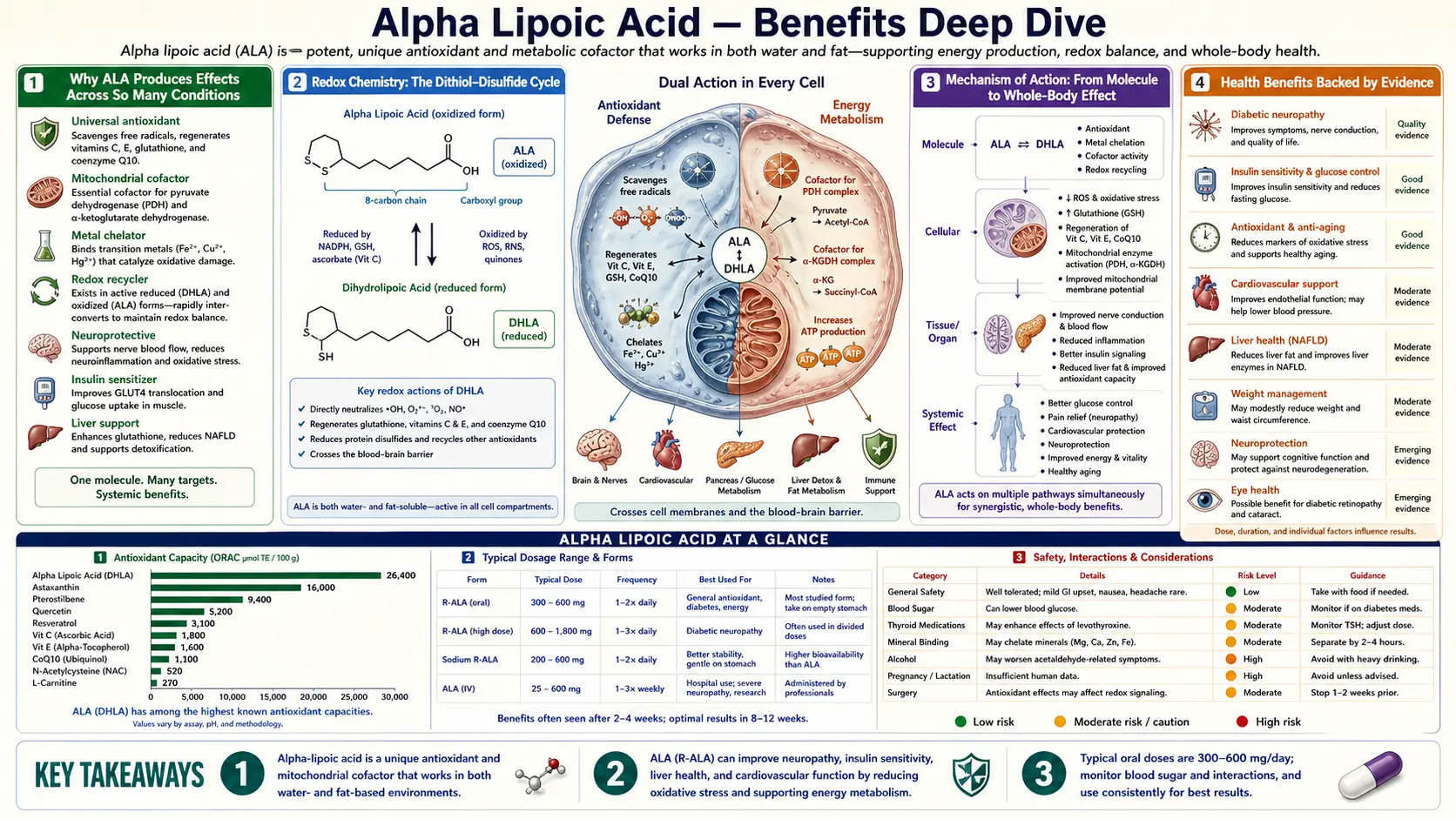
Alpha lipoic acid (ALA) acts in the body in more than one way. Protein-bound lipoic acid is the cofactor of five mitochondrial enzyme systems, including pyruvate dehydrogenase (PDH) and alpha-ketoglutarate dehydrogenase (α-KGDH); free ALA and its reduced form, dihydrolipoic acid (DHLA), act as antioxidants and bind metals in laboratory studies; and cell and animal research describes signaling effects through Nrf2 and AMPK. In human trials the evidence is strongest for short-term relief of diabetic nerve-pain symptoms. Effects on blood sugar and weight were small, the 4-year NATHAN 1 neuropathy trial missed its primary endpoint, and placebo-controlled trials in progressive multiple sclerosis (2026) and chemotherapy neuropathy (Guo 2014) did not meet their main outcomes. Each page below covers one area in depth.
Deep-Dive Articles
Diabetic Peripheral Neuropathy
The most-studied use; in Germany lipoic acid is a prescription medicine for diabetic neuropathy. Trial by trial through ALADIN I/II/III, SYDNEY 1/2, ORPIL, DEKAN and the 4-year NATHAN 1, which missed its primary endpoint; the Ziegler, Mijnhout, Han and Hsieh meta-analyses; intravenous and oral doses used in studies; and the proposed ways high blood sugar damages nerves.
Read the deep dive →Mitochondrial Function & Bioenergetics
Protein-bound lipoic acid is the cofactor of five mitochondrial enzyme systems (PDH, α-KGDH, BCKDH, OADH and the glycine cleavage system). The Bruce Ames and Tory Hagen UC Berkeley studies of R-lipoic acid with acetyl-L-carnitine in old rats, and what human trials found in fibromyalgia, long COVID, inherited mitochondrial disorders and statin muscle symptoms.
Read the deep dive →Blood Sugar & Insulin Sensitivity
AMPK and GLUT4 findings from cell and animal studies, and clamp studies in people. Meta-analyses of HbA1c, fasting glucose and weight (Akbari 2018, Jibril 2022, Kucukgoncu 2017), whose effects were small. What the research shows on hypoglycemia with diabetes medicines, and insulin autoimmune syndrome, reported in Japanese and in European patients.
Read the deep dive →Neuroprotection & Cognition
Reviews describe ALA crossing the blood-brain barrier. The open Hager Alzheimer's studies and two controlled combination trials; the 2017 multiple sclerosis pilot that slowed brain atrophy and the larger 2026 phase 2 trial that did not slow walking decline; the negative Guo 2014 chemotherapy-neuropathy trial; and animal research in stroke and Parkinson's disease.
Read the deep dive →Interactive Visualization Free Radicals & Your Antioxidant Network Follow one superoxide radical down the whole relay — SOD, catalase, glutathione, vitamin E, vitamin C, NADPH — then release free iron and watch a membrane tear itself apart. Launch →
Table of Contents
- Deep-Dive Articles
- How ALA Acts in the Body
- Research Papers: Diabetic Neuropathy
- Research Papers: Mitochondria & Bioenergetics
- Research Papers: Blood Sugar & Insulin Sensitivity
- Research Papers: Neuroprotection & Cognition
- Research Papers: Cross-Cutting (Forms, Safety, Mechanism)
- External Authoritative Resources
- Connections
- Featured Videos
How ALA Acts in the Body
ALA is studied in many conditions because laboratory research describes several distinct actions. Each maps to one of the deep-dive pages; how far each action translates into a clinical effect in people is a separate question, answered by the trials on those pages.
- Mitochondrial enzyme cofactor — protein-bound lipoic acid is the cofactor of PDH, α-KGDH, BCKDH, 2-oxoadipate dehydrogenase and the glycine cleavage system (Mayr 2014). The body makes and binds this cofactor inside mitochondria, so supplemental free ALA is studied mainly for its own chemistry (Solmonson and DeBerardinis 2018). See mitochondrial function.
- Antioxidant interactions — in laboratory studies ALA and DHLA react with reactive oxygen species and interact with vitamin C and glutathione (Packer 1995), and DHLA reduced ubiquinone (oxidized CoQ10) to ubiquinol (Kozlov 1999). The Linus Pauling Institute notes that whether DHLA effectively regenerates antioxidants under physiological conditions is unclear.
- Nerve function and blood flow — in experimental diabetes, ALA prevented or improved nerve conduction, blood flow inside the nerve and nerve Na+/K+-ATPase activity, as the SYDNEY investigators summarize (Ametov 2003). In Germany lipoic acid is a prescription medicine for diabetic peripheral neuropathy.
- Glucose uptake — in obese rats ALA activated AMPK in skeletal muscle and increased insulin-stimulated glucose disposal (Lee 2005), and in a 4-week pilot trial in type 2 diabetes it raised insulin-stimulated glucose disposal (Jacob 1999). Meta-analyses found small effects on blood sugar.
Reviews also list metal chelation and activation of the Nrf2 pathway in cell and animal studies (Shay 2009), and describe ALA crossing the blood-brain barrier (Packer 1997), the starting point of central nervous system research. A mechanism seen in the laboratory does not by itself show a clinical benefit.
Research Papers: Diabetic Neuropathy
- Ziegler D, Hanefeld M, Ruhnau KJ, Meissner HP, Lobisch M, Schütte K, Gries FA (1995). Treatment of symptomatic diabetic peripheral neuropathy with the anti-oxidant alpha-lipoic acid. A 3-week multicentre randomized controlled trial (ALADIN Study). Diabetologia 38(12):1425-33. — PubMed PMID: 8786016
- Reljanovic M, Reichel G, Rett K, Lobisch M, Schuette K, Möller W, Tritschler HJ, Mehnert H (1999). Treatment of diabetic polyneuropathy with the antioxidant thioctic acid (alpha-lipoic acid): a two year multicenter randomized double-blind placebo-controlled trial (ALADIN II). Alpha Lipoic Acid in Diabetic Neuropathy. Free Radical Research 31(3):171-9. — PubMed PMID: 10499773
- Ziegler D, Hanefeld M, Ruhnau KJ, Hasche H, Lobisch M, Schütte K, Kerum G, Malessa R (1999). Treatment of symptomatic diabetic polyneuropathy with the antioxidant alpha-lipoic acid: a 7-month multicenter randomized controlled trial (ALADIN III Study). ALADIN III Study Group. Alpha-Lipoic Acid in Diabetic Neuropathy. Diabetes Care 22(8):1296-301. — PubMed PMID: 10480774
- Ametov AS, Barinov A, Dyck PJ, Hermann R, Kozlova N, Litchy WJ, et al. (2003). The sensory symptoms of diabetic polyneuropathy are improved with alpha-lipoic acid: the SYDNEY trial. Diabetes Care 26(3):770-6. — PubMed PMID: 12610036
- Ziegler D, Ametov A, Barinov A, Dyck PJ, Gurieva I, Low PA, et al. (2006). Oral treatment with alpha-lipoic acid improves symptomatic diabetic polyneuropathy: the SYDNEY 2 trial. Diabetes Care 29(11):2365-70. — PubMed PMID: 17065669
- Ruhnau KJ, Meissner HP, Finn JR, Reljanovic M, Lobisch M, Schütte K, et al. (1999). Effects of 3-week oral treatment with the antioxidant thioctic acid (alpha-lipoic acid) in symptomatic diabetic polyneuropathy. Diabetic Medicine 16(12):1040-3. — PubMed PMID: 10656234
- Ziegler D, Low PA, Litchy WJ, Boulton AJ, Vinik AI, Freeman R, et al. (2011). Efficacy and safety of antioxidant treatment with α-lipoic acid over 4 years in diabetic polyneuropathy: the NATHAN 1 trial. Diabetes Care 34(9):2054-60. — PubMed PMID: 21775755
- Ziegler D, Schatz H, Conrad F, Gries FA, Ulrich H, Reichel G (1997). Effects of treatment with the antioxidant alpha-lipoic acid on cardiac autonomic neuropathy in NIDDM patients. A 4-month randomized controlled multicenter trial (DEKAN Study). Deutsche Kardiale Autonome Neuropathie. Diabetes Care 20(3):369-73. — PubMed PMID: 9051389
- Ziegler D, Nowak H, Kempler P, Vargha P, Low PA (2004). Treatment of symptomatic diabetic polyneuropathy with the antioxidant alpha-lipoic acid: a meta-analysis. Diabetic Medicine 21(2):114-21. — PubMed PMID: 14984445
- Ziegler D (2004). Thioctic acid for patients with symptomatic diabetic polyneuropathy: a critical review. Treatments in Endocrinology 3(3):173-89. — PubMed PMID: 16026113
- Mijnhout GS, Kollen BJ, Alkhalaf A, Kleefstra N, Bilo HJ (2012). Alpha lipoic Acid for symptomatic peripheral neuropathy in patients with diabetes: a meta-analysis of randomized controlled trials. International Journal of Endocrinology 2012:456279. — PubMed PMID: 22331979
- Han T, Bai J, Liu W, Hu Y (2012). A systematic review and meta-analysis of α-lipoic acid in the treatment of diabetic peripheral neuropathy. European Journal of Endocrinology 167(4):465-71. — PubMed PMID: 22837391
- Hsieh RY, Huang IC, Chen C, Sung JY (2023). Effects of Oral Alpha-Lipoic Acid Treatment on Diabetic Polyneuropathy: A Meta-Analysis and Systematic Review. Nutrients 15(16):3634. — PubMed PMID: 37630823
PubMed Topic Searches
- ALA mechanism in diabetic nerve damage (polyol pathway) — PubMed: ALA aldose reductase polyol pathway
- Intraneural blood flow and ALA — PubMed: ALA intraneural blood flow
Research Papers: Mitochondria & Bioenergetics
- Mayr JA, Feichtinger RG, Tort F, Ribes A, Sperl W (2014). Lipoic acid biosynthesis defects. Journal of Inherited Metabolic Disease 37(4):553-63. — PubMed PMID: 24777537
- Solmonson A, DeBerardinis RJ (2018). Lipoic acid metabolism and mitochondrial redox regulation. Journal of Biological Chemistry 293(20):7522-7530. — PubMed PMID: 29191830
- Hagen TM, Liu J, Lykkesfeldt J, Wehr CM, Ingersoll RT, Vinarsky V, Bartholomew JC, Ames BN (2002). Feeding acetyl-L-carnitine and lipoic acid to old rats significantly improves metabolic function while decreasing oxidative stress. Proceedings of the National Academy of Sciences of the USA 99(4):1870-5. — PubMed PMID: 11854487
- Liu J, Head E, Gharib AM, Yuan W, Ingersoll RT, Hagen TM, Cotman CW, Ames BN (2002). Memory loss in old rats is associated with brain mitochondrial decay and RNA/DNA oxidation: partial reversal by feeding acetyl-L-carnitine and/or R-alpha -lipoic acid. Proceedings of the National Academy of Sciences of the USA 99(4):2356-61. — PubMed PMID: 11854529
- Gilron I, Robb S, Tu D, Holden R, Towheed T, Ziegler D, et al. (2021). Double-blind, randomized, placebo-controlled crossover trial of alpha-lipoic acid for the treatment of fibromyalgia pain: the IMPALA trial. Pain 162(2):561-568. — PubMed PMID: 32773602
- Rodriguez MC, MacDonald JR, Mahoney DJ, Parise G, Beal MF, Tarnopolsky MA (2007). Beneficial effects of creatine, CoQ10, and lipoic acid in mitochondrial disorders. Muscle & Nerve 35(2):235-42. — PubMed PMID: 17080429
- Cameron M, Taylor C, Lapidus J, Ramsey K, Koop D, Spain R (2020). Gastrointestinal Tolerability and Absorption of R- Versus R,S-Lipoic Acid in Progressive Multiple Sclerosis: A Randomized Crossover Trial. Journal of Clinical Pharmacology 60(8):1099-1106. — PubMed PMID: 32212340
PubMed Topic Searches
- Lipoylation of PDH and α-KGDH (mechanism) — PubMed: lipoylation PDH α-KGDH
- ALA + acetyl-L-carnitine combination — PubMed: ALA + acetyl-L-carnitine combination
- ALA and mitochondrial membrane potential — PubMed: ALA mitochondrial membrane potential
- ALA and chronic fatigue syndrome — PubMed: ALA chronic fatigue syndrome
- ALA and fibromyalgia — PubMed: ALA fibromyalgia
- Lipoic acid synthase (LIAS) and endogenous synthesis — PubMed: LIAS endogenous synthesis
- R-alpha lipoic acid vs racemic in mitochondrial function — PubMed: R-ALA mitochondrial function
- ALA and AMPK / mTOR in skeletal muscle — PubMed: ALA AMPK mTOR muscle
Research Papers: Blood Sugar & Insulin Sensitivity
- Akbari M, Ostadmohammadi V, Lankarani KB, Tabrizi R, Kolahdooz F, Khatibi SR, Asemi Z (2018). The effects of alpha-lipoic acid supplementation on glucose control and lipid profiles among patients with metabolic diseases: A systematic review and meta-analysis of randomized controlled trials. Metabolism: Clinical and Experimental 87:56-69. — PubMed PMID: 29990473
- Jibril AT, Jayedi A, Shab-Bidar S (2022). Efficacy and safety of oral alpha-lipoic acid supplementation for type 2 diabetes management: a systematic review and dose-response meta-analysis of randomized trials. Endocrine Connections 11(10):e220322. — PubMed PMID: 36006850
- Kucukgoncu S, Zhou E, Lucas KB, Tek C (2017). Alpha-lipoic acid (ALA) as a supplementation for weight loss: results from a meta-analysis of randomized controlled trials. Obesity Reviews 18(5):594-601. — PubMed PMID: 28295905
- Jacob S, Ruus P, Hermann R, Tritschler HJ, Maerker E, Renn W, et al. (1999). Oral administration of RAC-alpha-lipoic acid modulates insulin sensitivity in patients with type-2 diabetes mellitus: a placebo-controlled pilot trial. Free Radical Biology & Medicine 27(3-4):309-14. — PubMed PMID: 10468203
- Lee WJ, Song KH, Koh EH, Won JC, Kim HS, Park HS, et al. (2005). Alpha-lipoic acid increases insulin sensitivity by activating AMPK in skeletal muscle. Biochemical and Biophysical Research Communications 332(3):885-91. — PubMed PMID: 15913551
- Gleiter CH, Schreeb KH, Freudenthaler S, Thomas M, Elze M, Fieger-Büschges H, et al. (1999). Lack of interaction between thioctic acid, glibenclamide and acarbose. British Journal of Clinical Pharmacology 48(6):819-25. — PubMed PMID: 10594485
PubMed Topic Searches
- ALA HbA1c meta-analyses — PubMed: ALA HbA1c meta-analyses
- ALA GLUT4 translocation — PubMed: ALA GLUT4 translocation
- ALA insulin sensitivity in metabolic syndrome — PubMed: ALA insulin sensitivity HOMA-IR
- ALA fasting glucose trials — PubMed: ALA fasting glucose
- ALA in prediabetes and impaired glucose tolerance — PubMed: ALA prediabetes
- ALA + berberine in metabolic syndrome — PubMed: ALA + berberine combination
- ALA and hypoglycemia with insulin / sulfonylureas — PubMed: ALA hypoglycemia interactions
- ALA and gestational diabetes — PubMed: ALA gestational diabetes
Research Papers: Neuroprotection & Cognition
- Packer L, Tritschler HJ, Wessel K (1997). Neuroprotection by the metabolic antioxidant alpha-lipoic acid. Free Radical Biology & Medicine 22(1-2):359-78. — PubMed PMID: 8958163
- Hager K, Marahrens A, Kenklies M, Riederer P, Münch G (2001). Alpha-lipoic acid as a new treatment option for Alzheimer [corrected] type dementia. Archives of Gerontology and Geriatrics 32(3):275-82. — PubMed PMID: 11395173
- Hager K, Kenklies M, McAfoose J, Engel J, Münch G (2007). Alpha-lipoic acid as a new treatment option for Alzheimer's disease--a 48 months follow-up analysis. Journal of Neural Transmission. Supplementum (72):189-93. — PubMed PMID: 17982894
- Galasko DR, Peskind E, Clark CM, Quinn JF, Ringman JM, Jicha GA, et al. (2012). Antioxidants for Alzheimer disease: a randomized clinical trial with cerebrospinal fluid biomarker measures. Archives of Neurology 69(7):836-41. — PubMed PMID: 22431837
- Yadav V, Marracci G, Lovera J, Woodward W, Bogardus K, Marquardt W, et al. (2005). Lipoic acid in multiple sclerosis: a pilot study. Multiple Sclerosis 11(2):159-65. — PubMed PMID: 15794388
- Spain R, Powers K, Murchison C, Heriza E, Winges K, Yadav V, et al. (2017). Lipoic acid in secondary progressive MS: A randomized controlled pilot trial. Neurology: Neuroimmunology & Neuroinflammation 4(5):e374. — PubMed PMID: 28680916
- Spain RI, Paz Soldán MM, Freedman MS, Repovic P, Solomon AJ, Rinker JR, et al. (2026). Lipoic Acid for Treatment of Progressive Multiple Sclerosis: A Phase 2 Randomized Clinical Trial. Neurology 106(1):e214454. — PubMed PMID: 41397213
- Guo Y, Jones D, Palmer JL, Forman A, Dakhil SR, Velasco MR, et al. (2014). Oral alpha-lipoic acid to prevent chemotherapy-induced peripheral neuropathy: a randomized, double-blind, placebo-controlled trial. Supportive Care in Cancer 22(5):1223-31. — PubMed PMID: 24362907
PubMed Topic Searches
- ALA blood-brain barrier pharmacokinetics — PubMed: ALA BBB crossing
- ALA stroke and cerebral ischemia (animal data) — PubMed: ALA stroke
- ALA chemotherapy-induced peripheral neuropathy (CIPN) — PubMed: ALA CIPN
- ALA in Parkinson's disease — PubMed: ALA Parkinson's
- ALA, cognitive aging and processing speed — PubMed: ALA cognitive aging
- ALA + acetyl-L-carnitine and cognitive function — PubMed: ALA + acetyl-L-carnitine cognition
- ALA and glutamate excitotoxicity — PubMed: ALA glutamate excitotoxicity
Research Papers: Cross-Cutting (Forms, Safety, Mechanism)
- Cameron M, Taylor C, Lapidus J, Ramsey K, Koop D, Spain R (2020). Gastrointestinal Tolerability and Absorption of R- Versus R,S-Lipoic Acid in Progressive Multiple Sclerosis: A Randomized Crossover Trial. Journal of Clinical Pharmacology 60(8):1099-1106. — PubMed PMID: 32212340
- Hermann R, Mungo J, Cnota PJ, Ziegler D (2014). Enantiomer-selective pharmacokinetics, oral bioavailability, and sex effects of various alpha-lipoic acid dosage forms. Clinical Pharmacology: Advances and Applications 6:195-204. — PubMed PMID: 25506250
- Carlson DA, Smith AR, Fischer SJ, Young KL, Packer L (2007). The plasma pharmacokinetics of R-(+)-lipoic acid administered as sodium R-(+)-lipoate to healthy human subjects. Alternative Medicine Review 12(4):343-51. — PubMed PMID: 18069903
- Packer L, Witt EH, Tritschler HJ (1995). alpha-Lipoic acid as a biological antioxidant. Free Radical Biology & Medicine 19(2):227-50. — PubMed PMID: 7649494
- Kozlov AV, Gille L, Staniek K, Nohl H (1999). Dihydrolipoic acid maintains ubiquinone in the antioxidant active form by two-electron reduction of ubiquinone and one-electron reduction of ubisemiquinone. Archives of Biochemistry and Biophysics 363(1):148-54. — PubMed PMID: 10049509
- Shay KP, Moreau RF, Smith EJ, Smith AR, Hagen TM (2009). Alpha-lipoic acid as a dietary supplement: molecular mechanisms and therapeutic potential. Biochimica et Biophysica Acta 1790(10):1149-60. — PubMed PMID: 19664690
- Gullo D, Evans JL, Sortino G, Goldfine ID, Vigneri R (2014). Insulin autoimmune syndrome (Hirata Disease) in European Caucasians taking α-lipoic acid. Clinical Endocrinology 81(2):204-9. — PubMed PMID: 24111525
- Uchigata Y (2007). The novel agent, alpha lipoic acid, can cause the development of insulin autoimmune syndrome. Internal Medicine 46(17):1321-2. — PubMed PMID: 17827827
- Cappellani D, Macchia E, Falorni A, Marchetti P (2020). Insulin Autoimmune Syndrome (Hirata Disease): A Comprehensive Review Fifty Years After Its First Description. Diabetes, Metabolic Syndrome and Obesity 13:963-978. — PubMed PMID: 32308449
- EFSA Panel on Nutrition, Novel Foods and Food Allergens (NDA); Turck D, Castenmiller J, de Henauw S, Hirsch-Ernst KI, Kearney J, Knutsen HK, et al. (2021). Scientific opinion on the relationship between intake of alpha-lipoic acid (thioctic acid) and the risk of insulin autoimmune syndrome. EFSA Journal 19(6):e06577. — PubMed PMID: 34122657
- Spain RI, Andeen NK, Gibson PC, Samuels MH, Morris CD, Solomon AJ, et al. (2021). Lipoic acid supplementation associated with neural epidermal growth factor-like 1 (NELL1)-associated membranous nephropathy. Kidney International 100(6):1208-1213. — PubMed PMID: 34662650
- Zempleni J, Trusty TA, Mock DM (1997). Lipoic acid reduces the activities of biotin-dependent carboxylases in rat liver. Journal of Nutrition 127(9):1776-81. — PubMed PMID: 9278559
- Gal EM (1965). Reversal of selective toxicity of (-)-alpha-lipoic acid by thiamine in thiamine-deficient rats. Nature 207(996):535. — PubMed PMID: 5328673
- Cremer DR, Rabeler R, Roberts A, Lynch B (2006). Safety evaluation of alpha-lipoic acid (ALA). Regulatory Toxicology and Pharmacology 46(1):29-41. — PubMed PMID: 16904799
PubMed Topic Searches
- R-alpha lipoic acid vs racemic bioavailability — PubMed: R-ALA bioavailability
- Sodium R-lipoate (Na-R-ALA) stability — PubMed: Na-R-ALA stability
- ALA interactions with vitamin C, vitamin E, glutathione and CoQ10 — PubMed: ALA antioxidant network
- ALA and Nrf2 pathway activation — PubMed: ALA Nrf2
- ALA heavy metal chelation (mercury, lead, arsenic) — PubMed: ALA heavy metal chelation
- Insulin autoimmune syndrome (Hirata disease) and ALA — PubMed: IAS Hirata HLA-DRB1
- ALA and biotin — PubMed: ALA biotin
- ALA, thiamine and PDH — PubMed: ALA thiamine PDH
- ALA safety in long-term use — PubMed: ALA long-term safety
The Andy Cutler protocol (frequent low-dose oral ALA for suspected mercury toxicity) is described on the main Alpha Lipoic Acid page; a PubMed search for this page found no clinical trial of it.
External Authoritative Resources
- Linus Pauling Institute — Lipoic Acid Micronutrient Information Center — a scientific summary of ALA biology and clinical evidence
- NCCIH — Herbs and Supplements at a Glance
- MedlinePlus — Alpha Lipoic Acid
- PubMed — All research on alpha lipoic acid
Connections
- Free Radicals & Your Antioxidant Network — interactive animation
- Alpha Lipoic Acid (Main Page)
- ALA for Diabetic Neuropathy
- ALA for Mitochondrial Function
- ALA for Blood Sugar
- ALA for Neuroprotection
- All Antioxidants
- CoQ10
- Glutathione
- NAC
- Oxidative Stress
- Diabetes
- Peripheral Neuropathy
- Hemoglobin A1c
- Fasting Insulin
- History