Astaxanthin for Cardiovascular & Lipid Health
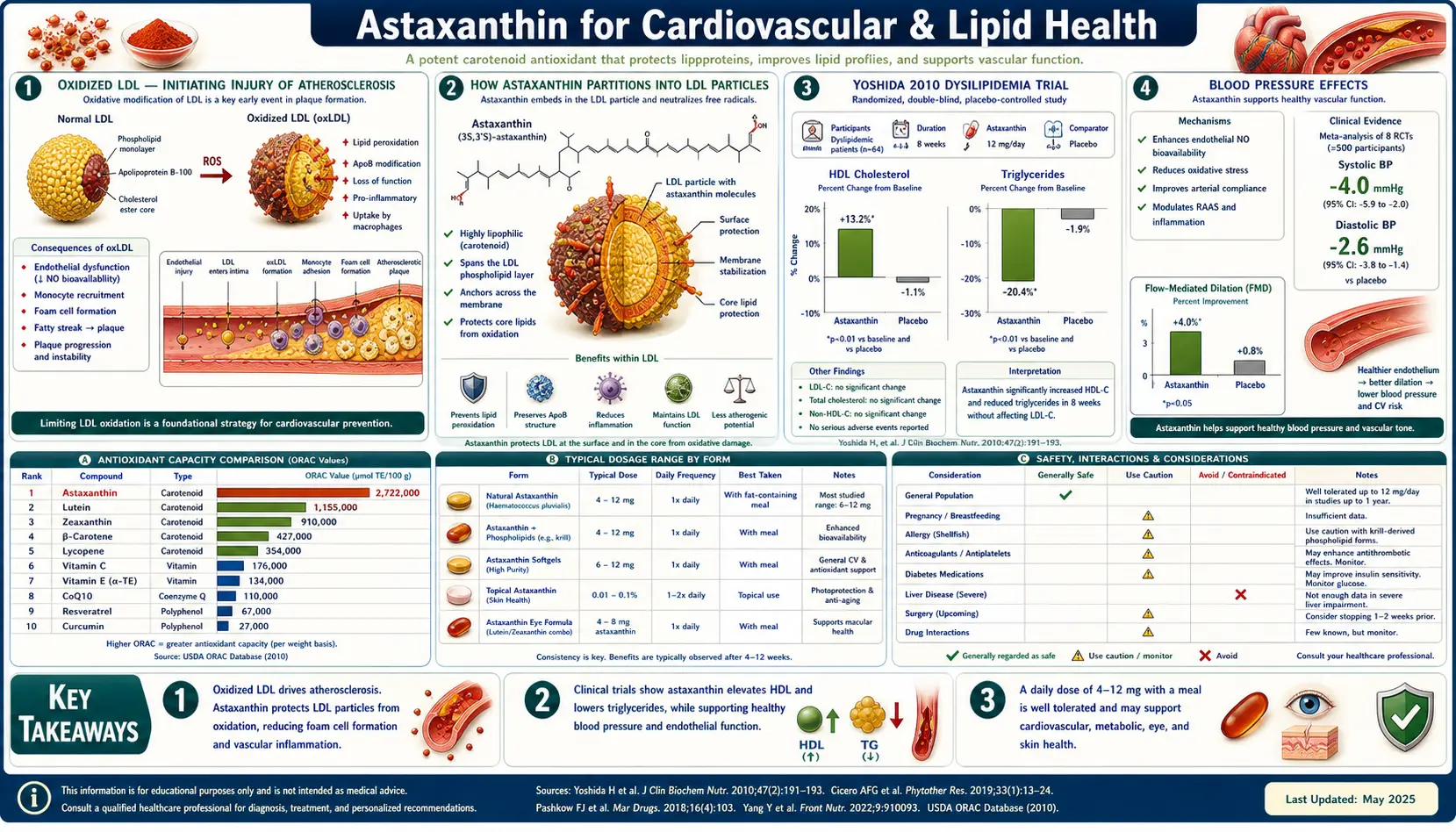
Astaxanthin has been tested for blood lipids, blood pressure, inflammation and LDL oxidation, mostly in small trials lasting from 2 weeks to 3 months. In the most-cited lipid trial (Yoshida 2010), triglycerides fell at 12 and 18 mg/day and HDL cholesterol rose at 6 and 12 mg/day over 12 weeks, while LDL cholesterol did not change. The meta-analyses do not agree: one found no significant effect on any blood lipid (Ursoniu 2015), another found a small rise in HDL and no effect on blood pressure (Xia 2020), and a third found marginal effects in adults at risk of metabolic syndrome (Leung 2022). A one-year trial in kidney-transplant recipients found no effect on arterial stiffness (Coombes 2016). No trial found for this page measured heart attacks, strokes or deaths.
Table of Contents
- Oxidized LDL and Atherosclerosis
- Astaxanthin in LDL Particles and LDL Oxidation Studies
- The Yoshida 2010 Trial (HDL and Triglycerides)
- Blood Pressure Findings
- Endothelial Function and Arterial Stiffness
- CRP, IL-6, and Inflammatory Markers
- Krill Oil: What the Research Reports
- Statins and Astaxanthin: What Has Been Studied
- ApoB, Lp(a), and Cholesterol Efflux
- Doses Used in the Cardiovascular Studies
- Related Pages on Heart and Lipid Nutrients
- Safety Findings Relevant to Heart and Blood
- Key Research Papers
- Connections
- Featured Videos
Oxidized LDL and Atherosclerosis
One widely studied model of atherosclerosis gives a central role to the oxidation of LDL particles inside the artery wall. The steps it describes are:
- ApoB-containing lipoproteins (LDL, IDL, Lp(a), VLDL remnants) cross the arterial endothelium and are retained in the space beneath it
- There they are exposed to reactive oxygen species from local cells such as macrophages
- Oxidation of the particles' polyunsaturated fatty acids and of the ApoB protein produces oxidized LDL (oxLDL), which scavenger receptors on macrophages recognize
- Macrophages take up oxLDL through scavenger receptors such as SR-A and CD36, become lipid-filled foam cells, and accumulate as fatty streaks
- Foam cells release signals that recruit more immune cells and drive smooth-muscle growth, leading to fibrous plaque
This model is the reason antioxidants, including astaxanthin, have been tested for heart and blood-vessel health. The laboratory and biomarker studies of astaxanthin and LDL oxidation are described in the next section; no trial found for this page has tested whether astaxanthin changes cardiovascular events.
Astaxanthin in LDL Particles and LDL Oxidation Studies
After it is eaten, astaxanthin is absorbed with dietary fat and carried in lipoproteins. In three men given a single 100 mg dose with a meal, plasma levels peaked at 6.7 hours, and astaxanthin travelled mainly in chylomicron and VLDL particles, with smaller amounts in LDL and HDL (Østerlie 2000).
Studies of LDL oxidation and related markers report:
- Iwamoto 2000 — in a test tube, astaxanthin lengthened the lag time before LDL oxidized, from 19.9 minutes (control) to 31.5, 45.4 and 65.0 minutes as the concentration rose. In 24 volunteers who took 1.8, 3.6, 14.4 or 21.6 mg/day for 14 days, the lag time of their LDL was 5.0%, 26.2%, 42.3% and 30.7% longer than before supplementation.
- Karppi 2007 — in healthy non-smoking Finnish men given 8 mg/day or placebo for 3 months, plasma 12- and 15-hydroxy fatty acids (oxidation products) fell in the astaxanthin group; the difference from placebo for 15-hydroxy fatty acids was not quite significant (p = 0.056).
- Choi 2011 (Plant Foods for Human Nutrition) — in 27 overweight adults given astaxanthin or placebo for 12 weeks, LDL cholesterol and ApoB were lower than at the start in the astaxanthin group, and the oxidation markers malondialdehyde and isoprostane were lower than with placebo.
- Choi 2011 (Phytotherapy Research) — 23 overweight or obese adults took 5 or 20 mg/day for 3 weeks with no placebo group; malondialdehyde and isoprostane fell from baseline in both groups.
- Urakaze 2021 — in 53 adults, including some with prediabetes, given 12 mg/day or placebo for 12 weeks, malondialdehyde-modified LDL fell from 87.3 to 76.3 U/L in the astaxanthin group compared with before supplementation; total cholesterol, triglycerides and HDL did not change.
These are short studies of laboratory markers. None measured plaque growth or cardiovascular events.
The Yoshida 2010 Trial (HDL and Triglycerides)
Yoshida H, Yanai H, Ito K et al. (2010, Atherosclerosis) is the most often cited human trial of astaxanthin and blood lipids.
Methods
- 61 non-obese adults aged 25 to 60 with fasting triglycerides of 120–200 mg/dL, without diabetes or hypertension
- Randomized, placebo-controlled: astaxanthin 0, 6, 12 or 18 mg/day for 12 weeks
Results reported in the abstract
- Triglycerides: significantly reduced at 12 and 18 mg/day
- HDL cholesterol: significantly increased at 6 and 12 mg/day
- Adiponectin: increased at 12 and 18 mg/day; its changes correlated with the HDL changes
- LDL cholesterol and body mass index: unchanged at all doses
The abstract does not report percentage changes. The authors described it as the first randomized, placebo-controlled human study of its kind. Later meta-analyses that pooled this trial with others did not find a consistent effect on triglycerides (Ursoniu 2015; Xia 2020).
Blood Pressure Findings
The pooled evidence does not show a clear blood-pressure effect:
- Xia 2020 — a meta-analysis of 14 articles found astaxanthin was not associated with changes in systolic or diastolic blood pressure. A published letter questioned parts of its analysis and called for a reanalysis (Hajhashemy 2021).
- Leung 2022 — in adults at risk of metabolic syndrome, a meta-analysis found a marginal effect on systolic blood pressure and called for more robust evidence.
- Mashhadi 2018 — in a single 8-week trial in 44 people with type 2 diabetes, 8 mg/day lowered systolic blood pressure (p < 0.05), triglycerides and VLDL cholesterol, and raised adiponectin, compared with placebo.
- Spiller 2003 — in an 8-week safety trial of 6 mg/day in 35 adults, blood pressure did not differ from placebo.
Mechanisms such as calcium-channel effects or a diuretic action, sometimes proposed for astaxanthin, were not supported by any human study found for this page.
Endothelial Function and Arterial Stiffness
The endothelium is the cell layer lining the blood vessels; it helps control vessel tone, clotting and inflammation. Flow-mediated dilation (FMD) of the brachial artery — how much the artery widens after a cuff on the arm is released — is a common non-invasive measure of endothelial function, and pulse wave velocity is a common measure of arterial stiffness.
Human evidence for astaxanthin on these measures is limited:
- Coombes 2016 (the XANTHIN trial) — 61 kidney-transplant recipients received 12 mg/day astaxanthin or placebo for one year. There were no significant differences between groups in aortic pulse wave velocity, F2-isoprostanes (an oxidation marker), pentraxin-3 (an inflammation marker), or any secondary measure, which included vascular function and carotid intima-media thickness. The authors noted that larger-than-expected variability reduced the trial's power.
- Urakaze 2021 — included a vascular endothelial function test, but the abstract does not report an effect on it.
Earlier statements that astaxanthin improves FMD by 1–3 percentage points were not supported by any trial found for this page.
CRP, IL-6, and Inflammatory Markers
Inflammation is studied as a cardiovascular risk factor alongside cholesterol. In the CANTOS trial, 10,061 people with a previous heart attack and high-sensitivity CRP of 2 mg/L or more were given canakinumab, an antibody against interleukin-1β, or placebo; the 150 mg dose lowered the rate of recurrent cardiovascular events without lowering blood lipids, and the drug was associated with more fatal infections (Ridker 2017).
Astaxanthin trials report mixed effects on inflammatory markers:
- Pooled trials — CRP fell only in trials lasting 12 weeks or more or using more than 12 mg/day (Xia 2020).
- Healthy young women — in an 8-week trial of 0, 2 or 8 mg/day, plasma CRP was lower at week 8 with 2 mg, but plasma IL-6 and interferon-gamma rose with 8 mg (Park 2010).
- Kidney-transplant recipients — one year of 12 mg/day did not change pentraxin-3 or the other inflammation measures compared with placebo (Coombes 2016).
Laboratory and animal work describes effects on inflammatory signaling, for example reduced NF-κB activity in the platelets of rats (Satti 2021). Earlier statements on this page that astaxanthin lowers hs-CRP by 20–40% and lowers TNFα and soluble adhesion molecules were not supported by any trial found for it.
Krill Oil: What the Research Reports
Krill oil, from Antarctic krill (Euphausia superba), carries omega-3 fatty acids (EPA and DHA) mostly as phospholipids rather than triglycerides, and contains astaxanthin. A 2014 review reports that the astaxanthin in krill is mainly the 3R,3'R form and largely esterified (Ambati 2014).
In a 7-week randomized trial in 113 adults with normal or slightly raised cholesterol or triglycerides, krill oil (3.0 g/day, 543 mg EPA + DHA) and fish oil (1.8 g/day, 864 mg EPA + DHA) raised plasma EPA, DHA and DPA to a similar degree. There were no significant differences between the groups in serum lipids or in markers of oxidative stress and inflammation (Ulven 2011).
No trial found for this page tested whether the astaxanthin in krill oil, or astaxanthin taken with omega-3 fatty acids, changes blood lipids or cardiovascular outcomes beyond the omega-3 alone. Related page: omega-3 fatty acids.
Statins and Astaxanthin: What Has Been Studied
Statins lower LDL cholesterol and ApoB-containing particles and are among the most studied cardiovascular drugs, with large outcome trials. Astaxanthin has not been studied in that way:
- No trial found for this page compared astaxanthin with a statin, or tested astaxanthin added to statin treatment, for any cardiovascular outcome.
- In the trials and meta-analyses above, astaxanthin did not lower LDL cholesterol (Yoshida 2010; Ursoniu 2015; Xia 2020), the main measured effect of statins. One small 12-week trial reported lower LDL and ApoB compared with baseline (Choi 2011).
- No trial of astaxanthin for statin-associated muscle symptoms was found. The CoQ10 page covers how statins affect the body's own CoQ10.
A comparison table of statins and astaxanthin that appeared here earlier gave figures for astaxanthin (for example HDL +10–15% and triglycerides −25%) that no cited trial reported, and has been removed. Decisions about cholesterol-lowering medicines belong with a clinician.
ApoB, Lp(a), and Cholesterol Efflux
- ApoB — each LDL, IDL, Lp(a) and VLDL particle carries one ApoB-100 molecule, so ApoB counts atherogenic particles.
- Lp(a) (lipoprotein little-a) — an LDL-like particle with an attached apolipoprotein(a), whose level is largely genetically determined.
What has been reported for astaxanthin:
- ApoB: lower than at baseline after 12 weeks in one small placebo-controlled trial in overweight adults (Choi 2011). No meta-analysis of ApoB was found.
- Lp(a): no human study of astaxanthin and Lp(a) was found for this page.
- Cholesterol efflux: in mouse and other macrophage cell cultures, astaxanthin increased the ABCA1 and ABCG1 transporters and cholesterol efflux to apoA-I and HDL (Iizuka 2012). This is a cell study, not a measurement in people.
Earlier statements that astaxanthin shifts LDL toward larger particles and improves HDL function in several human studies were not supported by any study found for this page.
Doses Used in the Cardiovascular Studies
There is no official recommended intake for astaxanthin. These are the amounts used in the studies on this page, not instructions:
- Blood lipids — 6, 12 or 18 mg/day for 12 weeks (Yoshida 2010)
- LDL oxidation — 1.8 to 21.6 mg/day for 14 days (Iwamoto 2000); 8 mg/day for 3 months (Karppi 2007)
- Oxidative stress in overweight adults — 5 or 20 mg/day for 3 weeks (Choi 2011, Phytotherapy Research)
- Type 2 diabetes — 8 mg/day for 8 weeks (Mashhadi 2018)
- Prediabetes and healthy adults — 12 mg/day for 12 weeks (Urakaze 2021)
- Inflammation in healthy women — 2 or 8 mg/day for 8 weeks (Park 2010)
- Kidney-transplant recipients — 12 mg/day for 1 year (Coombes 2016)
Intake limits. In 2020 the European Food Safety Authority concluded that 8 mg/day from food supplements, on top of astaxanthin from the usual diet, is safe for adults, using an acceptable daily intake of 0.2 mg per kg of body weight (EFSA 2020). Amounts studied for other nutrients, such as CoQ10, are on their own pages.
Related Pages on Heart and Lipid Nutrients
Other nutrients studied for heart and blood-lipid health have their own pages, each with its own evidence: CoQ10, omega-3 fatty acids, vitamin K2 and magnesium. No trial found for this page tested astaxanthin in combination with these nutrients for a cardiovascular outcome.
Safety Findings Relevant to Heart and Blood
- Adverse events in trials — a 2019 review of 87 human studies of natural astaxanthin found none that reported safety concerns (Brendler 2019). In an 8-week safety trial of 6 mg/day, blood pressure and blood chemistry did not differ from placebo except for very small differences the authors judged clinically unimportant (Spiller 2003).
- Blood pressure — pooled trials did not show a consistent effect on systolic or diastolic pressure (Xia 2020; Leung 2022).
- Blood clotting — in rats, astaxanthin reduced platelet aggregation and prolonged bleeding time (Satti 2021). No clinical trial of astaxanthin taken with anticoagulant or antiplatelet drugs was found, so the interaction is unstudied rather than known to be absent. Decisions about combining supplements with these medicines belong with a clinician.
- Blood glucose — a 2015 meta-analysis observed a slight glucose-lowering effect (Ursoniu 2015); a 2020 meta-analysis found no association with fasting glucose or HbA1c (Xia 2020).
- Pregnancy and breastfeeding — none of the trials cited on this page studied pregnant or breastfeeding women.
- Synthetic astaxanthin — a 2019 safety review notes that few safety studies in humans or animals have used synthetic astaxanthin, and calls for further studies to set a separate acceptable intake for it (Brendler 2019).
- Regulatory status — the US FDA does not approve dietary supplements before they are marketed. Its listings for astaxanthin are as color additives for the feed of salmonid fish: synthetic astaxanthin (21 CFR 73.35), Haematococcus algae meal (21 CFR 73.185) and Phaffia yeast (21 CFR 73.355). In the EU, EFSA assessed it as a novel food in supplements at up to 8 mg/day (EFSA 2020).
Key Research Papers
- Yoshida H, Yanai H, Ito K, et al. (2010). Administration of natural astaxanthin increases serum HDL-cholesterol and adiponectin in subjects with mild hyperlipidemia. Atherosclerosis — PubMed PMID: 19892350
- Ursoniu S, Sahebkar A, Serban MC, et al. (2015). Lipid profile and glucose changes after supplementation with astaxanthin: a systematic review and meta-analysis of randomized controlled trials. Archives of Medical Science — PubMed PMID: 25995739
- Xia W, Tang N, Kord-Varkaneh H, et al. (2020). The effects of astaxanthin supplementation on obesity, blood pressure, CRP, glycemic biomarkers, and lipid profile: A meta-analysis of randomized controlled trials. Pharmacological Research — PubMed PMID: 32755613
- Hajhashemy Z, Saneei P (2021). Meta-analysis of astaxanthin supplementation on obesity, blood pressure, CRP, glycemic biomarkers, and lipid profile: Reanalysis is needed [letter]. Pharmacological Research — PubMed PMID: 32858120
- Leung LY, Chan SM, Tam HL, et al. (2022). Astaxanthin Influence on Health Outcomes of Adults at Risk of Metabolic Syndrome: A Systematic Review and Meta-Analysis. Nutrients — PubMed PMID: 35631193
- Iwamoto T, Hosoda K, Hirano R, et al. (2000). Inhibition of low-density lipoprotein oxidation by astaxanthin. Journal of Atherosclerosis and Thrombosis — PubMed PMID: 11521685
- Karppi J, Rissanen TH, Nyyssönen K, et al. (2007). Effects of astaxanthin supplementation on lipid peroxidation. International Journal for Vitamin and Nutrition Research — PubMed PMID: 17685090
- Choi HD, Youn YK, Shin WG (2011). Positive effects of astaxanthin on lipid profiles and oxidative stress in overweight subjects. Plant Foods for Human Nutrition — PubMed PMID: 21964877
- Choi HD, Kim JH, Chang MJ, et al. (2011). Effects of astaxanthin on oxidative stress in overweight and obese adults. Phytotherapy Research — PubMed PMID: 21480416
- Mashhadi NS, Zakerkish M, Mohammadiasl J, et al. (2018). Astaxanthin improves glucose metabolism and reduces blood pressure in patients with type 2 diabetes mellitus. Asia Pacific Journal of Clinical Nutrition — PubMed PMID: 29384321
- Urakaze M, Kobashi C, Satou Y, et al. (2021). The Beneficial Effects of Astaxanthin on Glucose Metabolism and Modified Low-Density Lipoprotein in Healthy Volunteers and Subjects with Prediabetes. Nutrients — PubMed PMID: 34959932
- Coombes JS, Sharman JE, Fassett RG (2016). Astaxanthin has no effect on arterial stiffness, oxidative stress, or inflammation in renal transplant recipients: a randomized controlled trial (the XANTHIN trial). American Journal of Clinical Nutrition — PubMed PMID: 26675778
- Park JS, Chyun JH, Kim YK, et al. (2010). Astaxanthin decreased oxidative stress and inflammation and enhanced immune response in humans. Nutrition & Metabolism — PubMed PMID: 20205737
- Ridker PM, Everett BM, Thuren T, et al. (2017). Antiinflammatory Therapy with Canakinumab for Atherosclerotic Disease. New England Journal of Medicine — PubMed PMID: 28845751
- Ulven SM, Kirkhus B, Lamglait A, et al. (2011). Metabolic effects of krill oil are essentially similar to those of fish oil but at lower dose of EPA and DHA, in healthy volunteers. Lipids — PubMed PMID: 21042875
- Iizuka M, Ayaori M, Uto-Kondo H, et al. (2012). Astaxanthin enhances ATP-binding cassette transporter A1/G1 expressions and cholesterol efflux from macrophages. Journal of Nutritional Science and Vitaminology — PubMed PMID: 22790567
- Østerlie M, Bjerkeng B, Liaaen-Jensen S (2000). Plasma appearance and distribution of astaxanthin E/Z and R/S isomers in plasma lipoproteins of men after single dose administration of astaxanthin. Journal of Nutritional Biochemistry — PubMed PMID: 11120445
- Ambati RR, Phang SM, Ravi S, et al. (2014). Astaxanthin: sources, extraction, stability, biological activities and its commercial applications--a review. Marine Drugs — PubMed PMID: 24402174
- Satti HH, Khaleel EF, Badi RM, et al. (2021). Antiplatelet activity of astaxanthin in control- and high cholesterol-fed rats mediated by down-regulation of P2Y12, inhibition of NF-κB, and increasing intracellular levels of cAMP. Platelets — PubMed PMID: 32379559
- Fassett RG, Coombes JS (2011). Astaxanthin: a potential therapeutic agent in cardiovascular disease. Marine Drugs — PubMed PMID: 21556169
- Pashkow FJ, Watumull DG, Campbell CL (2008). Astaxanthin: a novel potential treatment for oxidative stress and inflammation in cardiovascular disease. American Journal of Cardiology — PubMed PMID: 18474276
- Brendler T, Williamson EM (2019). Astaxanthin: How much is too much? A safety review. Phytotherapy Research — PubMed PMID: 31788888
- Spiller GA, Dewell A (2003). Safety of an astaxanthin-rich Haematococcus pluvialis algal extract: a randomized clinical trial. Journal of Medicinal Food — PubMed PMID: 12804020
- EFSA Panel on Nutrition, Novel Foods and Food Allergens (NDA), Turck D, Castenmiller J, et al. (2020). Safety of astaxanthin for its use as a novel food in food supplements. EFSA Journal — PubMed PMID: 32874213
Two entries listed here earlier could not be matched to a findable paper and were removed: “Kim YK et al., Effects of astaxanthin on coronary blood flow and blood lipids” and “Saito M et al., Astaxanthin and the cardiovascular system”. A third, attributed to Iwabayashi M, Fujioka N et al. in Anti-Aging Medicine, was listed under a title that does not match the published paper and could not be checked against its text.
PubMed Topic Searches
- Astaxanthin and cardiovascular disease — PubMed: astaxanthin cardiovascular disease
- Astaxanthin, HDL, triglycerides and blood lipids — PubMed: astaxanthin HDL triglyceride lipid
- Astaxanthin and oxidized LDL — PubMed: astaxanthin oxidized LDL
- Astaxanthin and blood pressure — PubMed: astaxanthin blood pressure
- Astaxanthin and endothelial function — PubMed: astaxanthin endothelial function
- Astaxanthin, CRP and vascular inflammation — PubMed: astaxanthin CRP vascular inflammation
- Krill oil, astaxanthin and cardiovascular markers — PubMed: krill oil astaxanthin cardiovascular
Connections
- Astaxanthin Overview
- Astaxanthin Benefits Hub
- Astaxanthin for Eye Health
- Astaxanthin for Skin
- Astaxanthin for Exercise
- CoQ10
- Alpha Lipoic Acid
- Glutathione
- NAC
- Vitamin K2
- Vitamin E
- Vitamin C
- Magnesium
- Omega-3 (Krill Oil)
- Salmon
- Cardiology
- Cardiovascular Disease
- Cholesterol Management
- Atherosclerosis
- Hypertension
- Coronary Artery Disease
- Heart Failure
- Diabetes
- Lipid Panel
- ApoB
- Inflammatory Markers
- Oxidative Stress
- History