Astaxanthin for Exercise Performance & Recovery
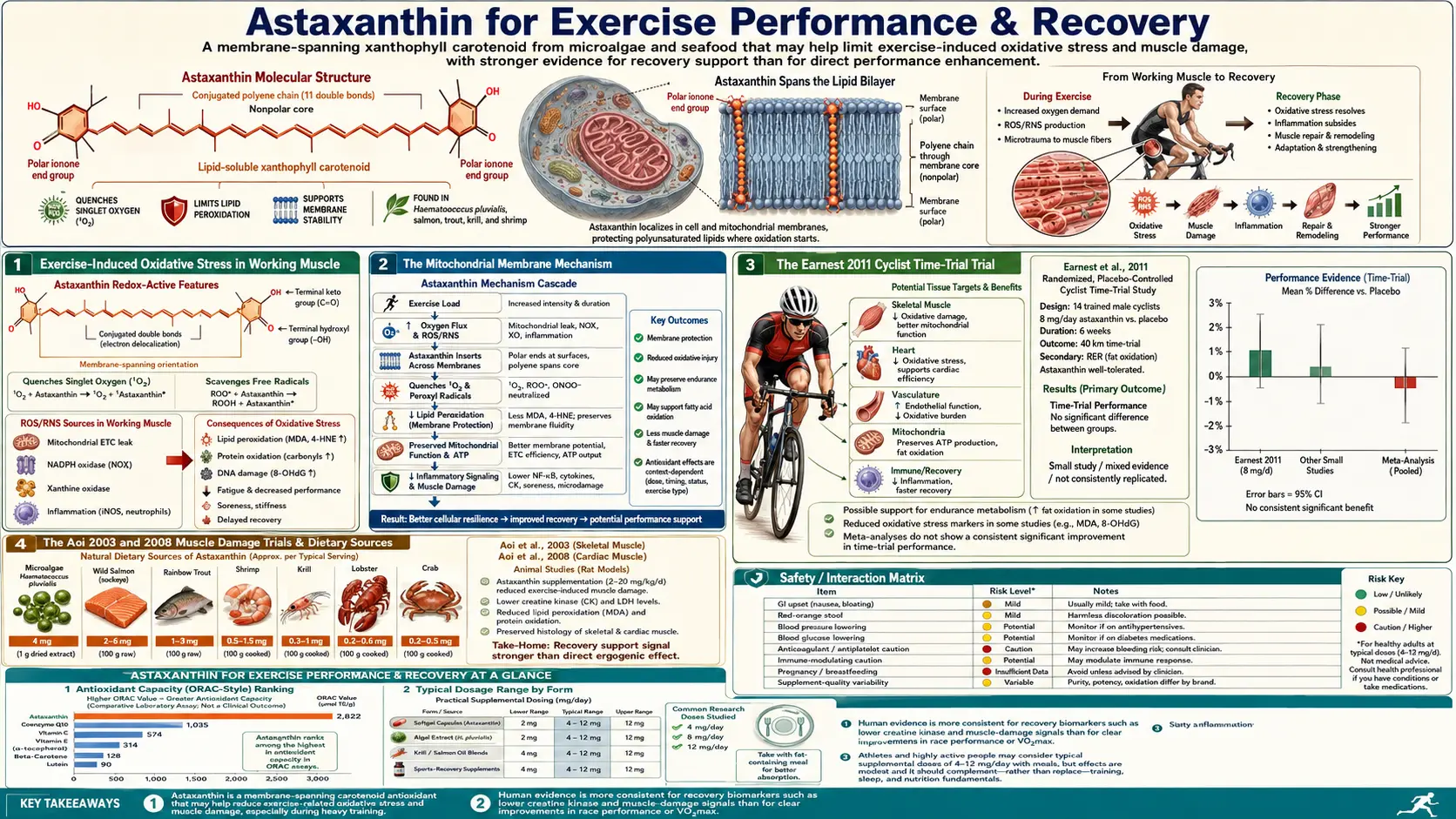
The exercise results for astaxanthin are mixed. In the Earnest 2011 trial, cyclists taking 4 mg/day for 28 days improved a 20 km time trial by 121 seconds, against 19 seconds on placebo, but only 14 of 21 completed the trial and the authors found no change in fat or carbohydrate use. A 2013 trial of 20 mg/day in 32 trained cyclists found no improvement. The Aoi 2003 and 2008 studies often cited for muscle damage and fat burning were in mice, and the Brown 2017 paper is a narrative review that found the human data “equivocal”. A 2026 meta-analysis of 24 trials found lower creatine kinase after exercise but no significant gain in VO2max, time-trial performance or power.
Table of Contents
- Exercise-Induced Oxidative Stress in Working Muscle
- Mitochondria: What the Animal Studies Show
- The Earnest 2011 Cyclist Trial and Later Performance Trials
- The Aoi 2003 and 2008 Studies (Both in Mice)
- Reviews and Meta-Analyses: Brown 2017, Liu 2024, Liu 2026
- Fat Oxidation During Exercise: Mixed Results
- Muscle Damage and Soreness in Human Trials
- Doses Used in Exercise Studies and Intake Limits
- Other Nutrients Studied in Exercise Research
- Antioxidants and Training Adaptation: What the Trials Found
- Safety Findings and Open Questions
- Key Research Papers
- Connections
- Featured Videos
Exercise-Induced Oxidative Stress in Working Muscle
Intense exercise produces oxidative stress in skeletal muscle through several sources:
- Mitochondrial electron leak — oxygen use by working muscle rises many-fold during hard exercise, and a small fraction of electrons passing through the respiratory chain forms superoxide.
- Xanthine oxidase — during brief ischemia and reperfusion in heavily worked muscle, purine breakdown through xanthine oxidase generates superoxide.
- NADPH oxidases — enzymes in the muscle cell membrane produce reactive oxygen species in response to contraction and stretch, as a regulated signal rather than as incidental damage.
- Catecholamine auto-oxidation — the rise in epinephrine and norepinephrine during intense exercise adds a further source.
- Immune-cell infiltration — in the hours after damaging (especially eccentric or unaccustomed) exercise, neutrophils enter muscle and release reactive oxygen species.
Some of this oxidant production acts as a signal for training adaptation, such as the formation of new mitochondria and higher antioxidant enzyme levels. In trials of high-dose vitamin C, alone or with vitamin E, some of these adaptations were reduced (see Antioxidants and Training Adaptation). Whether astaxanthin has the same effect has not been tested directly in a trial found for this page.
Mitochondria: What the Animal Studies Show
The inner mitochondrial membrane holds the electron transport chain and is rich in cardiolipin, a phospholipid with polyunsaturated fatty-acid tails that is vulnerable to oxidation. CoQ10 is one of the electron carriers in this chain. Because astaxanthin sits across lipid membranes in laboratory models, researchers have proposed that it protects mitochondrial membranes in working muscle. The direct evidence comes from animals:
- Rats — 1 mg/kg body weight for 45 days delayed exhaustion in a swimming test by 29%, and raised mitochondrial manganese superoxide dismutase, glutathione peroxidase and glutathione in the soleus muscle (Polotow 2014).
- Mice — astaxanthin increased fat use during treadmill running and prolonged running time to exhaustion, and prevented an exercise-induced oxidative modification of carnitine palmitoyltransferase I (CPT I), the enzyme that moves fatty acids into mitochondria (Aoi 2008).
Measurements of cardiolipin oxidation, membrane potential or respiratory-chain function in the muscle of people taking astaxanthin were not found for this page, so the mitochondrial explanation has not been shown in humans.
The Earnest 2011 Cyclist Trial and Later Performance Trials
Earnest 2011
- Design — 21 competitive cyclists were randomly assigned to 4 mg/day astaxanthin or placebo for 28 days (a parallel-group trial, not a crossover). Testing included a VO2max test and, on a separate day after a 10-hour fast, a 2-hour constant-intensity ride followed by a 20 km time trial.
- Completion — 14 participants completed the trial, 7 in each group.
- Time trial — the astaxanthin group improved by 121 seconds (95% CI −185 to −53) and the placebo group by 19 seconds (95% CI −84 to 45); the difference between groups was significant.
- Power — power output rose by 20 W in the astaxanthin group and 1.6 W in the placebo group.
- Mechanism — there was no treatment effect on carbohydrate or fat oxidation or on blood markers of fuel mobilization; the authors wrote that the mechanism “remains obscure” (Earnest 2011).
The abstract does not report a percentage improvement, a change in power at lactate threshold, heart rate or perceived effort; those figures, previously given on this page, could not be traced to the paper.
Later performance trials
- Res 2013 — 32 well-trained male cyclists or triathletes took 20 mg/day or placebo for 4 weeks. Plasma astaxanthin rose, but antioxidant capacity, malondialdehyde, fat oxidation and time-trial performance did not change compared with placebo (Res 2013).
- Brown 2021 — in a crossover trial in 12 recreationally trained male cyclists, 12 mg/day for 7 days improved 40 km time-trial time by 1.2% (51 seconds) and raised fat oxidation between 39 and 40 km (Brown 2021).
The Aoi 2003 and 2008 Studies (Both in Mice)
Both Aoi studies are often cited as if one of them included people. Neither did.
Aoi W et al. (2003, Antioxidants & Redox Signaling)
Mice received astaxanthin in their diet for 3 weeks of exercise acclimation and then ran on a treadmill until exhaustion. Exercise-induced increases in oxidative markers (4-hydroxy-2-nonenal-modified protein and 8-hydroxy-2'-deoxyguanosine) in the gastrocnemius muscle and the heart were blunted, and the rises in plasma creatine kinase and in myeloperoxidase activity, a marker of neutrophil infiltration, were smaller. Astaxanthin accumulated in both muscle and heart (Aoi 2003).
Aoi W et al. (2008, Biochemical and Biophysical Research Communications)
Mice were treated with astaxanthin for 4 weeks, with or without running exercise. Astaxanthin increased fat use during exercise, prolonged running time to exhaustion, increased the co-location of the fatty-acid transporter with CPT I in muscle, prevented an exercise-induced oxidative modification of CPT I, and sped the loss of body fat with training (Aoi 2008). This page previously described a 2008 human trial in university students at 12 mg/day; no such trial by this group was found.
Reviews and Meta-Analyses: Brown 2017, Liu 2024, Liu 2026
- Brown 2017 — a narrative review, not a meta-analysis. It concluded that the benefits seen in mouse exercise models “have yet to be consistently realized” in exercising humans, with “equivocal data”, in part because of a scarcity of well-controlled trials (Brown 2017).
- Liu 2024 — a meta-analysis of 11 randomized trials in 346 healthy participants. Astaxanthin combined with regular training was associated with greater fat oxidation (SMD 2.56) and better physical performance (SMD 0.62); subgroup analyses showed larger effects for aerobic exercise, doses of 20 mg or more, and durations over 12 weeks (Liu 2024).
- Liu 2026 — a meta-analysis of 24 randomized trials. Astaxanthin lowered creatine kinase (SMD −0.45) and lactate dehydrogenase (SMD −0.93, with substantial heterogeneity) after exercise, but had no significant effect on malondialdehyde, interleukin-6, VO2max, time-trial performance or maximal workload and power (Liu 2026).
The two meta-analyses differ on performance: the 2024 analysis found an improvement when astaxanthin was combined with training, while the larger 2026 analysis found no significant change in time-trial performance, VO2max or power.
Fat Oxidation During Exercise: Mixed Results
Carnitine palmitoyltransferase I (CPT I) controls the entry of fatty acids into mitochondria for burning. The idea that astaxanthin shifts working muscle toward fat comes from the Aoi 2008 mouse study. The human trials do not agree:
- No change — Earnest 2011 (4 mg/day, 28 days), Res 2013 (20 mg/day, 4 weeks) and McAllister 2022 (6 mg/day for 4 weeks in 14 active young men, crossover; blood glutathione rose about 7%, fat oxidation during a graded test did not differ).
- Higher fat oxidation late in a time trial — Brown 2021 (12 mg/day, 7 days; between 39 and 40 km only).
- Pooled — Liu 2024 reported greater fat oxidation when astaxanthin was combined with regular training.
Glycogen sparing, reduced lactate and benefits for low-carbohydrate or ultra-endurance athletes, described on this page earlier, were not measured in any trial found for this page.
Muscle Damage and Soreness in Human Trials
Delayed-onset muscle soreness (DOMS) develops 12 to 72 hours after unaccustomed or eccentric-heavy exercise, and reflects small-scale muscle damage, inflammation and sensitized nerve endings. Creatine kinase (CK) in the blood is the usual marker of muscle damage in these studies.
- Bloomer 2005 — 20 resistance-trained men took an algal extract providing 4 mg/day astaxanthin or placebo for 3 weeks before heavy eccentric exercise and for 96 hours after. Muscle soreness, CK and muscle performance responded the same way in both groups (Bloomer 2005).
- Djordjevic 2012 — 32 elite young soccer players took astaxanthin or placebo for 90 days and then performed a 2-hour exercise bout. Post-exercise CK and aspartate aminotransferase were lower in the astaxanthin group, and superoxide rose after exercise significantly only in the placebo group; lipid and protein oxidation markers did not change (Djordjevic 2012).
- Pooled — the 2026 meta-analysis found lower CK and LDH after exercise with astaxanthin (Liu 2026).
No trial found for this page measured soreness scores as a main result with a positive finding. The earlier statements that smaller trials showed reduced DOMS pain, and that combining astaxanthin with omega-3 fatty acids enhanced the effect, could not be traced to a study and have been removed.
Doses Used in Exercise Studies and Intake Limits
There is no official recommended intake for astaxanthin. The figures below are what the cited trials used, not instructions.
- 4 mg/day for 28 days — 20 km time trial (Earnest 2011)
- 4 mg/day for 3 weeks — muscle injury after eccentric exercise, no effect (Bloomer 2005)
- 6 mg/day for 4 weeks — glutathione and fat oxidation (McAllister 2022)
- 12 mg/day for 7 days — 40 km time trial (Brown 2021)
- 20 mg/day for 4 weeks — fat oxidation and time trial, no effect (Res 2013)
- 90 days — muscle damage markers in soccer players (Djordjevic 2012; the dose is not stated in the abstract)
Intake limits — in 2020 the European Food Safety Authority concluded that 8 mg/day from food supplements, on top of the astaxanthin in the usual diet, is safe for adults, using an acceptable daily intake of 0.2 mg per kg of body weight (EFSA 2020). Several of the exercise trials used more than this.
Regulatory status in the United States — the FDA does not approve dietary supplements before they are marketed, and it has not approved astaxanthin as a supplement. Its FDA listings are as color additives for the feed of salmonid fish: synthetic astaxanthin (21 CFR 73.35), Haematococcus algae meal (21 CFR 73.185) and Phaffia yeast (21 CFR 73.355).
Other Nutrients Studied in Exercise Research
These nutrients have their own exercise research. They are listed for reference; none was tested in combination with astaxanthin in a trial cited on this page.
- CoQ10 / ubiquinol — an electron carrier in the mitochondrial respiratory chain.
- Omega-3 fatty acids (EPA and DHA) — studied for inflammation and muscle recovery; krill oil contains both omega-3 fatty acids and some astaxanthin.
- Vitamin C — a cofactor for collagen synthesis; in trials of 1 g/day, alone or with vitamin E, some training adaptations were reduced (Gomez-Cabrera 2008; Paulsen 2014).
Antioxidants and Training Adaptation: What the Trials Found
Exercise scientists have asked whether antioxidant supplements blunt the adaptations that training produces, since some of the oxidants made during exercise act as signals. The trials that tested this used vitamins C and E:
- Gomez-Cabrera 2008 — in 14 men training for 8 weeks (5 of them given 1 g/day vitamin C) and in rats, vitamin C hampered the gain in endurance capacity and prevented the exercise-induced rise in markers of mitochondrial biogenesis and antioxidant enzymes (Gomez-Cabrera 2008).
- Ristow 2009 — in 39 young men training for 4 weeks, vitamin C 1,000 mg/day plus vitamin E 400 IU/day prevented the improvement in insulin sensitivity that exercise produced without the vitamins (Ristow 2009).
- Paulsen 2014 — in 54 young men and women training for 11 weeks, vitamin C 1,000 mg plus vitamin E 235 mg per day did not change the gains in VO2max or running performance, but the rise in mitochondrial markers in muscle seen with placebo did not occur (Paulsen 2014).
No trial found for this page tested whether astaxanthin blunts training adaptations. Statements made here earlier — that astaxanthin does not blunt adaptation because it stays in mitochondrial membranes, and that timing doses away from training preserves the training signal — are not supported by a study and have been removed. In the 2024 meta-analysis, performance improved when astaxanthin was combined with regular training (Liu 2024).
Safety Findings and Open Questions
- Adverse events in trials — a 2019 review of 87 human studies of natural astaxanthin found none that reported safety concerns (Brendler 2019). The exercise trials cited here lasted 7 days to 90 days.
- Anti-doping — astaxanthin is not a substance on the World Anti-Doping Agency Prohibited List. Multi-ingredient products can contain other ingredients.
- Blood pressure — pooled trials did not show a consistent effect on systolic or diastolic pressure (Xia 2020).
- Blood clotting — in rats, astaxanthin reduced platelet aggregation and prolonged bleeding time (Satti 2021). No clinical trial of astaxanthin with anticoagulant or antiplatelet drugs, including aspirin, was found, so the interaction is unstudied rather than known to be absent.
- Synthetic astaxanthin — it is a different mixture of stereoisomers from the natural form, and few safety studies in humans or animals have used it (Brendler 2019).
- Source of the astaxanthin — commercial astaxanthin comes from the alga Haematococcus pluvialis, from Phaffia yeast, from chemical synthesis, or from crustaceans such as krill (Ambati 2014). No study found for this page examined reactions in people with shellfish allergy.
- Pregnancy — none of the trials cited on this page studied pregnant or breastfeeding women, and EFSA's conclusion is stated for adults without addressing pregnancy.
Key Research Papers
- Earnest CP, Lupo M, White KM, et al. (2011). Effect of astaxanthin on cycling time trial performance. International Journal of Sports Medicine — PubMed PMID: 21984399
- Brown DR, Warner AR, Deb SK, et al. (2021). The effect of astaxanthin supplementation on performance and fat oxidation during a 40 km cycling time trial. Journal of Science and Medicine in Sport — PubMed PMID: 32660833
- Res PT, Cermak NM, Stinkens R, et al. (2013). Astaxanthin supplementation does not augment fat use or improve endurance performance. Medicine and Science in Sports and Exercise — PubMed PMID: 23274592
- McAllister MJ, Mettler JA, Patek K, et al. (2022). Astaxanthin Supplementation Increases Glutathione Concentrations but Does Not Impact Fat Oxidation During Exercise in Active Young Men. International Journal of Sport Nutrition and Exercise Metabolism — PubMed PMID: 34611051
- Bloomer RJ, Fry A, Schilling B, et al. (2005). Astaxanthin supplementation does not attenuate muscle injury following eccentric exercise in resistance-trained men. International Journal of Sport Nutrition and Exercise Metabolism — PubMed PMID: 16286671
- Djordjevic B, Baralic I, Kotur-Stevuljevic J, et al. (2012). Effect of astaxanthin supplementation on muscle damage and oxidative stress markers in elite young soccer players. Journal of Sports Medicine and Physical Fitness — PubMed PMID: 22828460
- Aoi W, Naito Y, Sakuma K, et al. (2003). Astaxanthin limits exercise-induced skeletal and cardiac muscle damage in mice. Antioxidants & Redox Signaling — PubMed PMID: 12626126
- Aoi W, Naito Y, Takanami Y, et al. (2008). Astaxanthin improves muscle lipid metabolism in exercise via inhibitory effect of oxidative CPT I modification. Biochemical and Biophysical Research Communications — PubMed PMID: 18082622
- Polotow TG, Vardaris CV, Mihaliuc AR, et al. (2014). Astaxanthin supplementation delays physical exhaustion and prevents redox imbalances in plasma and soleus muscles of Wistar rats. Nutrients — PubMed PMID: 25514562
- Ikeuchi M, Koyama T, Takahashi J, et al. (2007). Effects of astaxanthin in obese mice fed a high-fat diet. Bioscience, Biotechnology, and Biochemistry — PubMed PMID: 17420580
- Brown DR, Gough LA, Deb SK, et al. (2017). Astaxanthin in Exercise Metabolism, Performance and Recovery: A Review. Frontiers in Nutrition — PubMed PMID: 29404334
- Liu C, Dong X, Jia J, et al. (2024). Effects of Astaxanthin Supplementation on Fatigue, Motor Function and Cognition: A Meta-Analysis of Randomized Controlled Trials. Biological Research for Nursing — PubMed PMID: 38243785
- Liu S, Yao W, Wei Y, et al. (2026). The Effects of Astaxanthin Supplementation on Exercise Recovery Biomarkers and Exercise Performance: A Systematic Review and Meta-Analysis. Nutrients — PubMed PMID: 42197030
- Gomez-Cabrera MC, Domenech E, Romagnoli M, et al. (2008). Oral administration of vitamin C decreases muscle mitochondrial biogenesis and hampers training-induced adaptations in endurance performance. American Journal of Clinical Nutrition — PubMed PMID: 18175748
- Ristow M, Zarse K, Oberbach A, et al. (2009). Antioxidants prevent health-promoting effects of physical exercise in humans. Proceedings of the National Academy of Sciences of the United States of America — PubMed PMID: 19433800
- Paulsen G, Cumming KT, Holden G, et al. (2014). Vitamin C and E supplementation hampers cellular adaptation to endurance training in humans: a double-blind, randomised, controlled trial. Journal of Physiology — PubMed PMID: 24492839
- Brendler T, Williamson EM (2019). Astaxanthin: How much is too much? A safety review. Phytotherapy Research — PubMed PMID: 31788888
- EFSA Panel on Nutrition, Novel Foods and Food Allergens (NDA), Turck D, Castenmiller J, et al. (2020). Safety of astaxanthin for its use as a novel food in food supplements. EFSA Journal — PubMed PMID: 32874213
- Satti HH, Khaleel EF, Badi RM, et al. (2021). Antiplatelet activity of astaxanthin in control- and high cholesterol-fed rats mediated by down-regulation of P2Y12, inhibition of NF-κB, and increasing intracellular levels of cAMP. Platelets — PubMed PMID: 32379559
- Xia W, Tang N, Kord-Varkaneh H, et al. (2020). The effects of astaxanthin supplementation on obesity, blood pressure, CRP, glycemic biomarkers, and lipid profile: A meta-analysis of randomized controlled trials. Pharmacological Research — PubMed PMID: 32755613
- Ambati RR, Phang SM, Ravi S, et al. (2014). Astaxanthin: sources, extraction, stability, biological activities and its commercial applications--a review. Marine Drugs — PubMed PMID: 24402174
PubMed Topic Searches
Connections
- Astaxanthin Overview
- Astaxanthin Benefits Hub
- Astaxanthin for Eye Health
- Astaxanthin for Skin
- Astaxanthin for Cardiovascular
- CoQ10
- Alpha Lipoic Acid for Mitochondria
- Alpha Lipoic Acid Overview
- Glutathione
- NAC
- PQQ
- Vitamin C
- Vitamin E
- Vitamin D3
- Magnesium
- Omega-3 (Krill Oil)
- Salmon
- Oxidative Stress
- Longevity Protocols
- Fatigue
- History