Astaxanthin for Skin Photoprotection & Anti-Aging
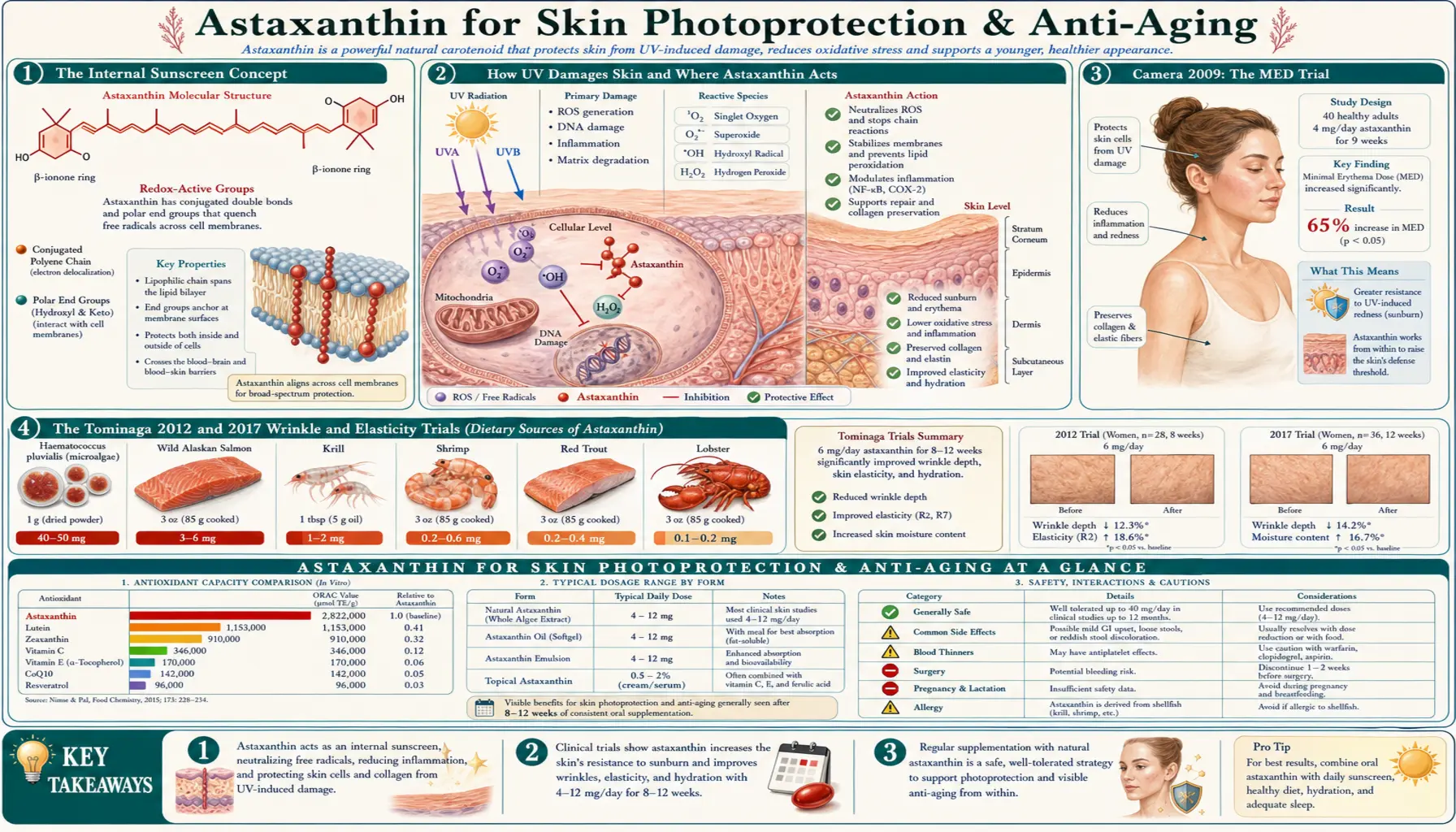
Astaxanthin is sometimes called an “internal sunscreen”, but it does not block UV light. The human trials measured how skin responds: in the Ito 2018 trial, 4 mg/day for 10 weeks raised the UV dose needed to redden the skin compared with placebo, and a 2021 meta-analysis of eleven studies found improved skin moisture and elasticity but no significant reduction in wrinkle depth (Zhou 2021). Camera 2009, often cited as a UV trial in people, was a cell-culture study. The trials are small, mostly Japanese, and several were run by authors working for astaxanthin manufacturers.
Table of Contents
- The “Internal Sunscreen” Idea
- How UV Damages Skin: What the Laboratory Studies Show
- The Ito 2018 UV Trial and the Camera 2009 Cell Study
- The Tominaga 2012 and 2017 Studies and Other Skin Trials
- Reviews: Davinelli 2018 and the Zhou 2021 Meta-Analysis
- Topical Astaxanthin: What Has Been Studied
- Eczema, Acne, Seborrheic Dermatitis, Psoriasis and Rosacea
- Hyperpigmentation and Age Spots
- Doses Used in Skin Studies and Intake Limits
- Other Nutrients Studied in Skin Research
- Safety Findings and Open Questions
- Key Research Papers
- Connections
- Featured Videos
The “Internal Sunscreen” Idea
Topical sunscreens work by absorbing or reflecting UV light before it reaches living skin cells. “Internal sunscreen” is an informal label for compounds taken by mouth that reach the skin through the bloodstream and are studied for their effect on the damage UV causes once it has entered the skin. They do not absorb UV the way a sunscreen filter does.
Astaxanthin is one of several compounds studied this way. The human trials on this page measured skin responses such as the minimal erythema dose, moisture, elasticity and wrinkles. None tested astaxanthin as a substitute for sunscreen.
How UV Damages Skin: What the Laboratory Studies Show
UV radiation damages skin through several pathways:
- Direct DNA damage — UV-B (280-320 nm) is absorbed directly by DNA bases, producing cyclobutane pyrimidine dimers and 6-4 photoproducts, which can cause mutations if not repaired.
- Singlet oxygen and other reactive oxygen species — UV-A (320-400 nm) is absorbed by light-sensitive molecules in skin that pass the energy to oxygen, generating singlet oxygen (¹O&sub2;), which attacks membrane lipids, proteins and DNA.
- Inflammation — UV-damaged cells release signals such as IL-1α that recruit immune cells, which produce further reactive oxygen species.
- Matrix metalloproteinase (MMP) activation — UV-triggered signaling raises MMP-1 and related enzymes that break down dermal collagen, a main mechanism of photoaging.
- Pigment changes — UV stimulates melanin production, and uneven pigment can develop into age spots.
What the laboratory studies of astaxanthin report:
- Singlet oxygen — in a solvent-based test-tube assay, astaxanthin quenched singlet oxygen faster than the other compounds tested (rate constants in 109 per molar per second: astaxanthin 5.4, beta-carotene 1.1, vitamin E 0.049, vitamin C 0.00089; Nishida 2023). This is the source of the “6,000 times vitamin C” figure; it is a reaction speed in a test tube, not a measure of effect in skin.
- UVA damage in human skin cells — in cultured human dermal fibroblasts, astaxanthin counteracted UVA-induced cell death, reactive oxygen species, lipid peroxidation and loss of antioxidant enzymes, while beta-carotene only partly prevented these changes (Camera 2009). In cultured fibroblasts, astaxanthin added after UVA exposure reduced the rise in MMP-1 and skin fibroblast elastase (Suganuma 2010). An algal extract containing astaxanthin, and synthetic astaxanthin, protected cultured skin cells against UVA-induced DNA damage (Lyons 2002).
- Animal skin — in hairless mice exposed to UVA for 70 days, dietary astaxanthin suppressed the rise in water loss through the skin and wrinkle formation (Komatsu 2017).
These are cell and animal results. Astaxanthin does not absorb UV-B in the way a sunscreen does, so these studies do not show prevention of direct UV-B DNA damage.
The Ito 2018 UV Trial and the Camera 2009 Cell Study
The minimal erythema dose (MED) is the smallest UV dose that produces just-visible reddening of the skin, read about a day after exposure. A higher MED means more UV is needed to redden the skin. SPF testing of topical sunscreens is based on the same measurement.
Ito 2018 — 23 healthy Japanese adults were randomized to a capsule containing 4 mg of astaxanthin or placebo for 10 weeks. MED and UV-induced changes in moisture and transepidermal water loss were measured at baseline and after 9 weeks. The astaxanthin group showed a higher MED than the placebo group and less loss of skin moisture in the irradiated area, and reported improvements in “rough skin” and “texture” in non-irradiated areas (Ito 2018). The authors were employees of the sponsoring company. The abstract does not give the size of the MED change as a percentage.
Camera 2009 — this study is often described as an MED trial in people, with a 15-20% rise in MED after 4 mg/day for 4 weeks. It was not: Camera and colleagues exposed cultured human dermal fibroblasts to UVA in the laboratory and compared astaxanthin, canthaxanthin and beta-carotene (Camera 2009). No volunteers, MED measurements or skin biopsies were involved.
The Tominaga 2012 and 2017 Studies and Other Skin Trials
The Tominaga studies were carried out by authors including researchers at an astaxanthin manufacturer.
Tominaga K et al. (2012, Acta Biochimica Polonica)
The paper reports two studies (Tominaga 2012):
- Open-label study, 30 healthy women, 8 weeks — 6 mg/day oral astaxanthin from Haematococcus pluvialis combined with 2 ml/day of a topical astaxanthin solution, with no control group. Improvements were reported in crow's-feet wrinkles, age-spot size, elasticity, skin texture, moisture of the outer skin layer (in 10 subjects with dry skin) and corneocyte condition. Because oral and topical astaxanthin were given together without a control group, the contribution of each cannot be separated.
- Randomized, double-blind, placebo-controlled study, 36 healthy men, 6 weeks — 6 mg/day oral astaxanthin. Crow's-feet wrinkles, elasticity and transepidermal water loss improved; moisture and sebum showed “strong tendencies” toward improvement.
Tominaga K et al. (2017, Journal of Clinical Biochemistry and Nutrition)
Alongside cell experiments, 65 healthy women took 6 mg or 12 mg/day of oral astaxanthin or placebo for 16 weeks, from August to December in Japan. Wrinkle measures and skin moisture worsened significantly in the placebo group, while the astaxanthin groups showed no significant change. Interleukin-1α in the outer skin layer rose in the placebo and 6 mg groups but not in the 12 mg group (Tominaga 2017). The finding is a smaller seasonal decline, not an improvement from baseline. No topical product was used.
Yoon 2014
44 healthy adults with moderately photoaged skin took 2 mg/day astaxanthin combined with 3 g/day collagen hydrolysate, or placebo, for 12 weeks. Facial elasticity and transepidermal water loss improved compared with placebo, procollagen type I expression rose and MMP-1 and MMP-12 expression fell; UV-induced DNA damage did not differ between groups (Yoon 2014). Because two ingredients were given together, the effect of astaxanthin alone cannot be separated.
Reviews: Davinelli 2018 and the Zhou 2021 Meta-Analysis
Zhou 2021 — a systematic review and meta-analysis found eleven studies (nine randomized controlled trials of oral astaxanthin and two open-label studies). Pooled, oral astaxanthin improved skin moisture (standardized mean difference 0.53) and elasticity (0.77) compared with placebo, but the reduction in wrinkle depth (−0.26) was not statistically significant (Zhou 2021).
Davinelli 2018 — often cited as a systematic review pooling eleven trials, it is a narrative review of astaxanthin and skin. It describes the proposed photoprotective, antioxidant and anti-inflammatory mechanisms as “still debated” (Davinelli 2018).
The limits of the evidence are visible in the trials themselves: small samples (23 to 65 people), durations of 6 to 16 weeks, mainly Japanese participants, and several studies run or funded by astaxanthin manufacturers.
Topical Astaxanthin: What Has Been Studied
Astaxanthin dissolves poorly in water, which makes it hard to apply to skin. In hairless mice, a liposomal astaxanthin preparation applied before UV exposure prevented UV-induced skin thickening and collagen loss, and a version containing a cationic lipid reduced melanin production (Hama 2012).
In people, the only topical use found for this page is the open-label part of Tominaga 2012, in which a topical astaxanthin solution was used together with oral astaxanthin and without a control group. No controlled trial of a topical astaxanthin product alone, and no trial comparing particular concentrations, was found. Claims that 1-2% serums, or combined oral and topical use, give better results than either alone are not supported by the studies cited here.
Eczema, Acne, Seborrheic Dermatitis, Psoriasis and Rosacea
Astaxanthin's anti-inflammatory activity in laboratory studies has led to interest in chronic inflammatory skin conditions. No randomized clinical trial of oral astaxanthin was found for this page in eczema (atopic dermatitis), acne, seborrheic dermatitis, psoriasis or rosacea. Statements about reduced flares, fewer acne lesions or benefit in seborrheic dermatitis, and the doses attached to them, could not be traced to a published study and have been removed. The PubMed searches below show the current literature.
Hyperpigmentation and Age Spots
Solar lentigines (age spots) and melasma are areas of increased skin pigment, driven mainly by long-term sun exposure (lentigines) or hormonal influences (melasma).
- In people — the open-label, uncontrolled part of Tominaga 2012 reported smaller age spots on the cheek after 8 weeks of combined oral and topical astaxanthin. No randomized trial of astaxanthin for hyperpigmentation was found; a “clinical study” of topical astaxanthin for hyperpigmentation listed on this page earlier could not be found in PubMed.
- In animals — in a rat model of UV and chemically induced skin cancer, astaxanthin and its esters normalized raised tyrosinase activity, the enzyme that makes melanin (Rao 2013); in hairless mice, a topical liposomal preparation reduced melanin production after UV exposure (Hama 2012).
Comparisons with hydroquinone or other pigment treatments have not been tested in a trial found for this page.
Doses Used in Skin Studies and Intake Limits
There is no official recommended intake for astaxanthin. The figures below are what the cited studies used, not instructions.
- 4 mg/day for 10 weeks — MED and skin moisture (Ito 2018)
- 6 mg/day for 6-8 weeks — with a topical solution in the open-label study, and alone in the placebo-controlled study (Tominaga 2012)
- 6 or 12 mg/day for 16 weeks — wrinkles, moisture and IL-1α (Tominaga 2017)
- 2 mg/day with 3 g collagen hydrolysate for 12 weeks — elasticity and water loss (Yoon 2014)
Intake limits — in 2020 the European Food Safety Authority concluded that 8 mg/day from food supplements, on top of the astaxanthin in the usual diet, is safe for adults, using an acceptable daily intake of 0.2 mg per kg of body weight (EFSA 2020).
Regulatory status in the United States — the FDA does not approve dietary supplements before they are marketed, and it has not approved astaxanthin as a supplement. Its FDA listings are as color additives for the feed of salmonid fish: synthetic astaxanthin (21 CFR 73.35), Haematococcus algae meal (21 CFR 73.185) and Phaffia yeast (21 CFR 73.355).
Other Nutrients Studied in Skin Research
Several other nutrients have their own skin research; they are listed here for reference, not as combinations tested with astaxanthin. Apart from the collagen hydrolysate in Yoon 2014, no combination below was tested together with astaxanthin in a trial cited on this page.
- Vitamin C — a required cofactor for the enzymes that stabilize collagen, and a water-soluble antioxidant.
- Vitamin E — a fat-soluble antioxidant found in cell membranes and skin surface lipids.
- Omega-3 fatty acids — studied for skin barrier lipids and inflammation.
- Zinc — a cofactor in wound healing and many skin enzymes, and studied in acne.
Safety Findings and Open Questions
- Adverse events in trials — a 2019 review of 87 human studies of natural astaxanthin found none that reported safety concerns (Brendler 2019). The skin trials cited here lasted 6 to 16 weeks.
- Not a sunscreen — astaxanthin does not absorb UV the way sunscreen filters do, and no trial has compared it with sunscreen or tested it as a replacement.
- Source of the astaxanthin — commercial astaxanthin comes from the alga Haematococcus pluvialis, from Phaffia yeast, from chemical synthesis, or from crustaceans such as krill (Ambati 2014). No study found for this page examined reactions to algal astaxanthin in people with shellfish allergy.
- Synthetic astaxanthin — it is a different mixture of stereoisomers from the natural form, and few safety studies in humans or animals have used it (Brendler 2019).
- Pregnancy and breastfeeding — none of the trials cited on this page studied pregnant or breastfeeding women, and EFSA's conclusion is stated for adults without addressing pregnancy.
- Blood clotting — in rats, astaxanthin reduced platelet aggregation and prolonged bleeding time (Satti 2021). No clinical trial of astaxanthin with anticoagulant or antiplatelet drugs was found, so the interaction is unstudied rather than known to be absent.
- Blood pressure — pooled trials did not show a consistent effect on systolic or diastolic pressure (Xia 2020).
Key Research Papers
- Ito N, Seki S, Ueda F (2018). The Protective Role of Astaxanthin for UV-Induced Skin Deterioration in Healthy People-A Randomized, Double-Blind, Placebo-Controlled Trial. Nutrients — PubMed PMID: 29941810
- Camera E, Mastrofrancesco A, Fabbri C, et al. (2009). Astaxanthin, canthaxanthin and beta-carotene differently affect UVA-induced oxidative damage and expression of oxidative stress-responsive enzymes. Experimental Dermatology — PubMed PMID: 18803658
- Tominaga K, Hongo N, Karato M, et al. (2012). Cosmetic benefits of astaxanthin on humans subjects. Acta Biochimica Polonica — PubMed PMID: 22428137
- Tominaga K, Hongo N, Fujishita M, et al. (2017). Protective effects of astaxanthin on skin deterioration. Journal of Clinical Biochemistry and Nutrition — PubMed PMID: 28751807
- Yoon HS, Cho HH, Cho S, et al. (2014). Supplementating with dietary astaxanthin combined with collagen hydrolysate improves facial elasticity and decreases matrix metalloproteinase-1 and -12 expression: a comparative study with placebo. Journal of Medicinal Food — PubMed PMID: 24955642
- Zhou X, Cao Q, Orfila C, et al. (2021). Systematic Review and Meta-Analysis on the Effects of Astaxanthin on Human Skin Ageing. Nutrients — PubMed PMID: 34578794
- Davinelli S, Nielsen ME, Scapagnini G (2018). Astaxanthin in Skin Health, Repair, and Disease: A Comprehensive Review. Nutrients — PubMed PMID: 29690549
- Suganuma K, Nakajima H, Ohtsuki M, et al. (2010). Astaxanthin attenuates the UVA-induced up-regulation of matrix-metalloproteinase-1 and skin fibroblast elastase in human dermal fibroblasts. Journal of Dermatological Science — PubMed PMID: 20219323
- Lyons NM, O'Brien NM (2002). Modulatory effects of an algal extract containing astaxanthin on UVA-irradiated cells in culture. Journal of Dermatological Science — PubMed PMID: 12354422
- Komatsu T, Sasaki S, Manabe Y, et al. (2017). Preventive effect of dietary astaxanthin on UVA-induced skin photoaging in hairless mice. PLoS One — PubMed PMID: 28170435
- Hama S, Takahashi K, Inai Y, et al. (2012). Protective effects of topical application of a poorly soluble antioxidant astaxanthin liposomal formulation on ultraviolet-induced skin damage. Journal of Pharmaceutical Sciences — PubMed PMID: 22628205
- Rao AR, Sindhuja HN, Dharmesh SM, et al. (2013). Effective inhibition of skin cancer, tyrosinase, and antioxidative properties by astaxanthin and astaxanthin esters from the green alga Haematococcus pluvialis. Journal of Agricultural and Food Chemistry — PubMed PMID: 23473626
- Shimidzu N, Goto M, Miki W (1996). Carotenoids as Singlet Oxygen Quenchers in Marine Organisms. Fisheries Science 62(1):134–137 — doi:10.2331/fishsci.62.134
- Nishida Y, Berg PC, Shakersain B, et al. (2023). Astaxanthin: Past, Present, and Future. Marine Drugs — PubMed PMID: 37888449
- Ambati RR, Phang SM, Ravi S, et al. (2014). Astaxanthin: sources, extraction, stability, biological activities and its commercial applications--a review. Marine Drugs — PubMed PMID: 24402174
- Brendler T, Williamson EM (2019). Astaxanthin: How much is too much? A safety review. Phytotherapy Research — PubMed PMID: 31788888
- EFSA Panel on Nutrition, Novel Foods and Food Allergens (NDA), Turck D, Castenmiller J, et al. (2020). Safety of astaxanthin for its use as a novel food in food supplements. EFSA Journal — PubMed PMID: 32874213
- Satti HH, Khaleel EF, Badi RM, et al. (2021). Antiplatelet activity of astaxanthin in control- and high cholesterol-fed rats mediated by down-regulation of P2Y12, inhibition of NF-κB, and increasing intracellular levels of cAMP. Platelets — PubMed PMID: 32379559
- Xia W, Tang N, Kord-Varkaneh H, et al. (2020). The effects of astaxanthin supplementation on obesity, blood pressure, CRP, glycemic biomarkers, and lipid profile: A meta-analysis of randomized controlled trials. Pharmacological Research — PubMed PMID: 32755613
PubMed Topic Searches
Connections
- Astaxanthin Overview
- Astaxanthin Benefits Hub
- Astaxanthin for Eye Health
- Astaxanthin for Exercise
- Astaxanthin for Cardiovascular
- CoQ10
- Glutathione
- NAC
- Vitamin C
- Vitamin E
- Vitamin A (Carotenoids)
- Vitamin D3
- Zinc
- Omega-3 Fatty Acids
- Dermatology
- Acne
- Eczema
- Psoriasis
- Rosacea
- Oxidative Stress
- Longevity Protocols
- History