Astaxanthin — Benefits Deep Dive
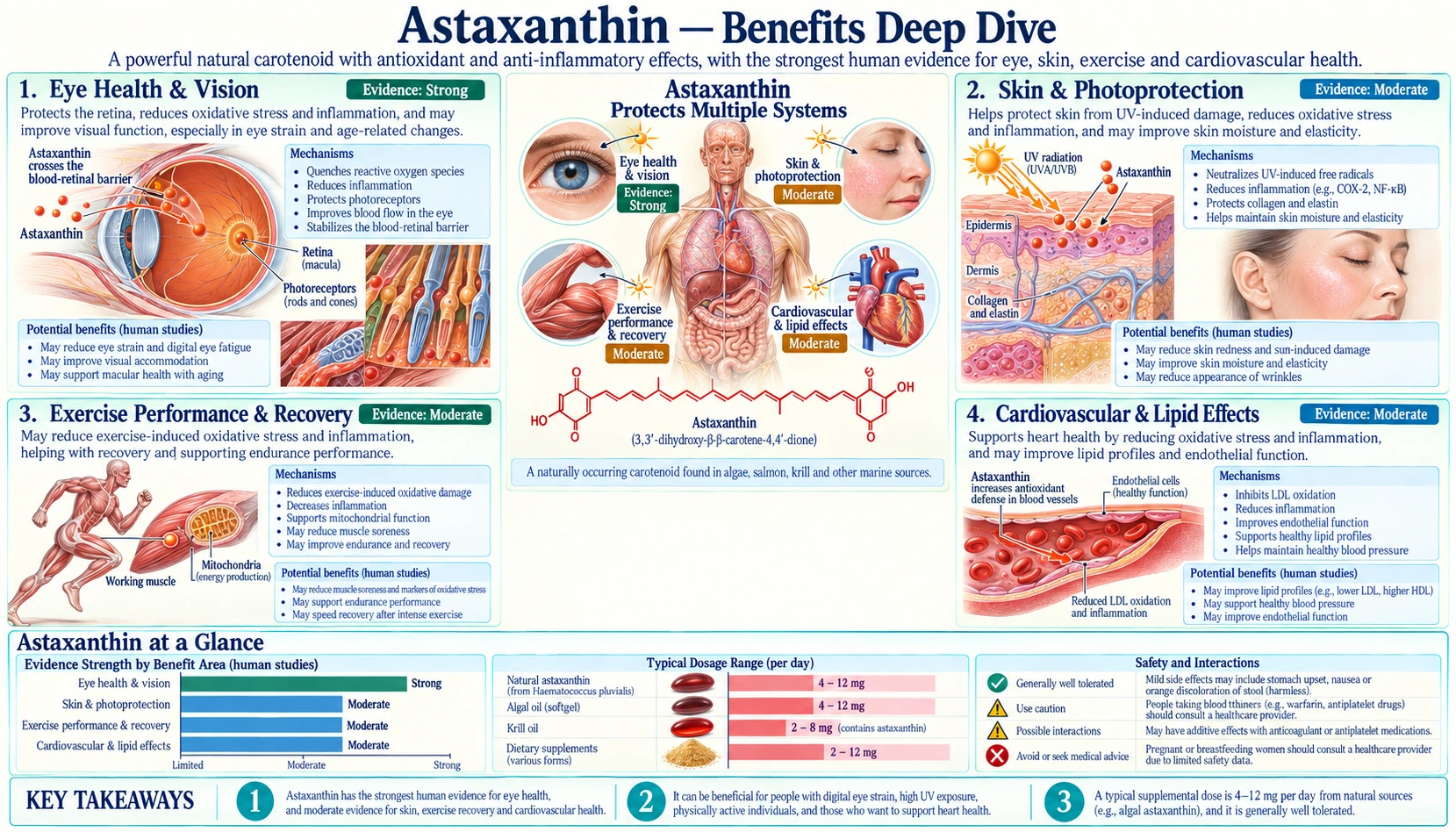
Astaxanthin has been tested for the eyes, the skin, exercise, and the heart and blood lipids. Most of the human trials are small and short, and the meta-analyses do not all agree: they report improvements in skin moisture and elasticity, mixed results for exercise and for blood lipids, and no clear effect on blood pressure. The widely repeated “6,000 times vitamin C” figure comes from one test-tube assay of how fast compounds quench singlet oxygen in a solvent, not from studies in people. Each page below covers one area in detail.
Deep-Dive Articles
Eye Health & Vision
What the small human trials measured: the Sekikawa 2023 screen-work trial (corrected visual acuity preserved in participants aged 40 and over on 9 mg/day), the seven-ingredient CARMIS combination study in macular degeneration (Parisi 2008), and the Hashimoto 2013 cataract-surgery study, which measured antioxidant activity in the fluid at the front of the eye rather than in the retina. The earlier Japanese eye-strain trials (Nagaki 2002, Iwasaki 2006, Nakamura 2004) appeared in journals not indexed in PubMed.
Read the deep dive →Skin & Photoprotection
Astaxanthin does not block UV. In the Ito 2018 trial, 4 mg/day for 10 weeks raised the UV dose needed to redden the skin; Camera 2009, often cited as a UV trial, was a cell-culture study. Also covers the Tominaga 2012 and 2017 studies and the Zhou 2021 meta-analysis of eleven studies, which found better skin moisture and elasticity but no significant change in wrinkle depth.
Read the deep dive →Exercise Performance & Recovery
The Earnest 2011 cyclist trial (20 km time trial 121 seconds faster after 4 mg/day for 28 days, against 19 seconds on placebo; 14 of 21 cyclists completed it), the Brown 2021 crossover trial, the Aoi 2003 and 2008 studies (both in mice), the Brown 2017 narrative review, and two meta-analyses that differ on performance (Liu 2024; Liu 2026).
Read the deep dive →Cardiovascular & Lipid Effects
The Yoshida 2010 trial (over 12 weeks, triglycerides fell at 12 and 18 mg/day and HDL cholesterol rose at 6 and 12 mg/day; the abstract gives no percentages) and three meta-analyses: no significant lipid effect (Ursoniu 2015), no blood-pressure effect and a small HDL rise (Xia 2020), and marginal effects in adults at risk of metabolic syndrome (Leung 2022), with context on lipid tests such as ApoB.
Read the deep dive →Table of Contents
- Deep-Dive Articles
- Why Astaxanthin Is Studied in So Many Tissues
- Research Papers: Eye Health & Vision
- Research Papers: Skin & Photoprotection
- Research Papers: Exercise Performance & Recovery
- Research Papers: Cardiovascular & Lipid Effects
- Research Papers: Chemistry, Forms, Safety and Other Uses
- External Authoritative Resources
- Connections
- Featured Videos
Why Astaxanthin Is Studied in So Many Tissues
Astaxanthin's chemistry gives researchers several reasons to test it in different tissues. The points below are laboratory and animal findings: they explain why the human trials were run, not what those trials found. The trial results are on the four deep-dive pages.
- Position in the cell membrane — its polar end rings sit near the membrane surfaces while its long carbon chain lies inside. In a liposome study it was about twice as effective as beta-carotene at limiting iron-induced lipid peroxidation, and the authors attributed this to radical trapping both at the surface and inside the membrane (Goto 2001). In a model membrane rich in polyunsaturated fats it lowered lipid hydroperoxides by 40%, while beta-carotene and lycopene raised them by more than 85% (McNulty 2007). This is why it is studied in tissues with membranes rich in polyunsaturated fats, such as the retina, working muscle, sperm and skin.
- Reaching the brain and the eye — in rats it was detected in the hippocampus and cerebral cortex after a single oral dose (Manabe 2018). In people, a study of patients having cataract surgery measured higher antioxidant activity in the fluid at the front of the eye after 6 mg/day for 2 weeks (Hashimoto 2013); that is not a measurement of the retina. The often-repeated claim that astaxanthin is the only carotenoid to cross both the blood-brain and the blood-retinal barrier was not supported by any study found for these pages. See eye health.
- The pro-oxidant question — in the ATBC and CARET trials in smokers, beta-carotene supplements were followed by more lung cancer (18% higher incidence in ATBC; relative risk 1.28 in CARET). In membrane and skin-cell experiments, astaxanthin did not show the pro-oxidant effect that beta-carotene did (McNulty 2007; Camera 2009). No long-term outcome trial comparable to ATBC or CARET has tested astaxanthin, so whether that laboratory difference holds in people is not known.
- Singlet-oxygen quenching — the “6,000 times vitamin C” figure comes from a 2007 chemiluminescence assay of quenching speed in a laboratory solvent. A 2023 review tabulates that assay's rate constants (in 109 per molar per second): astaxanthin 5.4, beta-carotene 1.1, vitamin E 0.049 and vitamin C 0.00089 (Nishida 2023). The often-quoted 550-fold (vitamin E) and 11-fold (beta-carotene) multiples are not supported by that table. These are reaction speeds in a test tube; they do not show how much reaches a tissue or whether anything changes clinically. Singlet oxygen is relevant to light-exposed tissues such as the skin.
Laboratory and animal studies also describe effects on inflammatory signaling, such as reduced NF-κB activity in the platelets of rats (Satti 2021). In people, the pooled trials report a small rise in HDL cholesterol and lower CRP only in longer or higher-dose trials, with no clear effect on blood pressure (Xia 2020). The findings for each area are on the cardiovascular, eye, skin and exercise pages; fertility and cognition trials are summarized on the main Astaxanthin page.
Research Papers: Eye Health & Vision
- Sekikawa T, Kizawa Y, Li Y, et al. (2023). Effects of diet containing astaxanthin on visual function in healthy individuals: a randomized, double-blind, placebo-controlled, parallel study. Journal of Clinical Biochemistry and Nutrition — PubMed PMID: 36777084
- Kizawa Y, Sekikawa T, Kageyama M, et al. (2021). Effects of anthocyanin, astaxanthin, and lutein on eye functions: a randomized, double-blind, placebo-controlled study. Journal of Clinical Biochemistry and Nutrition — PubMed PMID: 34376917
- Parisi V, Tedeschi M, Gallinaro G, et al. (2008). Carotenoids and antioxidants in age-related maculopathy italian study: multifocal electroretinogram modifications after 1 year. Ophthalmology — PubMed PMID: 17716735
- Hashimoto H, Arai K, Hayashi S, et al. (2013). Effects of astaxanthin on antioxidation in human aqueous humor. Journal of Clinical Biochemistry and Nutrition — PubMed PMID: 23874063
- Giannaccare G, Pellegrini M, Senni C, et al. (2020). Clinical Applications of Astaxanthin in the Treatment of Ocular Diseases: Emerging Insights. Marine Drugs — PubMed PMID: 32370045
The Japanese eye-strain and accommodation trials often cited for astaxanthin (Nagaki 2002, Iwasaki 2006, Nakamura 2004) were published in Japanese-language journals not indexed in PubMed, and could not be checked for these pages. A “Hashimoto 2018 blue-light trial” listed here previously could not be found; the Hashimoto studies in PubMed measured the aqueous humor of cataract-surgery patients.
PubMed Topic Searches
- Astaxanthin and diabetic retinopathy — PubMed: astaxanthin diabetic retinopathy
- Astaxanthin and dry eye — PubMed: astaxanthin dry eye
- Astaxanthin and the blood-retinal barrier — PubMed: astaxanthin blood-retinal barrier
- Astaxanthin, glaucoma and intraocular pressure — PubMed: astaxanthin glaucoma
- Astaxanthin and choroidal blood flow — PubMed: astaxanthin choroidal blood flow
Research Papers: Skin & Photoprotection
- Ito N, Seki S, Ueda F (2018). The Protective Role of Astaxanthin for UV-Induced Skin Deterioration in Healthy People-A Randomized, Double-Blind, Placebo-Controlled Trial. Nutrients — PubMed PMID: 29941810
- Camera E, Mastrofrancesco A, Fabbri C, et al. (2009). Astaxanthin, canthaxanthin and beta-carotene differently affect UVA-induced oxidative damage and expression of oxidative stress-responsive enzymes. Experimental Dermatology — PubMed PMID: 18803658
- Tominaga K, Hongo N, Karato M, et al. (2012). Cosmetic benefits of astaxanthin on humans subjects. Acta Biochimica Polonica — PubMed PMID: 22428137
- Tominaga K, Hongo N, Fujishita M, et al. (2017). Protective effects of astaxanthin on skin deterioration. Journal of Clinical Biochemistry and Nutrition — PubMed PMID: 28751807
- Zhou X, Cao Q, Orfila C, et al. (2021). Systematic Review and Meta-Analysis on the Effects of Astaxanthin on Human Skin Ageing. Nutrients — PubMed PMID: 34578794
- Davinelli S, Nielsen ME, Scapagnini G (2018). Astaxanthin in Skin Health, Repair, and Disease: A Comprehensive Review. Nutrients — PubMed PMID: 29690549
Camera 2009 was a cell-culture study in human dermal fibroblasts; the trial that measured the minimal erythema dose in people is Ito 2018. Davinelli 2018 is a narrative review; the systematic review and meta-analysis of eleven studies is Zhou 2021.
PubMed Topic Searches
- Astaxanthin, singlet oxygen and skin — PubMed: astaxanthin singlet oxygen skin
- Astaxanthin and neutrophil oxidative burst — PubMed: astaxanthin neutrophil burst
- Astaxanthin and atopic dermatitis or eczema — PubMed: astaxanthin atopic dermatitis
- Astaxanthin, seborrheic dermatitis and acne — PubMed: astaxanthin acne seborrheic
- Astaxanthin, hyperpigmentation and age spots — PubMed: astaxanthin hyperpigmentation
- Topical astaxanthin and photoaging — PubMed: topical astaxanthin photoaging
Research Papers: Exercise Performance & Recovery
- Earnest CP, Lupo M, White KM, et al. (2011). Effect of astaxanthin on cycling time trial performance. International Journal of Sports Medicine — PubMed PMID: 21984399
- Brown DR, Warner AR, Deb SK, et al. (2021). The effect of astaxanthin supplementation on performance and fat oxidation during a 40 km cycling time trial. Journal of Science and Medicine in Sport — PubMed PMID: 32660833
- Aoi W, Naito Y, Sakuma K, et al. (2003). Astaxanthin limits exercise-induced skeletal and cardiac muscle damage in mice. Antioxidants & Redox Signaling — PubMed PMID: 12626126
- Aoi W, Naito Y, Takanami Y, et al. (2008). Astaxanthin improves muscle lipid metabolism in exercise via inhibitory effect of oxidative CPT I modification. Biochemical and Biophysical Research Communications — PubMed PMID: 18082622
- Brown DR, Gough LA, Deb SK, et al. (2017). Astaxanthin in Exercise Metabolism, Performance and Recovery: A Review. Frontiers in Nutrition — PubMed PMID: 29404334
- Liu C, Dong X, Jia J, et al. (2024). Effects of Astaxanthin Supplementation on Fatigue, Motor Function and Cognition: A Meta-Analysis of Randomized Controlled Trials. Biological Research for Nursing — PubMed PMID: 38243785
- Liu S, Yao W, Wei Y, et al. (2026). The Effects of Astaxanthin Supplementation on Exercise Recovery Biomarkers and Exercise Performance: A Systematic Review and Meta-Analysis. Nutrients — PubMed PMID: 42197030
Both Aoi studies (2003 and 2008) were in mice. Brown 2017 is a narrative review, not a meta-analysis.
PubMed Topic Searches
- Astaxanthin, exercise and lipid peroxidation — PubMed: astaxanthin lipid peroxidation muscle
- Astaxanthin and muscle mitochondria — PubMed: astaxanthin mitochondrial membrane
- Astaxanthin and delayed-onset muscle soreness (DOMS) — PubMed: astaxanthin DOMS
- Astaxanthin and fat oxidation during exercise — PubMed: astaxanthin FAO CPT1 exercise
- Astaxanthin, creatine kinase and LDH after exercise — PubMed: astaxanthin CK LDH
- Astaxanthin and time to exhaustion — PubMed: astaxanthin endurance
Research Papers: Cardiovascular & Lipid Effects
- Yoshida H, Yanai H, Ito K, et al. (2010). Administration of natural astaxanthin increases serum HDL-cholesterol and adiponectin in subjects with mild hyperlipidemia. Atherosclerosis — PubMed PMID: 19892350
- Ursoniu S, Sahebkar A, Serban MC, et al. (2015). Lipid profile and glucose changes after supplementation with astaxanthin: a systematic review and meta-analysis of randomized controlled trials. Archives of Medical Science — PubMed PMID: 25995739
- Xia W, Tang N, Kord-Varkaneh H, et al. (2020). The effects of astaxanthin supplementation on obesity, blood pressure, CRP, glycemic biomarkers, and lipid profile: A meta-analysis of randomized controlled trials. Pharmacological Research — PubMed PMID: 32755613
- Leung LY, Chan SM, Tam HL, et al. (2022). Astaxanthin Influence on Health Outcomes of Adults at Risk of Metabolic Syndrome: A Systematic Review and Meta-Analysis. Nutrients — PubMed PMID: 35631193
- Satti HH, Khaleel EF, Badi RM, et al. (2021). Antiplatelet activity of astaxanthin in control- and high cholesterol-fed rats mediated by down-regulation of P2Y12, inhibition of NF-κB, and increasing intracellular levels of cAMP. Platelets — PubMed PMID: 32379559
Satti 2021 is a study in rats.
PubMed Topic Searches
- Astaxanthin and oxidized LDL — PubMed: astaxanthin oxidized LDL
- Astaxanthin and blood pressure (meta-analyses) — PubMed: astaxanthin blood pressure
- Astaxanthin, endothelial function and flow-mediated dilation — PubMed: astaxanthin endothelial FMD
- Astaxanthin and high-sensitivity CRP — PubMed: astaxanthin hs-CRP
- Krill oil, astaxanthin and blood lipids — PubMed: krill oil astaxanthin cardiovascular
- Astaxanthin and PPARα signaling — PubMed: astaxanthin PPAR alpha
- Astaxanthin and ApoB — PubMed: astaxanthin ApoB
- Astaxanthin and arterial stiffness — PubMed: astaxanthin arterial stiffness
- Astaxanthin and platelet aggregation — PubMed: astaxanthin platelet
Research Papers: Chemistry, Forms, Safety and Other Uses
- Shimidzu N, Goto M, Miki W (1996). Carotenoids as Singlet Oxygen Quenchers in Marine Organisms. Fisheries Science 62(1):134–137 — doi:10.2331/fishsci.62.134
- Nishida Y, Berg PC, Shakersain B, et al. (2023). Astaxanthin: Past, Present, and Future. Marine Drugs — PubMed PMID: 37888449
- Goto S, Kogure K, Abe K, et al. (2001). Efficient radical trapping at the surface and inside the phospholipid membrane is responsible for highly potent antiperoxidative activity of the carotenoid astaxanthin. Biochimica et Biophysica Acta — PubMed PMID: 11406102
- McNulty HP, Byun J, Lockwood SF, et al. (2007). Differential effects of carotenoids on lipid peroxidation due to membrane interactions: X-ray diffraction analysis. Biochimica et Biophysica Acta — PubMed PMID: 17070769
- Ambati RR, Phang SM, Ravi S, et al. (2014). Astaxanthin: sources, extraction, stability, biological activities and its commercial applications--a review. Marine Drugs — PubMed PMID: 24402174
- Rüfer CE, Moeseneder J, Briviba K, et al. (2008). Bioavailability of astaxanthin stereoisomers from wild (Oncorhynchus spp.) and aquacultured (Salmo salar) salmon in healthy men: a randomised, double-blind study. British Journal of Nutrition — PubMed PMID: 17967218
- Østerlie M, Bjerkeng B, Liaaen-Jensen S (2000). Plasma appearance and distribution of astaxanthin E/Z and R/S isomers in plasma lipoproteins of men after single dose administration of astaxanthin. Journal of Nutritional Biochemistry — PubMed PMID: 11120445
- Alpha-Tocopherol, Beta Carotene Cancer Prevention Study Group (1994). The effect of vitamin E and beta carotene on the incidence of lung cancer and other cancers in male smokers. New England Journal of Medicine — PubMed PMID: 8127329
- Omenn GS, Goodman GE, Thornquist MD, et al. (1996). Effects of a combination of beta carotene and vitamin A on lung cancer and cardiovascular disease. New England Journal of Medicine — PubMed PMID: 8602180
- Manabe Y, Komatsu T, Seki S, et al. (2018). Dietary astaxanthin can accumulate in the brain of rats. Bioscience, Biotechnology, and Biochemistry — PubMed PMID: 29625535
- Katagiri M, Satoh A, Tsuji S, et al. (2012). Effects of astaxanthin-rich Haematococcus pluvialis extract on cognitive function: a randomised, double-blind, placebo-controlled study. Journal of Clinical Biochemistry and Nutrition — PubMed PMID: 22962526
- Comhaire FH, El Garem Y, Mahmoud A, et al. (2005). Combined conventional/antioxidant "Astaxanthin" treatment for male infertility: a double blind, randomized trial. Asian Journal of Andrology — PubMed PMID: 16110353
- Kumalic SI, Klun IV, Bokal EV, et al. (2020). Effect of the oral intake of astaxanthin on semen parameters in patients with oligo-astheno-teratozoospermia: a randomized double-blind placebo-controlled trial. Radiology and Oncology — PubMed PMID: 33885235
- Brendler T, Williamson EM (2019). Astaxanthin: How much is too much? A safety review. Phytotherapy Research — PubMed PMID: 31788888
- EFSA Panel on Nutrition, Novel Foods and Food Allergens (NDA), Turck D, Castenmiller J, et al. (2020). Safety of astaxanthin for its use as a novel food in food supplements. EFSA Journal — PubMed PMID: 32874213
- Spiller GA, Dewell A (2003). Safety of an astaxanthin-rich Haematococcus pluvialis algal extract: a randomized clinical trial. Journal of Medicinal Food — PubMed PMID: 12804020
Comhaire 2005 (16 mg/day in 30 men; total pregnancy rates 54.5% with astaxanthin and 10.5% with placebo) and Kumalic 2020 (16 mg/day, no change in any semen parameter) are the two randomized trials in male infertility. Katagiri 2012 is the cognition trial; its authors wrote that the sample was too small to show a significant difference from placebo.
PubMed Topic Searches
- Natural vs synthetic astaxanthin stereoisomers — PubMed: natural vs synthetic stereoisomer
- Haematococcus pluvialis production and biology — PubMed: Haematococcus pluvialis production
- Astaxanthin orientation in the membrane bilayer — PubMed: astaxanthin trans-membrane orientation
- Astaxanthin pharmacokinetics and absorption — PubMed: astaxanthin pharmacokinetics food
- ATBC and CARET beta-carotene trials in smokers — PubMed: ATBC CARET beta-carotene
- Beta-carotene as a pro-oxidant at high oxygen pressure — PubMed: beta-carotene pro-oxidant chemistry
- Astaxanthin safety and adverse events — PubMed: astaxanthin long-term safety
- Astaxanthin and 5-alpha reductase — PubMed: astaxanthin 5-alpha reductase
- Astaxanthin and NF-κB signaling — PubMed: astaxanthin NF-kappaB
External Authoritative Resources
- Linus Pauling Institute — Carotenoids Micronutrient Information Center — a scientific summary of carotenoid biology
- NCCIH — Herbs and Supplements at a Glance
- PubMed — All research on astaxanthin (about 4,700 papers as of October 2026)
Connections
- Astaxanthin (Main Page)
- Astaxanthin for Eye Health
- Astaxanthin for Skin Photoprotection
- Astaxanthin for Exercise Performance
- Astaxanthin for Cardiovascular Health
- All Antioxidants
- CoQ10
- Alpha Lipoic Acid
- Glutathione
- NAC
- PQQ
- Vitamin A (Carotenoids)
- Vitamin E
- Vitamin C
- Omega-3 (Krill Oil)
- Salmon
- Ophthalmology
- Macular Degeneration
- Dermatology
- Cardiovascular Disease
- Cholesterol Management
- Oxidative Stress
- Longevity Protocols
- Lipid Panel
- ApoB
- Inflammatory Markers
- History