Valine — Benefits Deep Dive
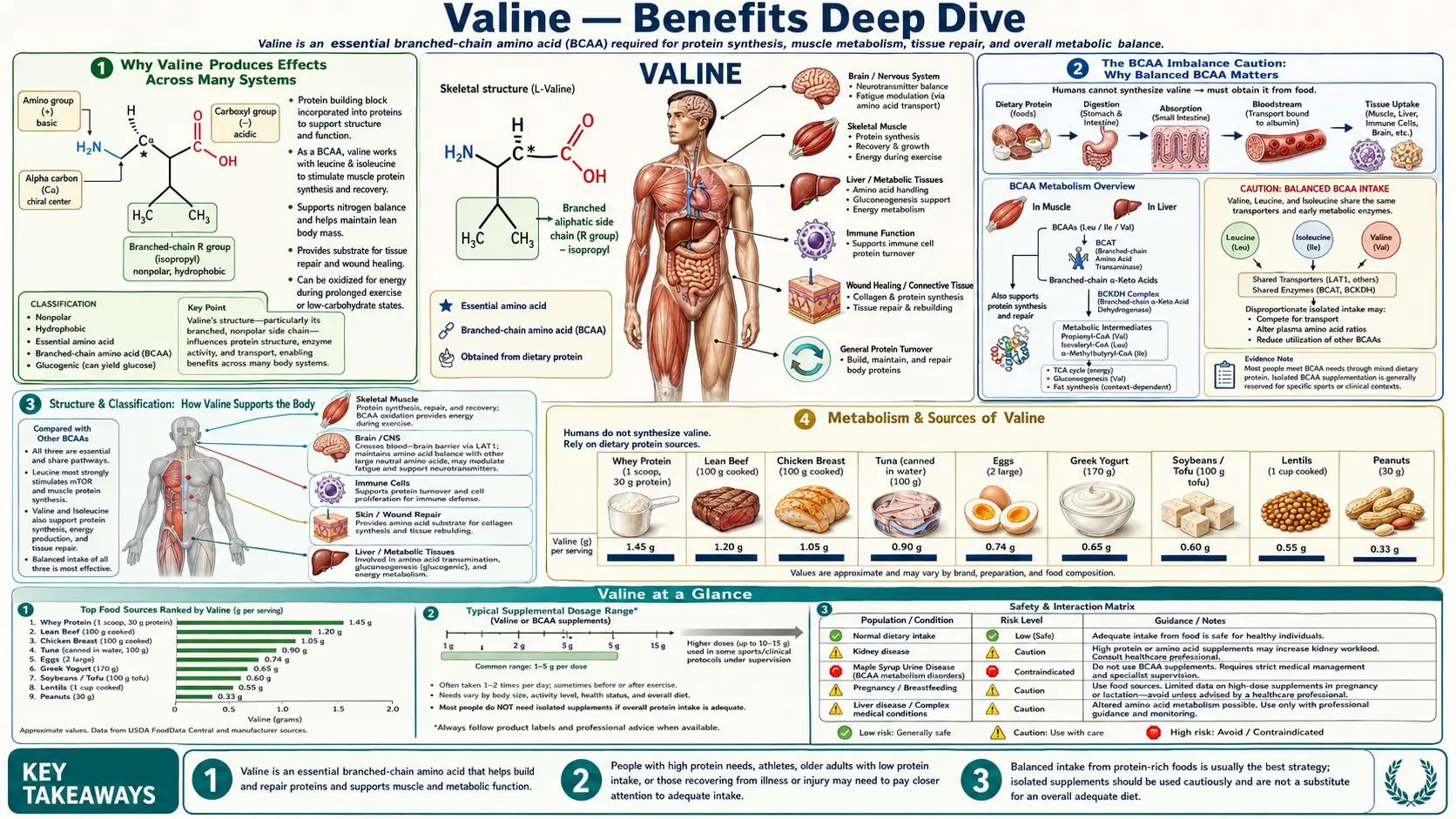
Valine is an essential branched-chain amino acid (BCAA) — one of three (with leucine and isoleucine) that share a non-linear, branched aliphatic side chain and a distinctive catabolic pathway that bypasses first-pass hepatic processing. It is the often-overlooked third BCAA, perennially underappreciated alongside leucine's star-billed mTOR-activating role. Yet valine's contribution is structural and metabolic in equal measure: a constituent of approximately 5-6% of human muscle protein, a glucogenic substrate that feeds the TCA cycle via methylmalonyl-CoA → succinyl-CoA (the same vitamin-B12-dependent metabolic node disrupted in methylmalonic acidemia and reflected in elevated methylmalonic acid as a marker of B12 deficiency), and a key competitor with tryptophan for blood-brain-barrier transport that underlies the Newsholme central fatigue hypothesis. The four deep-dive pages below explore valine's role in muscle protein synthesis (with the cautionary tale of leucine-only supplementation depleting valine and isoleucine — the Harper BCAA imbalance hypothesis), energy metabolism (with the maple syrup urine disease story), cognitive performance during prolonged exercise, and nitrogen balance for surgical recovery, trauma, burns, and the Marchesini studies on BCAA-enriched nutrition for hepatic encephalopathy.
Deep-Dive Articles
Muscle Protein Synthesis
Valine as one of three BCAAs, the 2:1:1 leucine:isoleucine:valine ratio that mirrors muscle composition, valine's role in mTOR pathway substrate provision (mTOR signaling without substrate is a factory with no raw materials), the Harper BCAA antagonism hypothesis showing that excess leucine alone depletes plasma valine and isoleucine, the leucine-only supplementation trap, and why balanced BCAA outperforms isolated leucine in nearly every controlled comparison.
Energy Metabolism
Valine catabolism through ten enzymatic steps to propionyl-CoA → methylmalonyl-CoA → succinyl-CoA → TCA cycle. The maple syrup urine disease (MSUD) connection through BCKAD deficiency, thiamine-responsive MSUD revealing vitamin B1 as the rate-limiting cofactor, methylmalonyl-CoA mutase and vitamin B12, why MMA is the most sensitive marker of B12 deficiency, gluconeogenic contribution from muscle proteolysis during fasting, and valine's role as an anaplerotic TCA substrate.
Cognitive Performance
The LAT1 large-neutral-amino-acid transporter at the blood-brain barrier and the eight amino acids that compete for it, the Fernstrom-Wurtman ratio of free tryptophan to BCAA, the Newsholme central fatigue hypothesis (rising free tryptophan + falling BCAA in prolonged exercise → more brain serotonin → reduced effort tolerance), the BCAA-to-AAA Fischer ratio in hepatic encephalopathy, and the practical biochemistry of why high-protein meals can produce alertness while high-carb meals cause drowsiness.
Nitrogen Balance & Wound Healing
Negative nitrogen balance in trauma, burns, sepsis, cancer cachexia, and cirrhosis. Valine as direct substrate for accelerated tissue synthesis, valine's nitrogen contribution to muscle glutamine pool (the dominant amino acid exported during catabolic illness), the Marchesini long-term oral BCAA protocol for cirrhotic patients with hepatic encephalopathy history (Gastroenterology 2003 trial), BCAA-enriched parenteral nutrition for liver failure, and BCAA contribution to surgical recovery.
Table of Contents
- Deep-Dive Articles
- Why Valine Produces Effects Across Many Systems
- The BCAA Imbalance Caution: Why Balanced BCAA Matters
- Research Papers: Muscle Protein Synthesis and BCAA Ratios
- Research Papers: Energy Metabolism, MSUD, and B12 Connection
- Research Papers: Central Fatigue, LAT1, and Cognitive Performance
- Research Papers: Nitrogen Balance, Cirrhosis, and Wound Healing
- Research Papers: Cross-Cutting (Mechanism, Status, Safety)
- External Authoritative Resources
- Connections
- Featured Videos
Why Valine Produces Effects Across Many Systems
Most amino acids act primarily through one role: a structural building block of protein. The branched-chain amino acids, including valine, are unusual because they operate through four fundamentally distinct mechanisms, and each of those mechanisms maps to a distinct category of clinical effect.
- Structural substrate for protein synthesis — valine constitutes approximately 5-6% of human skeletal muscle protein and similar fractions of most non-collagen body proteins. Adequate valine availability is necessary for any state of accelerated synthesis — muscle hypertrophy from resistance training, tissue repair after surgery or trauma, immune cell expansion during infection.
- Metabolic fuel and TCA anaplerotic substrate — valine catabolism via propionyl-CoA → methylmalonyl-CoA → succinyl-CoA feeds carbon directly into the TCA cycle as an anaplerotic input. This drives the energy-metabolism effects, the gluconeogenic contribution during fasting, and the metabolic pathway whose genetic disruption causes maple syrup urine disease.
- Blood-brain-barrier transport competition — valine competes with seven other large neutral amino acids (including tryptophan, tyrosine, and phenylalanine) for LAT1-mediated transport into the brain. This drives the central fatigue effects of BCAA during exercise, the cognitive benefits of high-protein meals, and the role of BCAA-enriched feeding in hepatic encephalopathy.
- Glutamine nitrogen donor — BCAA transamination in muscle generates glutamate, which is then amidated to glutamine. Valine therefore indirectly supports gut barrier integrity, immune cell function, and acid-base homeostasis through the muscle-to-glutamine pipeline.
The therapeutic complication is that valine cannot be considered in isolation. Its four mechanisms each depend on the relative balance with leucine and isoleucine. The most-studied form of imbalance — excess leucine alone depleting valine and isoleucine — is the subject of its own caution below.
The BCAA Imbalance Caution: Why Balanced BCAA Matters
Critical caution: The supplement market continues to promote leucine-only and high-leucine-ratio products (4:1:1, 8:1:1, even 10:1:1 leucine:isoleucine:valine) on the rationale that "leucine is the only amino acid that directly activates mTOR." This framing is technically true about the signaling step but ignores the substrate availability step. Excess dietary leucine alone — without proportional valine and isoleucine — competitively saturates the shared catabolic enzymes (BCAT2 and BCKAD), accelerates the catabolism of any valine and isoleucine present in the diet, and ultimately depletes plasma valine and isoleucine concentrations. This is the Harper BCAA imbalance hypothesis, established in Alfred Harper's 1950s-1960s rat experiments at the University of Wisconsin and replicated in pig, chicken, and human studies since. The clinical translation: balanced BCAA at the 2:1:1 ratio (mirroring muscle composition) outperforms leucine alone in head-to-head trials of muscle protein synthesis (Moberg 2016), and whole-protein EAA-complete sources outperform isolated BCAA in nearly all controlled comparisons. For most adults, the most effective valine "supplementation" is simply adequate dietary protein from sources that naturally provide BCAAs at 2:1:1 (whey, casein, eggs, meat, fish, soy, quinoa). Isolated leucine or high-leucine BCAA supplements are not just unnecessary — they may actively impair the very anabolic processes they are marketed to support.
Research Papers: Muscle Protein Synthesis and BCAA Ratios
- Harper AE, Benevenga NJ, Wohlhueter RM (1970). Effects of ingestion of disproportionate amounts of amino acids. Physiological Reviews. — PubMed: Harper imbalance
- Moberg M et al. (2016). Activation of mTORC1 by leucine is potentiated by branched-chain amino acids and even more so by essential amino acids following resistance exercise. AJP — Cell Physiology. — PubMed: Moberg leucine vs BCAA vs EAA
- Wolfson RL et al. (2016). Sestrin2 is a leucine sensor for the mTORC1 pathway. Science. — PubMed: Sestrin2 leucine sensing
- Fouré A, Bendahan D (2017). Is BCAA supplementation an efficient nutritional strategy to alleviate skeletal muscle damage? Nutrients. — PubMed: BCAA and muscle damage
- Plotkin DL et al. (2021). Isolated leucine and BCAA supplementation for muscular strength and hypertrophy: a narrative review. IJSNEM. — PubMed: Plotkin review
- Jackman SR et al. (2017). BCAA ingestion stimulates muscle myofibrillar protein synthesis following resistance exercise in humans. Frontiers in Physiology. — PubMed: Jackman BCAA and MPS
- Volpi E et al. (2003). Essential amino acids are primarily responsible for the amino acid stimulation of muscle protein anabolism in healthy elderly adults. AJCN. — PubMed: Volpi EAA and elderly
- Bauer J et al. (2013). Evidence-based recommendations for dietary protein intake in older people (PROT-AGE). JAMDA. — PubMed: PROT-AGE recommendations
- Phillips SM (2017). Current concepts and unresolved questions in dietary protein requirements and supplements in adults. Frontiers in Nutrition. — PubMed: Phillips protein requirements
- Wagenmakers AJ (1998). Muscle amino acid metabolism at rest and during exercise. Exercise and Sport Sciences Reviews. — PubMed: Wagenmakers exercise amino acid
Research Papers: Energy Metabolism, MSUD, and B12 Connection
- Menkes JH, Hurst PL, Craig JM (1954). A new syndrome: progressive familial infantile cerebral dysfunction with an unusual urinary substance (the original MSUD description). Pediatrics. — PubMed: Original MSUD case
- Strauss KA, Puffenberger EG, Morton DH (2020). Maple syrup urine disease. GeneReviews. — PubMed: MSUD GeneReviews
- Harper AE, Miller RH, Block KP (1984). Branched-chain amino acid metabolism. Annual Review of Nutrition. — PubMed: Harper BCAA review
- Brunetti-Pierri N et al. (2011). Phenylbutyrate therapy for maple syrup urine disease. Human Molecular Genetics. — PubMed: Phenylbutyrate for MSUD
- Mazariegos GV et al. (2012). Liver transplantation for classical maple syrup urine disease. Journal of Pediatrics. — PubMed: Liver transplant for MSUD
- Banerjee R, Ragsdale SW (2003). The many faces of vitamin B12: catalysis by cobalamin-dependent enzymes. Annual Review of Biochemistry. — PubMed: B12-dependent enzymes
- Stabler SP (2013). Vitamin B12 deficiency. NEJM. — PubMed: Stabler B12 review
- Roe CR, Brunengraber H (2015). Anaplerotic treatment of long-chain fat oxidation disorders with triheptanoin. MGM. — PubMed: Anaplerotic therapy
- Wang TJ et al. (2011). Metabolite profiles and the risk of developing diabetes. Nature Medicine. — PubMed: BCAA and diabetes risk
- Lynch CJ, Adams SH (2014). BCAAs in metabolic signalling and insulin resistance. Nature Reviews Endocrinology. — PubMed: BCAA and insulin resistance
Research Papers: Central Fatigue, LAT1, and Cognitive Performance
- Newsholme EA et al. (1987). Amino acid metabolism, the brain, and fatigue. Trends in Neurosciences. — PubMed: Newsholme central fatigue
- Fernstrom JD, Wurtman RJ (1971). Brain serotonin content: increase following ingestion of carbohydrate diet. Science. — PubMed: Fernstrom-Wurtman
- Blomstrand E (2006). A role for BCAAs in reducing central fatigue. Journal of Nutrition. — PubMed: Blomstrand central fatigue
- Davis JM et al. (2000). Carbohydrates, BCAAs, and endurance: the central fatigue hypothesis. IJSN. — PubMed: Davis central fatigue review
- Watson P et al. (2008). BCAA supplementation on prolonged exercise capacity in a warm environment. EJAP. — PubMed: BCAA in heat
- Fischer JE, Baldessarini RJ (1971). False neurotransmitters and hepatic failure. Lancet. — PubMed: Fischer false neurotransmitters
- Boado RJ, Pardridge WM (1990). Molecular cloning of the large neutral amino acid transporter (LAT1) at the BBB. — PubMed: LAT1 cloning
- Hawkins RA et al. (2006). Structure of the BBB and its role in the transport of amino acids. Journal of Nutrition. — PubMed: BBB amino acid transport
- Choi S et al. (2013). Oral BCAAs that reduce brain serotonin during exercise also lower brain catecholamines. Amino Acids. — PubMed: BCAA and catecholamines
- Negro M et al. (2008). BCAA supplementation does not enhance athletic performance but affects muscle recovery and the immune system. JSMS. — PubMed: Negro BCAA recovery
Research Papers: Nitrogen Balance, Cirrhosis, and Wound Healing
- Marchesini G et al. (2003). Nutritional supplementation with BCAAs in advanced cirrhosis: a double-blind, randomized trial. Gastroenterology. — PubMed: Marchesini 2003
- Gluud LL et al. (2017). BCAAs for people with hepatic encephalopathy (Cochrane Review). — PubMed: Cochrane HE review
- Fischer JE et al. (1976). The role of plasma amino acids in hepatic encephalopathy. Surgery. — PubMed: Fischer ratio paper
- Plauth M et al. (2019). ESPEN guideline on clinical nutrition in liver disease. Clinical Nutrition. — PubMed: ESPEN liver guidelines
- Williams JZ, Barbul A (2003). Nutrition and wound healing. Surgical Clinics of North America. — PubMed: Wound healing nutrition
- Tsien C et al. (2015). Late evening snack: exploiting a period of anabolic opportunity in cirrhosis. JGH. — PubMed: Late evening snack
- Wischmeyer PE et al. (2013). Glutamine in the critically ill. Current Opinion in Critical Care. — PubMed: Glutamine in ICU
- Heyland D et al. (2013). REDOXS trial of glutamine and antioxidants in critically ill patients. NEJM. — PubMed: REDOXS
- Sallé A et al. (2008). HMB, arginine, and glutamine supplementation in pressure ulcer healing. JPEN. — PubMed: HMB and pressure ulcers
- Singer P et al. (2019). ESPEN guideline on clinical nutrition in the ICU. Clinical Nutrition. — PubMed: ESPEN ICU guidelines
Research Papers: Cross-Cutting (Mechanism, Status, Safety)
- Holecek M (2018). Branched-chain amino acids in health and disease: metabolism, alterations in blood plasma, and as supplements. Nutrition & Metabolism. — PubMed: Holecek BCAA review
- Wu G (2010). Functional amino acids in growth, reproduction, and health. Advances in Nutrition. — PubMed: Wu functional amino acids
- Layman DK (2003). The role of leucine in weight loss diets and glucose homeostasis. Journal of Nutrition. — PubMed: Layman leucine
- WHO/FAO/UNU (2007). Protein and amino acid requirements in human nutrition. WHO Technical Report. — PubMed: WHO/FAO requirements
- Garlick PJ (2005). The role of leucine in the regulation of protein metabolism. Journal of Nutrition. — PubMed: Garlick leucine regulation
- Norton LE, Layman DK (2006). Leucine regulates translation initiation of protein synthesis in skeletal muscle after exercise. Journal of Nutrition. — PubMed: Leucine and translation
- Shimomura Y et al. (2004). Exercise promotes BCAA catabolism: effects of BCAA supplementation on skeletal muscle during exercise. Journal of Nutrition. — PubMed: Shimomura exercise BCAA
- Pencharz PB et al. (2008). Recent developments in understanding protein needs — how much and what kind should we eat? Applied Physiology, Nutrition, and Metabolism. — PubMed: Pencharz protein needs
- Riazi R, Wykes LJ, Ball RO, Pencharz PB (2003). The total branched-chain amino acid requirement in young healthy adult men determined by indicator amino acid oxidation. Journal of Nutrition. — PubMed: Riazi BCAA requirement
- Elango R et al. (2012). Recent advances in determining protein and amino acid requirements in humans. British Journal of Nutrition. — PubMed: Elango requirements
External Authoritative Resources
- Linus Pauling Institute — Micronutrient Information Center — authoritative summaries of amino acid biology and supplementation evidence
- NIH Office of Dietary Supplements — Fact Sheets Index (BCAA and amino acid entries)
- GeneReviews — Maple Syrup Urine Disease (Strauss, Puffenberger, Morton)
- WHO/FAO/UNU — Protein and Amino Acid Requirements in Human Nutrition (2007 Technical Report)
- ESPEN — European Society for Clinical Nutrition and Metabolism Guidelines (liver disease and ICU nutrition)
- PubMed — All research on valine and BCAAs
Connections
- All Amino Acids
- Valine (Main Page)
- Valine for Muscle Protein Synthesis
- Valine for Energy Metabolism
- Valine for Cognitive Performance
- Valine for Nitrogen Balance & Wound Healing
- Leucine (BCAA Partner)
- Isoleucine (BCAA Partner)
- Glutamine
- Alanine (Glucose-Alanine Cycle)
- Tryptophan (LAT1 Competitor)
- Tyrosine (LAT1 Competitor)
- Phenylalanine (LAT1 Competitor)
- Arginine
- Vitamin B12 (Methylmalonyl-CoA Mutase Cofactor)
- Vitamin B1 / Thiamine (BCKAD Cofactor)
- Liver Disease
- Insulin Resistance
- Exercise
- Fasting
- Fatigue
- Eggs