Tryptophan — Benefits Deep Dive
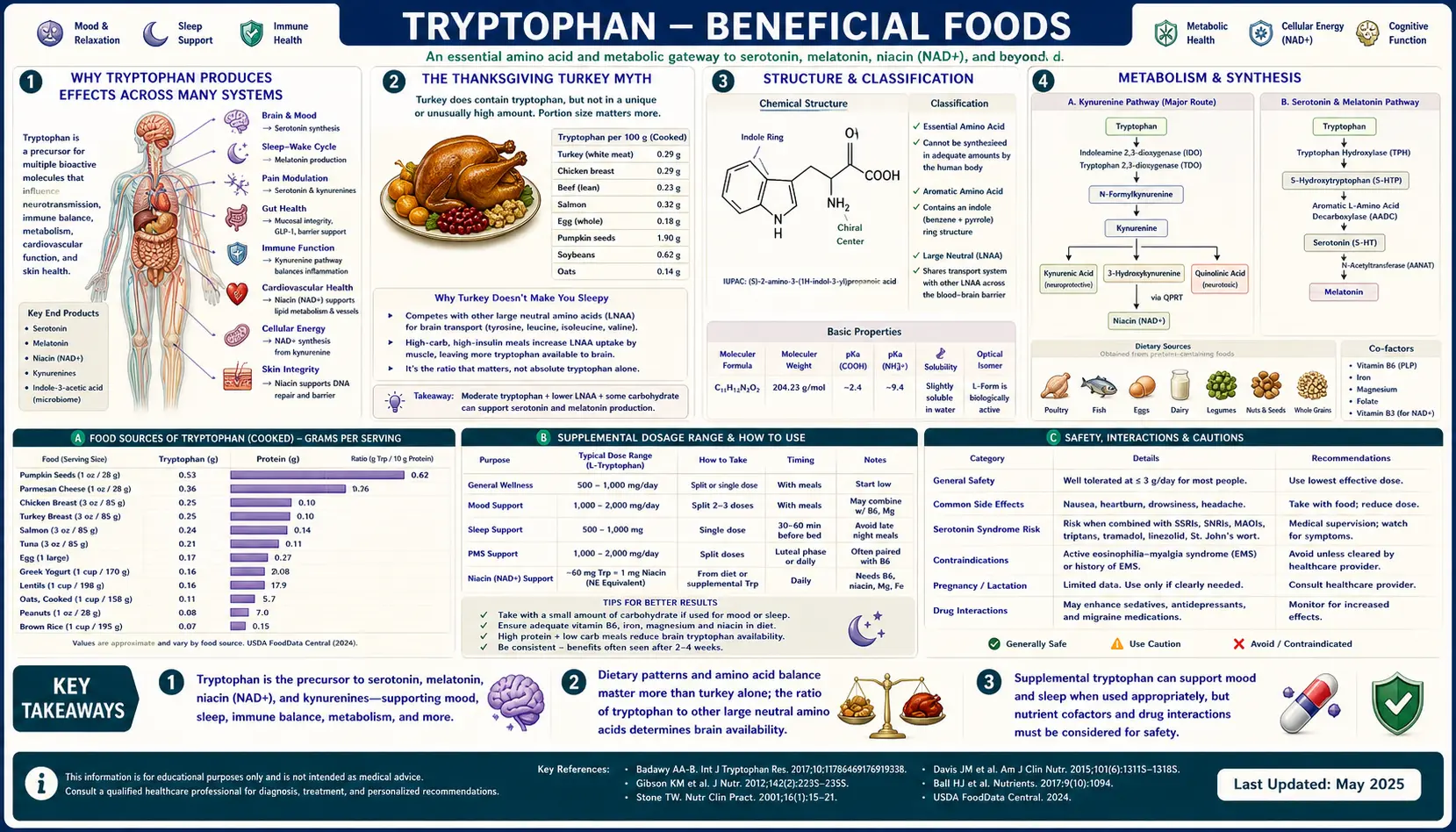
Tryptophan is the essential amino acid that no animal can synthesize from scratch — it must come from the diet. It is the precursor of three of the most consequential molecules in human physiology: serotonin (the master mood neurotransmitter), melatonin (the circadian sleep hormone), and niacin (vitamin B3, the precursor of NAD+ that powers every redox reaction in the body). It is the largest of the twenty proteinogenic amino acids, carrying a bulky indole ring that gives it the strongest UV absorbance of any amino acid. The kynurenine pathway, which routes roughly 95% of dietary tryptophan, is now understood to be one of the most important molecular bridges between inflammation, depression, and neurodegeneration. Tryptophan is also one of the most-discussed-yet-misunderstood amino acids in popular nutrition — the persistent Thanksgiving turkey-makes-you-sleepy myth survives despite being mechanistically wrong (carbohydrate load, alcohol, and meal size do the work; turkey is unremarkable for tryptophan content). Four benefit pages below explore the conditions where tryptophan produces the largest clinical effect.
Deep-Dive Articles
Sleep & Melatonin
The tryptophan → 5-HTP → serotonin → N-acetylserotonin → melatonin pathway and the pineal-specific AANAT and HIOMT enzymes that gate the final two steps. Why L-tryptophan, 5-HTP, and exogenous melatonin produce overlapping but not identical sleep effects. The 1989 L-tryptophan eosinophilia-myalgia syndrome (EMS) epidemic, the Showa Denko fermentation-contamination cause, the long FDA market withdrawal, and the modern post-2001 return of L-tryptophan to OTC sale.
Mood & Serotonin
Tryptophan hydroxylase 2 (TPH2) as the rate-limiting enzyme for brain serotonin synthesis. The acute tryptophan depletion paradigm (Delgado 1990) and the rapid relapse of depression in SSRI-recovered patients. The tryptophan-plus-carbohydrate trick: insulin-mediated branched-chain amino acid clearance opens the blood-brain barrier LAT1 transporter to tryptophan. How dietary precursor loading compares to SSRIs and to 5-HTP.
Niacin Synthesis
The kynurenine pathway produces niacin (vitamin B3, the NAD+ precursor) at an inefficient 60:1 ratio — about 60 mg of tryptophan yields 1 mg of niacin equivalent (NE). The pellagra-corn-tryptophan story: corn is uniquely low in both bioavailable niacin AND tryptophan, which is why pellagra ravaged the American South in the 1900s. Hartnup disease (genetic defect in neutral amino acid transport). The kynurenine / quinolinic acid neurotoxicity axis in depression and neurodegeneration.
Cognitive Function
Quinolinic acid as both an NMDA receptor agonist and a neurotoxin in chronic inflammation. The kynurenine pathway upregulation in major depression, suicidal ideation, and Alzheimer's disease. IDO and TDO enzyme regulation by interferon-gamma and cortisol. The Maes inflammation-depression hypothesis. Kynurenic acid as the neuroprotective branch (NMDA antagonist) and the kynurenic / quinolinic ratio as a candidate biomarker.
Table of Contents
- Deep-Dive Articles
- Why Tryptophan Produces Effects Across Many Systems
- The Thanksgiving Turkey Myth
- Research Papers: Sleep & Melatonin
- Research Papers: Mood & Serotonin
- Research Papers: Niacin Synthesis & Kynurenine Pathway
- Research Papers: Cognitive Function & Inflammation
- Research Papers: Cross-Cutting (Mechanism, Safety, EMS)
- External Authoritative Resources
- Connections
- Featured Videos
Why Tryptophan Produces Effects Across Many Systems
Most amino acids do one thing very well — they get incorporated into protein. Tryptophan does that too, but its real significance is as the chemical raw material for three of the most consequential signaling molecules in human physiology, each operating through a fundamentally different mechanism. Each of the three maps to a distinct category of clinical effect.
- Monoamine neurotransmitter precursor (serotonin) — tryptophan is the unique precursor for serotonin (5-hydroxytryptamine, 5-HT), the master mood neurotransmitter. The rate-limiting enzyme is tryptophan hydroxylase, which exists as TPH1 in the gut and TPH2 in the brain. This pathway is responsible for the mood, anxiety, appetite, and pain-tolerance effects of tryptophan supplementation.
- Hormone precursor (melatonin) — serotonin in the pineal gland is acetylated by AANAT (arylalkylamine N-acetyltransferase, the night-light-suppressed gateway enzyme) and methylated by HIOMT (hydroxyindole-O-methyltransferase) to yield melatonin, the master circadian hormone. This pathway accounts for the sleep-onset and circadian-realignment effects.
- Vitamin / cofactor precursor (NAD+ via niacin) — the kynurenine pathway, which catabolizes the other 95% of dietary tryptophan, ultimately yields niacin (vitamin B3) and nicotinamide adenine dinucleotide (NAD+), the universal redox cofactor. This is the metabolic basis for the historical pellagra story and the inefficient 60:1 conversion ratio.
The complication — and the reason tryptophan biology has exploded as a research topic over the last twenty years — is that the kynurenine pathway is regulated by inflammation. The first and rate-limiting enzyme, indoleamine 2,3-dioxygenase (IDO), is strongly induced by interferon-gamma. The hepatic equivalent, tryptophan 2,3-dioxygenase (TDO), is induced by cortisol. When the body is inflamed or chronically stressed, both enzymes upregulate, dietary tryptophan is shunted into kynurenine instead of serotonin, and the downstream kynurenine pathway produces both the neuroprotective kynurenic acid branch and the neurotoxic quinolinic acid branch. The latter is a direct NMDA receptor agonist and an excitotoxin. This inflammation-depression-neurodegeneration link is one of the most active areas in contemporary psychiatric and neurological research.
Two practical implications follow. First, supplementing tryptophan or 5-HTP in the setting of active inflammation may not deliver the expected serotonin boost — the substrate gets pulled into kynurenine instead. Resolving the underlying inflammation matters more than adding more precursor. Second, the same biology explains why depression is so prevalent in chronic inflammatory disease (rheumatoid arthritis, inflammatory bowel disease, hepatitis C) and why interferon-alpha therapy reliably triggers a depressive syndrome — the kynurenine pathway is being pharmacologically forced open.
The Thanksgiving Turkey Myth
The single most widely repeated tryptophan factoid in American popular culture — that turkey is exceptionally high in tryptophan and that this is why people fall asleep on the couch after Thanksgiving dinner — is mechanistically wrong on multiple counts.
First, turkey is unremarkable for tryptophan content. Per 100 g, roasted turkey provides about 250–300 mg of tryptophan. Chicken provides essentially the same. So does beef, pork, salmon, eggs, hard cheese, and most legumes. Pumpkin seeds at ~575 mg per 100 g and cheddar cheese at ~320 mg per 100 g both beat turkey. There is nothing tryptophan-distinctive about turkey at all.
Second, dietary tryptophan from a mixed-protein meal does not produce a meaningful brain serotonin surge. Tryptophan competes with the other large neutral amino acids (leucine, isoleucine, valine, tyrosine, phenylalanine) for the LAT1 transporter at the blood-brain barrier. Eating a protein-rich meal raises plasma tryptophan, but it raises the competing BCAAs more, so the ratio of tryptophan to its competitors actually goes down. A pure-carbohydrate meal, paradoxically, does raise the ratio (insulin clears the BCAAs into muscle without affecting tryptophan as much), which is why purified L-tryptophan supplementation is taken on an empty stomach or with a small carbohydrate, not with a steak.
Third, the actual cause of post-Thanksgiving sleepiness is the meal itself, not turkey-specific tryptophan. Large mixed meals trigger the postprandial parasympathetic response (the "rest and digest" shift), divert blood flow to the splanchnic circulation, and produce a measurable transient cognitive slowdown. Adding alcohol amplifies the effect. Add the cumulative effect of holiday social stress, often-disrupted sleep the night before, and afternoon timing that coincides with the natural early-afternoon dip in alertness, and the sleepiness is fully explained without invoking any tryptophan-specific mechanism.
The myth is so persistent that it shows up in medical school lectures and in popular nutrition books. It is wrong — and the deep-dive sub-articles below get the actual mechanisms right.
Research Papers: Sleep & Melatonin
- Hartmann E (1982). Effects of L-tryptophan on sleepiness and on sleep. Journal of Psychiatric Research. — PubMed: Hartmann L-tryptophan sleep
- Silber BY, Schmitt JA (2010). Effects of tryptophan loading on human cognition, mood, and sleep. Neuroscience & Biobehavioral Reviews. — PubMed: Silber tryptophan loading review
- AANAT (arylalkylamine N-acetyltransferase) as the pineal rate-limiting enzyme — PubMed: AANAT pineal
- HIOMT (hydroxyindole-O-methyltransferase) and pineal melatonin synthesis — PubMed: HIOMT melatonin synthesis
- 5-HTP vs L-tryptophan for sleep onset latency (Soulairac trials) — PubMed: 5-HTP vs L-tryptophan sleep
- Exogenous melatonin for circadian rhythm sleep-wake disorders — PubMed: Exogenous melatonin meta-analysis
- L-tryptophan eosinophilia-myalgia syndrome (EMS) 1989 outbreak — PubMed: EMS 1989 outbreak
- Showa Denko EMS contamination cause and identification — PubMed: Showa Denko contamination
- Tryptophan and slow-wave sleep architecture — PubMed: Tryptophan slow-wave sleep
- Cubero J et al., tryptophan-enriched infant formula and sleep onset — PubMed: Cubero infant formula
- Melatonin as antioxidant and mitochondrial protector (Reiter) — PubMed: Reiter melatonin antioxidant
- Tryptophan vs melatonin head-to-head for insomnia in elderly — PubMed: Tryptophan vs melatonin elderly
Research Papers: Mood & Serotonin
- Delgado PL et al. (1990). Serotonin function and the mechanism of antidepressant action. Reversal of antidepressant-induced remission by rapid depletion of plasma tryptophan. Archives of General Psychiatry. — PubMed: Delgado depletion 1990
- Tryptophan hydroxylase 2 (TPH2) brain isoform identification (Walther 2003) — PubMed: TPH2 identification
- Acute tryptophan depletion paradigm meta-analysis — PubMed: Acute tryptophan depletion meta-analysis
- Shaw K et al. (2002). Tryptophan and 5-HTP for depression (Cochrane review) — PubMed: Shaw Cochrane review
- Carbohydrate-induced insulin release and large-neutral-amino-acid clearance (Wurtman) — PubMed: Wurtman carbohydrate-tryptophan
- LAT1 (large neutral amino acid transporter) at blood-brain barrier and tryptophan competition — PubMed: LAT1 BBB transport
- Tryptophan supplementation for premenstrual dysphoric disorder — PubMed: Tryptophan for PMDD
- SSRI mechanism of action and the serotonin hypothesis of depression — PubMed: SSRI mechanism review
- Tryptophan for seasonal affective disorder (SAD) — PubMed: Tryptophan SAD
- Aggression, impulsivity, and tryptophan depletion — PubMed: Tryptophan and aggression
- 5-HTP for depression: systematic review — PubMed: 5-HTP depression
- Tryptophan and obsessive-compulsive disorder (OCD) — PubMed: Tryptophan and OCD
Research Papers: Niacin Synthesis & Kynurenine Pathway
- Goldberger J classic pellagra trials — PubMed: Goldberger pellagra
- Krehl WA et al. (1945). Corn, tryptophan, and pellagra demonstration — PubMed: Krehl corn-tryptophan
- 60:1 tryptophan to niacin equivalent (NE) conversion ratio — PubMed: Niacin equivalent conversion
- Hartnup disease (SLC6A19 mutation) and tryptophan transport defect — PubMed: Hartnup disease
- Indoleamine 2,3-dioxygenase (IDO) and interferon-gamma induction — PubMed: IDO induction
- Tryptophan 2,3-dioxygenase (TDO) hepatic regulation and cortisol — PubMed: TDO hepatic
- Kynurenine pathway as central regulator of inflammation (Schwarcz review) — PubMed: Schwarcz kynurenine review
- Quinolinic acid as NMDA receptor agonist and excitotoxin — PubMed: Quinolinic acid NMDA
- Kynurenic acid as neuroprotective NMDA antagonist — PubMed: Kynurenic acid neuroprotection
- NAD+ biosynthesis from tryptophan via de novo pathway — PubMed: NAD+ from tryptophan
- Pellagra-like syndrome in carcinoid tumor (tryptophan diversion) — PubMed: Carcinoid pellagra
- 3-hydroxykynurenine and oxidative stress — PubMed: 3-hydroxykynurenine
Research Papers: Cognitive Function & Inflammation
- Maes M et al. The inflammation and oxidative & nitrosative stress (IO&NS) hypothesis of depression — PubMed: Maes inflammation hypothesis
- Interferon-alpha induced depression and kynurenine pathway activation — PubMed: IFN-alpha depression
- Quinolinic acid in Alzheimer's disease brain — PubMed: Quinolinic acid in Alzheimer's
- Kynurenine pathway in Huntington's disease — PubMed: Kynurenine in Huntington's
- Suicidal ideation and CSF quinolinic acid (Erhardt 2013) — PubMed: Erhardt CSF suicide
- Kynurenic-to-quinolinic acid ratio as biomarker in depression — PubMed: KYN/QUIN ratio biomarker
- Tryptophan depletion and long-term memory consolidation — PubMed: Depletion and memory
- Indoleamine pathway and tumor immune escape — PubMed: IDO and tumor immunity
- Schizophrenia and elevated kynurenic acid — PubMed: Schizophrenia kynurenic acid
- Cognitive flexibility and acute tryptophan depletion in healthy volunteers — PubMed: ATD cognitive flexibility
- Microglial IDO induction in chronic neuroinflammation — PubMed: Microglial IDO
- IDO1 inhibitors (epacadostat) in clinical oncology trials — PubMed: IDO inhibitors oncology
Research Papers: Cross-Cutting (Mechanism, Safety, EMS)
- FDA Talk Paper on L-tryptophan and the eosinophilia-myalgia syndrome (EMS) recall history — PubMed: FDA EMS recall
- EBT (1,1-ethylidenebis-tryptophan) Peak 97 / Peak 200 contamination chemistry — PubMed: EBT contamination chemistry
- Post-2001 return of L-tryptophan to US OTC market — PubMed: L-tryptophan market return
- Serotonin syndrome from combined serotonergic agents — PubMed: Serotonin syndrome
- Tryptophan plasma concentration and circadian variation — PubMed: Diurnal tryptophan
- Tryptophan and pregnancy / lactation safety — PubMed: Pregnancy and tryptophan
- Tryptophan as fishmeal additive and broiler-chicken performance (food-supply niacin angle) — PubMed: Tryptophan in feed
- WHO/FAO essential amino acid requirements (2007 report) — PubMed: WHO/FAO 2007 report
- Vegan diet and tryptophan adequacy — PubMed: Vegan tryptophan adequacy
- Linus Pauling Institute tryptophan summary — PubMed: LPI tryptophan
External Authoritative Resources
- Linus Pauling Institute — L-Tryptophan Micronutrient Information — concise scientific summary, regularly updated
- NIH Office of Dietary Supplements — Fact Sheet Index (search "tryptophan", "5-HTP", "melatonin", "niacin")
- MedlinePlus — L-Tryptophan
- MedlinePlus — 5-HTP (5-Hydroxytryptophan)
- PubMed — All research on tryptophan (~60,000+ papers)
- PubMed — Kynurenine pathway research
Connections
- All Amino Acids
- Tryptophan (Main Page)
- Tryptophan for Sleep & Melatonin
- Tryptophan for Mood & Serotonin
- Tryptophan and Niacin Synthesis
- Tryptophan and Cognitive Function
- Tyrosine
- Phenylalanine
- Glycine
- Vitamin B3 (Niacin)
- Vitamin B6
- Magnesium
- Depression
- Anxiety
- Insomnia
- Sleep Hygiene
- Gut-Brain Axis
- Brain Fog