Tryptophan: History and Discovery
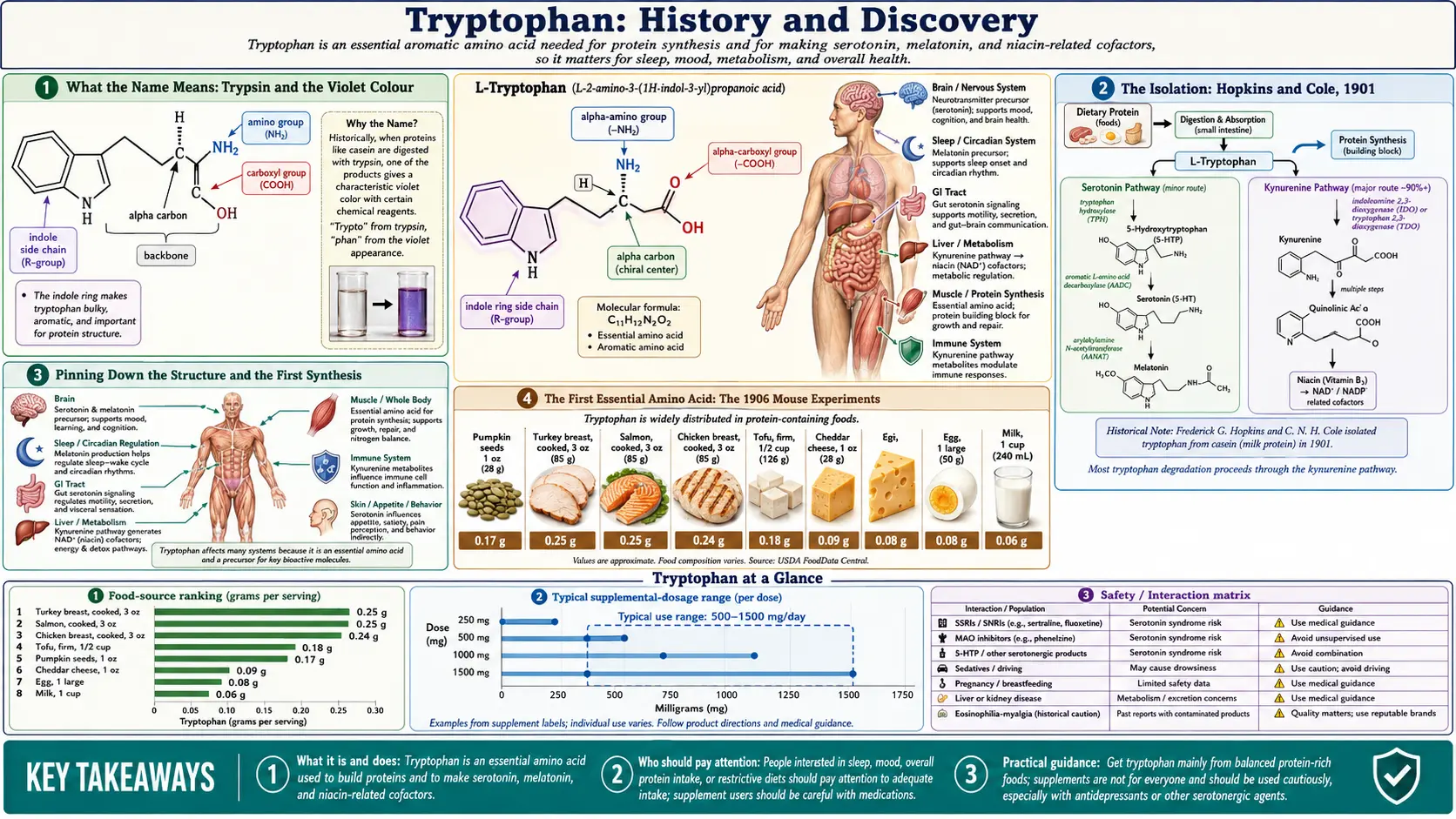
In 1901, two scientists at the University of Cambridge — Frederick Gowland Hopkins and his collaborator Sidney W. Cole — chased down a mysterious substance that turned digested protein a deep violet, and in doing so isolated the amino acid we now call tryptophan. It was a quietly historic moment: just a few years later, the same Hopkins would show that animals starved of this one molecule simply could not survive, making tryptophan the first amino acid ever proven to be essential — something the body cannot build for itself and must take in from food. This article tells that story plainly: where the strange name came from, how the molecule was finally pinned down and synthesized in the laboratory, how it helped launch the whole modern idea of essential nutrients, and where it sits in the long history of protein chemistry. Where the record is firm, we say so; where a date or a name is debated or approximate, we mark it as such.
Table of Contents
- What the Name Means: Trypsin and the Violet Colour
- The Isolation: Hopkins and Cole, 1901
- Pinning Down the Structure and the First Synthesis
- The First Essential Amino Acid: The 1906 Mouse Experiments
- Frederick Gowland Hopkins and the Nobel Prize
- The Wider Story: Naming Proteins and the Amino Acids
- From a Curiosity to Serotonin, Niacin, and Sleep
- What the Discovery Left Behind
- Research Papers and References
- Connections
- Featured Videos
What the Name Means: Trypsin and the Violet Colour
The word tryptophan looks intimidating, but its two halves tell a simple story. The first part comes from trypsin, a powerful digestive enzyme made by the pancreas that chops dietary protein into smaller pieces. The second part comes from the Greek phainein, meaning "to appear" or "to bring to light." Put together, the name means roughly "the thing that appears when protein is digested by trypsin" — which is exactly how it was first noticed.
That trypsin connection is itself a small piece of nineteenth-century history. The enzyme trypsin had been named in 1876 by the German physiologist Wilhelm Kühne, and chemists soon noticed that when proteins were broken down by it, the resulting mixture would give striking colour reactions. The German researcher Richard Neumeister is generally credited with first using the term tryptophan around 1890 for the still-impure, colour-producing substance that showed up in these tryptic digests. In other words, the substance had a name and a reputation roughly a decade before anyone managed to isolate it in pure form.
The colour itself mattered. A protein test known as the Adamkiewicz reaction — in which proteins treated with certain reagents turn a vivid violet — had been known for years, but no one knew which part of the protein was responsible for it. As the next section describes, answering that single question is what led Hopkins and Cole straight to tryptophan. The refined version of that colour test they developed is still taught today as the Hopkins–Cole reaction, a name that quietly preserves the discovery in every biochemistry textbook.
The Isolation: Hopkins and Cole, 1901
The clean isolation of tryptophan is one of the better-documented moments in amino-acid history, and the credit is clear. Working at the University of Cambridge, the biochemist Frederick Gowland Hopkins and his collaborator Sidney W. Cole set out to identify the exact substance in protein responsible for the long-known violet Adamkiewicz colour reaction. Their results were published in 1901 in The Journal of Physiology, in a paper with the memorably cautious title "A contribution to the chemistry of proteids: Part I. A preliminary study of a hitherto undescribed product of tryptic digestion."
The practical work was painstaking. Hopkins and Cole used casein — the main protein of milk — as their raw material, breaking it down and then carefully separating out the substance that carried the colour reaction. By the figures usually quoted, they recovered only a few grams of tryptophan from many hundreds of grams of crude casein, a reminder of how scarce this amino acid is even in a protein that contains it. Once they had the purified material in hand, it gave the characteristic tryptophan colour reaction, confirming that this elusive constituent and the long-discussed "tryptophan" of the tryptic digest were one and the same.
It is worth being precise about what was and was not new here. The name tryptophan predates the isolation — Neumeister had used it around 1890 for an impure substance. What Hopkins and Cole achieved in 1901 was the genuine isolation and characterization of the pure amino acid: turning a suspected colour-producing fragment into a defined chemical substance. For that reason, 1901 is the date the scientific literature treats as the discovery of tryptophan, and Hopkins and Cole are the names attached to it.
Pinning Down the Structure and the First Synthesis
Isolating a substance is not the same as knowing what it looks like at the molecular level. Tryptophan turned out to contain an indole ring — a distinctive double-ring structure of carbon and nitrogen that gives the molecule much of its chemistry and is the reason tryptophan is the bulkiest of the standard amino acids. (It is this two-ring shape that later earned tryptophan the single-letter biochemical code W, the widest letter in the alphabet.) Working out that this indole framework was part of the molecule, rather than merely guessing it, took a few more years of laboratory effort after the 1901 isolation.
The decisive step came from the German chemist and pharmacologist Alexander Ellinger, working with Claude Flamand. In the years around 1907–1908 they reported the first laboratory synthesis of tryptophan and confirmed its structure — their paper "Über synthetisch gewonnenes Tryptophan und einige seiner Derivate" ("On synthetically obtained tryptophan and some of its derivatives") appeared in a German physiological-chemistry journal in 1908. Building the molecule from scratch in the lab and finding it identical to the natural substance was the proof that the proposed indole structure was correct.
This synthetic work sat on top of a broader foundation in indole chemistry. The famous Fischer indole synthesis, developed by Emil Fischer in 1883, had given chemists a reliable way to build indole rings, and indole chemistry of that era made the structural work on tryptophan possible. The sequence is a tidy illustration of how chemistry actually advances: nature supplied the molecule, a careful isolation gave it a definite identity, and synthetic chemistry then confirmed exactly what it was by making it from simpler ingredients.
The First Essential Amino Acid: The 1906 Mouse Experiments
The most far-reaching part of tryptophan's history is not its isolation but what came next — because tryptophan became the molecule that first proved the idea of an essential amino acid. In a study published in The Journal of Physiology for 1906–1907, Hopkins and his colleague Edith Gertrude Willcock, a research fellow at Newnham College, Cambridge, ran a deceptively simple feeding experiment that changed how scientists thought about nutrition.
Their design exploited a quirk of one particular protein. Zein, the main storage protein of maize (corn), contains essentially no tryptophan. Willcock and Hopkins fed mice a diet in which zein was the only source of protein. The animals declined and died within a couple of weeks. When the very same zein diet was supplemented with a small amount of tryptophan, the mice lived noticeably longer. A single missing amino acid, in other words, made the difference between a diet that could not sustain life and one that could.
The conclusion was historic: tryptophan was the first amino acid recognized as essential for the normal life and growth of an animal — a substance the body cannot manufacture for itself and must obtain ready-made from food. Their paper's title captured the larger ambition: "The importance of individual amino-acids in metabolism." This was a direct early challenge to the older assumption that protein was a single interchangeable foodstuff; instead, the particular amino acids in a protein turned out to matter enormously. Over the following decades, researchers would identify the other essential amino acids one by one, with the last of them — threonine — not pinned down until the 1930s, in the work of William Cumming Rose. Tryptophan, fittingly, was the one that opened the door.
Frederick Gowland Hopkins and the Nobel Prize
The figure at the centre of tryptophan's story, Sir Frederick Gowland Hopkins (1861–1947), is one of the founding figures of modern biochemistry, and his tryptophan work was part of a much larger life. The same feeding experiments that revealed tryptophan's importance also pointed Hopkins toward an even bigger discovery: he showed that animals fed on purified protein, fat, carbohydrate, minerals, and water alone failed to grow, which led him to propose that ordinary food must contain tiny amounts of additional, then-unknown substances necessary for life. He called these "accessory food factors" — what the world would soon call vitamins.
It was for this vitamin work, not specifically for tryptophan, that Hopkins received the Nobel Prize in Physiology or Medicine in 1929, an award he shared with the Dutch physician Christiaan Eijkman. The prize citation honoured Hopkins "for his discovery of the growth-stimulating vitamins." The connection to tryptophan is real and direct, though: the very experiments that exposed tryptophan as an essential nutrient were part of the same line of research that revealed how diets can fail in subtle, specific ways — the insight that ultimately earned him the prize. It is a useful reminder that the discovery of a single amino acid can be one thread in a discovery far larger than itself.
The Wider Story: Naming Proteins and the Amino Acids
Tryptophan did not arrive in a vacuum. By 1901 it joined a slowly growing roster of amino acids that chemists had been teasing out of proteins for nearly a century. The first of them, asparagine, had been isolated as far back as 1806 from asparagus juice; glycine followed in 1820, extracted from gelatin and at first called the "sugar of gelatin" for its sweet taste; and others such as leucine, cystine, and tyrosine were identified across the 1800s. Tryptophan, isolated in 1901, was one of the later additions to this list precisely because it is so scarce in most proteins and so easily destroyed by the harsh acid treatments early chemists used to break proteins apart.
The very word protein was younger than some of these amino acids. It was coined in 1838: the Dutch chemist Gerardus Johannes Mulder described the substances, and the great Swedish chemist Jöns Jacob Berzelius proposed the name, drawing on the Greek proteios, meaning "primary" or "of first rank" — a fitting label for what was rightly suspected to be the principal stuff of living tissue. Understanding what proteins actually were, however, required understanding how their amino-acid building blocks were joined together.
That final piece came from the towering German chemist Emil Fischer, who won the Nobel Prize in Chemistry in 1902 for his work on sugars and purines. In the years that followed, Fischer proposed that the amino acids in proteins are linked by what he named peptide bonds, and he proved the idea by chemically stitching amino acids into chains, eventually building a synthetic peptide of eighteen units that behaved much like a natural protein fragment. Tryptophan thus entered science at exactly the moment when proteins were ceasing to be a mysterious "primary substance" and becoming understood as precise chains of individual amino acids — of which tryptophan was one of the rarest and, as it turned out, one of the most important.
From a Curiosity to Serotonin, Niacin, and Sleep
For its first half-century, tryptophan was mainly a story about nutrition and protein chemistry. Its modern fame — as the amino acid behind mood, sleep, and the famous "Thanksgiving turkey" folklore — came later, once scientists worked out what the body actually does with it. In the mid-twentieth century, researchers established that tryptophan is the raw material the body uses to make serotonin, a key brain chemical involved in mood and well-being, and from serotonin in turn the sleep-timing hormone melatonin. Serotonin itself was isolated and chemically identified in the late 1940s, and the pathway running from dietary tryptophan to serotonin to melatonin was pieced together in the decades after.
A second pathway proved just as important. Most of the tryptophan in the diet is actually broken down along the kynurenine pathway, which the body can use to make small amounts of niacin (vitamin B3). This link explained a long-standing medical mystery: why pellagra, the disease of niacin deficiency, struck populations living largely on maize. Maize protein is poor in tryptophan, so a corn-heavy diet supplies little niacin both directly and indirectly — the same tryptophan-poor protein, zein, that Willcock and Hopkins had used in their mouse experiments. The thread connecting a laboratory mouse in 1906 to a real human deficiency disease is one of the quiet elegances of this history.
These discoveries transformed tryptophan from a chemical curiosity into one of the most studied amino acids in human health. The detailed biology — how tryptophan supports serotonin and mood, melatonin and sleep, and niacin production — is covered in depth on the main Tryptophan page and in the companion Tryptophan Benefits articles. This history is concerned with how the molecule was found and understood in the first place.
What the Discovery Left Behind
The discovery of tryptophan left a legacy out of all proportion to the few grams Hopkins and Cole first pulled from a vat of milk protein. Most directly, it gave the world its first proven essential amino acid and, with it, the entire concept that specific dietary components — not just "enough protein" or "enough food" — are required for health. That idea reshaped nutrition science. Every modern statement about which amino acids humans must eat, every fortified food, and every discussion of protein quality traces back to the line of reasoning that began with a mouse that could not live on corn protein alone.
The discovery also left its mark in the everyday vocabulary of the laboratory. The Hopkins–Cole reaction still bears its discoverers' names, and tryptophan's single-letter code W is a small in-joke about its bulky double-ring shape that working biochemists use every day. And the career it helped launch — Hopkins's path from chasing a violet colour to discovering vitamins to a Nobel Prize — stands as a model of how a narrow, careful question can open onto something enormous.
Two honest notes belong at the end. First, the history of any amino acid is a history of many hands: Kühne who named trypsin, Neumeister who first used the word tryptophan, Hopkins and Cole who isolated it, Ellinger and Flamand who synthesized it, Willcock who co-authored its essentiality, and the mid-century researchers who connected it to serotonin and niacin. No single person "invented" tryptophan; it was uncovered step by step. Second, knowing the history is not the same as a health claim — the practical questions of how much tryptophan to eat, who benefits from it, and when supplementation makes sense are matters for the main topic pages and for a qualified clinician, not for a history article. What the history offers is something different and worth having on its own: the true story of how one of the body's small but indispensable molecules came to be known.
Research Papers and References
The list below pairs the key primary papers in tryptophan's discovery with curated PubMed topic searches into the historical and biochemical literature. Author names, titles, and journals are given as plain text; only stable DOI, PMID, or archive links are hyperlinked, and each opens in a new tab. The 1901 isolation paper and the 1906–1907 essentiality paper are the two landmark primary sources of this history.
- Hopkins FG, Cole SW. A contribution to the chemistry of proteids: Part I. A preliminary study of a hitherto undescribed product of tryptic digestion. The Journal of Physiology. 1901;27(4-5):418-428. (doi:10.1113/jphysiol.1901.sp000880) — PMID: 16992614
- Willcock EG, Hopkins FG. The importance of individual amino-acids in metabolism: Observations on the effect of adding tryptophane to a dietary in which zein is the sole nitrogenous constituent. The Journal of Physiology. 1906-1907;35(1-2):88-102. Reprinted as a Nutrition Classic in Nutrition Reviews. 1975;33(1):15-17. — PMID: 1089213
- Ellinger A, Flamand C. Über synthetisch gewonnenes Tryptophan und einige seiner Derivate. Hoppe-Seyler's Zeitschrift für physiologische Chemie. 1908;55(1):8-24. — doi:10.1515/bchm2.1908.55.1.8
- The Nobel Prize in Physiology or Medicine 1929 — Christiaan Eijkman and Sir Frederick Gowland Hopkins. — NobelPrize.org: 1929 Physiology or Medicine
- The Nobel Prize in Chemistry 1902 — Hermann Emil Fischer. — NobelPrize.org: 1902 Chemistry
- Tryptophan — history of discovery and isolation — PubMed: tryptophan discovery and isolation
- Tryptophan as an essential amino acid — nutrition history — PubMed: tryptophan essentiality and nutrition history
External Authoritative Resources
- NobelPrize.org — Sir Frederick Gowland Hopkins (Facts)
- NIH Office of Dietary Supplements — Fact Sheets
- PubMed — All research on tryptophan
Connections
- All Amino Acids
- Tryptophan
- Tryptophan Benefits
- Asparagine
- Glycine
- Threonine
- Tyrosine
- Vitamin B3 (Niacin)