Proline — Benefits Deep Dive
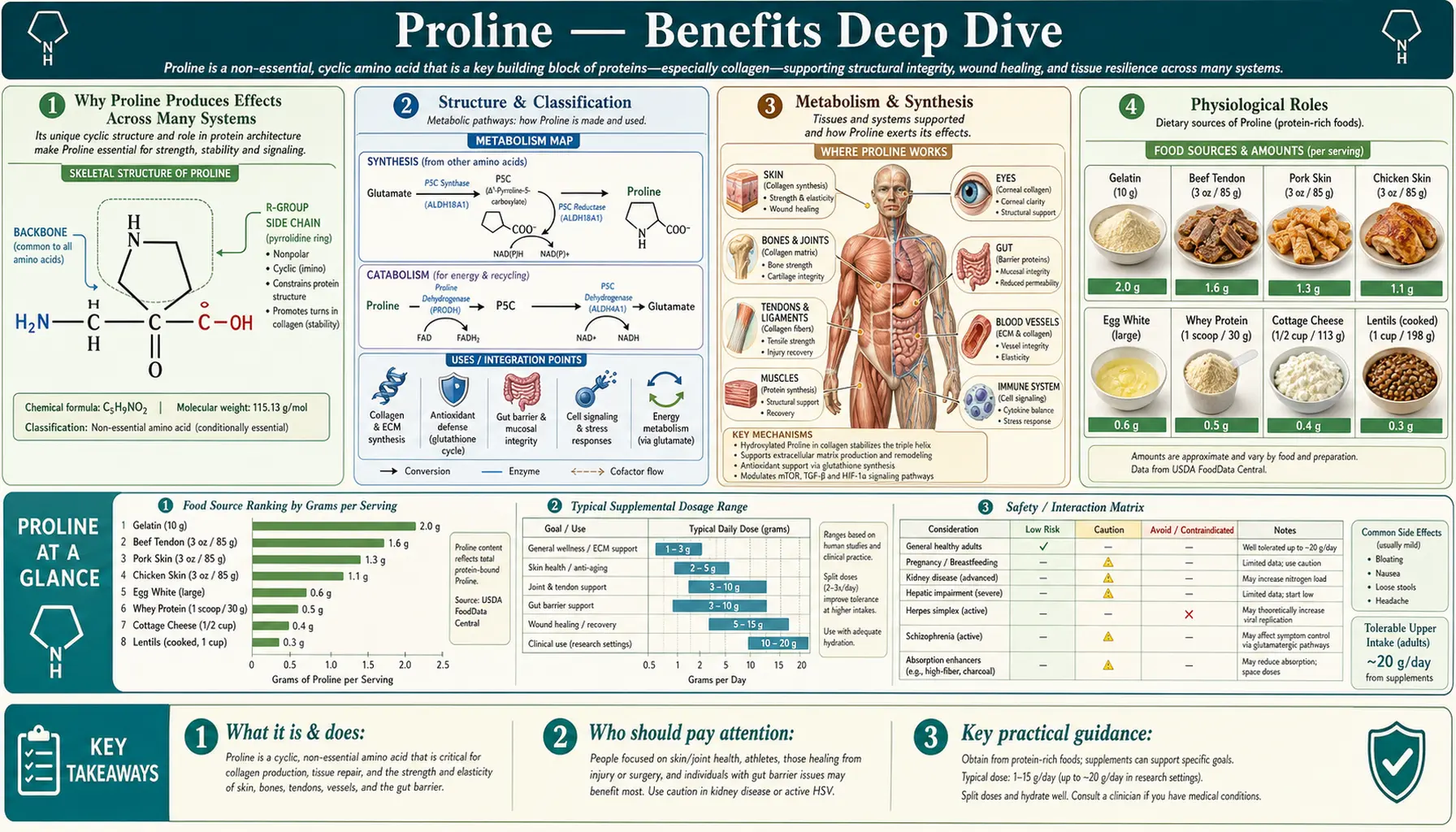
Proline is the only proteinogenic amino acid where the side chain folds back to bond with the alpha-nitrogen, forming the pyrrolidine ring that creates the rigid kink in collagen. Together with glycine and hydroxyproline, proline is the structural protein of connective tissue — the residues that allow the collagen triple helix to wind tightly enough to give tendons their tensile strength, skin its elasticity, arteries their compliance, cartilage its compressive resilience, and bone its fracture-resistant flexibility. Four deep-dive pages below explore the conditions where proline produces the largest clinical effect: collagen biosynthesis and the vitamin-C-dependent hydroxylation machinery, surgical and chronic wound healing, the arterial-collagen hypothesis of cardiovascular disease, and the oral collagen-peptide clinical evidence for skin elasticity.
Deep-Dive Articles
Collagen Synthesis
Why proline and hydroxyproline together account for roughly 23% of all collagen residues, the prolyl-4-hydroxylase (P4H) and prolyl-3-hydroxylase (P3H) enzymes that hydroxylate proline residues into hydroxyproline using vitamin C, oxygen, alpha-ketoglutarate, and ferrous iron as obligate cofactors, the unique pyrrolidine ring that confers rigidity to the collagen triple helix, and scurvy as the textbook example of what happens when collagen synthesis fails at the hydroxylation step.
Wound Healing
Proline turnover at wound sites (Albina 1993 measurements showing proline concentrations in wound fluid up to 50% higher than plasma), the arginine → ornithine → proline pathway through ornithine aminotransferase, the metabolic flux that distinguishes regenerative wound repair from fibrotic scarring, surgical wound randomized trials, and the practical implications for diabetic ulcers, pressure sores, and burns.
Cardiovascular Health
Proline in arterial wall collagen and elastin, the Pauling and Rath unified theory of cardiovascular disease (lysine + proline + vitamin C as the collagen-restoration protocol), proline as collagen-cross-link substrate, lipoprotein(a) binding inhibition, the lysine analog hypothesis, vascular aging, and the clinical evidence on the Pauling protocol for atherosclerosis.
Skin Health
Proline, glycine, and hydroxyproline as the bone-broth and collagen-peptide story, oral collagen peptide hydrolysate clinical trials for skin elasticity (Choi 2014 nutricosmetics review, Proksch 2014 double-blind RCT showing measurable elasticity improvement in 8 weeks), age-related collagen decline at ~1% per year after age 25, photoaging, and the practical case for dietary collagen.
Table of Contents
- Deep-Dive Articles
- Why Proline Produces Effects Across Many Systems
- Research Papers: Collagen Synthesis
- Research Papers: Wound Healing
- Research Papers: Cardiovascular Health
- Research Papers: Skin Health
- Research Papers: Cross-Cutting (Metabolism, Sources, Safety)
- External Authoritative Resources
- Connections
- Featured Videos
Why Proline Produces Effects Across Many Systems
Most amino acids produce a diverse set of clinical effects because each gets shuttled into multiple metabolic pathways — lysine into carnitine synthesis and into collagen, glycine into glutathione and into the central nervous system as an inhibitory neurotransmitter, methionine into the methylation cycle and into cysteine and taurine. Proline is unusual among amino acids in that almost all of its clinical effects radiate from a single mechanism: incorporation into collagen, the most abundant protein in the human body, accounting for roughly 30% of total body protein. Wherever collagen is structurally critical, proline matters.
- The pyrrolidine ring as the rigid kink in the triple helix — proline is the only proteinogenic amino acid where the side chain folds back to covalently bond with the alpha-nitrogen of the amino group, forming a five-membered pyrrolidine ring. This ring locks the phi backbone angle into a narrow range, creating the rigid kink that allows three polypeptide chains to wind around each other into the tight collagen triple helix. No other amino acid can substitute, which is why every third position in the collagen Gly-X-Y repeat is preferentially occupied by proline (X position) or hydroxyproline (Y position). The unique geometry of proline is what makes collagen the strongest structural protein in the body.
- Hydroxylation to hydroxyproline as the stability-conferring modification — after proline residues are incorporated into nascent procollagen chains, the enzymes prolyl-4-hydroxylase (P4H) and prolyl-3-hydroxylase (P3H) hydroxylate selected proline residues to form hydroxyproline. These enzymes are absolutely dependent on four cofactors: molecular oxygen, ferrous iron (Fe2+), alpha-ketoglutarate, and ascorbic acid (vitamin C). Without ascorbic acid, the iron oxidizes to Fe3+ and the hydroxylase becomes catalytically inactive. Hydroxyproline residues form inter-chain hydrogen bonds that stabilize the triple helix at body temperature; without them, collagen unfolds. Scurvy is the clinical manifestation of this entire system failing.
- Universal need across all collagen-rich tissues — skin (type I + III collagen), bone matrix (type I), articular cartilage (type II), tendon and ligament (type I), basement membranes (type IV), arteries (type I + III + elastin), cornea (type I + V), intestinal lamina propria (type I + III + V), and the reticular fibers of every solid organ all contain proline at roughly 11-13% molar abundance and hydroxyproline at another 10-12%. Wherever the body builds a load-bearing or shape-defining structure, proline is doing the structural work.
The therapeutic complication is that proline is not considered an essential amino acid for healthy adults — the body can synthesize proline from glutamate via the P5C pathway, or from arginine via ornithine aminotransferase. Functional insufficiency arises when collagen demand exceeds endogenous synthesis: during wound healing, after surgery or burn injury, in chronic inflammatory states with high collagen turnover (rheumatoid arthritis, osteoarthritis), during pregnancy and lactation, and in older adults whose endogenous synthesis declines. In these settings, proline becomes conditionally essential, which is why surgical wound healing trials consistently show improved collagen deposition with dietary supplementation. The fourth deep-dive page explores the most popular clinical application — oral collagen peptides for skin elasticity — which delivers proline, glycine, and hydroxyproline in the exact ratios found in human collagen, bypassing the need for endogenous synthesis entirely.
Research Papers: Collagen Synthesis
- Proline and hydroxyproline as approximately 23% of collagen residues — PubMed: Collagen amino-acid composition
- Prolyl 4-hydroxylase (P4H) structure, mechanism, and vitamin C dependence — PubMed: P4H mechanism
- Prolyl 3-hydroxylase (P3H) and osteogenesis imperfecta type VIII — PubMed: P3H and OI
- Pyrrolidine ring geometry and the collagen triple helix — PubMed: Pyrrolidine ring geometry
- Scurvy and collagen-synthesis failure (historical and modern reviews) — PubMed: Scurvy and collagen
- Gly-X-Y repeating motif and proline preference in X position — PubMed: Gly-X-Y motif
- Pyrrolidine-5-carboxylate (P5C) pathway from glutamate to proline — PubMed: P5C pathway
- Ornithine aminotransferase and proline biosynthesis from arginine — PubMed: Ornithine aminotransferase
- Endoplasmic reticulum chaperones (HSP47) and procollagen folding — PubMed: HSP47 chaperone
- Collagen denaturation temperature and hydroxyproline content correlation — PubMed: Collagen thermal stability
Research Papers: Wound Healing
- Albina JE et al. (1993). Detection of squamous-cell carcinoma cells in the wound by amino acid analysis (high proline turnover at wound sites) — PubMed: Albina 1993
- Arginine to ornithine to proline pathway in healing wounds — PubMed: Arg-Orn-Pro pathway
- Surgical wound healing and dietary amino acid supplementation — PubMed: Surgical wound nutrition trials
- Diabetic foot ulcer healing and amino acid status — PubMed: Diabetic ulcer nutrition
- Pressure ulcer healing and conditionally essential amino acids — PubMed: Pressure ulcers
- Burn wound healing, collagen deposition, and proline turnover — PubMed: Burn wound healing
- Fibroblast proline metabolism in granulation tissue — PubMed: Fibroblast proline metabolism
- Hydroxyproline measurement as an index of new collagen deposition — PubMed: Hydroxyproline as wound biomarker
- Hypertrophic scarring and dysregulated collagen synthesis — PubMed: Hypertrophic scar mechanism
- ASPEN nutrition guidelines for wound healing — PubMed: ASPEN wound nutrition
Research Papers: Cardiovascular Health
- Rath M, Pauling L (1992). A unified theory of human cardiovascular disease leading the way to the abolition of this disease as a cause for human mortality. Journal of Orthomolecular Medicine — PubMed: Rath-Pauling unified theory
- Pauling L, Rath M (1992). A unified theory of human cardiovascular disease leading the way to the abolition of this disease as a cause for human mortality — PubMed: Pauling cardiovascular protocol
- Arterial wall collagen types I and III in vascular structure — PubMed: Arterial collagen
- Elastin composition and proline content in arterial wall — PubMed: Elastin and proline
- Lipoprotein(a), Lp(a), and lysine-binding kringle domains — PubMed: Lp(a) lysine binding
- Vitamin C, scorbutic guinea pigs, and atherosclerosis-like lesions — PubMed: Vitamin C and atherosclerosis
- Vascular aging, collagen cross-linking, and arterial stiffness — PubMed: Arterial stiffness and collagen
- Vascular Ehlers-Danlos syndrome (COL3A1) and type III collagen deficiency — PubMed: Vascular EDS
- Aortic aneurysm and disrupted collagen-elastin matrix — PubMed: Aortic aneurysm matrix
- Cochrane review of vitamin C supplementation for cardiovascular disease prevention — PubMed: Vitamin C and CVD prevention
Research Papers: Skin Health
- Proksch E et al. (2014). Oral supplementation of specific collagen peptides has beneficial effects on human skin physiology: a double-blind, placebo-controlled study. Skin Pharmacology and Physiology — PubMed: Proksch 2014
- Choi FD et al. (2019). Oral collagen supplementation: a systematic review of dermatological applications — PubMed: Choi systematic review
- Asserin J et al. (2015). The effect of oral collagen peptide supplementation on skin moisture and the dermal collagen network — PubMed: Asserin 2015
- Inoue N et al. (2016). Ingestion of bioactive collagen hydrolysates enhance facial skin moisture and elasticity — PubMed: Inoue 2016
- Bolke L et al. (2019). A collagen supplement improves skin hydration, elasticity, roughness, and density — PubMed: Bolke 2019
- Age-related decline in dermal collagen content — PubMed: Age-related collagen decline
- UV-induced matrix metalloproteinase activation and photoaging — PubMed: UV photoaging MMP
- Bone broth and gelatin as traditional sources of collagen amino acids — PubMed: Bone broth amino acids
- Collagen peptide pharmacokinetics: Pro-Hyp dipeptide absorption — PubMed: Pro-Hyp absorption
- Type VII collagen and epidermolysis bullosa — PubMed: Type VII collagen
Research Papers: Cross-Cutting (Metabolism, Sources, Safety)
- Phang JM et al. Proline metabolism in cell regulation and cancer biology — PubMed: Phang proline metabolism
- Proline dehydrogenase (PRODH) and reactive oxygen species generation — PubMed: PRODH and ROS
- Hyperprolinemia type I (PRODH deficiency) and type II (P5CDH deficiency) — PubMed: Hyperprolinemia
- Pyrroline-5-carboxylate reductase (PYCR1/2/3) isoforms — PubMed: PYCR1 cutis laxa
- Bone broth and gelatin amino acid composition (proline + glycine + hydroxyproline) — PubMed: Bone broth composition
- Collagen hydrolysate vs intact collagen vs free amino acids for joint health — PubMed: Collagen supplement comparison
- Vitamin C and prolyl hydroxylase activity in cultured fibroblasts — PubMed: Vitamin C in fibroblasts
- Iron deficiency and impaired prolyl hydroxylation — PubMed: Iron and prolyl hydroxylase
- Proline-rich antimicrobial peptides (PR-AMP) and innate immunity — PubMed: Proline-rich antimicrobial peptides
- Proline-rich polypeptide (colostrinin) and immunomodulation — PubMed: Colostrinin
External Authoritative Resources
- PubMed — All research on Proline (~50,000+ papers)
- PubChem — L-Proline (CID 145742) (molecular structure, properties, references)
- UniProt — Prolyl 4-hydroxylase subunit alpha-1 (P4HA1) (human enzyme reference)
- MedlinePlus Genetics — Hyperprolinemia (rare inborn errors of proline metabolism)
- Osteogenesis Imperfecta Foundation (P3H1/LEPRE1-related OI type VIII)
Connections
- All Amino Acids
- Proline (Main Page)
- Proline for Collagen Synthesis
- Proline for Wound Healing
- Proline for Cardiovascular Health
- Proline for Skin Health
- Glycine
- Lysine
- Arginine
- Glutamine
- Vitamin C (Hydroxylase Cofactor)
- Iron (Hydroxylase Cofactor)
- Copper (Lysyl Oxidase)
- Collagen
- Bone Broth
- Atherosclerosis
- Osteoporosis
- Gut Healing