Proline: Food Sources & Daily Intake
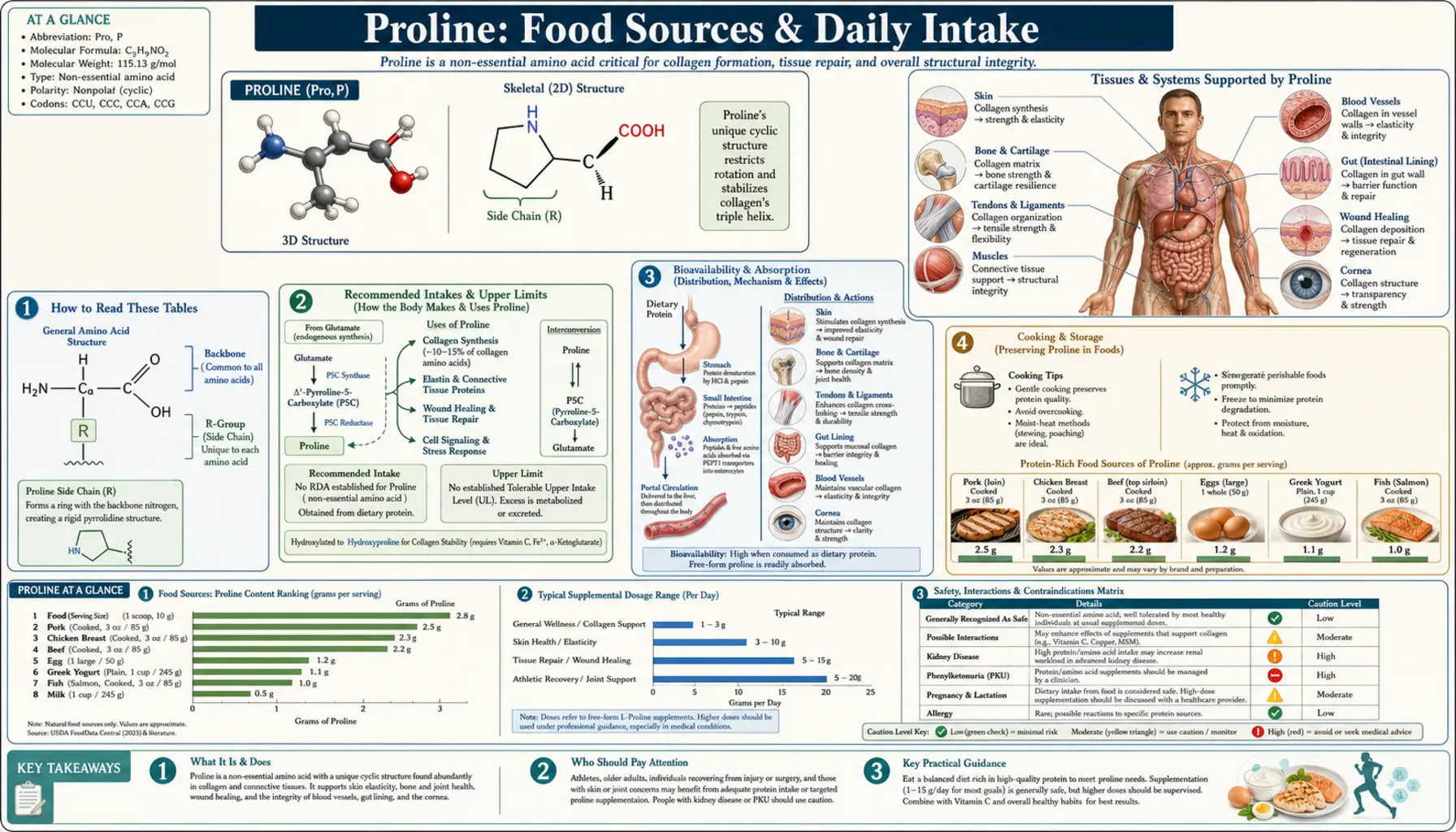
Proline is one of the main building blocks of collagen — the structural protein that holds skin, tendons, ligaments, cartilage, bone and blood-vessel walls together — where it pairs with glycine and hydroxyproline. The body can make proline from glutamate, so it is classed as non-essential, but it becomes conditionally essential during rapid growth, wound healing and recovery, when demand runs high. To actually build collagen from proline the body needs vitamin C, which the enzyme that converts proline to hydroxyproline depends on. The richest dietary sources are collagen itself — gelatin and bone broth — followed by hard cheeses, meat, fish and eggs. The table below shows grams of proline per 100 g of food; there is no FDA Daily Value for individual amino acids, so amounts are absolute.
| Proline: Food Sources & Daily Intake | |||||
|---|---|---|---|---|---|
| Rank | Food (serving) | Per 100 g | Glucose | Fructose | Notes |
| 1 | Gelatin (Dry) 1 tbsp / 7 g | 🟢 12 g | 0 | 0 | By far the richest source — pure collagen protein. |
| 2 | Parmesan Cheese 1 oz / 28 g | 🟡 4.2 g | — | — | Concentrated aged-dairy protein. |
| 3 | Cheddar Cheese 1 oz / 28 g | 🟡 2.7 g | 0 | 0 | |
| 4 | Soybeans 1 cup cooked / 172 g | 🟡 2.4 g | — | — | Top whole-plant source. |
| 5 | Pork Organ Meats 3 oz / 85 g | 🟡 1.6 g | — | — | Nutrient-dense organ meat. |
| 6 | Lentils 1 cup cooked / 198 g | 🟡 1.5 g | — | — | |
| 7 | Chicken Organ Meats 3 oz / 85 g | 🟡 1.3 g | — | — | Nutrient-dense organ meat (giblets). |
| 8 | Beef Meat 3 oz / 85 g | 🟡 1.3 g | 0 | 0 | |
| 9 | Beef Organ Meats 3 oz / 85 g | ⚪ 1.2 g | — | — | Nutrient-dense organ meat. |
| 10 | Sunflower Seeds 1 oz / 28 g | ⚪ 1.2 g | — | — | |
| 11 | Peanuts 1 oz / 28 g | ⚪ 1.1 g | — | — | |
| 12 | White Beans 1 cup cooked / 179 g | ⚪ 1.0 g | — | — | |
| 13 | Chicken 3 oz / 85 g | ⚪ 0.9 g | 0 | 0 | |
| 14 | Pork 3 oz / 85 g | ⚪ 0.9 g | 0 | 0 | |
| 15 | Tuna 3 oz / 85 g | ⚪ 0.8 g | 0 | 0 | |
| 16 | Salmon 3 oz / 85 g | ⚪ 0.7 g | 0 | 0 | |
| 17 | Brown Rice 1 cup / 195 g | ⚪ 0.1 g | 0 | 0 | Common staple. |
Table of Contents
- How to Read These Tables
- Recommended Intakes & Upper Limits
- Bioavailability & Absorption
- Cooking & Storage
- Vegetarian & Vegan Sources
- Who Needs to Pay Attention
- Data Sources & References
- Connections
- Featured Videos
How to Read These Tables
- Non-essential, but it matters during healing. The body normally makes its own proline, so there is no dietary requirement. During rapid growth or while healing a wound, demand can outpace what the body produces — that is when proline-rich food (and the vitamin C needed to use it) becomes useful.
- Grams per 100 g, not %DV. There is no FDA Daily Value for individual amino acids, so this table reports the absolute grams per 100 g of food and ranks foods by that. A typical serving is shown beside each food.
- Proline concentrates in collagen. The foods at the top of the list are collagen itself — gelatin and bone broth made from connective tissue, skin and bone — plus aged dairy. Ordinary muscle meat, fish, eggs and legumes supply proline too, just less densely.
Recommended Intakes & Upper Limits
Your personal target depends on age, sex and pregnancy. The Daily Value used for the %DV column above is a single label figure; the table below is the age-specific guidance.
| Reference | Adult value | Notes |
|---|---|---|
| Status | Non-essential (conditionally essential in growth/healing) | The body makes proline from glutamate, but demand can outstrip supply during rapid growth, wound healing or recovery. |
| Adult requirement | None set | No WHO/FAO or DRI requirement exists for proline; it is not an essential amino acid. |
| Main role | Building block of collagen | Proline and its hydroxylated form (hydroxyproline) make up much of collagen, the body’s main structural protein in skin, joints and connective tissue. |
| Richest in | Collagen-rich & dairy foods | Gelatin and bone broth (from connective tissue), then hard cheeses, meat, fish and eggs. |
Bioavailability & Absorption
Proline from food is well absorbed as part of dietary protein, and the body can also synthesize it from glutamate, so blood levels are rarely a problem in anyone eating enough total protein. What matters for connective tissue is having proline available together with the cofactors collagen synthesis needs — especially vitamin C, plus iron and oxygen — because the enzyme prolyl hydroxylase uses vitamin C to convert proline into the hydroxyproline that locks collagen’s triple helix together. Eating proline-rich food without enough vitamin C limits how much usable collagen the body can build.
Cooking & Storage
Proline is stable to ordinary cooking and is not destroyed by normal heat. In fact, the most proline-dense food of all is created by cooking: simmering bones, skin and connective tissue for hours dissolves their collagen into gelatin — this is exactly what bone broth is, and why it carries so much proline and glycine. Slow, moist heat (braising, stewing, stock-making) is the way to extract collagen-bound proline from tougher cuts and bones.
Vegetarian & Vegan Sources
Getting proline for collagen-style repair is harder on a plant-based diet, because the densest sources — gelatin and bone broth — are animal connective tissue, and plants contain no collagen at all. Plant eaters can still supply plenty of proline as an amino acid from soybeans, white and other beans, lentils, peanuts and sunflower seeds, with smaller amounts from vegetables like asparagus and cabbage. The body then builds its own collagen from that proline — provided total protein is adequate and vitamin C intake is good, since vitamin C is the limiting cofactor for collagen synthesis.
Who Needs to Pay Attention
Outright proline deficiency is essentially unknown in people eating adequate protein, because the body manufactures its own. Proline becomes more relevant in situations of high connective-tissue demand — wound healing, recovery from surgery or burns, and rapid growth — where supply may not keep up with need. The practical priority in those settings is enough total quality protein plus sufficient vitamin C, the cofactor that lets proline be turned into collagen; proline alone, without vitamin C, cannot build sound new tissue.
Data Sources & References
- NIH MedlinePlus — Amino acids
- Linus Pauling Institute — vitamin C and collagen synthesis
- PubMed — proline, vitamin C and collagen synthesis in wound healing