MK-7 vs MK-4 — Comparing the Two Principal Vitamin K2 Forms
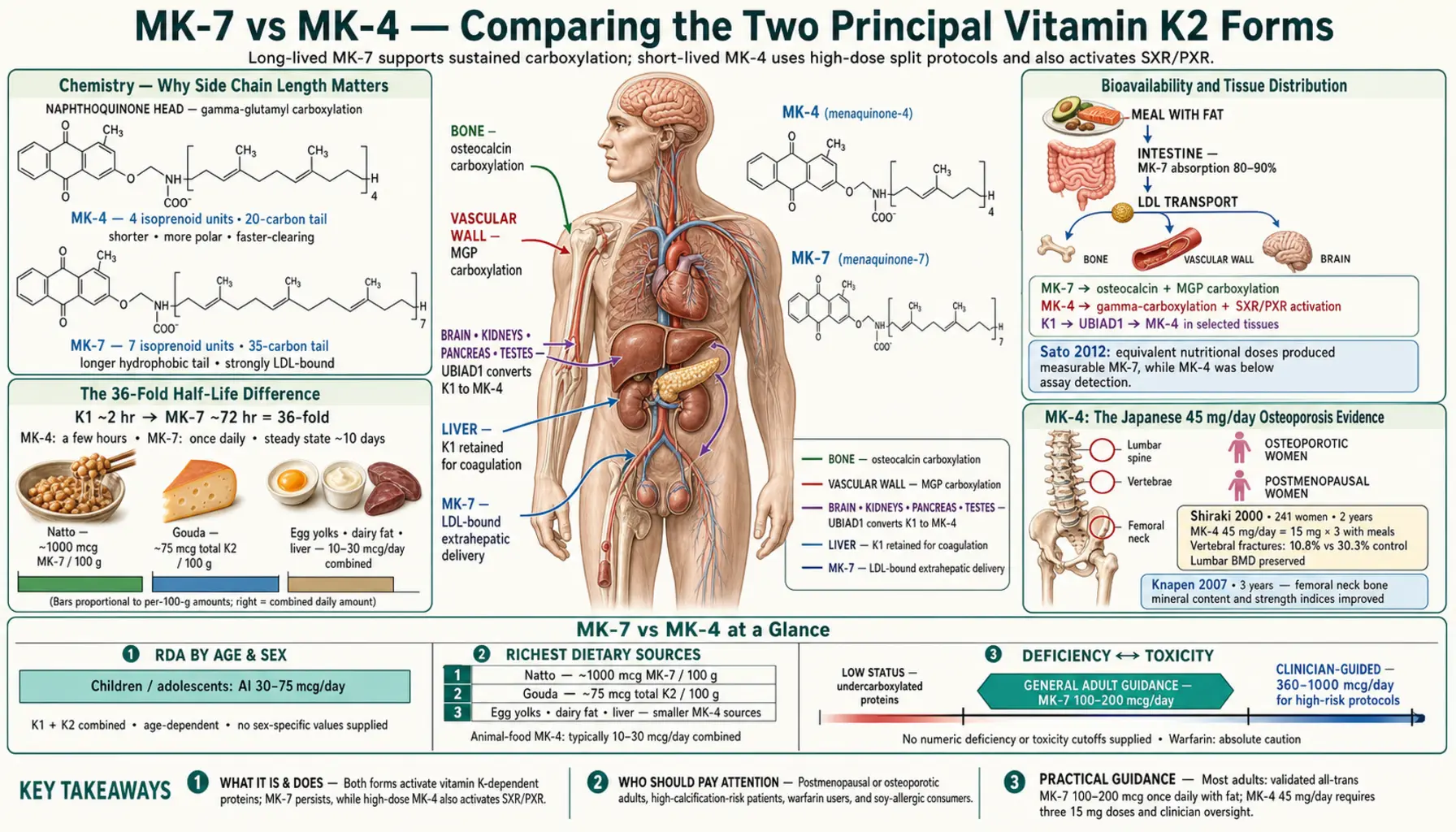
The single most-asked vitamin K2 question is "MK-7 or MK-4?" The answer depends on what evidence base and protocol you want to follow. MK-7 (long-chain menaquinone, ~72 hour half-life, naturally produced by Bacillus subtilis natto fermentation, dosed at 100–200 mcg once-daily) dominates the modern Western trial literature on arterial stiffness, dp-ucMGP reduction, and bone-density preservation. MK-4 (short-chain menaquinone, hours-long half-life, naturally found in animal foods and endogenously synthesized from K1 by the UBIAD1 enzyme, dosed at 45 mg/day in three split doses) dominates the Japanese pharmaceutical literature where high-dose protocols have produced significant fracture-reduction results in osteoporotic women. This page walks through both bodies of evidence, the pharmacokinetic differences that explain why the two protocols look so different, the cis/trans isomer quality problem, source-quality concerns, and practical dosing recommendations for each form.
Table of Contents
- Chemistry — Why Side Chain Length Matters
- The 36-Fold Half-Life Difference
- Bioavailability and Tissue Distribution
- MK-4: The Japanese 45 mg/day Osteoporosis Evidence
- MK-7: The Knapen and LARS Bone & Vascular Trials
- Mechanism Beyond Carboxylation: SXR/PXR Receptor Activation
- The Cis vs Trans MK-7 Quality Problem
- Source Quality — Natto, Synthetic, Chickpea
- Practical Dosing Recommendations
- Combination MK-4 + MK-7 Supplements
- Cautions & Contraindications
- Key Research Papers
- Connections
- Featured Videos
1. Chemistry — Why Side Chain Length Matters
The vitamin K2 menaquinones share the same naphthoquinone "head" group as Vitamin K1, but differ in the length of the isoprenoid tail attached to the ring. The number in "MK-n" refers to the number of isoprenoid units in the side chain.
- MK-4 (menaquinone-4) has a 4-unit (geranylgeranyl) side chain, 20 carbons long. The relatively short side chain makes MK-4 more polar and faster-clearing.
- MK-7 (menaquinone-7) has a 7-unit side chain, 35 carbons long. The much longer hydrophobic tail makes MK-7 strongly LDL-bound in circulation, dramatically extending its half-life and enabling efficient delivery to extrahepatic tissues.
- Other menaquinones (MK-5 through MK-13) exist in foods (especially fermented cheeses produce MK-8 and MK-9), with progressively longer half-lives as side chain length increases. MK-7 sits in the practical sweet spot of long half-life + commercial availability + safety record.
The naphthoquinone head group is the part of the molecule that participates in the gamma-glutamyl carboxylation reaction — so all menaquinones can in principle activate the same Vitamin K-dependent proteins. What differs is how long they stay around to do it and which tissues they reach.
2. The 36-Fold Half-Life Difference
Plasma half-life is the single most important pharmacological difference between the two forms.
| Form | Half-Life | Steady-State Behavior | Required Dosing Frequency |
|---|---|---|---|
| K1 (phylloquinone) | 1–2 hours | Plasma falls back to baseline between meals | Multiple times daily from food |
| MK-4 | A few hours | Does not accumulate at nutritional doses | 3× daily required for clinical effect |
| MK-7 | ~72 hours | Reaches steady state at ~10 days of daily dosing | Once daily sufficient |
| MK-9 | Even longer (days) | Highest accumulation in tissues | Once daily or less |
The 36-fold half-life difference between K1 (~2 hr) and MK-7 (~72 hr) is the single most consequential pharmacokinetic fact about vitamin K supplementation. It explains why a 100 mcg daily dose of MK-7 produces sustained extrahepatic protein activation, while a 100 mcg dose of K1 (with the same naphthoquinone) does not — the K1 disappears from plasma between doses, while the MK-7 maintains circulating levels around the clock.
The half-life also explains why MK-4 requires high doses (45 mg/day) in the Japanese osteoporosis protocols: MK-4 plasma levels drop quickly, so each dose must be large enough to push tissue uptake before clearance. MK-7 reaches the same extrahepatic targets with a 200–500-fold lower dose because it persists in circulation.
3. Bioavailability and Tissue Distribution
- MK-7 bioavailability is excellent. Studies show absorption efficiency of 80–90% from both natto and supplements (synthetic MK-7 in soft-gel or oil-based capsules). Like all fat-soluble vitamins, absorption requires adequate dietary fat — take MK-7 with a meal containing at least a few grams of fat.
- MK-4 bioavailability at nutritional doses is poor. The Sato 2012 study comparing equivalent doses of MK-4 and MK-7 found that MK-7 produced measurable plasma levels and osteocalcin carboxylation improvements while MK-4 at the same nutritional dose did not — the MK-4 plasma signal was below the detection limit of most assays. This is why MK-4 only "works" at the very high Japanese pharmaceutical dose.
- LDL-bound transport favors extrahepatic delivery for MK-7. After intestinal absorption, MK-7 incorporates into LDL particles and is delivered widely to extrahepatic tissues (bone, vascular wall, brain). K1 by contrast is preferentially retained in the liver (HDL-bound, hepatic uptake) and primarily used for coagulation factor synthesis.
- MK-4 has tissue-specific endogenous synthesis. The UBIAD1 enzyme converts K1 to MK-4 in the brain, kidneys, pancreas, and testes — so MK-4 tissue levels are determined partly by local synthesis from K1 rather than dietary MK-4 alone. This is why brain MK-4 levels are high even in people consuming little dietary MK-4.
4. MK-4: The Japanese 45 mg/day Osteoporosis Evidence
The Japanese MK-4 evidence base is the source of the high-dose pharmaceutical protocol. The compound (called "menatetrenone" in Japan and Korea) is approved as an osteoporosis treatment, prescribed at 45 mg/day divided into three 15 mg doses with meals.
Shiraki 2000 trial
Shiraki and colleagues randomized 241 osteoporotic women to menatetrenone 45 mg/day vs no treatment for 2 years. Results showed significant reduction in vertebral fracture rate (10.8% with menatetrenone vs 30.3% with control) and significant preservation of lumbar BMD compared to control. This trial is the citation that drives Japanese clinical practice. Journal of Bone and Mineral Research 15(3): 515–521. doi:10.1359/jbmr.2000.15.3.515
Knapen 2007 (Western MK-4 trial, lower dose)
Knapen et al. tested MK-4 at a much lower dose (45 mg/day) on hip geometry and bone strength indices in healthy postmenopausal women over 3 years and found significant improvements in femoral neck bone mineral content and bone strength indices. Osteoporosis International 18(7): 963–972. doi:10.1007/s00198-007-0337-9
Iwamoto clinical review
Iwamoto and Sato (2013) reviewed the entire menatetrenone Japanese clinical literature, concluding that the 45 mg/day dose reduces fracture risk in postmenopausal women through a combination of osteocalcin carboxylation, SXR/PXR receptor activation, and direct effects on osteoblast and osteoclast differentiation. Expert Opinion on Pharmacotherapy 14(4): 449–458. doi:10.1517/14656566.2013.766663
The Japanese clinical context is important: menatetrenone competes with bisphosphonates and SERMs as a first-line osteoporosis treatment because it is well-tolerated, oral, and inexpensive. Western osteoporosis guidelines have not adopted high-dose MK-4 because (1) the trials are predominantly Japanese-population, (2) head-to-head trials against modern denosumab have not been conducted, and (3) the cost-effectiveness vs generic bisphosphonates is not established.
5. MK-7: The Knapen and LARS Bone & Vascular Trials
The MK-7 evidence base has grown rapidly since 2010 and is now the dominant Western K2 literature.
Knapen 2013 (3-year LARS bone trial)
The landmark MK-7 bone trial. 244 healthy postmenopausal women randomized to MK-7 180 mcg/day vs placebo for 3 years. Results showed significant preservation of lumbar spine and femoral neck BMD, with the MK-7 group showing significantly reduced age-related decline in bone mineral content. Vertebral bone strength indices improved measurably. Osteoporosis International 24(9): 2499–2507. doi:10.1007/s00198-013-2325-6
Knapen 2015 (arterial stiffness trial)
Same author group, parallel vascular outcome. The MK-7 180 mcg/day group showed significant improvement in carotid-femoral pulse wave velocity over 3 years compared to placebo. Pulse wave velocity is an independent predictor of cardiovascular events. Thrombosis and Haemostasis 113(5): 1135–1144. doi:10.1160/TH14-08-0675
Inaba 2015 (low-dose MK-7)
Tested whether even smaller MK-7 doses (90 mcg vs 180 mcg vs 360 mcg daily) could measurably reduce undercarboxylated osteocalcin. All three doses significantly improved osteocalcin carboxylation, with a clear dose-response. Even 90 mcg/day produced functional benefit, establishing the lower end of effective dosing. Journal of Nutritional Science and Vitaminology 61(6): 471–480. doi:10.3177/jnsv.61.471
Brandenburg 2017 (aortic valve calcification)
Open-label trial in patients with calcific aortic valve disease. MK-7 1000 mcg/day significantly slowed aortic valve calcification progression measured by cardiac CT versus matched controls. Circulation 135(21): 2081–2083. doi:10.1161/CIRCULATIONAHA.116.027011
Caluwe 2014 (hemodialysis dose-finding)
Hemodialysis patients have dramatically elevated dp-ucMGP from accelerated vascular calcification. MK-7 360 mcg/day reduced dp-ucMGP significantly more than 180 mcg/day in this high-risk population. Nephrology Dialysis Transplantation 29(7): 1385–1390. doi:10.1093/ndt/gft464
Together, these trials establish MK-7 100–200 mcg/day as the standard adult nutritional dose for both bone and vascular protection, with 360–1000 mcg/day reserved for high-calcification-risk populations (CKD, established cardiovascular disease, aortic stenosis).
6. Mechanism Beyond Carboxylation: SXR/PXR Receptor Activation
Both MK-4 and MK-7 activate the gamma-glutamyl carboxylase enzyme. But MK-4 has an additional, carboxylation-independent mechanism: activation of the steroid and xenobiotic receptor (SXR/PXR), a nuclear receptor that regulates bone-specific gene transcription. This was demonstrated by Tabb et al. (2003) in Journal of Biological Chemistry, who showed that MK-4 binds and activates SXR, upregulating expression of bone matrix proteins (tsukushi, matrilin-2, CD14) that contribute to osteoblast function. doi:10.1074/jbc.M303136200
This SXR/PXR mechanism is the proposed explanation for why high-dose MK-4 produces bone benefits beyond what simple osteocalcin carboxylation would predict — the high MK-4 concentrations needed are partially to saturate the SXR/PXR receptor system. MK-7 binds SXR/PXR less efficiently due to its longer side chain, so its bone effects are predominantly through osteocalcin carboxylation alone.
For practical purposes: if you want the SXR/PXR mechanism, you need MK-4 at the high dose. If you only want osteocalcin and MGP carboxylation (the dominant evidence-based benefits), MK-7 at 100–200 mcg/day suffices and is dramatically cheaper.
7. The Cis vs Trans MK-7 Quality Problem
Only the all-trans isomer of MK-7 is biologically active. The cis isomer is biologically inactive and may even compete with all-trans MK-7 for absorption and tissue uptake.
This matters because synthetic MK-7 production by chemical synthesis can yield a mixture of cis and trans isomers, and cheap commodity MK-7 (often sourced from low-cost Chinese manufacturers) may contain anywhere from 10–50% inactive cis-isomer. A "180 mcg MK-7" label that is actually 50% cis delivers only 90 mcg of bioactive material.
Trustworthy commercial MK-7 sources that specify all-trans purity:
- MenaQ7 by NattoPharma (Norway, derived from natto fermentation; 100% all-trans by definition because biological synthesis only produces the trans form)
- K2VITAL by Kappa Bioscience (Norway, synthetic with documented 99%+ all-trans purity)
- Gnosis Vitamk7 (Italy, fermentation-derived)
Always look for explicit "all-trans" or "100% trans" or ">99% trans" labeling. If the label is silent on cis/trans content, assume it is cheap and likely impure. The price difference between commodity and validated MK-7 is real but not dramatic — usually $15–25/month for validated all-trans MK-7 vs $5–10/month for unverified material.
Naturally-derived MK-7 (from natto fermentation, fermented cheese, or other bacterial sources) is always all-trans because biological synthesis cannot produce the cis isomer.
8. Source Quality — Natto, Synthetic, Chickpea
- Natto-derived MK-7: The original natural source. Bacillus subtilis var. natto ferments soybeans and produces MK-7 as a metabolic byproduct. Natto-derived MK-7 is 100% all-trans, comes with trace soy protein (a concern for soy-allergic individuals), and represents the form humans have consumed for centuries in eastern Japan. Whole-food natto delivers ~1000 mcg MK-7 per 100 g serving.
- Synthetic MK-7: Chemical synthesis from precursors. Purity depends on the manufacturer's process and quality control — well-controlled synthesis (K2VITAL) produces >99% all-trans; poor processes produce mixed cis/trans. No allergen concern.
- Chickpea-fermented MK-7: A newer option for soy-allergic consumers. B. subtilis can be grown on chickpea substrate instead of soy. Some commercial vegan-soy-free MK-7 products use this approach. Still all-trans because of biological synthesis.
- Cheese-derived MK-7 / MK-8 / MK-9: Hard aged cheeses (Gouda, Brie, Edam, cheddar) contain a mixture of menaquinones from bacterial cultures. Gouda is particularly rich, providing ~75 mcg total K2 per 100 g. Not a feasible supplement source but a genuine dietary contribution.
- MK-4 sources: All commercial MK-4 supplements are synthetic (chemical conversion from menadione). The synthetic process is straightforward and there is no cis/trans issue with MK-4. Animal-food MK-4 (egg yolks, dairy fat, liver) provides smaller daily amounts (typically 10–30 mcg/day combined).
9. Practical Dosing Recommendations
For general adult prevention (bone + vascular, no diagnosed disease)
- MK-7 100–200 mcg/day, once daily with breakfast or dinner. Take with a meal containing fat for absorption. Choose validated all-trans (MenaQ7 or K2VITAL labeled).
- Optional pairing: Vitamin D3 2000–5000 IU/day (single capsule). Many D3+K2 combinations exist; check the K2 form is MK-7 with verified all-trans purity.
For postmenopausal bone protection, established osteopenia
- MK-7 180 mcg/day (matches the Knapen 3-year LARS trial dose). Single daily dose.
- Plus D3 2000–4000 IU/day (target 25(OH)D 40–60 ng/mL).
- Plus dietary calcium 1000–1200 mg/day (preferably food, not pills).
- Continue indefinitely. Benefits are cumulative over years.
For high-risk vascular calcification (CKD, established CVD, aortic stenosis)
- MK-7 360 mcg/day (matches Caluwe hemodialysis trial). Single daily dose.
- Consider 1000 mcg/day if monitoring dp-ucMGP biomarker and not responding to 360 mcg (matches Brandenburg aortic valve trial).
- Coordinate with nephrologist or cardiologist; ensure warfarin is not part of the regimen.
For Japanese-style high-dose osteoporosis treatment
- MK-4 45 mg/day, split as 15 mg three times daily with meals (matches Shiraki 2000 protocol).
- This is a pharmaceutical-dose regimen; coordinate with a clinician familiar with the Japanese literature.
- Cost: typically $40–80/month at this dose.
- Not a replacement for bisphosphonates or denosumab in patients with T-scores below -2.5; use as adjunct.
For Vitamin K-Deficiency Bleeding (VKDB) prophylaxis in newborns
- Use Vitamin K1 IM injection (0.5–1 mg single dose at birth), not K2. The pediatric standard is the K1 protocol; K2 has not been validated for newborn coagulation prophylaxis.
10. Combination MK-4 + MK-7 Supplements
Many commercial K2 products combine MK-4 + MK-7 (e.g., "MK-4 1500 mcg + MK-7 100 mcg"). The rationale is to leverage MK-7's long half-life for sustained extrahepatic carboxylation while also providing some MK-4 for the SXR/PXR mechanism.
The evidence for combination supplements is weaker than for either form alone — almost all the bone/vascular clinical trials have used one form at a time. The combination approach is plausible from a mechanism standpoint but is not directly trial-validated.
For most people, plain MK-7 at 100–200 mcg/day is sufficient and is supported by the strongest trial evidence. Combination supplements are reasonable but not necessary.
11. Cautions & Contraindications
- Warfarin (Coumadin) — absolute caution. Both MK-4 and MK-7 will counteract warfarin. K2 supplementation cannot be added to warfarin therapy without coordinated hematology supervision and INR monitoring. Switching to a DOAC (apixaban, rivaroxaban) eliminates the problem because DOACs do not act on the vitamin K cycle.
- High-dose MK-4 in pregnancy not studied. Nutritional doses of MK-7 (90–200 mcg) appear safe in pregnancy and lactation; the 45 mg/day MK-4 osteoporosis dose has not been studied in pregnant women and should not be used.
- Soy allergy: Natto-derived MK-7 contains trace soy protein. Allergic individuals should use synthetic all-trans MK-7 (K2VITAL) or chickpea-fermented MK-7.
- Cis-isomer contamination: Unverified MK-7 may be up to 50% inactive cis isomer. Always choose validated all-trans (MenaQ7, K2VITAL, Vitamk7).
- Active thromboembolic disease: If you have recent DVT, PE, mechanical heart valve, or atrial fibrillation requiring anticoagulation, K2 supplementation should be paused or coordinated with the prescriber.
- Multivitamin stacking: Many bone-support multivitamins already contain MK-7. Read labels — total daily K2 intake from all supplements should stay below 360 mcg/day unless monitoring dp-ucMGP and ucOC biomarkers under clinician guidance.
- MK-4 absorption requires fat with each dose. Because of the short half-life and need for 3× daily dosing, MK-4 protocols require careful attention to taking each dose with a fat-containing meal. Missed doses substantially reduce effect.
- Children and adolescents: No established pediatric dose for K2 supplementation. The AI for vitamin K (K1 + K2 combined) in children is 30–75 mcg/day depending on age; most children meet this through normal diet and do not require supplements.
Key Research Papers
- Shiraki M, Shiraki Y, Aoki C, Miura M (2000). Vitamin K2 (menatetrenone) effectively prevents fractures and sustains lumbar bone mineral density in osteoporosis. Journal of Bone and Mineral Research 15(3): 515–521. doi:10.1359/jbmr.2000.15.3.515
- Knapen MHJ, Schurgers LJ, Vermeer C (2007). Vitamin K2 supplementation improves hip bone geometry and bone strength indices in postmenopausal women. Osteoporosis International 18(7): 963–972. doi:10.1007/s00198-007-0337-9
- Knapen MHJ, Drummen NE, Smit E, Vermeer C, Theuwissen E (2013). Three-year low-dose menaquinone-7 supplementation helps decrease bone loss in healthy postmenopausal women. Osteoporosis International 24(9): 2499–2507. doi:10.1007/s00198-013-2325-6
- Knapen MHJ, Braam LAJLM, Drummen NE, Bekers O, Hoeks APG, Vermeer C (2015). Menaquinone-7 supplementation improves arterial stiffness in healthy postmenopausal women: a double-blind randomised clinical trial. Thrombosis and Haemostasis 113(5): 1135–1144. doi:10.1160/TH14-08-0675
- Sato T, Schurgers LJ, Uenishi K (2012). Comparison of menaquinone-4 and menaquinone-7 bioavailability in healthy women. Nutrition Journal 11: 93. doi:10.1186/1475-2891-11-93
- Inaba N, Sato T, Yamashita T (2015). Low-dose daily intake of vitamin K2 (menaquinone-7) improves osteocalcin gamma-carboxylation: a double-blind, randomized controlled trial. Journal of Nutritional Science and Vitaminology 61(6): 471–480. doi:10.3177/jnsv.61.471
- Iwamoto J, Sato Y (2013). Menatetrenone for the treatment of osteoporosis. Expert Opinion on Pharmacotherapy 14(4): 449–458. Find on PubMed
- Yamaguchi M, Weitzmann MN (2011). Vitamin K2 stimulates osteoblastogenesis and suppresses osteoclastogenesis by suppressing NF-κB activation. International Journal of Molecular Medicine 27(1): 3–14. doi:10.3892/ijmm.2010.562
- Tabb MM, Sun A, Zhou C, Grun F, Errandi J, Romero K, Pham H, Inoue S, Mallick S, Lin M, Forman BM, Blumberg B (2003). Vitamin K2 regulation of bone homeostasis is mediated by the steroid and xenobiotic receptor SXR. Journal of Biological Chemistry 278(45): 43919–43927. doi:10.1074/jbc.M303136200
- Caluwe R, Vandecasteele S, Van Vlem B, Vermeer C, De Vriese AS (2014). Vitamin K2 supplementation in haemodialysis patients: a randomized dose-finding study. Nephrology Dialysis Transplantation 29(7): 1385–1390. doi:10.1093/ndt/gft464
- Brandenburg VM, Reinartz S, Kaesler N, Kruger T, Dirrichs T, Kramann R, Peeters F, Floege J, Keszei A, Marx N, Schurgers LJ, Koos R (2017). Slower progression of aortic valve calcification with vitamin K supplementation: results from a prospective interventional proof-of-concept study. Circulation 135(21): 2081–2083. doi:10.1161/CIRCULATIONAHA.116.027011
- Schurgers LJ, Teunissen KJF, Hamulyak K, Knapen MHJ, Vik H, Vermeer C (2007). Vitamin K-containing dietary supplements: comparison of synthetic vitamin K1 and natto-derived menaquinone-7. Blood 109(8): 3279–3283. doi:10.1182/blood-2006-08-040709
- Theuwissen E, Magdeleyns EJ, Braam LAJLM, Teunissen KJ, Knapen MHJ, Binnekamp IAG, van Summeren MJH, Vermeer C (2014). Vitamin K status in healthy volunteers. Food & Function 5(2): 229–234. doi:10.1039/c3fo60464k
- Nakagawa K, Hirota Y, Sawada N, Yuge N, Watanabe M, Uchino Y, Okuda N, Shimomura Y, Suhara Y, Okano T (2010). Identification of UBIAD1 as a novel human menaquinone-4 biosynthetic enzyme. Nature 468(7320): 117–121. doi:10.1038/nature09464
PubMed Topic Searches
- PubMed: MK-7 vs MK-4 comparison
- PubMed: Sato MK-4 vs MK-7 bioavailability
- PubMed: cis/trans MK-7 isomer purity
- PubMed: Menatetrenone osteoporosis (Japan)
- PubMed: UBIAD1 MK-4 biosynthesis
- PubMed: Natto MK-7 pharmacokinetics
Connections
- All Vitamins
- Vitamin K (Main Page)
- Vitamin K Benefits Hub
- K2 and Arterial Calcification
- K2 and Bone Health
- K2 and Insulin Sensitivity
- Vitamin K and Blood Clotting
- Vitamin D3
- Vitamin D3 and Bone Health
- Vitamin E
- Calcium
- Magnesium
- Cardiovascular Disease
- Coronary Artery Disease
- Osteoporosis
- Bisphosphonates
- Chronic Kidney Disease
- Fermented Foods
- Natto
- Bacillus Subtilis