Vitamin K: Food Sources & Daily Intake
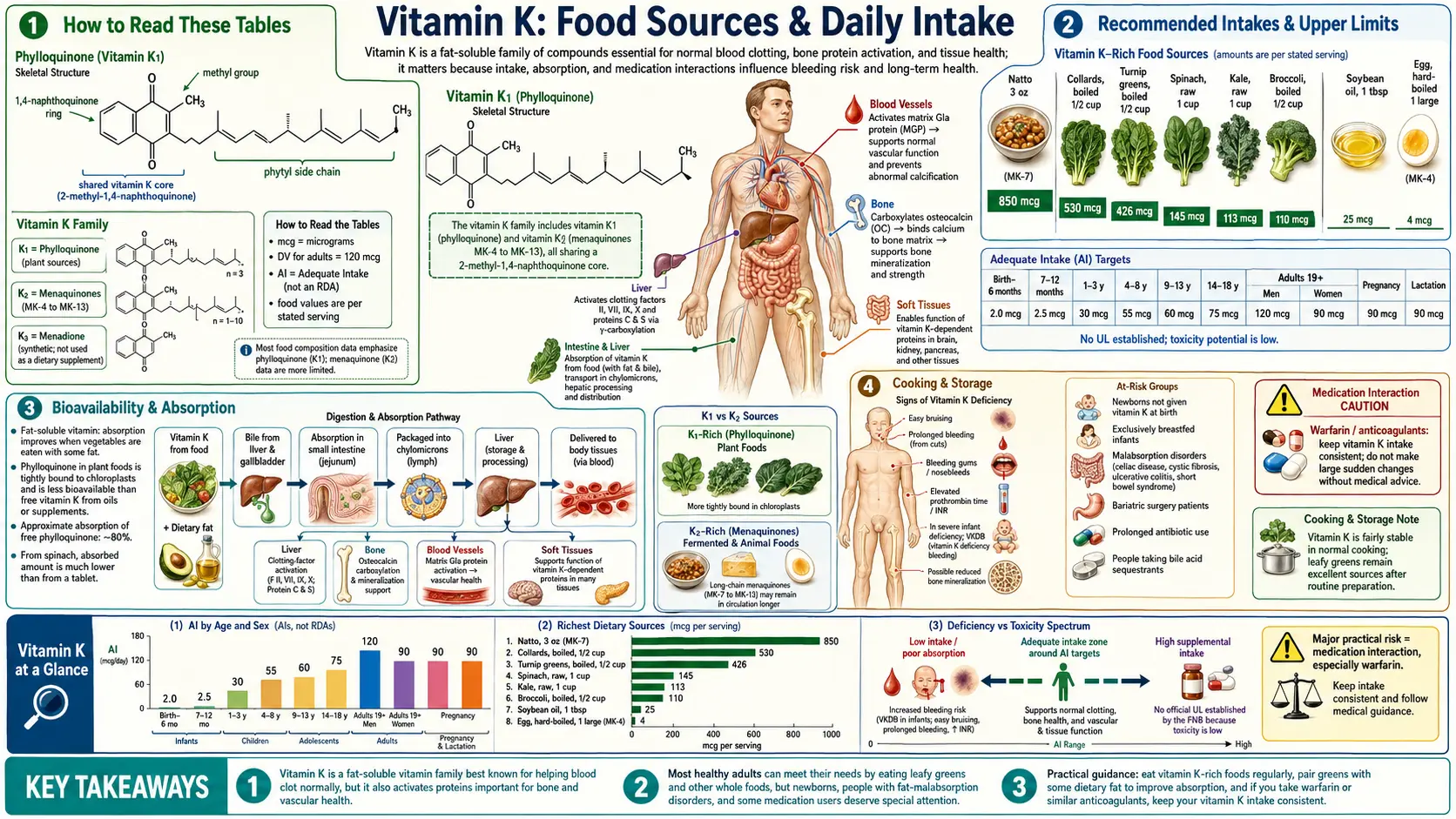
Vitamin K is a fat-soluble vitamin best known for one job your life depends on: it switches on the proteins that make your blood clot. (The “K” comes from Koagulation, the German spelling.) It also activates proteins that steer calcium into your bones and keep it out of your arteries. There are two natural families: K1 (phylloquinone), which dominates the diet and comes overwhelmingly from dark leafy greens, and K2 (menaquinones), made by bacteria and found in some cheeses, egg yolk and liver. The table below is K1, the form that makes up most of what people actually eat.
| Vitamin K: Food Sources & Daily Intake | ||||||
|---|---|---|---|---|---|---|
| Rank | Food (serving) | Per 100 g | %DV / 100g | Glucose | Fructose | Notes |
| 1 | Parsley, Raw ½ cup chopped / 30 g | 1,640 mcg | 🟢 1,367% | — | — | Tiny portions add up fast — parsley is extraordinarily concentrated. |
| 2 | Swiss Chard, Raw 1 cup / 36 g | 830 mcg | 🟢 692% | — | — | |
| 3 | Mustard Greens 1 cup / 140 g | 593 mcg | 🟢 494% | — | — | |
| 4 | Spinach 1 cup / 180 g | 494 mcg | 🟢 412% | — | — | |
| 5 | Beet Greens 1 cup / 144 g | 484 mcg | 🟢 403% | — | — | |
| 6 | Spinach, Raw 1 cup / 30 g | 483 mcg | 🟢 403% | 0.1 | 0.1 | Cooked spinach is even denser per cup because it wilts down. |
| 7 | Kale 1 cup / 130 g | 418 mcg | 🟢 348% | 0.5 | 0.4 | One of the richest whole-food K1 sources — a single serving is several days’ worth. |
| 8 | Collard Greens 1 cup / 190 g | 407 mcg | 🟢 339% | — | — | |
| 9 | Turnip Greens 1 cup / 144 g | 368 mcg | 🟢 307% | — | — | |
| 10 | Broccoli 1 cup / 156 g | 141 mcg | 🟢 118% | 0.5 | 0.7 | Steam rather than boil to keep more of the vitamin. |
| 11 | Brussels Sprouts 1 cup / 156 g | 140 mcg | 🟢 117% | — | — | |
| 12 | Green Leaf Lettuce, Raw 1 cup shredded / 36 g | 126 mcg | 🟢 105% | 0.4 | 0.4 | |
| 13 | Cabbage 1 cup / 150 g | 109 mcg | 🟢 91% | 1.6 | 1.2 | |
| 14 | Canola Oil 1 tbsp / 14 g | 71 mcg | 🟢 59% | 0 | 0 | |
| 15 | Asparagus 1 cup / 180 g | 51 mcg | 🟡 42% | 0.4 | 0.8 | |
| 16 | Kiwifruit 1 medium / 69 g | 40 mcg | 🟡 34% | 4.1 | 4.3 | One of the few fruits with meaningful K1. |
| 17 | Brown Rice 1 cup / 195 g | 0.2 mcg | ⚪ 0% | 0 | 0 | Common staple. |
Table of Contents
- How to Read These Tables
- Recommended Intakes & Upper Limits
- Bioavailability & Absorption
- Cooking & Storage
- Vegetarian & Vegan Sources
- Who Needs to Pay Attention
- Data Sources & References
- Connections
- Featured Videos
How to Read These Tables
- Fat-soluble — eat it with fat. Unlike water-soluble vitamins, vitamin K needs some dietary fat to be absorbed. A drizzle of olive oil or a vinaigrette on your greens genuinely improves how much you take up — plain steamed greens deliver less.
- %DV vs AI. The %DV column compares a serving against the FDA Daily Value of 120 mcg. Your personal target is the Adequate Intake (AI) — 120 mcg for men and 90 mcg for women — not an RDA, because the data are too limited to set one. See the second table.
- Per 100 g vs per serving. Per-100 g lets you compare foods fairly; the serving size shown beside each food is what you actually eat. A single cup of cooked kale, collards or spinach clears several days’ worth in one go.
Recommended Intakes & Upper Limits
Your personal target depends on age, sex and pregnancy. The Daily Value used for the %DV column above is a single label figure; the table below is the age-specific guidance.
| Life stage | RDA / AI (mcg/day) | Upper limit (mcg/day) |
|---|---|---|
| Infants 0–6 mo | 2.0* (AI) | Not set |
| Infants 7–12 mo | 2.5* (AI) | Not set |
| Children 1–3 y | 30* (AI) | Not set |
| Children 4–8 y | 55* (AI) | Not set |
| Children 9–13 y | 60* (AI) | Not set |
| Males 14–18 y | 75* (AI) | Not set |
| Males 19+ y | 120* (AI) | Not set |
| Females 14–18 y | 75* (AI) | Not set |
| Females 19+ y | 90* (AI) | Not set |
| Pregnancy | 75–90* (AI) | Not set |
| Lactation | 75–90* (AI) | Not set |
Bioavailability & Absorption
Vitamin K1 is wrapped inside the cell structures of plants, so the body absorbs only a modest fraction of it from raw greens — often well under a fifth of what’s on the label. Two things help a lot: fat in the same meal (the vitamin rides along with dietary fat into the bloodstream) and gentle cooking, which breaks down plant cell walls and frees the vitamin. This is the rare case where greens cooked in a little oil can beat the same greens raw. The K1 in plant oils and supplements is generally absorbed more readily than the K1 locked in vegetables.
Cooking & Storage
Good news: vitamin K is one of the more stable vitamins. It holds up well to normal cooking, heat and storage — far better than fragile vitamin C — though prolonged exposure to light can slowly degrade it. Because it’s fat-soluble it does not leach away into cooking water the way water-soluble vitamins do, so boiling greens loses relatively little. The practical move is simply to pair greens with a fat source: sauté in olive oil, toss with a vinaigrette, or add avocado or nuts. That single habit improves absorption more than any cooking method alone.
Vegetarian & Vegan Sources
K1 is an easy win for plant-based eaters — every top source is a plant (kale, collards, spinach, chard, broccoli, herbs and plant oils), and a normal serving of greens far exceeds the AI. The nuance is K2: the menaquinone form concentrates in animal foods (cheese, egg yolk, liver). Most evidence suggests adequate K1 covers the basics for healthy people, and the body converts some K1 to K2; vegans who want a K2 source can use a supplement.
Who Needs to Pay Attention
Anyone taking warfarin (Coumadin) or another vitamin-K-antagonist blood thinner should read this carefully. Warfarin works by blocking vitamin K, so what you eat directly affects how well it controls your clotting. The goal is not to avoid greens — it is to keep your vitamin K intake steady and consistent from week to week. Big swings (a sudden kale phase, then none) are what destabilize the dose and your INR. Keep your green-vegetable habits roughly the same day to day, and talk to your clinician or pharmacist before making any major diet change or starting a vitamin K supplement. Newer blood thinners (apixaban, rivaroxaban) are not affected by vitamin K, but never change your medication on your own. Outright deficiency is uncommon in adults; the group most at risk is newborns, who are born with very little — which is why a vitamin K shot at birth is standard and prevents dangerous bleeding. Because there is no documented toxicity, no Upper Limit exists for K1 or K2, but the warfarin interaction is real and important.
Data Sources & References
- NIH Office of Dietary Supplements — Vitamin K Fact Sheet (AI, DV, no UL, warfarin)
- Linus Pauling Institute — Vitamin K Micronutrient Information Center
- PubMed — vitamin K, phylloquinone, bone health and warfarin interaction
Connections
- All Vitamins
- Vitamin K (Main Page)
- Vitamin K Benefits
- Vitamin K History
- Vitamin D3 (works with K for bone & arteries)
- Calcium (K helps direct it to bone)
- Kale
- Spinach