Vitamin D3: History and Discovery
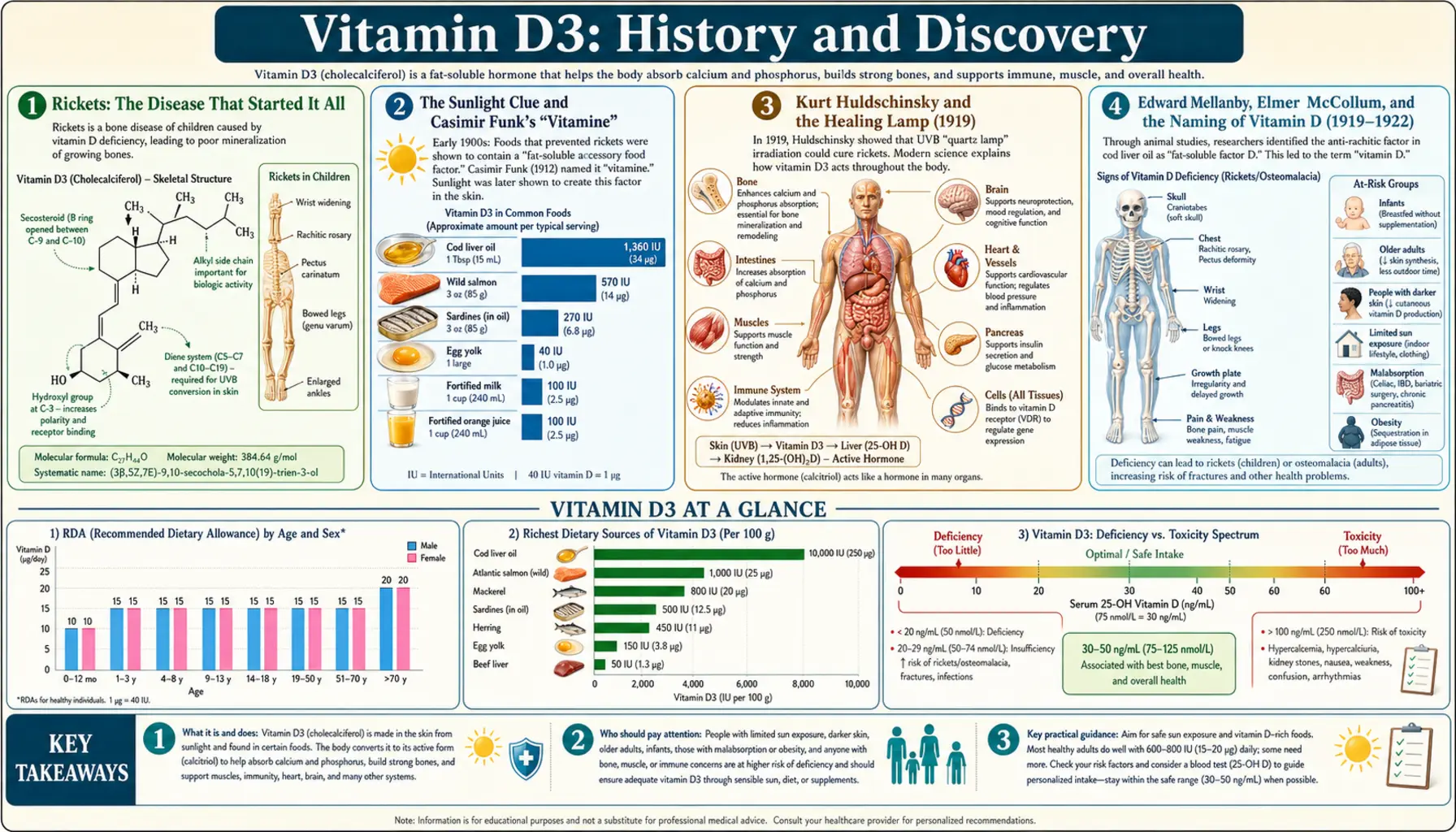
The story of Vitamin D3 begins not in a laboratory but in the soot-darkened cities of the Industrial Revolution, where a bone-softening childhood disease called rickets had become so common it was nicknamed "the English disease." Untangling its cause took more than a century of careful work by named, real people: physicians who noticed that sunlight seemed to heal it, a German pediatrician who in 1919 cured children with an ultraviolet lamp, an American chemist who in 1922 proved the healing factor in cod liver oil was a brand-new nutrient and gave it the name "vitamin D," and a Nobel-Prize-winning German chemist whose work on the sterols finally revealed the molecule's structure. This article tells that discovery story in order — who did what, when, and where the credit was disputed — and explains the unusual twist at its heart: Vitamin D turned out not to be a true dietary vitamin at all, but a hormone the skin makes from sunlight. Every name, date, and prize below has been checked against the historical and scientific record; where the record is uncertain, we say so plainly.
Table of Contents
- Rickets: The Disease That Started It All
- The Sunlight Clue and Casimir Funk's "Vitamine"
- Kurt Huldschinsky and the Healing Lamp (1919)
- Edward Mellanby, Elmer McCollum, and the Naming of Vitamin D (1919–1922)
- Steenbock, Hess, and the Irradiation Discovery (1924)
- Adolf Windaus, the Structure, and the 1928 Nobel Prize
- D2 Versus D3: Two Molecules, One Vitamin
- The Hormone Within: Calcidiol and Calcitriol (1968–1971)
- What the History Means Today
- Research Papers and References
- Connections
- Featured Videos
Rickets: The Disease That Started It All
Almost every vitamin was discovered by chasing down a deficiency disease, and for Vitamin D that disease is rickets — a disorder of growing children in which the bones fail to harden properly, leaving them soft, weak, and prone to bending under the body's own weight. The classic signs are bowed legs, knock-knees, swollen wrist and rib joints, a squared-off skull, delayed walking, and a generally stunted, sickly child. It is a deeply old affliction, but it became something close to an epidemic during the seventeenth, eighteenth, and nineteenth centuries in the crowded, smoke-choked industrial cities of northern Europe. So strongly was it tied to British industrial towns that it earned the grim nickname "the English disease."
Rickets was described in medical detail surprisingly early. The English physicians Daniel Whistler (in 1645) and Francis Glisson (in 1650) are usually credited with the first careful clinical accounts of the disease in the medical literature, and Glisson's treatise in particular became the standard reference for generations. What none of these early writers could supply was a cause. For centuries rickets was blamed on everything from bad air to poor parenting, and although cod liver oil was used as a folk remedy in some fishing communities, no one understood why it helped. The disease was visible, common, and crippling — and its true cause would not be pinned down until the twentieth century.
It is worth holding onto this starting point, because it explains the shape of everything that follows. Vitamin D was not discovered by someone looking for a vitamin. It was discovered by people trying to understand why so many children's bones were going soft — and the answer, when it finally came, turned out to involve both food and, surprisingly, sunlight.
The Sunlight Clue and Casimir Funk's "Vitamine"
One of the strangest features of rickets is that it tracked the seasons and the sky. The disease was worst in winter, worst in the sunless interiors of industrial cities, and noticeably rarer among children who lived and played outdoors in sunny climates. A handful of nineteenth-century observers noticed this and made the leap. The Polish physician Jędrzej Śniadecki is reported to have argued as early as the 1820s that sunlight could prevent and treat rickets, having observed that the disease was common among children in the city of Warsaw but rare in the surrounding countryside. Decades later, in 1890, the English physician Theobald Palm compiled reports from missionary doctors around the world and concluded that sunlight exposure was the key protective factor, recommending systematic sunbathing. These early sunlight observations are part of the historical record, though they were not widely accepted at the time and the exact wording of the oldest claims is hard to verify; we present them as the genuine early clues they were, not as the settled discovery.
While physicians puzzled over rickets, the broader idea of the "vitamin" was being born. In 1912, the Polish-born biochemist Casimir Funk, then working in London, proposed that several deficiency diseases — beriberi, scurvy, pellagra, and rickets among them — were each caused by the lack of a specific trace substance in the diet. He coined the word vitamine (from "vital amine") for these substances. The final "e" was later dropped to give the modern vitamin, once it became clear that not all of them were amines. Funk did not discover Vitamin D, and as the sections below show, Vitamin D would prove to be the most unusual member of the family — barely a dietary substance at all. But it was Funk's framework that gave the antirachitic factor its eventual name and its place among the vitamins.
Kurt Huldschinsky and the Healing Lamp (1919)
The sunlight clue moved from observation to proof in the hands of a German pediatrician named Kurt Huldschinsky. Working in Berlin in the aftermath of the First World War — a time when, by some estimates, roughly half of all German city children suffered from rickets to some degree — Huldschinsky tested a bold idea: if natural sunlight seemed to help, perhaps artificial ultraviolet light could too. In the winter of 1918–1919 he placed a small group of rachitic children under mercury-quartz ultraviolet lamps and documented, with X-rays, that their soft bones began to harden and heal. He published this result in 1919.
This was a landmark. For the first time, someone had deliberately cured rickets with a controlled, reproducible treatment, and had shown that the active agent was ultraviolet radiation — not diet, not fresh air in general, but a specific part of the light spectrum. Huldschinsky went further, demonstrating that irradiating one limb of a child produced healing throughout the skeleton, which told him the effect was systemic, carried through the body, rather than purely local to the skin exposed. He could not have known the molecular reason — that UVB light converts a cholesterol relative in the skin into Vitamin D3, which then circulates to the bones — but his clinical demonstration was solid and is well documented. For this and his later rickets work, Huldschinsky was honored with the Otto Heubner Prize of the German pediatric society in 1926.
Huldschinsky's lamps proved the sunlight side of the story. At almost the same time, on the other side of the question, researchers were proving the dietary side — and a quiet argument about what, exactly, was in cod liver oil was about to produce the name we use today.
Edward Mellanby, Elmer McCollum, and the Naming of Vitamin D (1919–1922)
The dietary thread runs through two researchers whose work fits together like a relay. The first is the British physician and researcher Sir Edward Mellanby. Around 1918–1919, working in London with dogs raised indoors on controlled diets, Mellanby produced rickets experimentally and then cured it — most reliably with cod liver oil. This established, for the first time in a controlled animal model, that rickets was a dietary deficiency disease that a specific fat-soluble factor in food could prevent and cure. Mellanby, however, drew a reasonable but ultimately mistaken conclusion: because cod liver oil was already known to be rich in the recently named "fat-soluble vitamin A," he attributed the antirachitic effect to vitamin A itself.
The correction came from the American biochemist Elmer Verner McCollum at Johns Hopkins University — the same McCollum who, with Marguerite Davis, had helped discover vitamin A in 1913. In a now-classic experiment published in 1922 ("Studies on Experimental Rickets. XXI," in the Journal of Biological Chemistry, with co-workers including Nina Simmonds and Paul Shipley), McCollum took cod liver oil and deliberately destroyed its vitamin A activity by bubbling oxygen through it while heating it. The treated oil could no longer cure the eye disease (xerophthalmia) caused by vitamin A deficiency — yet it still cured rickets. The two effects had been separated. The antirachitic factor was therefore something distinct from vitamin A: a new, previously unrecognized nutrient.
Because it was the fourth such fat-soluble or accessory factor to be named after A, B, and C, McCollum called it vitamin D. That is the moment the name in the title of this page was born: not from sunlight research, but from a careful subtraction experiment on fish oil. The two halves of the discovery — Huldschinsky's ultraviolet light and McCollum's dietary factor — were still, at this point, thought to be two different things. Reconciling them was the next breakthrough.
Steenbock, Hess, and the Irradiation Discovery (1924)
The bridge between "sunlight cures rickets" and "a vitamin in food cures rickets" was built in 1924, when two American research groups independently made the same remarkable discovery: you could give an ordinary food the power to cure rickets simply by shining ultraviolet light on it. The two leaders were Harry Steenbock, a biochemist at the University of Wisconsin, and Alfred Fabian Hess of Columbia University in New York. Both reported in 1924 that irradiating foods, oils, and especially their fatty (sterol) fractions made those foods antirachitic — able to prevent and cure rickets in test animals — even though the un-irradiated versions could not.
This was the unifying insight. Ultraviolet light and dietary Vitamin D were not two separate cures for rickets; they were two routes to the same substance. UV light was acting on a fatty precursor — in food, in oils, and (as later became clear) in the skin itself — converting it into the active antirachitic factor. Sunlight worked because the body manufactures the vitamin in irradiated skin; fortified food worked because irradiation manufactured it in the food first.
Here the history includes a genuine, well-documented dispute — not over who discovered the irradiation effect (Steenbock and Hess are both credited, having worked independently and published the same year) but over what to do with it. Steenbock chose to patent the irradiation process, filing a patent application in 1924 (granted in 1928) and assigning it to the newly created Wisconsin Alumni Research Foundation (WARF), arguing that patent control would prevent quack products and fund further research; royalties from milk fortification and the irradiation process went on to support science at Wisconsin for decades. Hess took the opposite path, declining to seek a commercial monopoly and stating that the procedure should be given freely for the benefit of children with rickets. Both positions are part of the record; we report the contrast as the real ethical fork it was, without casting either man as villain. Steenbock's patent, in particular, helped launch the era of Vitamin D–fortified milk that all but eliminated rickets in many countries.
Adolf Windaus, the Structure, and the 1928 Nobel Prize
By the mid-1920s, scientists knew rickets was caused by lack of a fat-soluble factor that the body could also make from ultraviolet light. What they still did not know was the factor's actual chemical identity — its molecular structure. That problem belonged to one of the great organic chemists of the era, the German Adolf Otto Reinhold Windaus, who had spent much of his career working out the structures of the sterols, the family of compounds that includes cholesterol.
Windaus's key realization was that the antirachitic vitamin belonged to the sterol family, and that ultraviolet light created it by chemically altering a sterol precursor. This connection — between the sterols he had studied for decades and the newly discovered vitamins — was so significant that in 1928 Windaus was awarded the Nobel Prize in Chemistry. The official citation, in the Nobel Foundation's own words, was "for the services rendered through his research into the constitution of the sterols and their connection with the vitamins." (The prize recognized his sterol work broadly; the detailed structure of the vitamin itself was still being refined at the time the prize was awarded.)
Over the following years, Windaus and his collaborators — together with the British group of Robert Benedict Bourdillon and colleagues, who isolated and crystallized active material in the early 1930s — pieced together which precursors gave rise to which forms of the vitamin. It is worth noting honestly that the first proposed chemical structures of Vitamin D in this period were not perfectly correct and were revised as the chemistry matured; this is normal for cutting-edge structural work of the 1930s, and it does not diminish the achievement. What Windaus established beyond doubt was the central fact: Vitamin D is a modified sterol, and sunlight is the chemist that modifies it.
D2 Versus D3: Two Molecules, One Vitamin
As the chemistry was worked out, it became clear that "Vitamin D" was not a single molecule but a small family, and two members mattered most. The confusion of the early 1930s — with different labs irradiating different starting materials and getting slightly different active compounds — was resolved by distinguishing them with numbers.
Vitamin D2 (ergocalciferol) came first in the laboratory. It is produced by shining ultraviolet light on ergosterol, a sterol found in yeast and fungi. The team of J. A. Askew and colleagues in Britain isolated and identified this irradiation product in 1932, and Windaus's group independently characterized it as well. Because ergosterol was cheap and abundant in yeast, D2 became the first form that could be produced industrially — and it is the form still made today by irradiating mushrooms and yeast, the basis of most vegetarian Vitamin D supplements.
Vitamin D3 (cholecalciferol) — the subject of this page and the form humans actually make in their own skin — was pinned down a few years later. Windaus's group identified 7-dehydrocholesterol as the natural skin precursor (around 1935) and identified the irradiation product, Vitamin D3 itself, by about 1937. The crucial point is that D3 is the animal and human form: when ultraviolet B light strikes 7-dehydrocholesterol in the skin, it produces cholecalciferol, exactly as it does in cod and other animals whose oils were the original dietary source. D2 and D3 differ only slightly in their side chains, but D3 is generally the more effective form at raising and sustaining blood levels in people — the reason it is the form emphasized throughout this site.
The Hormone Within: Calcidiol and Calcitriol (1968–1971)
The discovery story did not end with the structure of the vitamin. A second wave of work, decades later, revealed something even more surprising: the molecule the skin makes is not the molecule that does the work. Vitamin D3 is really a prohormone — an inactive precursor that the body must chemically activate in two stages before it can act. Uncovering that activation pathway was a major achievement of the 1960s and 1970s, and much of it centered on the laboratory of the American biochemist Hector F. DeLuca at the University of Wisconsin (the same institution as Steenbock, decades on).
The first activation step was identified in 1968, when J. W. Blunt, Hector DeLuca, and Heinrich Schnoes isolated and identified 25-hydroxyvitamin D3 (calcidiol) — the form the liver makes, and, as it happens, the form measured today in the standard Vitamin D blood test. The second, decisive step came in 1971, when Michael F. Holick, Heinrich Schnoes, and Hector DeLuca identified 1,25-dihydroxyvitamin D3 (calcitriol) as the fully active hormonal form — the molecule the kidneys produce and the one that actually switches genes on and off in target tissues. Other groups, including those of Anthony Norman and of Egon Kodicek in Britain, contributed importantly to characterizing these active metabolites in the same era; this was a competitive, fast-moving field rather than the work of any single lab.
The implication reframed everything. Vitamin D is not really a vitamin in the classic sense — a small organic substance we must eat because the body cannot make it. We can make it, from sunlight, and we then convert it into a true steroid hormone that regulates gene activity throughout the body. The name "vitamin" is a historical accident, frozen in place from McCollum's 1922 naming, from a time before anyone understood what the molecule really was. This is the honest, slightly paradoxical truth at the center of Vitamin D3's identity: it is the "vitamin" that is actually a hormone.
What the History Means Today
Looked at as a whole, the discovery of Vitamin D3 is a model of how medical science actually advances: not in a single eureka moment, but as a relay of partial answers handed from one careful researcher to the next, across countries and generations. Physicians noticed sunlight mattered; Huldschinsky proved it with a lamp; Mellanby proved diet mattered; McCollum named the dietary factor; Steenbock and Hess showed the two were the same thing seen from different sides; Windaus and others revealed it was a modified sterol; and DeLuca, Holick, and their contemporaries showed it was, in truth, a hormone. Each step was real, datable, and attributable to named people whose work has been confirmed.
That history also explains the practical reality the rest of this site is concerned with. Because the active form is a hormone that regulates a large fraction of the human genome, Vitamin D touches far more than bone — though bone, through rickets, is where its story began. Because the body makes it from sunlight, modern indoor life has produced widespread insufficiency that the discoverers of rickets would have recognized at once. And because it is fat-soluble and converted in two stages, its dosing, its blood testing (which measures the 25-hydroxy form Blunt and DeLuca first identified), and its partner nutrients all follow directly from the biochemistry these scientists uncovered. The deeper exploration of those benefits, mechanisms, dosing, and cautions belongs to the companion Vitamin D3 Benefits articles and the main Vitamin D3 page; this history exists to answer a simpler, older question — how we came to know about it at all.
A closing note on honesty, in the spirit of this page: a discovery story tells you where knowledge came from, not what dose you should take. Nothing here is medical advice, the oldest sunlight observations are reported as the unverified early clues they are, and anyone making real decisions about Vitamin D — especially in pregnancy, in kidney or liver disease, or alongside other medications — should do so with a clinician. The history is reason to take this remarkable molecule seriously; the care belongs to your own circumstances.
Research Papers and References
The list below combines key primary sources and peer-reviewed historical reviews on the discovery of Vitamin D with curated PubMed topic-search links and an authoritative external resource. Author names, titles, and journals are given as plain text; only the stable DOI, PMID, or archive link is hyperlinked, and each opens in a new tab. Some early figures (Whistler, Glisson, Śniadecki, Palm, Huldschinsky) are named in the article as historical sources; the modern reviews below document and discuss their contributions.
- McCollum EV, Simmonds N, Becker JE, Shipley PG. Studies on experimental rickets. XXI. An experimental demonstration of the existence of a vitamin which promotes calcium deposition. Journal of Biological Chemistry. 1922;53:293-312. (JBC Classics reprint) — PMID: 11991957
- Blunt JW, DeLuca HF, Schnoes HK. 25-Hydroxycholecalciferol. A biologically active metabolite of vitamin D3. Biochemistry. 1968;7(10):3317-3322. — doi:10.1021/bi00850a001 · PMID: 4300699
- Holick MF, Schnoes HK, DeLuca HF. Identification of 1,25-dihydroxycholecalciferol, a form of vitamin D3 metabolically active in the intestine. Proceedings of the National Academy of Sciences USA. 1971;68(4):803-804. — doi:10.1073/pnas.68.4.803 · PMID: 4323790
- DeLuca HF. History of the discovery of vitamin D and its active metabolites. BoneKEy Reports. 2014;3:479. — doi:10.1038/bonekey.2013.213 · PMID: 24466410
- Jones G. 100 YEARS OF VITAMIN D: Historical aspects of vitamin D. Endocrine Connections. 2022;11(4):e210594. — doi:10.1530/EC-21-0594
- Wolf G. The discovery of vitamin D: the contribution of Adolf Windaus. Journal of Nutrition. 2004;134(6):1299-1302. — doi:10.1093/jn/134.6.1299 · PMID: 15173387
- Vitamin D discovery and history — PubMed: vitamin D discovery and the history of rickets
- Ultraviolet light, Huldschinsky, and the early treatment of rickets — PubMed: Huldschinsky and ultraviolet treatment of rickets
External Authoritative Resources
- NobelPrize.org — Adolf Windaus, Nobel Prize in Chemistry 1928
- NIH Office of Dietary Supplements — Vitamin D Fact Sheet
- PubMed — All research on the history of Vitamin D