Vitamin B9 (Folate) — Benefits Deep Dive
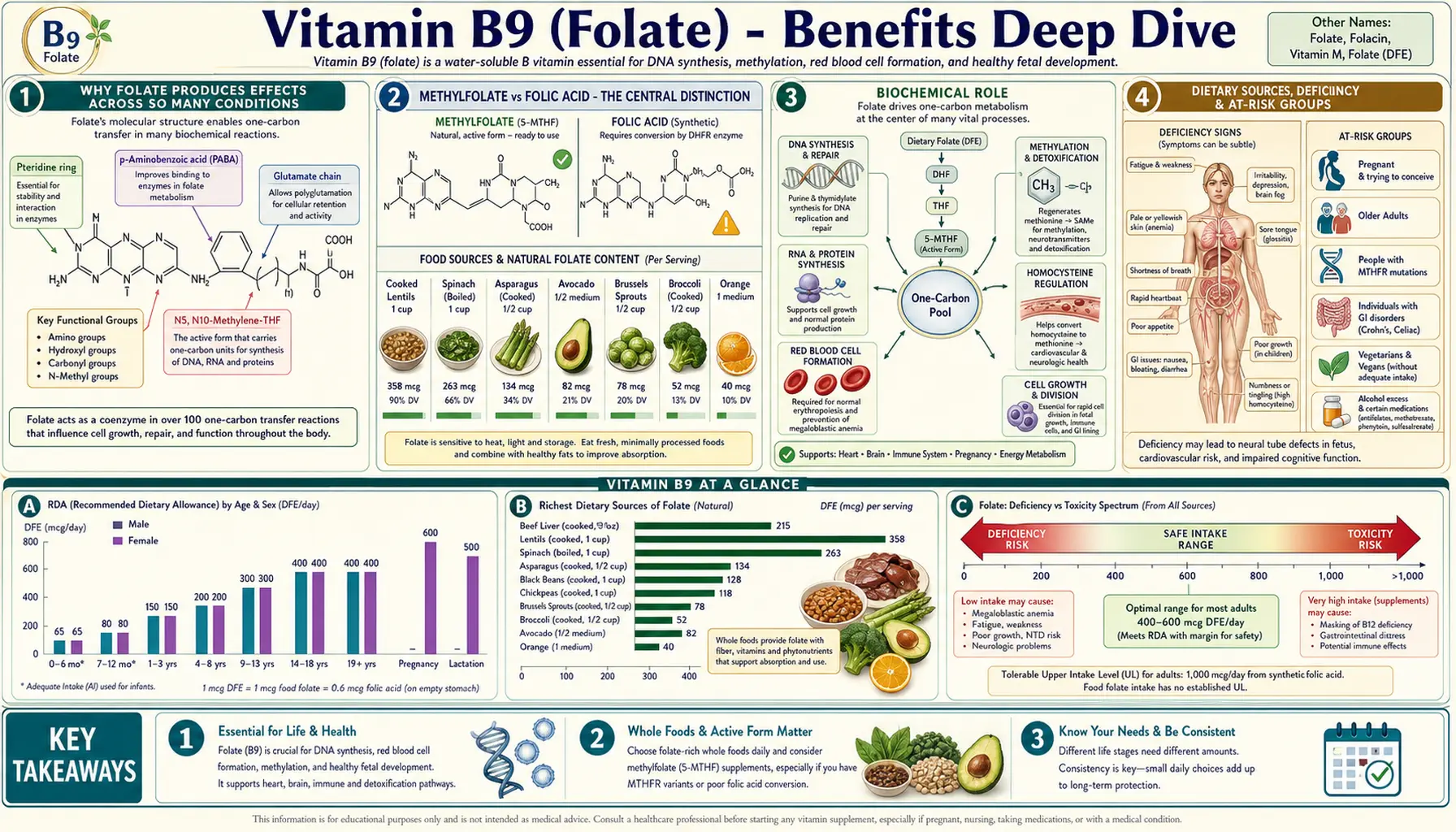
Folate produces clinically meaningful effects across an unusually wide range of conditions because it sits at the rate-limiting step of the methylation cycle — the single biochemical pathway that controls DNA synthesis, gene expression, homocysteine clearance, neurotransmitter production, and the construction of every new cell in the body. The four deep-dive pages below explore the indications where the trial evidence is strongest: prevention of neural tube defects (the only nutritional intervention proven to prevent a major birth defect), the methylation and homocysteine biochemistry that underlies the MTHFR conversation, the cardiovascular and stroke literature that emerged from the homocysteine hypothesis, and the methylfolate-versus-folic-acid distinction that drives the modern depression-adjunct evidence base.
Deep-Dive Articles
Pregnancy & Neural Tube Defects
The most-evidence-supported folate indication. Walks through the Wald MRC trial (1991) that established 4 mg/day prevents 70% of recurrent neural tube defects, the CDC/ACOG recommendation of 400 mcg preconception + 600 mcg pregnancy, the 1998 US folic acid grain fortification that dropped NTD rates 36%, the 28-day critical window before most women know they are pregnant, and why women carrying MTHFR variants need methylfolate rather than folic acid.
Methylation & Homocysteine
The biochemistry that connects every folate benefit. 5-MTHF donates the methyl group that converts homocysteine to methionine, generating SAMe — the body's universal methyl donor. Deep-dive on the MTHFR C677T and A1298C polymorphisms (40% heterozygous, 10% homozygous), the methyl-trap and B12 dependency, why methylfolate (5-MTHF / Metafolin / Quatrefolic) bypasses the DHFR-then-MTHFR conversion that synthetic folic acid requires, and the unmetabolized folic acid concern.
Cardiovascular & Stroke
The story of the homocysteine hypothesis and the trials that tested it. NORVIT, HOPE-2, and SEARCH lowered homocysteine but failed to reduce cardiovascular events in unselected secondary-prevention populations. The stroke signal, however, persisted — the 20,702-patient China Stroke Primary Prevention Trial (CSPPT) showed 21% first-stroke reduction with folate. Who benefits most: low baseline folate, MTHFR variants, and high homocysteine in unfortified populations.
Depression & Mental Health
L-methylfolate (brand name Deplin) is FDA-classified as a medical food for adjunctive treatment of major depression. The Papakostas 2012 trial established 15 mg/day methylfolate doubled SSRI response in non-responders. MTHFR carriers have higher rates of treatment-resistant depression and respond preferentially to methylfolate over synthetic folic acid. Mechanism: SAMe-dependent monoamine synthesis, BH4 regeneration, and the methylation-cycle reset that synthetic folic acid cannot replicate.
Table of Contents
- Deep-Dive Articles
- Why Folate Produces Effects Across So Many Conditions
- Methylfolate vs Folic Acid — The Central Distinction
- Research Papers: Pregnancy & Neural Tube Defects
- Research Papers: Methylation, MTHFR & Homocysteine
- Research Papers: Cardiovascular & Stroke
- Research Papers: Depression & Mental Health
- Research Papers: Cross-Cutting (Forms, Safety, Mechanism)
- External Authoritative Resources
- Connections
- Featured Videos
Why Folate Produces Effects Across So Many Conditions
Most B vitamins serve as cofactors for a handful of enzymes in narrow biochemical pathways. Folate is unusual because its active form (5-MTHF) sits at the rate-limiting step of methylation — a process that touches virtually every cellular function in the body. A single methyl group transfer cascade radiates outward into four distinct categories of clinical benefit:
- DNA synthesis & cell division — folate provides one-carbon units for thymidine, purine, and pyrimidine synthesis. Tissues with rapid turnover — embryonic neural tube, red blood cell precursors, intestinal epithelium, immune cells — fail first when folate is deficient. This drives the neural tube defect prevention evidence and the classic megaloblastic anemia presentation.
- Methylation cycle drive — 5-MTHF donates the methyl group that converts homocysteine to methionine, regenerating SAMe (S-adenosylmethionine) — the universal methyl donor for over 200 substrates including DNA, RNA, proteins, neurotransmitters, and phospholipids. The methylation chapter covers the MTHFR polymorphisms (C677T / A1298C) that interrupt this conversion in 40-60% of the population.
- Homocysteine clearance — vascular protection — the methyl-donation reaction simultaneously lowers homocysteine, an independent risk factor for atherosclerosis, stroke, venous thromboembolism, and cognitive decline. The cardiovascular & stroke chapter walks through the trials that tested this mechanism.
- Monoamine neurotransmitter synthesis — folate-dependent methylation regenerates tetrahydrobiopterin (BH4), the rate-limiting cofactor for tyrosine hydroxylase and tryptophan hydroxylase — the enzymes that produce dopamine, norepinephrine, and serotonin. The depression chapter covers the L-methylfolate (Deplin) trials and the MTHFR-treatment-resistance connection.
The same molecule is therefore the rate-limiter for: making new red blood cells, building the embryonic brain and spinal cord, keeping the inner lining of blood vessels healthy, and producing the neurotransmitters that regulate mood. No other vitamin spans those four domains because no other vitamin sits at the rate-limiting step of a process this central.
Methylfolate vs Folic Acid — The Central Distinction
Every chapter that follows turns on a single biochemical fact: folate (the family of naturally occurring tetrahydrofolate forms found in leafy greens, liver, and active supplements) and folic acid (the fully oxidized synthetic compound used in grain fortification and inexpensive supplements) are not interchangeable in the body. The distinction matters in every clinical context where folate is used therapeutically.
- Folic acid is a man-made oxidized monoglutamate that does not exist in nature. To become active it must be reduced to dihydrofolate by dihydrofolate reductase (DHFR), reduced again to tetrahydrofolate by DHFR, and then converted by methylenetetrahydrofolate reductase (MTHFR) to the active 5-methyltetrahydrofolate (5-MTHF) form. Human DHFR is unusually slow — it saturates around 200-400 mcg per meal — and human MTHFR is unusually polymorphic.
- 5-MTHF (also called L-methylfolate, levomefolic acid, Metafolin, or Quatrefolic) is the actual active form found in your blood after eating spinach or liver. It bypasses both DHFR and MTHFR. It enters the methylation cycle directly. It does not produce unmetabolized folic acid (UMFA) in the bloodstream.
- MTHFR polymorphisms are extraordinarily common. The C677T variant reduces MTHFR enzyme activity 30% (heterozygous, ~40% of populations) or 70% (homozygous, ~10-12%). The A1298C variant further reduces activity. Compound heterozygotes (C677T + A1298C) can have 50-70% reduced activity. These individuals cannot efficiently convert synthetic folic acid into the active 5-MTHF form.
- Unmetabolized folic acid (UMFA) appears in serum at doses as low as 200 mcg per meal. Detected in the bloodstream of essentially all adults consuming fortified food in the US. Associated with reduced NK cell cytotoxicity (Troen 2006), potential masking of B12 deficiency hematology, and theoretical promotion of preexisting precancerous lesions through enhanced DNA synthesis.
- The clinical implication: for every indication covered in the four deep-dive chapters — neural tube defect prevention, MTHFR/homocysteine reduction, stroke risk reduction, and depression adjunctive therapy — the modern integrative-medicine standard is methylfolate (5-MTHF) at therapeutic doses, not synthetic folic acid. Methylfolate works for everyone (MTHFR polymorphism doesn't matter). Folic acid works partially, unpredictably, and risks UMFA accumulation.
This distinction recurs throughout each deep-dive page below.
Research Papers: Pregnancy & Neural Tube Defects
- MRC Vitamin Study (Wald 1991) — the landmark trial Search PubMed
- Czeizel & Dudas (1992) Hungarian primary prevention trial PubMed: Czeizel Dudas 1992
- Berry et al. (1999) Chinese folic acid trial PubMed: Berry China NTD prevention
- US folic acid fortification impact (Honein 2001 JAMA) PubMed: Honein fortification impact
- Williams et al. CDC NTD prevalence post-fortification PubMed: CDC NTD prevalence
- MTHFR C677T and neural tube defect risk PubMed: MTHFR C677T NTD risk
- Periconceptional folate and congenital heart defects PubMed: folate congenital heart defect
- Folate and autism spectrum disorder risk (Surn 2013 JAMA) PubMed: Suren ASD folate
- 5-MTHF vs folic acid in pregnancy (Lamers 2006) PubMed: Lamers 5-MTHF vs folic acid
- Pietrzik 5-MTHF supplementation in women of childbearing age PubMed: Pietrzik 5-MTHF women
- Folate and preterm birth PubMed: folate preterm birth
Research Papers: Methylation, MTHFR & Homocysteine
- Frosst et al. (1995) original C677T MTHFR variant discovery PubMed: Frosst 1995 MTHFR discovery
- Methyl trap hypothesis — B12 + folate interaction PubMed: methyl trap hypothesis
- SAMe production and methylation cycle PubMed: SAMe methylation cycle
- Unmetabolized folic acid (UMFA) detection in serum PubMed: UMFA serum detection
- Troen et al. NK cell cytotoxicity and UMFA PubMed: Troen NK cells UMFA
- Riboflavin (B2) as MTHFR enzyme stabilizer PubMed: riboflavin MTHFR stabilizer
- 5-MTHF (Metafolin) bioavailability vs folic acid PubMed: Metafolin bioavailability
- Quatrefolic (glucosamine 5-MTHF) pharmacokinetics PubMed: Quatrefolic pharmacokinetics
- VITACOG cognitive trial (Smith 2010) PubMed: VITACOG brain atrophy
- MTHFR A1298C variant clinical significance PubMed: MTHFR A1298C
Research Papers: Cardiovascular & Stroke
- HOPE-2 trial (Lonn 2006 NEJM) PubMed: HOPE-2 trial
- NORVIT trial (Bonaa 2006 NEJM) PubMed: NORVIT trial
- SEARCH trial (2010) PubMed: SEARCH trial
- CSPPT China Stroke Primary Prevention Trial (Huo 2015 JAMA) PubMed: CSPPT stroke trial
- Wang meta-analysis folic acid & stroke (Lancet 2007) PubMed: Wang Lancet stroke meta-analysis
- VISP trial (Toole 2004 JAMA) — recurrent stroke PubMed: VISP stroke trial
- Yang et al. fortification & stroke mortality PubMed: fortification stroke mortality
- Homocysteine and endothelial dysfunction PubMed: homocysteine endothelial dysfunction
- MTHFR C677T and cardiovascular meta-analysis PubMed: MTHFR cardiovascular meta-analysis
- 5-MTHF and endothelial function (Antoniades 2009) PubMed: Antoniades 5-MTHF endothelium
Research Papers: Depression & Mental Health
- Papakostas et al. (2012) L-methylfolate adjunct SSRI trial PubMed: Papakostas L-methylfolate
- Coppen & Bailey (2000) folate augmentation of fluoxetine PubMed: Coppen folate fluoxetine
- Fava & Mischoulon (2009) folate in depression review PubMed: Fava Mischoulon folate review
- L-methylfolate (Deplin) FDA medical food classification PubMed: Deplin L-methylfolate
- MTHFR C677T and depression risk meta-analysis PubMed: MTHFR depression risk
- Folate and treatment-resistant depression PubMed: folate treatment-resistant depression
- Postpartum depression and folate status PubMed: postpartum depression folate
- Tetrahydrobiopterin (BH4) regeneration and monoamines PubMed: BH4 monoamine folate
- L-methylfolate in schizophrenia adjunct PubMed: L-methylfolate schizophrenia
- Bipolar disorder and methylation PubMed: bipolar disorder folate
Research Papers: Cross-Cutting (Forms, Safety, Mechanism)
- Linus Pauling Institute folate monograph PubMed: LPI folate
- Folic acid and B12 masking review PubMed: folic acid B12 masking
- Folate and colorectal cancer dual-effect review PubMed: folate colorectal cancer dual effect
- Folate and methotrexate — folinic acid rescue PubMed: folinic acid methotrexate rescue
- Cerebral folate deficiency and folate-receptor autoantibodies PubMed: cerebral folate deficiency
- Anticonvulsant-induced folate depletion PubMed: anticonvulsant folate
- Alcohol and folate metabolism PubMed: alcohol folate
- Choline and folate one-carbon pathway sharing PubMed: choline folate one-carbon
- Folate-rich foods and bioavailability comparison PubMed: folate food bioavailability
- Folate safety upper intake review PubMed: folate UL safety
External Authoritative Resources
- Linus Pauling Institute — Folate Micronutrient Information Center — the single most authoritative scientific summary of folate biology and clinical evidence, regularly updated
- NIH Office of Dietary Supplements — Folate Fact Sheet for Health Professionals
- CDC — Folic Acid & Birth Defect Prevention
- ACOG — Nutrition During Pregnancy
- PubMed — All research on folate / folic acid / methylfolate
Connections
- All Vitamins
- Vitamin B9 (Main Page)
- B9 for Pregnancy & Neural Tube
- B9 for Methylation & Homocysteine
- B9 for Cardiovascular & Stroke
- B9 for Depression & Mental Health
- Folate and Mental Health
- Folate and Pregnancy
- Vitamin B12
- Vitamin B6
- Vitamin B2 (Riboflavin)
- Choline
- Methionine
- Homocysteine
- Anemia
- Depression
- Alzheimer's Disease