Vitamin B2 (Riboflavin) — Benefits Deep Dive
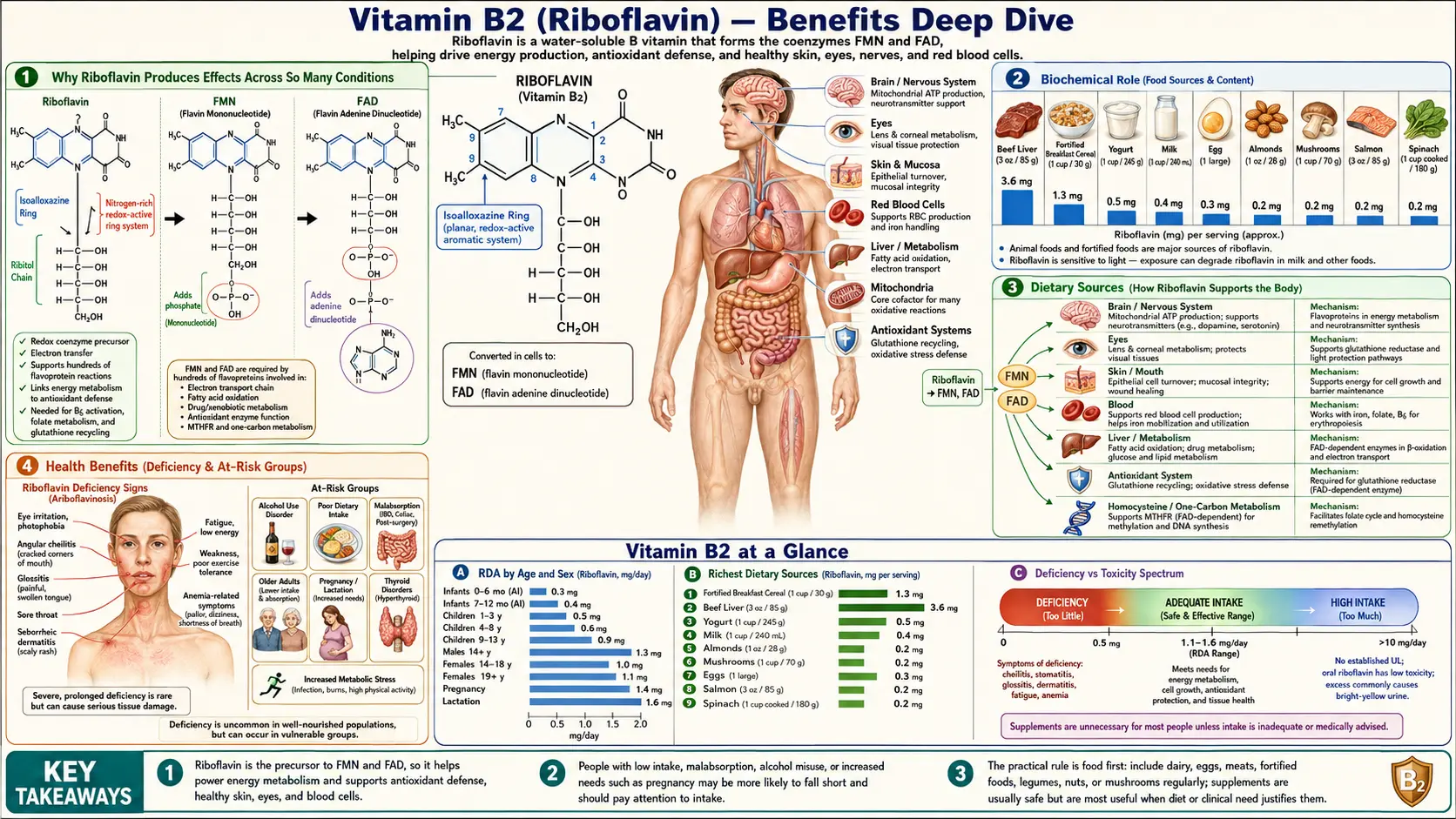
Vitamin B2 (riboflavin) is the precursor to two flavin coenzymes — FAD (flavin adenine dinucleotide) and FMN (flavin mononucleotide) — that participate in more than 100 enzymatic reactions across mitochondrial bioenergetics, redox defense, and one-carbon metabolism. Most benefits trace back to four distinct flavin-dependent enzyme roles: electron carrier in Complex I and II of the respiratory chain, cofactor for the antioxidant-regenerating enzyme glutathione reductase, cofactor for the methyl-folate-producing enzyme MTHFR, and cofactor for the acyl-CoA dehydrogenases of fatty-acid β-oxidation. Each benefit page below explores one of these mechanisms in clinical-trial depth.
Deep-Dive Articles
Migraine Prevention
The Schoenen 1998 BMJ trial established 400 mg/day riboflavin as a Level B AAN/AHS-recommended migraine preventive: 67% of patients achieved a >50% reduction in attack frequency by month 3. The mechanism is restoration of cortical mitochondrial energy reserve. Combination with CoQ10 and magnesium forms the "mitochondrial migraine stack." Pediatric and pregnancy data also covered. Bright yellow urine is the marker of adequate dosing.
Mitochondrial Cofactor
FAD and FMN are the obligate electron carriers in Complex I (NADH:ubiquinone oxidoreductase) and Complex II (succinate dehydrogenase) of the respiratory chain. FAD is also the prosthetic group on every acyl-CoA dehydrogenase of fatty-acid β-oxidation. Multiple acyl-CoA dehydrogenase deficiency (MADD / glutaric aciduria type II) is the textbook riboflavin-responsive inborn error and the proof that B2 is a true mitochondrial drug.
Glutathione Reductase Cofactor
Glutathione reductase (GR) is a FAD-flavoprotein that regenerates active reduced glutathione (GSH) from its oxidized disulfide (GSSG). Without adequate riboflavin, the entire glutathione defense system fails — B2 deficiency phenocopies glutathione deficiency. The erythrocyte glutathione reductase activity coefficient (EGRAC) is the clinical lab marker. Pairs naturally with NAC + glycine in the GlyNAC protocol.
MTHFR & Methylation
The less commonly discussed riboflavin role: FAD is the obligate cofactor for methylenetetrahydrofolate reductase (MTHFR). In carriers of the C677T thermolabile variant, the mutant enzyme has weaker FAD-binding affinity and is unusually sensitive to riboflavin status. The Bonaa, McNulty, and Wilson trials showed that B2 supplementation lowers homocysteine and blood pressure specifically in 677TT homozygotes.
Table of Contents
- Deep-Dive Articles
- Why Riboflavin Produces Effects Across So Many Conditions
- Research Papers: Migraine Prevention
- Research Papers: Mitochondrial Cofactor & MADD
- Research Papers: Glutathione Reductase & Redox
- Research Papers: MTHFR, Homocysteine & Blood Pressure
- Research Papers: Cross-Cutting (Forms, Status, Safety)
- External Authoritative Resources
- Connections
- Featured Videos
Why Riboflavin Produces Effects Across So Many Conditions
Most water-soluble vitamins are required as a single enzyme cofactor. Riboflavin is unusual because the two flavin coenzymes it produces — FAD and FMN — are prosthetic groups on at least 90 flavoenzymes in the human flavoproteome, and the relevant flavoenzymes cluster into four functionally distinct categories that each map to a different family of clinical benefits:
- Mitochondrial respiratory chain — FMN sits at the entry to Complex I and accepts electrons from NADH; FAD is covalently attached to Complex II (succinate dehydrogenase) and ETF-ubiquinone oxidoreductase. Without adequate flavins, oxidative phosphorylation stalls. This is the mechanism behind riboflavin's effect on migraine (the migrainous brain has reduced cortical ATP reserve) and the cellular fatigue of clinical riboflavin deficiency.
- Fatty-acid oxidation — every acyl-CoA dehydrogenase that shortens a fatty-acid chain in the mitochondrial matrix uses FAD as its electron acceptor. Defective FAD binding causes multiple acyl-CoA dehydrogenase deficiency (MADD), a riboflavin-responsive inborn error of metabolism that produces metabolic crises responsive to high-dose oral B2.
- Glutathione redox cycle — glutathione reductase is the FAD-flavoprotein that regenerates active GSH from GSSG using NADPH electrons. Riboflavin deficiency lowers GSH:GSSG ratios system-wide, increases oxidative stress, and reduces the eye lens's capacity to resist cataract formation.
- One-carbon metabolism — MTHFR (methylenetetrahydrofolate reductase) uses FAD to reduce 5,10-methylene-THF to 5-methyl-THF, which donates the methyl group that remethylates homocysteine to methionine. In carriers of the C677T thermolabile variant, B2 status is the rate-limiting factor for homocysteine clearance.
Additional roles operate as well — activation of vitamin B6 to pyridoxal 5′-phosphate by pyridoxine-5′-phosphate oxidase (a FMN flavoenzyme), reduction of methemoglobin to functional hemoglobin via cytochrome b5 reductase, mobilization of iron from ferritin, and the kynurenine-tryptophan-to-niacin pathway. The combination is why riboflavin status touches energy, mood, neuroprotection, cardiovascular risk, hematology, and metabolic disease all at once.
Research Papers: Migraine Prevention
- Schoenen J et al. (1998) — the pivotal 400 mg/day RCT — PubMed: Schoenen 1998 riboflavin migraine
- Boehnke 2004 open-label trial — PubMed: Boehnke 2004
- Condò 2009 pediatric migraine trial — PubMed: Condò 2009 pediatric
- MacLennan 2008 pediatric RCT — PubMed: MacLennan 2008
- Maizels 2004 riboflavin + magnesium + feverfew combination — PubMed: Maizels combination 2004
- Holland 2012 AAN/AHS Level B guideline endorsing riboflavin — PubMed: AAN/AHS guideline Holland 2012
- Thompson and Saluja 2017 review of riboflavin in migraine — PubMed: Thompson 2017 review
- Di Lorenzo MTHFR-stratified riboflavin trial — PubMed: Di Lorenzo MTHFR-stratified
- Namazi 2015 meta-analysis — PubMed: Namazi meta-analysis
- Magis 2007 thioctic acid vs riboflavin migraine prophylaxis — PubMed: Magis 2007
- Mitochondrial dysfunction in migraine — PubMed: mitochondrial dysfunction migraine
Research Papers: Mitochondrial Cofactor & MADD
- Olsen 2007 MADD riboflavin response — PubMed: Olsen ETFDH MADD
- Gianazza riboflavin-responsive MADD review — PubMed: RR-MADD review
- FMN at Complex I (NADH:ubiquinone oxidoreductase) — PubMed: FMN Complex I
- FAD at Complex II (succinate dehydrogenase) — PubMed: FAD SDH Complex II
- ETF and ETF-QO — the flavin electron bridge from β-oxidation to the respiratory chain — PubMed: ETF-QO flavin bridge
- Acyl-CoA dehydrogenases and FAD — PubMed: acyl-CoA dehydrogenase FAD
- Riboflavin in chronic fatigue and post-exertional malaise — PubMed: riboflavin chronic fatigue
- Riboflavin transporter deficiency (Brown-Vialetto-Van Laere syndrome) — PubMed: BVVL riboflavin transporter
Research Papers: Glutathione Reductase & Redox
- Glutathione reductase — FAD-binding crystallography — PubMed: GR FAD crystal structure
- EGRAC (erythrocyte glutathione reductase activity coefficient) as B2 status marker — PubMed: EGRAC riboflavin status
- Riboflavin deficiency lowers GSH:GSSG ratio — PubMed: B2 deficiency glutathione
- Riboflavin and cataract prevention — PubMed: B2 cataract lens
- Riboflavin and oxidative damage to red blood cells — PubMed: B2 erythrocyte oxidative damage
- Corneal cross-linking with riboflavin in keratoconus — PubMed: corneal cross-linking
Research Papers: MTHFR, Homocysteine & Blood Pressure
- McNulty 2006 B2-MTHFR677TT homocysteine RCT — PubMed: McNulty MTHFR 677TT
- Wilson 2013 riboflavin blood pressure MTHFR — PubMed: Wilson 2013 BP MTHFR
- Horigan 2010 riboflavin BP — PubMed: Horigan riboflavin BP
- Frosst 1995 MTHFR C677T thermolabile variant — PubMed: Frosst 1995 C677T
- Bonaa 2006 NORVIT homocysteine and cardiovascular outcomes — PubMed: Bonaa NORVIT
- Yamada 2001 FAD binding affinity of mutant MTHFR 677TT — PubMed: Yamada FAD binding 677TT
- Hustad 2000 plasma riboflavin and homocysteine — PubMed: Hustad riboflavin homocysteine
- Powers riboflavin and one-carbon metabolism review — PubMed: Powers riboflavin folate review
- Strain 2013 B2-genotype-targeted hypertension paper — PubMed: Strain genotype-targeted BP
Research Papers: Cross-Cutting (Forms, Status, Safety)
- Powers 2003 comprehensive riboflavin review — PubMed: Powers 2003 AJCN review
- Riboflavin-5′-phosphate (FMN) bioavailability — PubMed: R5P bioavailability
- Riboflavin absorption ceiling per single dose — PubMed: B2 absorption ceiling
- Photodegradation of riboflavin in milk and supplements — PubMed: riboflavin photodegradation
- RFVT2 / RFVT3 / SLC52 riboflavin transporters — PubMed: RFVT transporters
- Riboflavin safety profile — PubMed: B2 upper intake safety
- Vitamin B2 status in pregnancy and lactation — PubMed: B2 pregnancy lactation
- EGRAC reference values and clinical interpretation — PubMed: EGRAC reference values
External Authoritative Resources
- Linus Pauling Institute — Riboflavin Micronutrient Information Center — the single most authoritative scientific summary of riboflavin biology and clinical evidence, regularly updated
- NIH Office of Dietary Supplements — Riboflavin Fact Sheet for Health Professionals
- MedlinePlus — Riboflavin
- PubMed — All research on riboflavin
Connections
- All Vitamins
- Vitamin B2 (Main Page)
- B2 for Migraine Prevention
- B2 as Mitochondrial Cofactor
- B2 as Glutathione Reductase Cofactor
- B2 for MTHFR & Methylation
- Riboflavin and Energy Production
- Riboflavin and Migraine Prevention
- Vitamin B1 (Thiamine)
- Vitamin B3 (Niacin)
- Vitamin B6 (Pyridoxine)
- Vitamin B9 (Folate)
- Vitamin B12 (Cobalamin)
- Glutathione
- ALA for Mitochondria
- CoQ10 for Migraine
- Migraine (Disease)
- Homocysteine
- Magnesium
- Oxidative Stress