Vitamin B2: History and Discovery
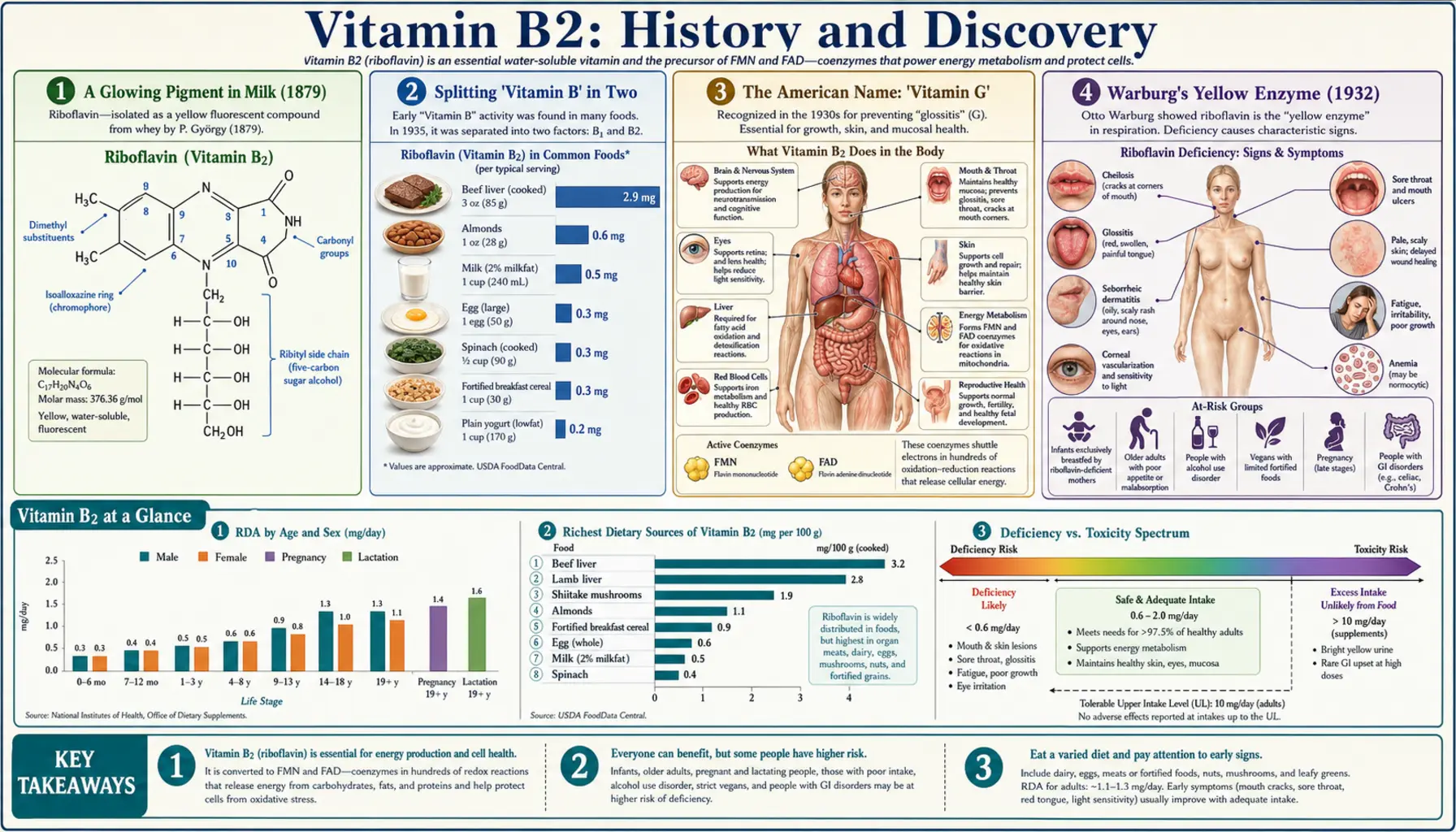
The story of vitamin B2 begins with a glow. In 1879 the British chemist Alexander Wynter Blyth separated from cow's milk a yellow substance that shone with a soft greenish light when sunlight fell on it; he called it lactochrome, "the colour of milk." He had no way of knowing that this pigment would one day be recognised as an essential nutrient. Over the next half-century that mysterious yellow colour reappeared in egg white, in liver, in yeast, and inside the very enzymes that let cells breathe — and a remarkable chain of chemists, working in Heidelberg, Zurich, and Berlin, finally pinned it down. By the mid-1930s riboflavin had been isolated, its exact structure worked out, and the molecule built from scratch in the laboratory. Two of the chemists at the centre of that work, Paul Karrer and Richard Kuhn, would win back-to-back Nobel Prizes in Chemistry. This article tells that discovery story — the deficiency clues, the named scientists, the verified dates, and the priority shared between rival laboratories — sticking to what the historical record actually supports.
Table of Contents
- A Glowing Pigment in Milk (1879)
- Splitting "Vitamin B" in Two
- The American Name: "Vitamin G"
- Warburg's Yellow Enzyme (1932)
- The Isolation and Crystallisation (1933)
- Structure and Synthesis: Kuhn and Karrer (1934–1935)
- How It Got the Name "Riboflavin"
- The Nobel Prizes
- Ariboflavinosis: Naming the Deficiency
- Research Papers and References
- Connections
- Featured Videos
A Glowing Pigment in Milk (1879)
The earliest documented step in riboflavin's history is not the discovery of a vitamin at all — it is the discovery of a colour. In 1879, the English analytical chemist Alexander Wynter Blyth isolated a water-soluble yellow pigment from the whey of cow's milk. The substance fluoresced a striking yellow-green when light struck it, and Blyth named it lactochrome — from the Latin lacto ("milk") and the Greek chrome ("colour"). It is the same glow anyone can see today: riboflavin is so brightly fluorescent that it tints the urine a vivid yellow after a B-complex supplement.
Blyth could describe the pigment but not explain it. The chemistry of the late nineteenth century had no concept of vitamins, no notion that a faint colour in milk might be a substance the body cannot live without. So lactochrome was filed away as a curiosity. More than fifty years would pass before scientists realised that Blyth had, in fact, held an essential nutrient in his hands. His 1879 observation is the firm starting point of the riboflavin timeline — a reminder that the vitamin announced itself by its colour long before anyone understood what it was for.
Splitting "Vitamin B" in Two
The modern idea of vitamins took shape in the early twentieth century, against the backdrop of the great deficiency diseases — scurvy, beriberi, pellagra, and rickets — that had haunted sailors, soldiers, and the poor for centuries. In 1912 the Polish-born biochemist Casimir Funk, working in London, proposed that such diseases were caused by the lack of specific trace substances in the diet, and coined the word vitamine (later shortened to vitamin) to describe them. Researchers soon sorted these accessory food factors into a fat-soluble group, "vitamine A," and a water-soluble group, "vitamine B."
It quickly became clear that "vitamin B" was not one thing but several. By the early 1920s investigators recognised that the water-soluble fraction contained at least two distinct factors: a heat-labile component, destroyed by prolonged heating, which prevented beriberi, and a heat-stable component, which survived heating and was needed for normal growth. The heat-labile anti-beriberi factor became vitamin B1 (thiamine); the heat-stable growth factor became vitamin B2. This is where riboflavin enters the vitamin story by name — defined at first not by its chemistry, which was still unknown, but simply as "the part of vitamin B that does not break down when you heat it."
The American Name: "Vitamin G"
For a time the new factor had two names on two sides of the Atlantic. In Britain and continental Europe it was called vitamin B2. In the United States, several researchers — following the influential Columbia University nutritionist Henry C. Sherman and colleagues — instead called the heat-stable growth-and-skin factor vitamin G. Work from this period bears the older label directly: a 1931 paper by A. Bourquin and H. C. Sherman, for instance, was titled simply "Quantitative determination of vitamin G (B2)."
The two names referred to the same nutrient, and the duplication eventually collapsed once the molecule itself was isolated and given a proper chemical name. "Vitamin G" faded from use, while "vitamin B2" survived as the everyday term still used today. The episode is a small but honest illustration of how vitamin science actually unfolded: factors were often named provisionally, by different groups, before anyone knew what they were — and some of those early names did not last.
Warburg's Yellow Enzyme (1932)
A crucial clue to riboflavin's purpose arrived from an unexpected direction — not from nutrition, but from the study of how cells breathe. In 1932, the German biochemist Otto Warburg and his collaborator Walter Christian, working in Berlin, isolated from yeast a yellow protein that was essential for cellular respiration. They called it the gelbes Ferment — the "yellow enzyme" (later known as the Old Yellow Enzyme). Warburg, already a Nobel laureate for earlier work on respiration, recognised that the protein owed its colour and its activity to a small non-protein partner attached to it.
The decisive demonstration came in 1935 from the Swedish biochemist Hugo Theorell. Theorell managed to split Warburg's yellow enzyme into two parts — a colourless protein (the apoenzyme) and the yellow pigment itself — and showed that neither part worked alone, but that recombining them restored the enzyme's activity. He identified the yellow pigment as a phosphate ester of riboflavin, the molecule we now call flavin mononucleotide (FMN). This was the first time anyone had separated an enzyme into protein and coenzyme and put it back together, and it revealed riboflavin's true biological job: it is the working core of a whole family of respiratory enzymes. Theorell's broader research on oxidation enzymes earned him the Nobel Prize in Physiology or Medicine in 1955.
The Isolation and Crystallisation (1933)
While Warburg was studying his yellow enzyme, other laboratories were racing to capture the growth factor itself in pure form. The breakthrough came in 1933 at the University of Heidelberg, where a team that included the physician-scientist Paul György, the chemist Richard Kuhn, and their colleague Theodor Wagner-Jauregg succeeded in isolating and purifying vitamin B2. Their assay was practical and ingenious: they measured whether rats fed a diet stripped of the factor failed to grow, and used that growth response to track the active substance as they purified it.
The same brightly fluorescent yellow pigment turned up wherever they looked, and they named each version after its source. From egg white they obtained ovoflavin; from milk whey, lactoflavin; from liver, hepatoflavin; and from yeast, a corresponding flavin. The shared ending -flavin comes from the Latin flavus, "yellow." The pivotal realisation was that these were not different compounds at all but one and the same molecule arriving from different foods — the elusive vitamin B2, finally held as a pure, crystalline, intensely yellow substance. With the compound in hand, the question turned from "what is it found in?" to "what is its structure?"
Structure and Synthesis: Kuhn and Karrer (1934–1935)
Working out the structure of riboflavin and then building it from simpler chemicals was the climax of the discovery story — and it was a genuine race between two great laboratories. In Heidelberg, Richard Kuhn's group pressed on from their isolation work; in Zurich, the Swiss chemist Paul Karrer attacked the same problem. The key insight, building on a suggestion that the pigment was a derivative of isoalloxazine, was that riboflavin consisted of that three-ringed isoalloxazine core carrying two methyl groups and a sugar-alcohol side chain derived from the five-carbon sugar ribose. In modern terms the molecule is 7,8-dimethyl-10-(D-ribityl)isoalloxazine.
The proof of any proposed structure is to build the molecule and show it is identical to the natural one. In 1935, the groups of Kuhn and Karrer achieved the first total chemical synthesis of riboflavin independently of one another — two laboratories reaching the same summit at nearly the same moment. This is a real, documented case of parallel priority rather than a single lone discoverer: both Kuhn and Karrer are properly credited with determining the structure and synthesising the vitamin in this 1934–1935 window. The synthetic molecule matched the natural lactoflavin exactly, closing the loop that had opened with Blyth's glowing pigment fifty-six years earlier.
How It Got the Name "Riboflavin"
The structure also settled the name. The molecule's yellow colour was captured by the suffix -flavin, from the Latin flavus; and because its side chain is derived from the sugar ribose, the prefix ribo- was attached. Put together, riboflavin literally means "the yellow substance with the ribose tail" — a name that, unusually for a vitamin, encodes its actual chemistry.
The name was formalised on the American side by the Council on Pharmacy and Chemistry of the American Medical Association, which adopted "riboflavin" in the late 1930s (commonly dated to 1937). This standardisation is what finally retired the patchwork of earlier labels — lactochrome, vitamin G, ovoflavin, lactoflavin, hepatoflavin — in favour of one chemical name. Today "riboflavin" and "vitamin B2" are used interchangeably, the chemical name and the vitamin-series name for the same molecule.
The Nobel Prizes
The riboflavin work sits at the centre of two consecutive Nobel Prizes in Chemistry, and the citations name flavins and vitamins directly. In 1937, Paul Karrer was awarded the Nobel Prize in Chemistry "for his investigations on carotenoids, flavins and vitamins A and B2" — the phrase "flavins" and "vitamin B2" pointing straight at his riboflavin research. He shared that year's prize with the British chemist Walter Norman Haworth, who was honoured for his work on carbohydrates and on vitamin C.
The following year, in 1938, the Nobel Prize in Chemistry went to Richard Kuhn "for his work on carotenoids and vitamins." Kuhn's award came at a dark moment: the Nazi government, in the wake of the 1936 Nobel Peace Prize to the imprisoned pacifist Carl von Ossietzky, forbade German citizens from accepting Nobel Prizes, and Kuhn was compelled to decline. He was able to receive his Nobel diploma and medal only after the Second World War. The two prizes, taken together, mark the formal scientific recognition that the once-mysterious yellow pigment of milk had been fully understood — isolated, structured, and synthesised.
Ariboflavinosis: Naming the Deficiency
Unlike beriberi (vitamin B1), scurvy (vitamin C), or pellagra (vitamin B3), severe riboflavin deficiency was never tied to a single dramatic, named epidemic disease — one reason its discovery was driven more by chemistry and animal-growth experiments than by a famous deficiency outbreak. Instead, lack of vitamin B2 produces a recognisable cluster of signs centred on the skin, mouth, and eyes, a condition that came to be called ariboflavinosis (literally "the state of being without riboflavin").
Its hallmarks are cracks and sores at the corners of the mouth (angular cheilitis), a sore, swollen, magenta-coloured tongue (glossitis), greasy scaling of the skin around the nose and folds of the face (seborrhoeic dermatitis), and sensitivity of the eyes to light. That the deficiency's essentiality for humans was confirmed by controlled dietary studies — rather than inferred from a historic plague — is itself part of riboflavin's distinctive story. The full modern picture of B2's functions, food sources, dosing, and deficiency signs is covered on the main Vitamin B2 page and in the Vitamin B2 Benefits articles; this history is concerned with how the vitamin came to be known in the first place.
Research Papers and References
The list below combines a key peer-reviewed history of riboflavin with curated PubMed topic-search links and authoritative resources on the vitamin's discovery, chemistry, and the Nobel Prizes that recognised it. Author names, titles, and journals are given as plain text; only the stable DOI, PMID, or archive link is hyperlinked, and each opens in a new tab. Early primary papers from the 1930s (Warburg and Christian on the yellow enzyme; Kuhn, György, and Wagner-Jauregg on the isolation; the Kuhn and Karrer syntheses) are named in the article as historical sources.
- Northrop-Clewes CA, Thurnham DI. The discovery and characterization of riboflavin. Annals of Nutrition and Metabolism. 2012;61(3):224-230. — doi:10.1159/000343111 · PMID: 23183293
- Powers HJ. Riboflavin (vitamin B-2) and health. American Journal of Clinical Nutrition. 2003;77(6):1352-1360. — doi:10.1093/ajcn/77.6.1352 Search PubMed
- Balasubramaniam S, Christodoulou J, Rahman S. Disorders of riboflavin metabolism. Journal of Inherited Metabolic Disease. 2019;42(4):608-619. — doi:10.1002/jimd.12058 Search PubMed
- Riboflavin discovery and history PubMed: riboflavin discovery and history
- Riboflavin, flavins, and the yellow enzyme PubMed: riboflavin, flavins, and flavoproteins
External Authoritative Resources
- NobelPrize.org — Paul Karrer, Nobel Prize in Chemistry 1937
- NobelPrize.org — Richard Kuhn, Nobel Prize in Chemistry 1938
- NobelPrize.org — Hugo Theorell, Nobel Prize in Physiology or Medicine 1955
- PubMed — All research on riboflavin (vitamin B2)