Air Pollution PM2.5: Fine Particulate Matter, Health Risks, and Protection
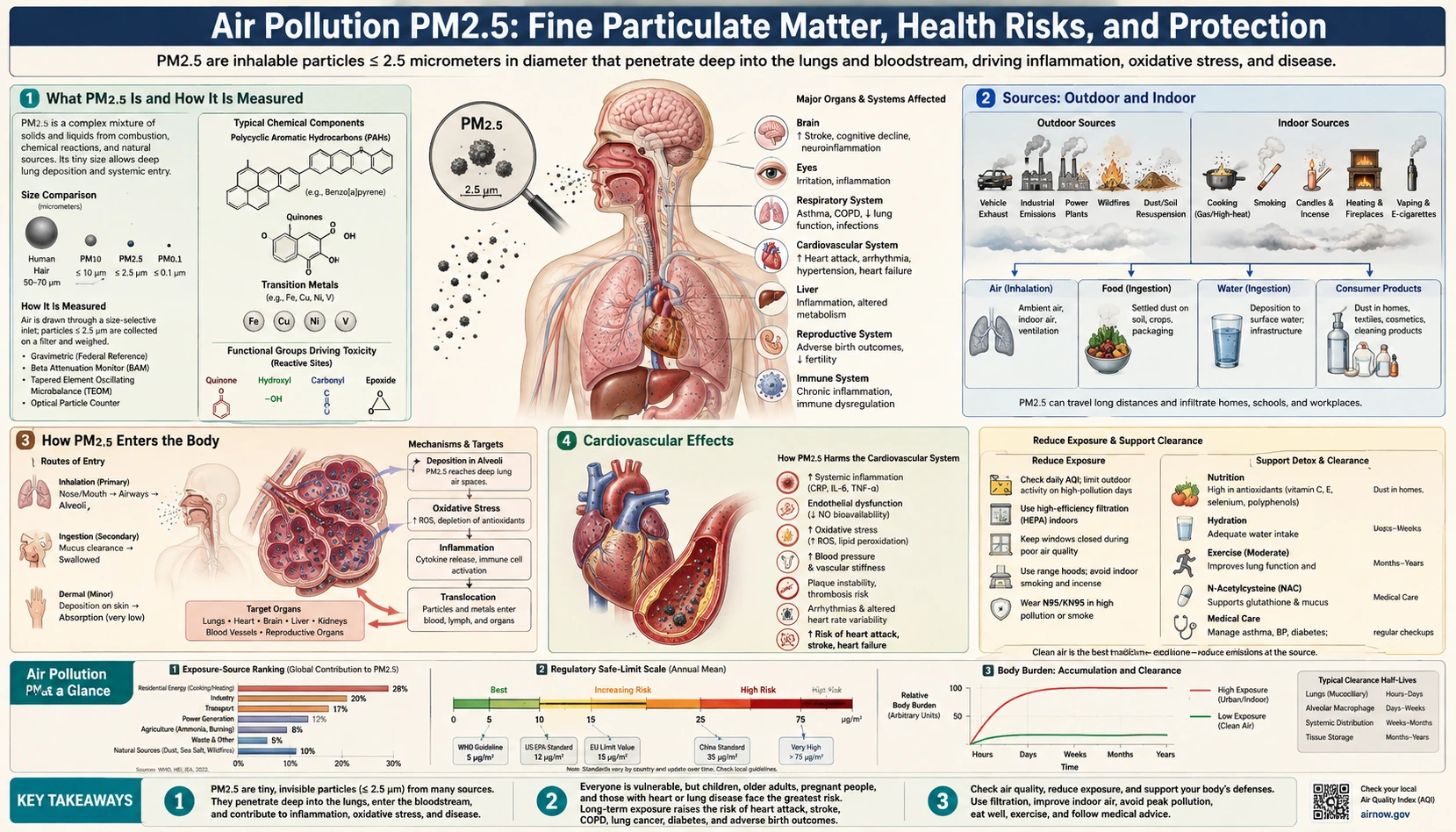
PM2.5 — fine particulate matter with an aerodynamic diameter of 2.5 micrometers or smaller. The World Health Organization estimates that ambient (outdoor) air pollution caused 4.2 million premature deaths worldwide in 2019, and that the combined effects of ambient and household air pollution are associated with 6.7 million premature deaths annually (WHO fact sheet).
Unlike coarser particles that are captured by nasal hairs and airway mucus, PM2.5 penetrates deep into the alveoli — the tiny air sacs where oxygen crosses into blood. In cohort studies, long-term exposure is associated with cardiovascular disease, lung cancer, type 2 diabetes, kidney disease, dementia, and low birthweight (studies below). This article explains what PM2.5 is, where it comes from, what studies report about its effects in the body, and what intervention studies report about reducing exposure.
Table of Contents
- What PM2.5 Is and How It Is Measured
- Sources: Outdoor and Indoor
- How PM2.5 Enters the Body
- Cardiovascular Effects
- Pulmonary Effects
- Neurological and Cognitive Effects
- Metabolic, Reproductive, and Cancer Effects
- Mechanisms of Harm
- WHO Guideline and the U.S. Standard
- What Studies Report on Reducing PM2.5 Exposure
- Key Research Papers
- Connections
- Featured Videos
What PM2.5 Is and How It Is Measured
Particulate matter (PM) is classified by aerodynamic diameter. PM10 includes all particles 10 µm or smaller; PM2.5 is the fine fraction at 2.5 µm or smaller; ultrafine particles (UFP or PM0.1) are smaller than 0.1 µm. As particle size decreases, depth of lung penetration and systemic bioavailability increase.
PM2.5 is not a single compound; it is a heterogeneous mixture of:
- Elemental carbon (soot). The black core of combustion particles from diesel engines, wood burning, and industrial processes.
- Organic carbon. Partially burned hydrocarbons, including polycyclic aromatic hydrocarbons (PAHs) and their toxic derivatives.
- Sulfates and nitrates. Secondary aerosols formed when sulfur dioxide and nitrogen oxides react in the atmosphere. Major component of regional haze.
- Metals. Lead, cadmium, arsenic, nickel, and manganese adsorbed onto particle surfaces from industrial emissions and brake dust.
- Biological material. Bacterial fragments, fungal spores, and endotoxins — especially in agricultural and dusty regions.
- Secondary organic aerosols. Formed by photochemical reactions of volatile organic compounds in the presence of sunlight and ozone.
PM2.5 is measured as mass concentration in micrograms per cubic meter (µg/m³). Regulatory monitoring in the U.S. uses Federal Reference Method gravimetric filters and continuous monitors. Low-cost optical sensors (used in consumer air quality monitors) estimate particle levels from light-scattering.
Sources: Outdoor and Indoor
Outdoor Sources
- Traffic and transportation. Diesel exhaust is a major urban source. A global modelling study found that in much of the USA, emissions from traffic and power generation are important contributors to PM2.5-related mortality (Lelieveld 2015, PubMed PMID: 26381985).
- Power generation. Coal- and oil-fired power plants emit sulfur dioxide and particulates that contribute to regional PM2.5 concentrations via secondary aerosol formation.
- Industrial processes. Smelting, cement manufacturing, and chemical plants emit primary PM2.5 and precursor gases.
- Biomass and agricultural burning. Wildfire smoke and agricultural burning produce regional smoke events.
- Wood burning for heating. Residential energy use such as heating and cooking had the largest impact on PM2.5-related premature mortality globally in the same modelling study, prevalent in India and China (Lelieveld 2015).
- Natural sources. Sea salt, windblown soil, and volcanic emissions also contribute PM2.5. In eastern USA, Europe, Russia and East Asia, agricultural emissions made the largest relative contribution to PM2.5 in the Lelieveld model.
Indoor Sources
- Cooking. Gas burners, frying, and toasting generate PM2.5 indoors.
- Candles and incense. Burning paraffin candles or incense sticks generates substantial PM2.5 and VOCs in enclosed spaces.
- Infiltration of outdoor air. Outdoor PM2.5 enters homes; in the Shanghai dormitory trial described below, indoor PM2.5 averaged 96.2 µg/m³ with sham air purifiers.
- Smoking and vaping. Tobacco smoke and vaping aerosol add fine particles indoors.
- Printers. Laser printers emit PM2.5 during printing, especially in unventilated offices.
- Cleaning products and air fresheners. Some react with ozone to form secondary organic aerosols and PM2.5 indoors.
How PM2.5 Enters the Body
Fine particles bypass the filtering mechanisms that protect the upper airways. Nasal hairs trap particles above about 10 µm; the mucociliary escalator clears particles in the conducting airways (trachea, bronchi). PM2.5, because of its size, deposits preferentially in the respiratory bronchioles and alveoli — regions where the airway is too deep for mucociliary clearance and too narrow for coughing to be effective.
From the alveoli, PM2.5 can:
- Translocate directly across the air-blood barrier into pulmonary capillaries, entering systemic circulation.
- Be engulfed by alveolar macrophages, which either break down the particles or carry them to lymph nodes.
- Travel via the olfactory nerve to the brain, a route proposed for ultrafine particles in particular.
Black carbon particles were identified in every human placenta screened in a 2019 Belgian study, including on the fetal side, and the placental load rose with the mother’s residential black carbon exposure during pregnancy (Bové 2019, PubMed PMID: 31530803). The particle surface carries compounds including PAHs, metals, and endotoxins.
Cardiovascular Effects
The 2010 American Heart Association scientific statement concluded that PM2.5 exposure over a few hours to weeks can trigger cardiovascular deaths and nonfatal events, that longer-term exposure raises cardiovascular mortality to an even greater extent, and that the overall evidence is consistent with a causal relationship (Brook 2010, PubMed PMID: 20458016).
- Hospital admissions. In 204 U.S. urban counties (11.5 million Medicare enrollees, 1999–2002), short-term rises in PM2.5 were associated with higher admission rates for cerebrovascular, peripheral and ischemic heart disease, heart rhythm disorders, heart failure, COPD, and respiratory infection. The largest association was for heart failure: a 1.28% higher risk per 10 µg/m³ same-day increase (Dominici 2006, PubMed PMID: 16522832).
- Traffic and heart attack onset. In a German case-crossover study of 691 heart-attack survivors, time spent in traffic was associated with the onset of a myocardial infarction within one hour afterward (odds ratio 2.92) (Peters 2004, PubMed PMID: 15496621).
- Atherosclerosis acceleration. In the Multi-Ethnic Study of Atherosclerosis (MESA, 5,362 participants, mean follow-up 2.5 years), 2.5 µg/m³ higher residential PM2.5 was associated with 5.0 µm/year greater progression of carotid intima-media thickness (a marker of atherosclerosis) among people in the same metropolitan area, against an average progression of 14 µm/year (Adar 2013, PubMed PMID: 23637576).
- Blood pressure. In the Shanghai air-purifier trial described below, 48 hours of real versus sham filtration lowered systolic and diastolic blood pressure by 2.7% and 4.8% (geometric means).
Pulmonary Effects
- Lung cancer. On 17 October 2013 IARC classified outdoor air pollution as carcinogenic to humans (Group 1), concluding there is sufficient evidence that it causes lung cancer; particulate matter, evaluated separately, was also classified Group 1 (IARC press release 221; Loomis 2013, PubMed PMID: 25035875). IARC’s working group reported that the lung-cancer associations persist after adjustment for tobacco smoking (Loomis 2014, PubMed PMID: 24694836). In the American Cancer Society cohort of about 500,000 adults, each 10 µg/m³ of fine particulate pollution was associated with about 8% higher lung-cancer mortality (Pope 2002, PubMed PMID: 11879110).
- COPD and respiratory infection. Short-term rises in PM2.5 were associated with higher hospital admission rates for both in the Medicare study above (Dominici 2006).
- Airway inflammation. Two hours of exposure to concentrated ambient particles produced a mild increase in airway neutrophils and higher blood fibrinogen 18 hours later in healthy volunteers, without symptoms or loss of lung function (Ghio 2000, PubMed PMID: 10988117).
- Reduced lung function in children. The Children’s Health Study followed 1,759 children in 12 Southern California communities from age 10 to 18. PM2.5 exposure was associated with deficits in the growth of FEV1, and the proportion of 18-year-olds with low FEV1 was 7.9% at the highest PM2.5 exposure versus 1.6% at the lowest (Gauderman 2004, PubMed PMID: 15356303).
Neurological and Cognitive Effects
Studies of PM2.5 and the brain report the following associations:
- Dementia and cognitive decline. In older U.S. women of the Women’s Health Initiative Memory Study, living where fine PM exceeded EPA standards was associated with 81% higher risk of global cognitive decline and 92% higher risk of all-cause dementia, with stronger effects in APOE ε4/4 carriers; the same paper reports mouse experiments (Cacciottolo 2017, PubMed PMID: 28140404). In Ontario, living less than 50 m from a major road was associated with a 7% higher incidence of dementia (Chen 2017, PubMed PMID: 28063597).
- Parkinson’s disease. The same Ontario cohort found no association between living near heavy traffic and Parkinson’s disease or multiple sclerosis (Chen 2017).
- Depression and anxiety. A 2019 systematic review and meta-analysis pooled five studies of long-term PM2.5 and depression: odds ratio 1.10 per 10 µg/m³. Two studies reported associations with anxiety, and short-term PM10 (not PM2.5) was associated with suicide. The authors note residual confounding and other methodological limits (Braithwaite 2019, PubMed PMID: 31850801).
- Neurodevelopment in children. In the Nurses’ Health Study II, higher PM2.5 during pregnancy, particularly the third trimester, was associated with higher odds of autism spectrum disorder in the child (odds ratio 1.57 per 4.42 µg/m³) (Raz 2015, PubMed PMID: 25522338). A 2020 meta-analysis of 25 studies found “some evidence” for prenatal PM2.5 and autism (pooled odds ratio 1.06), with trimester patterns inconsistent between studies (Chun 2020, PubMed PMID: 31733973).
Metabolic, Reproductive, and Cancer Effects
- Type 2 diabetes. In a cohort of 1.7 million U.S. veterans followed a median of 8.5 years, each 10 µg/m³ of PM2.5 was associated with 15% higher risk of incident diabetes. The same 2018 burden study estimated that ambient PM2.5 contributed to about 3.2 million incident diabetes cases worldwide in 2016 (Bowe 2018, PubMed PMID: 30074893).
- Low birth weight and preterm birth. In the European ESCAPE study of 74,178 women in 14 cohorts, each 5 µg/m³ of PM2.5 during pregnancy was associated with higher risk of low birthweight at term (odds ratio 1.18), and an increased risk was also seen at concentrations below the EU annual limit of 25 µg/m³ (Pedersen 2013, PubMed PMID: 24429273).
- Particles in the placenta. Black carbon particles were found on the fetal side of the placenta, in amounts that rose with maternal exposure (Bové 2019, above).
- Kidney disease. In 2.5 million U.S. veterans followed a median of 8.5 years, each 10 µg/m³ of PM2.5 was associated with higher risk of incident chronic kidney disease (hazard ratio 1.27), eGFR decline of 30% or more (1.28), and end-stage renal disease (1.26) (Bowe 2018, PubMed PMID: 28935655).
Mechanisms of Harm
The 2010 American Heart Association statement concluded that many credible pathological mechanisms have been described that lend biological plausibility to the epidemiology (Brook 2010). Mechanisms proposed in the research literature include:
- Oxidative stress. PM2.5 particles generate reactive oxygen species (ROS) both directly (via redox-active metals and quinones on their surfaces) and indirectly (by activating NADPH oxidase in macrophages and endothelial cells). ROS damage lipids, proteins, and DNA throughout the body.
- Systemic inflammation. Alveolar macrophages engulfing PM2.5 release cytokines (IL-6, TNF-α, IL-1β) that may enter systemic circulation and drive endothelial activation, coagulation, and atherosclerosis progression. In the Shanghai purifier trial, filtration lowered several circulating inflammatory and thrombogenic markers, including interleukin-1β (by 68.1%).
- Autonomic nervous system dysregulation. PM2.5 exposure suppresses heart rate variability within hours, interpreted as a shift toward sympathetic dominance.
- Endothelial dysfunction. PM2.5 directly damages arterial endothelium, reducing nitric oxide availability (impairing vasodilation), increasing adhesion molecule expression, and accelerating foam cell formation in plaque.
- Epigenetic modification. PM2.5 alters DNA methylation at immune, inflammatory, and metabolic gene loci, detectable in blood.
- Direct toxic cargo delivery. PAHs, heavy metals, and endotoxins adsorbed on PM2.5 surfaces enter cells with the particle, delivering toxic payload directly into cytoplasm and potentially into the nucleus.
- Blood-brain barrier disruption. PM2.5 and its chemical cargo promote neuroinflammation and reduce blood-brain barrier integrity, allowing other circulating toxins greater access to brain tissue.
WHO Guideline and the U.S. Standard
In 2021, the WHO adjusted almost all of its air quality guideline levels downward (WHO, 22 September 2021):
- Annual mean PM2.5: 5 µg/m³ (the 2005 guideline was 10 µg/m³; Hoffmann 2021, PubMed PMID: 34630006).
- 24-hour mean PM2.5: 15 µg/m³ (WHO guideline summary).
The WHO states that almost 80% of deaths related to PM2.5 could be avoided worldwide if current levels were reduced to the updated guideline. In the U.S. veterans diabetes analysis, risk rose substantially above 2.4 µg/m³ (Bowe 2018).
- On 7 February 2024 the U.S. EPA lowered the primary annual PM2.5 standard from 12.0 to 9.0 µg/m³, kept the 24-hour PM2.5 standard unchanged, and revised the Air Quality Index (Federal Register, 2024). On 12 March 2025 the EPA announced that it is reconsidering the particulate matter standards (EPA).
- In 2019, 99% of the world’s population lived in places where the WHO guideline levels were not met (WHO fact sheet).
What Studies Report on Reducing PM2.5 Exposure
Indoor air filtration
In a randomized, double-blind crossover trial, 35 healthy college students in Shanghai used real or sham air purifiers in their dormitories for 48 hours. Filtration cut indoor PM2.5 by 57% on average, from 96.2 to 41.3 µg/m³, within hours of operation, and lowered several inflammatory and clotting markers, systolic and diastolic blood pressure, and exhaled nitric oxide; effects on lung function were not statistically significant (Chen 2015, PubMed PMID: 26022815).
Traffic exposure
Time spent in traffic was associated with heart-attack onset within the following hour in the German case-crossover study (Peters 2004).
Population-level reductions
The 2010 AHA statement reports that reductions in PM levels are associated with decreases in cardiovascular mortality within a time frame as short as a few years (Brook 2010). In MESA, larger reductions in PM2.5 over follow-up were associated with slower progression of carotid intima-media thickness (Adar 2013). The ESCAPE authors estimated that reducing pregnancy PM2.5 to 10 µg/m³ would correspond to 22% fewer cases of low birthweight at term (Pedersen 2013). Decisions about health measures belong with a clinician.
Key Research Papers
- Pope CA III, et al. Lung cancer, cardiopulmonary mortality, and long-term exposure to fine particulate air pollution. JAMA. 2002;287(9):1132–1141. — PubMed PMID: 11879110
- Peters A, et al. Exposure to traffic and the onset of myocardial infarction. N Engl J Med. 2004;351(17):1721–1730. — PubMed PMID: 15496621
- Dockery DW, et al. An association between air pollution and mortality in six U.S. cities. N Engl J Med. 1993;329(24):1753–1759. — PubMed PMID: 8179653
- Gauderman WJ, et al. The effect of air pollution on lung development from 10 to 18 years of age. N Engl J Med. 2004;351(11):1057–1067. — PubMed PMID: 15356303
- Chen H, et al. Living near major roads and the incidence of dementia, Parkinson’s disease, and multiple sclerosis. Lancet. 2017;389(10070):718–726. — PubMed PMID: 28063597
- Cacciottolo M, et al. Particulate air pollutants, APOE alleles and their contributions to cognitive impairment in older women and to amyloidogenesis in experimental models. Transl Psychiatry. 2017;7(1):e1022. — PubMed PMID: 28140404
- Lelieveld J, et al. The contribution of outdoor air pollution sources to premature mortality on a global scale. Nature. 2015;525(7569):367–371. — PubMed PMID: 26381985
- Brook RD, et al. Particulate matter air pollution and cardiovascular disease: an update to the scientific statement from the American Heart Association. Circulation. 2010;121(21):2331–2378. — PubMed PMID: 20458016
- Ghio AJ, et al. Concentrated ambient air particles induce mild pulmonary inflammation in healthy human volunteers. Am J Respir Crit Care Med. 2000;162(3):981–988. — PubMed PMID: 10988117
- Landrigan PJ, et al. The Lancet Commission on pollution and health. Lancet. 2018;391(10119):462–512. — PubMed PMID: 29056410
- Raz R, et al. Autism spectrum disorder and particulate matter air pollution before, during, and after pregnancy: a nested case-control analysis within the Nurses’ Health Study II Cohort. Environ Health Perspect. 2015;123(3):264–270. — PubMed PMID: 25522338
- Dominici F, et al. Fine particulate air pollution and hospital admission for cardiovascular and respiratory diseases. JAMA. 2006;295(10):1127–1134. — PubMed PMID: 16522832
- Adar SD, et al. Fine particulate air pollution and the progression of carotid intima-medial thickness: a prospective cohort study from the multi-ethnic study of atherosclerosis and air pollution. PLoS Med. 2013;10(4):e1001430. — PubMed PMID: 23637576
- Loomis D, et al. The carcinogenicity of outdoor air pollution. Lancet Oncol. 2013;14(13):1262–1263. — PubMed PMID: 25035875
- Loomis D, Huang W, Chen G. The International Agency for Research on Cancer (IARC) evaluation of the carcinogenicity of outdoor air pollution: focus on China. Chin J Cancer. 2014;33(4):189–196. — PubMed PMID: 24694836
- Braithwaite I, et al. Air pollution (particulate matter) exposure and associations with depression, anxiety, bipolar, psychosis and suicide risk: a systematic review and meta-analysis. Environ Health Perspect. 2019;127(12):126002. — PubMed PMID: 31850801
- Chun H, et al. Maternal exposure to air pollution and risk of autism in children: a systematic review and meta-analysis. Environ Pollut. 2020;256:113307. — PubMed PMID: 31733973
- Bowe B, et al. The 2016 global and national burden of diabetes mellitus attributable to PM2.5 air pollution. Lancet Planet Health. 2018;2(7):e301–e312. — PubMed PMID: 30074893
- Bowe B, et al. Particulate matter air pollution and the risk of incident CKD and progression to ESRD. J Am Soc Nephrol. 2018;29(1):218–230. — PubMed PMID: 28935655
- Pedersen M, et al. Ambient air pollution and low birthweight: a European cohort study (ESCAPE). Lancet Respir Med. 2013;1(9):695–704. — PubMed PMID: 24429273
- Bové H, et al. Ambient black carbon particles reach the fetal side of human placenta. Nat Commun. 2019;10(1):3866. — PubMed PMID: 31530803
- Chen R, et al. Cardiopulmonary benefits of reducing indoor particles of outdoor origin: a randomized, double-blind crossover trial of air purifiers. J Am Coll Cardiol. 2015;65(21):2279–2287. — PubMed PMID: 26022815
- Hoffmann B, et al. WHO Air Quality Guidelines 2021 — aiming for healthier air for all: a joint statement by medical, public health, scientific societies and patient representative organisations. Int J Public Health. 2021;66:1604465. — PubMed PMID: 34630006