MSG (Monosodium Glutamate): Excitotoxin in Our Food

Table of Contents
- What MSG Is
- Excitotoxicity Theory
- Chinese Restaurant Syndrome History
- Hidden Names for MSG on Food Labels
- Neurological Effects
- Obesity and Metabolic Syndrome
- MSG in Baby Food Controversy
- U.S. Food and Drug Administration "Generally Recognized as Safe" Status Despite Complaints
- MSG Sensitivity Reactions
- MSG in Processed Foods
- How MSG Appears on Labels
- Connections
- Featured Videos
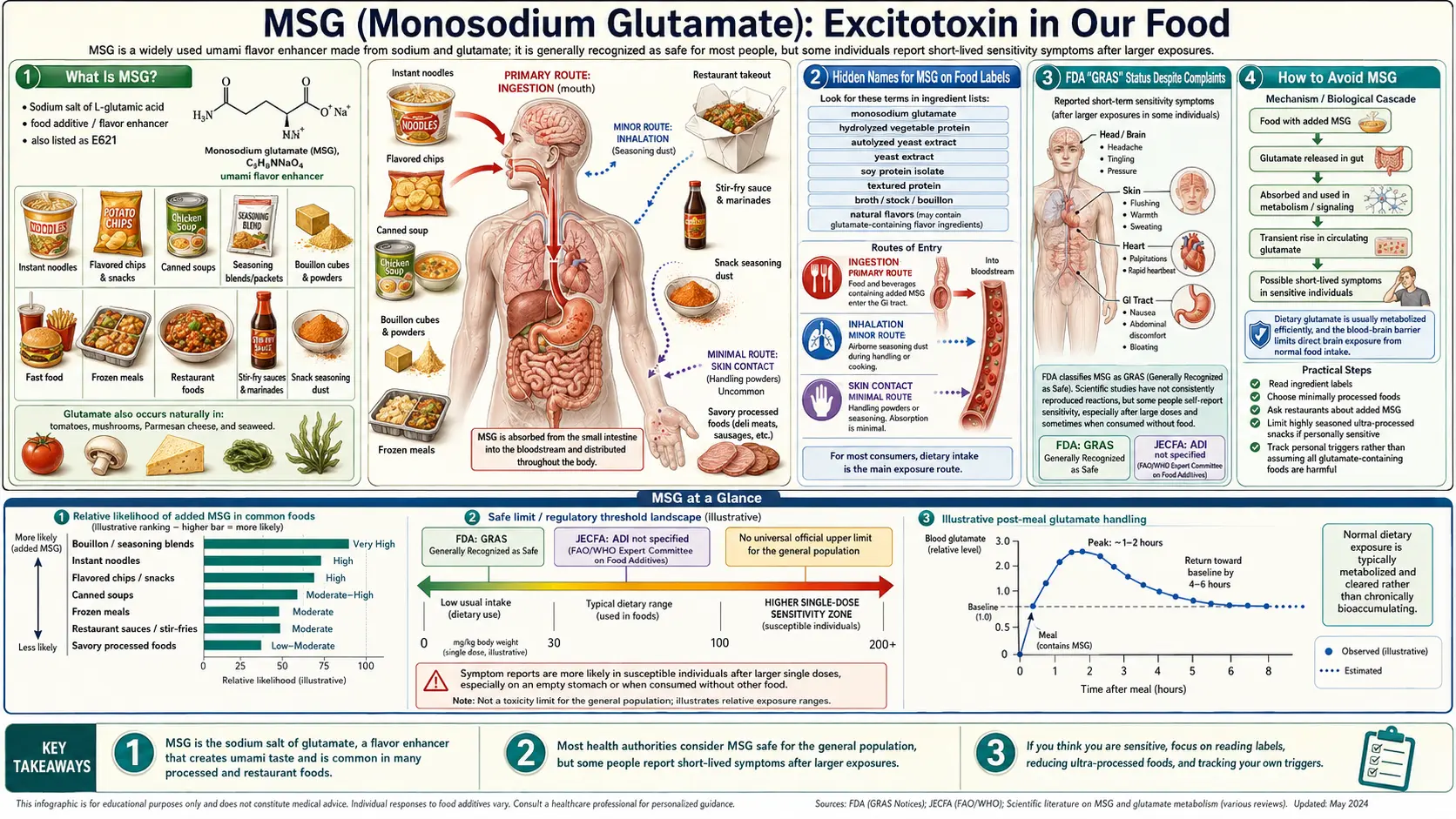
Monosodium glutamate (MSG) is one of the most widely used and most controversial food additives in the world. This flavor enhancer, found in thousands of processed foods, restaurant meals, and fast food products, has been the subject of intense debate for over five decades. While the food industry and regulatory agencies maintain that MSG is safe, a significant body of research and countless anecdotal reports suggest that this excitotoxic amino acid may contribute to neurological symptoms, obesity, metabolic syndrome, and other health problems.
The controversy surrounding MSG is complicated by the fact that the food industry has developed dozens of alternative names to disguise its presence in ingredient lists, making it nearly impossible for sensitive individuals to avoid. This page sets out what MSG is, the ingredient names under which free glutamate appears on labels, and what the research and regulators report about its effects.
What MSG Is
- Chemical identity: MSG is the sodium salt of glutamic acid, one of the most abundant amino acids in nature. It consists of a glutamate molecule bound to a sodium ion
- Flavor function: MSG activates glutamate receptors on the tongue, producing a savory, meaty taste sensation known as "umami," which was identified as the fifth basic taste alongside sweet, sour, salty, and bitter
- Discovery: MSG was first isolated in 1908 by Japanese chemist Kikunae Ikeda, who extracted glutamate from seaweed broth (kombu) and identified it as the source of the savory flavor characteristic of Japanese cuisine
- Manufacturing: Modern MSG is produced through bacterial fermentation of sugars derived from sugar cane, sugar beets, corn starch, or tapioca, producing a white crystalline powder that is approximately 78% free glutamic acid and 22% sodium
- Natural vs. manufactured: While glutamic acid occurs naturally in many foods (tomatoes, parmesan cheese, mushrooms), the free glutamic acid in manufactured MSG behaves differently because it is not bound to proteins and is absorbed much more rapidly into the bloodstream
- Scale of use: Global MSG production exceeds 3 million tons per year, with the majority consumed in Asian countries, though usage in Western processed foods has grown substantially
Excitotoxicity Theory
- What is excitotoxicity: Excitotoxicity is the pathological process by which neurons are damaged and killed by excessive stimulation from neurotransmitters like glutamate. When glutamate receptors are overstimulated, they allow excessive calcium influx into nerve cells, triggering cell death
- Dr. Russell Blaylock: Neurosurgeon and author Dr. Russell Blaylock brought widespread public attention to the excitotoxicity theory with his 1994 book "Excitotoxins: The Taste That Kills," which argued that dietary MSG and aspartame overstimulate neurons and contribute to neurodegenerative diseases
- Dr. John Olney: Neuroscientist Dr. John Olney first demonstrated in the late 1960s that MSG caused brain lesions in infant mice, particularly in the hypothalamus, and coined the term "excitotoxicity" to describe the mechanism
- Blood-brain barrier concerns: While the blood-brain barrier normally protects the brain from excess glutamate, certain brain regions (circumventricular organs) lack a complete blood-brain barrier and are directly exposed to blood glutamate levels
- Vulnerable populations: Infants, young children, the elderly, and individuals with compromised blood-brain barriers (from head injury, stroke, or neurological disease) may be particularly susceptible to excitotoxic effects from dietary glutamate
- Neurodegenerative link: Excitotoxicity has been implicated in the pathology of Alzheimer's disease, Parkinson's disease, amyotrophic lateral sclerosis (ALS) (Lou Gehrig's disease), multiple sclerosis, and Huntington's disease, raising questions about whether chronic dietary excitotoxin exposure could contribute to these conditions
Chinese Restaurant Syndrome History
- 1968 letter: Dr. Robert Ho Man Kwok published a letter in the New England Journal of Medicine describing symptoms he experienced after eating at Chinese restaurants, including numbness in the back of the neck radiating to the arms, general weakness, and heart palpitations
- Media sensation: The letter sparked widespread media coverage and public alarm, leading to the term "Chinese Restaurant Syndrome" and the widespread association of MSG with adverse reactions
- Cultural bias: Critics have argued that the focus on Chinese restaurants reflected cultural bias, since MSG was equally prevalent in American processed foods, snack chips, canned soups, and fast food
- Industry response: Critics argue that the food industry invested heavily in research aimed at disproving the connection between MSG and adverse symptoms, and that industry-funded studies tended to find no effect while some independent studies documented reactions
- Symptom complex: Commonly reported symptoms include headache, flushing, sweating, facial pressure or tightness, numbness or tingling, chest pain, nausea, heart palpitations, weakness, and drowsiness
- Renamed condition: The medical establishment has moved away from the term "Chinese Restaurant Syndrome" in favor of "MSG symptom complex," acknowledging the symptoms while attempting to address the cultural stereotyping
Hidden Names for MSG on Food Labels
The food industry uses dozens of alternative ingredient names that contain significant amounts of free glutamic acid, effectively hiding MSG from consumers who are trying to avoid it. The following ingredients always or frequently contain manufactured free glutamic acid:
Ingredients That Always Contain MSG
- Monosodium glutamate: The most obvious name, but increasingly rare on labels as manufacturers switch to alternatives
- Hydrolyzed protein: (hydrolyzed vegetable protein, hydrolyzed soy protein, hydrolyzed wheat protein) The acid or enzyme hydrolysis process breaks down proteins and releases free glutamic acid
- Autolyzed yeast: Yeast cells are broken down (autolyzed), releasing their internal glutamic acid content. Commonly used in soups, sauces, and snack foods
- Yeast extract: Similar to autolyzed yeast, yeast extract is a concentrated source of free glutamic acid widely used as a "natural" flavoring in health food products and conventional foods alike
- Sodium caseinate: Derived from casein (milk protein) through a process that creates free glutamic acid
- Calcium caseinate: Similar to sodium caseinate, contains significant amounts of free glutamic acid
- Textured protein: Highly processed plant proteins that contain free glutamic acid as a result of manufacturing
- Soy protein isolate: A highly refined form of soy protein that undergoes processing that generates substantial free glutamic acid
- Soy protein concentrate: Contains free glutamic acid produced during the concentration process
- Whey protein concentrate: Processing can generate free glutamic acid, particularly in highly refined forms
Ingredients That Often Contain MSG
- "Natural flavors" or "natural flavoring": This vague label category can include glutamate-containing ingredients without specific disclosure
- "Spices" or "seasoning": Under U.S. Food and Drug Administration (FDA) rules, added MSG cannot be listed as "spices and flavoring"; it must be listed as "monosodium glutamate". A seasoning can still contain ingredients naturally high in free glutamate, such as hydrolyzed protein or yeast extract, which appear on the label under their own names
- Bouillon, broth, or stock: Commercial versions almost always contain MSG or MSG-equivalent ingredients
- Maltodextrin: A processed starch that may contain free glutamic acid depending on the manufacturing process
- Citric acid: When produced through corn fermentation (as most commercial citric acid is), it may contain residual free glutamic acid
- "Flavoring" or "flavors": Another vague category that may include glutamate sources
- Protein-fortified anything: The processing of protein powders and protein-fortified foods often generates free glutamic acid
Neurological Effects
- Headaches and migraines: MSG is one of the most commonly reported dietary migraine triggers, with studies showing that oral doses of MSG can provoke headaches in sensitive individuals, particularly when consumed on an empty stomach
- Mechanism: Glutamate crosses into the brain through areas lacking a complete blood-brain barrier, overstimulating neurons and triggering the release of inflammatory substances that dilate blood vessels and activate pain pathways
- Dose-dependent effects: Research suggests that neurological symptoms from MSG are dose-dependent, with larger doses and consumption on an empty stomach producing more pronounced effects
- Brain lesions in animals: Dr. John Olney's original research and numerous subsequent animal studies have demonstrated that MSG can cause lesions in the hypothalamus and other brain regions, particularly in young animals
- Seizure threshold: Some research suggests that MSG may lower the seizure threshold in susceptible individuals, potentially exacerbating epilepsy and other seizure disorders
- Cognitive effects: Animal studies have shown that chronic MSG exposure can impair learning, memory, and cognitive function, potentially through excitotoxic damage to hippocampal neurons
Obesity and Metabolic Syndrome
- MSG-induced obesity in animals: Since the 1960s, researchers have used MSG injections to create obese animal models for diabetes and metabolic research. Neonatal MSG administration reliably produces obesity in laboratory animals by damaging the hypothalamic appetite regulation center
- Human epidemiological data: A 2008 cross-sectional study of 752 adults aged 40 to 59 in three rural villages in China (the INTERMAP study) found that MSG intake was positively associated with overweight, independent of total energy intake and physical activity (PubMed PMID: 18497735)
- Appetite stimulation: MSG enhances the palatability of food and may override normal satiety signals, leading to increased food intake. The food industry explicitly uses MSG for this purpose, to make people eat more
- Leptin resistance: Animal studies suggest that MSG exposure can induce leptin resistance, impairing the hormone signaling system that tells the brain when the body has consumed enough food
- Insulin response: MSG has been shown to stimulate insulin secretion independent of blood glucose levels, potentially promoting fat storage and contributing to insulin resistance over time
- Metabolic syndrome: Research has linked MSG consumption to components of metabolic syndrome including central obesity, elevated triglycerides, and insulin resistance
MSG in Baby Food Controversy
- Historical use: MSG was commonly added to commercial baby food products until the late 1960s, when Dr. John Olney's research demonstrating brain damage in infant mice raised alarm about the safety of feeding excitotoxins to infants
- Voluntary removal: Under public pressure following Olney's research and congressional hearings, major baby food manufacturers voluntarily removed added MSG from their products in 1969
- Hidden sources remain: Despite the removal of MSG itself, many baby foods and toddler foods still contain ingredients that contain free glutamic acid, such as hydrolyzed proteins, yeast extract, and "natural flavors"
- Immature blood-brain barrier: Infants and young children have incompletely developed blood-brain barriers, making their developing brains more vulnerable to the excitotoxic effects of glutamate than adult brains
- Critical development period: The first few years of life involve explosive brain growth and neural circuit formation, meaning that any excitotoxic damage during this period could have lasting neurodevelopmental consequences
U.S. Food and Drug Administration "Generally Recognized as Safe" Status Despite Complaints
- Generally recognized as safe (GRAS) designation: The U.S. Food and Drug Administration (FDA) considers the addition of MSG to foods to be "generally recognized as safe" (GRAS), a designation that means the substance is exempt from the formal premarket approval process required for food additives
- FASEB review: In 1995, the U.S. Food and Drug Administration commissioned the Federation of American Societies for Experimental Biology (FASEB) to review MSG safety. The report acknowledged that some individuals experience adverse reactions to MSG but concluded that it was generally safe at typical consumption levels. The FDA reports that the FASEB review identified short-term, generally mild symptoms (headache, numbness, flushing, tingling, palpitations, drowsiness) in some sensitive people who consume 3 grams or more of MSG without food, while a typical serving of a food with added MSG contains less than 0.5 grams
- Consumer complaints: The U.S. Food and Drug Administration has received thousands of complaints about adverse reactions to MSG over the decades, including reports of headaches, nausea, heart palpitations, chest pain, and numbness
- Industry influence: An industry trade group funded by MSG manufacturers has been a major force in defending MSG's GRAS status and in funding research on its safety
- Study design criticism: Critics argue that many industry-funded studies used inappropriate controls (administering MSG in capsules rather than in food), inadequate doses, or insensitive outcome measures designed to minimize the detection of adverse effects
- Labeling of free-glutamate ingredients: The FDA requires added MSG to be listed as "monosodium glutamate". Ingredients that naturally contain free glutamate, such as hydrolyzed vegetable protein, autolyzed yeast, yeast extract, soy extracts and protein isolate, must be listed on the ingredient panel by name, but the label does not have to say that they contain glutamate; foods containing them cannot claim "No MSG" or "No added MSG"
MSG Sensitivity Reactions
- Prevalence estimates: While exact numbers are debated, estimates suggest that 1-3% of the general population experiences noticeable adverse reactions to MSG, with higher rates among individuals with asthma and migraine disorders
- Common symptoms: Headache, flushing, sweating, facial pressure, numbness or tingling in the face and neck, heart palpitations, chest tightness, nausea, weakness, and drowsiness
- Asthma exacerbation: Some studies have documented worsening of asthma symptoms in MSG-sensitive individuals, with reactions occurring 1-2 hours after ingestion and potentially lasting up to 72 hours. A 1987 hospital challenge study of 32 people with asthma reported asthma reactions to MSG in 13, starting 1 to 2 hours after ingestion in seven and 6 to 12 hours after in six (PubMed PMID: 3312372). A 2000 review found that four later studies, covering 45 people with a history of asthma attacks after restaurant meals, recorded no asthma reactions to MSG, and concluded that MSG-induced asthma "has not been established conclusively" (PubMed PMID: 10736384)
- Delayed reactions: MSG reactions can be delayed by several hours, making it difficult for individuals to identify the connection between their symptoms and MSG consumption
- Cumulative effect: Some individuals report that a single exposure produces no noticeable symptoms, but multiple exposures over a short period trigger reactions, suggesting a threshold or cumulative effect
- Individual variation: Sensitivity appears to vary widely between individuals, with factors such as genetics, gut health, overall glutamate intake, and whether the MSG is consumed with food or on an empty stomach all influencing the response
MSG in Processed Foods
- Snack foods: Flavored chips, crackers, pretzels, and snack mixes typically contain MSG or MSG-equivalent ingredients as primary flavoring agents
- Canned soups and broths: Most commercial soups, broths, and bouillon cubes contain MSG or ingredients high in free glutamic acid
- Frozen meals: Virtually all frozen dinners, pot pies, and prepared meals use MSG or its hidden equivalents to enhance flavor
- Salad dressings and sauces: Ranch, Caesar, soy sauce, Worcestershire, barbecue sauce, and many other condiments contain MSG-equivalent ingredients
- Fast food: Major fast food chains use MSG extensively in their seasoning blends, breading, sauces, and marinades
- Processed meats: Hot dogs, sausages, deli meats, jerky, and other processed meat products commonly contain MSG or hydrolyzed proteins
- Seasoning blends: Many popular seasoning mixes and spice blends contain MSG as a primary ingredient; under FDA rules added MSG must be listed as "monosodium glutamate" and cannot be listed as "spices and flavoring"
- "Health" foods: Ironically, many products marketed as natural or healthy contain yeast extract, "natural flavors," or other MSG-equivalent ingredients
How MSG Appears on Labels
- Ingredient names: The ingredient names that contain free glutamic acid include hydrolyzed protein, autolyzed yeast, yeast extract, soy protein isolate, and natural flavors (listed in full above)
- Home cooking: Meals prepared at home from whole ingredients contain only the glutamate the ingredients naturally carry, plus any MSG the cook adds
- Processed foods: The more processed a food product is, the more likely it is to contain MSG or MSG-equivalent ingredients
- "Natural flavors": This vague ingredient category can include glutamate sources, and the label does not have to say so
- Whole seasonings: Fresh herbs, garlic, onions, lemon juice, vinegar, and whole spices add flavor without added MSG
- Restaurants: A request for food without MSG does not cover the pre-made sauces, seasoning blends, and bases many restaurants use, which may already contain MSG or its equivalents
- Changing recipes: Manufacturers frequently change formulations, so the ingredient list of a familiar product can change between purchases
- "No MSG" claims: Under FDA rules, a food containing hydrolyzed vegetable protein, autolyzed yeast, yeast extract, soy extracts or protein isolate cannot claim "No MSG" or "No added MSG" on its packaging
Connections
Featured Videos