Dangerous Supplements: Hidden Drugs, Contamination and Overdose Risks
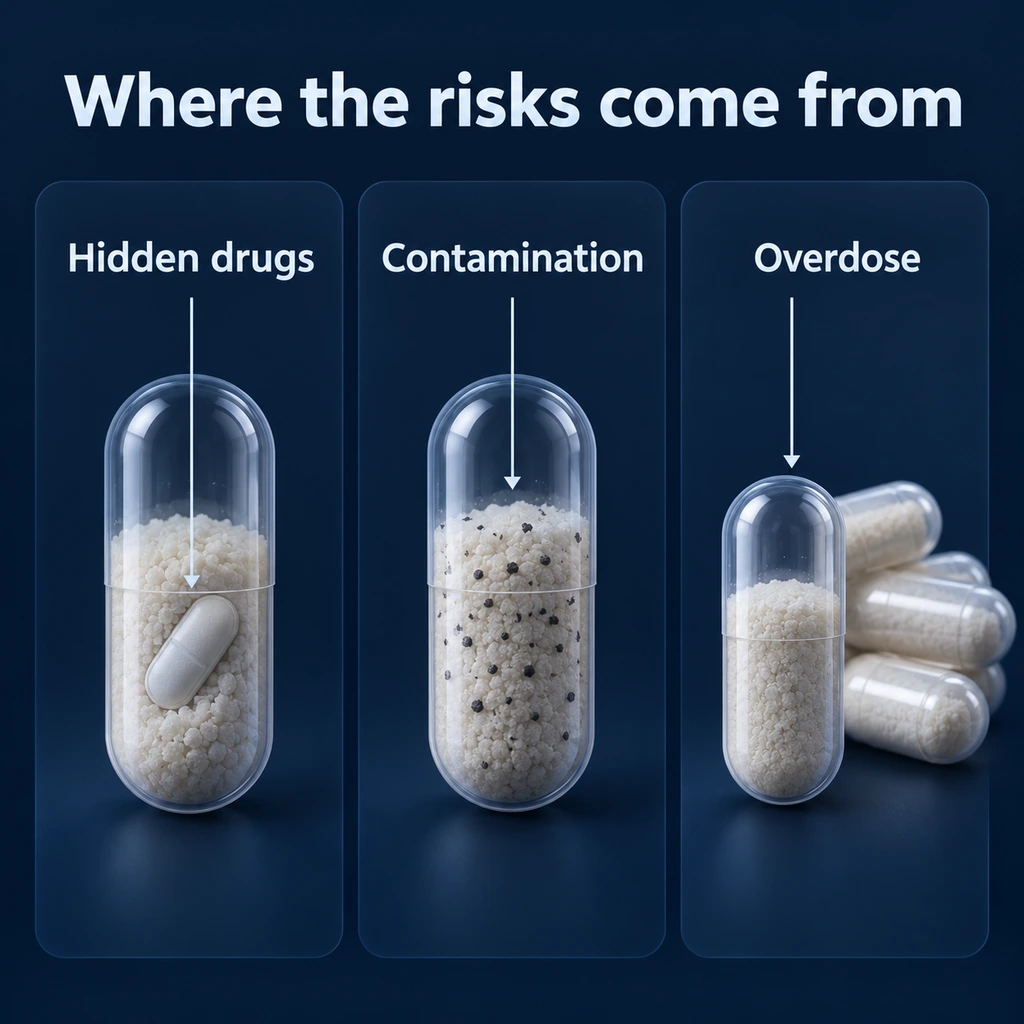
Most supplements on a pharmacy shelf are exactly what the label says, and most people who take them come to no harm. That is the honest starting point, and it is why the alarm you hear online — fifteen deadly brands, 150,000 poisonings a year — does not survive contact with the data. The real number is about 23,000 emergency-department visits a year in the United States, measured properly by the U.S. Centers for Disease Control and Prevention (CDC) and U.S. Food and Drug Administration (FDA) in the New England Journal of Medicine; serious, worth taking seriously, and a fraction of the figure being shouted. What the data also show is that the harm is not spread evenly. It clusters in a handful of recognisable patterns: a “natural” pill that secretly contains a prescription drug, a concentrated extract that injures the liver, a stimulant stack that sends a heart racing, a pain remedy that is really a hidden steroid, a mineral overdosed by a factory error, a memory pill sold on a study that does not say what the advertisement says. Learn the patterns and you can spot the next product before it has a name. That is what this section is for.
Table of Contents
1. The One Law That Explains Everything
In 1994 the United States passed the Dietary Supplement Health and Education Act, known as DSHEA. It did one decisive thing: it classified supplements as a category of food, not drugs. A drug must prove it is safe and effective before it is sold. A supplement does not. The one pre-market step is for new ingredients: makers of supplements containing ingredients introduced after 15 October 1994 are required to notify the FDA before marketing and give a reason to believe the ingredient is safe, such as historical use — but neither safety testing nor FDA approval is required before a supplement is sold. The manufacturer is responsible for its own safety, no agency checks the bottle before it reaches the shelf, and the U.S. Food and Drug Administration can act only after harm is reported — and only if it can prove the product is unsafe. That is not a loophole someone found later; it is how the law was written.
Two consequences follow, and every article in this section is really about one of them. First, a company that wants to hide a prescription drug inside a “herbal” capsule faces no pre-market test that would catch it. Second, a factory that gets a dose wrong by a factor of two hundred, or lets bacteria into a batch, is caught only when people get sick. The U.S. Food and Drug Administration does inspect manufacturers against Good Manufacturing Practice rules and does issue warning letters, recalls and, in the worst cases, court orders — but the inspection comes after the sale, not before.
2. How Big the Problem Actually Is
The best measurement comes from a ten-year national surveillance study of emergency departments, published in the New England Journal of Medicine in 2015. It estimated 23,005 emergency visits a year attributable to dietary supplements, leading to about 2,154 hospitalisations. The pattern inside that number matters more than the total:
- Among adults aged 20 to 34, the single largest cause was weight-loss and energy products, and the symptoms were cardiovascular: palpitations, chest pain, a racing heart.
- Among children under five, most visits were unsupervised ingestion — a child finding the bottle. Iron and multivitamins figure prominently.
- Among adults over 65, a large share were choking or swallowing problems with large pills, not poisoning at all.
Set beside the roughly 1.3 million emergency visits a year for adverse events from prescription drugs, supplements are a smaller problem — but they are a problem people do not expect, because the word “natural” is doing so much work on the label. The liver-injury registries add a second warning: in the U.S. Drug-Induced Liver Injury Network, liver injury from supplements other than bodybuilding products ended in death or liver transplant more often than injury from prescription drugs (13% vs 3%). Bodybuilding products caused long-lasting jaundice in young men but no deaths or transplants.
3. The Ten Risk Patterns (Deep-Dive Articles)
Each pattern has its own article: the mechanism, the documented cases from the public regulatory record, what it looks like from the outside, and what to do. Brands appear only where the U.S. Food and Drug Administration or FTC record names them, and only as that record states it.
Hidden Prescription Drugs in “Natural” Supplements
Sildenafil in a gas-station “herbal” pill, sibutramine in a slimming tea, steroids in a muscle builder. Why the U.S. Food and Drug Administration found unapproved drugs in 776 products in a decade, why they are still on sale after a recall, and how to search the tainted-products database yourself.
Read the deep dive →Hidden Steroids and Nonsteroidal Anti-Inflammatory Drugs in Joint-Pain Products
The arthritis remedy that works suspiciously fast. U.S. Food and Drug Administration testing found undeclared dexamethasone and diclofenac in two families of these products, and a hidden muscle relaxant in several of them — and why stopping one suddenly can be as dangerous as taking it.
Read the deep dive →Liver Injury from Supplements
Supplements now cause roughly one in six cases of drug-induced liver injury in the US registry, and the cases from non-bodybuilding products are more severe than drug-caused ones. Concentrated green-tea extract, bodybuilding products, the 2013 Hawaii hepatitis outbreak, kava and comfrey — and the warning signs.
Read the deep dive →Stimulants in Weight-Loss and Energy Products
The largest single source of supplement emergency visits in young adults. Ephedra’s ban, DMAA sold as “geranium extract”, concentrated caffeine, and why a “proprietary blend” means you cannot know the dose.
Read the deep dive →Sedatives, Phenibut and Kratom
A “relaxation” capsule containing an unapproved Russian anxiolytic; a leaf sold in smoke shops that acts on opioid receptors. Dependence, withdrawal seizures, falls in older adults, and the U.S. Centers for Disease Control and Prevention’s overdose-death count.
Read the deep dive →Memory and Brain Supplements: What the Evidence and the FTC Say
Apoaequorin and the FTC’s case over memory claims, phosphatidylserine dosed below the studied range, vitamin B6 at nerve-damaging levels, and the quietest risk of all: stopping a real dementia medication for a pill.
Read the deep dive →Vitamin and Mineral Overdose
The essential nutrients that turn on you at high doses: iron in a toddler, vitamin A, vitamin D, selenium (the 2008 outbreak from a product with 200 times its labelled dose), zinc that quietly depletes copper, B6 and the nerves.
Read the deep dive →Contamination: Heavy Metals, Bacteria and Substitution
Lead, mercury or arsenic in one Ayurvedic product in five, heavy metals in protein powders, a manufacturer placed under a federal consent decree for sanitation failures, and the herbal capsule that contains a different plant altogether.
Read the deep dive →Aristolochic Acid
A plant toxin behind herbal kidney failure and urinary-tract cancers, from the 1990s Belgian outbreak to Balkan nephropathy and contaminated wheat, and the DNA fingerprint that traces it.
Read the deep dive →How to Verify a Supplement Before You Take It
The independent third-party testing seals that actually mean something, how to read a label, the drug interactions that matter most, and the two-minute U.S. Food and Drug Administration check. The honest version of “which brands are safe”.
Read the deep dive →4. Five Red Flags on a Label
- It works within an hour, or within days. Genuine herbs and nutrients act slowly. Fast relief from a “natural” product for pain, erection or weight is the single most reliable sign of a hidden drug.
- “Proprietary blend” with no per-ingredient amounts. Legal, common, and it means the stimulant or active dose is unknowable from the label.
- Sold at a petrol station, a smoke shop, or only through social-media advertisements — the channels the U.S. Food and Drug Administration’s tainted-product warnings come from most often.
- Words like “natural sildenafil”, “legal steroid”, “clinically proven” with no study named, or a study that turns out to be the company’s own.
- A dose far above the Tolerable Upper Intake Level for a vitamin or mineral, especially vitamin A, D, B6, iron, selenium or zinc.
5. If Something Has Already Gone Wrong
- Poison Control (US): 1-800-222-1222, free, 24 hours. Having the bottle at hand lets the caller read out the ingredients and dose.
- Racing heart, chest pain, fainting, severe headache, confusion, seizure, or a child who has swallowed pills — these are emergency signs, a matter for emergency services (911 in the US) rather than Poison Control.
- Dark urine, pale stool, yellow eyes, deep fatigue, itching after weeks of a product — these are signs of liver injury. Liver blood tests (alanine aminotransferase (ALT), aspartate aminotransferase (AST), alkaline phosphatase (ALP), bilirubin) show whether the liver is injured, and stopping the product is the usual first step in supplement-related liver injury.
- If you have taken a joint-pain product for weeks and feel unwell when a bottle runs out — stopping suddenly can itself be dangerous: the product may contain a hidden steroid, and a steroid taken for weeks is normally reduced gradually (tapered) rather than stopped at once.
- Clinicians can only link an injury to a supplement when they know exactly what was taken, brand and dose. The U.S. Food and Drug Administration’s MedWatch accepts reports from anyone. The registry that will protect the next person is built from these reports.
6. Source Video — and What We Do Differently
This section was prompted by the video below, embedded permanently here. Unlike the Featured Videos at the foot of the page, which rotate, this frame is fixed.
Hidden Elder — 15 DEADLY Supplements to AVOID at All Costs (And 5 That Are ACTUALLY Safe), YouTube (43 minutes, 3 September 2026).
What the video gets right. Nearly every product it names has a real, public regulatory record: U.S. Food and Drug Administration warnings for hidden sildenafil, dexamethasone and diclofenac; the 2013 hepatitis outbreak traced to a reformulated weight-loss product; a fat-burner line’s 2009 recall; the FTC’s litigation over memory-supplement claims; a 2023 federal consent decree against a fruit-and-vegetable capsule maker for manufacturing failures. Those records are cited in full on the articles above. The underlying warning — that “natural” on a label guarantees nothing — is correct and important.
What this section does not repeat. Three things, deliberately. First, the video tells a named patient story for every product (“a 78-year-old woman from Ohio…”). Case stories told without sources cannot be checked, so this page uses no anecdotes at all; the documented outbreaks and registry data are more than enough. Second, the video gives a figure of 150,000 injuries a year; the measured U.S. figure from emergency-department surveillance is about 23,000 emergency visits a year, cited above. Third, the video closes by naming five brands as safe. Brand endorsements are left out here, because a brand’s reputation is not a test result. Instead, How to Verify a Supplement explains the independent certifications and checks that let you judge any bottle for yourself — which is the durable version of the same advice.
Key Research Papers
- Geller AI, Shehab N, Weidle NJ, et al. Emergency Department Visits for Adverse Events Related to Dietary Supplements. New England Journal of Medicine. 2015;373(16):1531-1540. — The ten-year national surveillance estimate: 23,005 emergency visits and 2,154 hospitalisations a year; weight-loss and energy products lead in young adults, unsupervised ingestion in children, pill choking in the elderly. — doi:10.1056/NEJMsa1504267
- Navarro VJ, Barnhart H, Bonkovsky HL, et al. Liver injury from herbals and dietary supplements in the U.S. Drug-Induced Liver Injury Network. Hepatology. 2014;60(4):1399-1408. — Supplements accounted for a rising share of registry cases, and non-bodybuilding supplement injury was more likely to end in transplant or death than injury from medications. — doi:10.1002/hep.27317
- Navarro VJ, Khan I, Björnsson E, Seeff LB, Serrano J, Hoofnagle JH. Liver injury from herbal and dietary supplements. Hepatology. 2017;65(1):363-373. — The field review: which ingredients, which patterns of injury, and why causality is so hard to prove for multi-ingredient products. — doi:10.1002/hep.28813
- Tucker J, Fischer T, Upjohn L, Mazzera D, Kumar M. Unapproved Pharmaceutical Ingredients Included in Dietary Supplements Associated With US Food and Drug Administration Warnings. JAMA Network Open. 2018;1(6):e183337. — 776 products in FDA warnings over 2007-2016; sexual enhancement, weight loss and muscle building made up almost all of them, and one in five contained more than one hidden drug. — doi:10.1001/jamanetworkopen.2018.3337
- Cohen PA, Maller G, DeSouza R, Neal-Kababick J. Presence of Banned Drugs in Dietary Supplements Following FDA Recalls. JAMA. 2014;312(16):1691-1693. — Two-thirds of recalled supplements re-purchased months to years later still contained the banned drug. — doi:10.1001/jama.2014.10308
- Roytman MM, Pörzgen P, Lee CL, et al. Outbreak of Severe Hepatitis Linked to Weight-Loss Supplement OxyELITE Pro. American Journal of Gastroenterology. 2014;109(8):1296-1298. — The Hawaii cluster of 2013, including liver transplants, traced to the reformulated product. — doi:10.1038/ajg.2014.159
- Saper RB, Phillips RS, Sehgal A, et al. Lead, Mercury, and Arsenic in US- and Indian-Manufactured Ayurvedic Medicines Sold via the Internet. JAMA. 2008;300(8):915-923. — About one product in five contained detectable lead, mercury or arsenic, some at doses far above safety limits. — doi:10.1001/jama.300.8.915
- MacFarquhar JK, Broussard DL, Melstrom P, et al. Acute Selenium Toxicity Associated With a Dietary Supplement. Archives of Internal Medicine. 2010;170(3):256-261. — A liquid supplement manufactured with roughly 200 times its labelled selenium; 201 identified cases with hair loss, nail changes, diarrhoea and fatigue. — doi:10.1001/archinternmed.2009.495
- Olsen EO, O’Donnell J, Mattson CL, Schier JG, Wilson N. Notes from the Field: Unintentional Drug Overdose Deaths with Kratom Detected — 27 States, July 2016–December 2017. MMWR Morbidity and Mortality Weekly Report. 2019;68(14):326-327. — Kratom detected in 152 overdose deaths; in most, other drugs were present as well, and in seven kratom was the only substance found. — doi:10.15585/mmwr.mm6814a2
Connections
- All Toxins
- Hidden Prescription Drugs
- Hidden Steroids & Nonsteroidal Anti-Inflammatory Drugs
- Liver Injury from Supplements
- Stimulants in Weight-Loss Products
- Sedatives, Phenibut & Kratom
- Memory & Brain Supplements
- Vitamin & Mineral Overdose
- Contamination & Substitution
- How to Verify a Supplement
- Acetaminophen — the over-the-counter drug that causes more liver failure than any supplement.
- Banned Additives — the same US-versus-elsewhere regulatory gap, applied to food.
- Heavy & Toxic Metals — lead, mercury, arsenic and cadmium in full.
- Vitamin A Toxicity
- Vitamin D Toxicity
- Vitamin B6 Toxicity
- Iron Toxicity
- Selenium Toxicity
- Zinc Toxicity
- Kava
- Comfrey
- Green Tea
- Lab Tests — the liver panel and the metal screens referred to above.