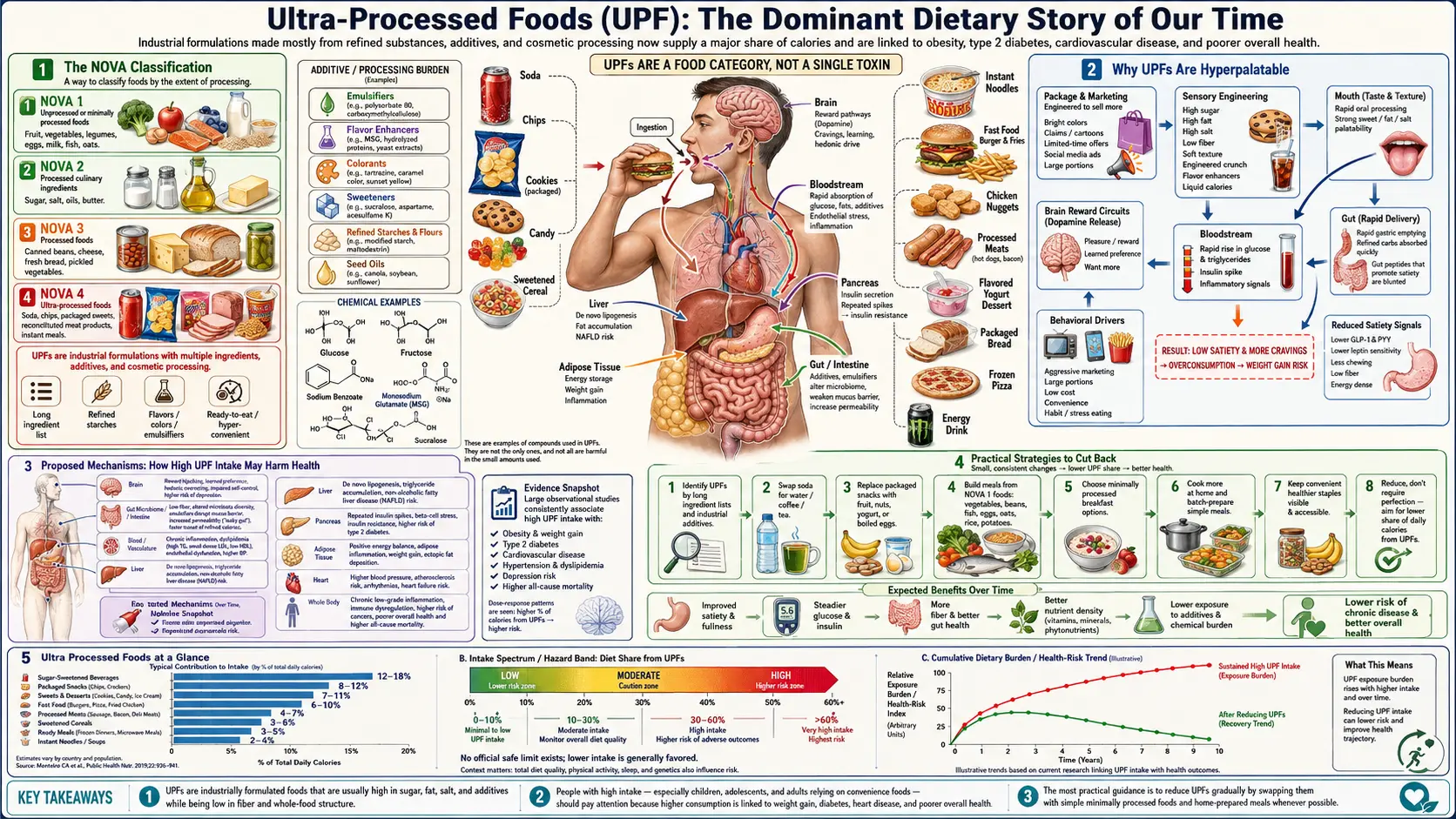
Ultra-Processed Foods (UPF): The Dominant Dietary Story of Our Time

Ultra-processed foods (UPFs) are the fourth group of the NOVA classification, developed by Monteiro and colleagues at the University of São Paulo, which groups foods according to the extent and purpose of industrial processing. NOVA describes ultra-processed foods as formulations of ingredients, mostly of exclusive industrial use, that result from a series of industrial processes, frequently with cosmetic additives such as flavours, colours and emulsifiers (Monteiro 2019). In US national survey data, ultra-processed foods supplied 57.0% of adults’ calories in 2017–2018, up from 53.5% in 2001–2002 (Juul 2022), and 67.0% of calories among US children and adolescents aged 2–19 in 2017–2018 (Wang 2021). In the UK National Diet and Nutrition Survey (2008–2014), the figure was 56.8% (Rauber 2018).
This article describes the NOVA classification, the epidemiological and experimental evidence on UPFs and chronic disease, the mechanisms researchers have proposed, and what is and is not known.
Table of Contents
The NOVA Classification
The four groups as described by Monteiro and colleagues (2019):
- NOVA 1 — Unprocessed or minimally processed foods. Grains, legumes, vegetables, fruits, nuts, milk, meat and other foods altered only by processes such as drying, grinding, roasting, boiling, pasteurization, refrigeration, freezing, vacuum packaging or non-alcoholic fermentation, with no added salt, sugar, oils, fats or other food substances.
- NOVA 2 — Processed culinary ingredients. Substances such as oils and fats, sugar and salt, obtained from group 1 foods or from nature and used to prepare, season and cook group 1 foods.
- NOVA 3 — Processed foods. Industrial products made by adding salt, sugar or another group 2 substance to group 1 foods, preserved by methods such as canning and bottling or, for breads and cheeses, made using non-alcoholic fermentation.
- NOVA 4 — Ultra-processed foods. Examples listed by the NOVA authors include carbonated soft drinks; sweet or savoury packaged snacks; confectionery; ice cream; mass-produced packaged breads and buns; margarines and other spreads; cookies, pastries, cakes and cake mixes; breakfast “cereals”; pre-prepared pies and pasta and pizza dishes; nuggets, sausages, burgers, hot dogs and other reconstituted meat products; and powdered and packaged instant soups, noodles and desserts.
What Makes a Food Ultra-Processed
According to the NOVA authors, a product is ultra-processed if its ingredient list contains at least one item characteristic of the group (Monteiro 2019):
- Food substances never or rarely used in kitchens — for example hydrolysed proteins, soya protein isolate, gluten, casein, whey protein, “mechanically separated meat”, fructose, high-fructose corn syrup, “fruit juice concentrate”, invert sugar, maltodextrin, dextrose, lactose, soluble or insoluble fibre, and hydrogenated or interesterified oils.
- “Cosmetic” additives — flavours, flavour enhancers, colours, emulsifiers, emulsifying salts, sweeteners, thickeners, and anti-foaming, bulking, carbonating, foaming, gelling and glazing agents.
The same paper notes that additives which prolong shelf life or prevent microbial growth may also be used in processed foods, processed culinary ingredients and, infrequently, minimally processed foods, so a preservative on its own does not place a food in group 4. A US analysis defined ultra-processed foods as formulations that include substances not used in culinary preparations, in particular additives used to imitate the sensory qualities of minimally processed foods (Martínez Steele 2016).
Why UPFs Are Described as Hyperpalatable
The NOVA authors write that the processes and ingredients used to make ultra-processed foods are designed to create highly profitable, convenient, hyper-palatable products liable to displace other foods, and describe marketing strategies that include vivid packaging, health claims and campaigns aimed at children (Monteiro 2019).
The main experimental test is Hall and colleagues’ 2019 inpatient trial at the NIH Clinical Center. Twenty weight-stable adults ate an ultra-processed diet and an unprocessed diet for 2 weeks each, in random order, with meals matched for presented calories, energy density, macronutrients, sugar, sodium and fiber, and ate as much or as little as they wanted. On the ultra-processed diet, energy intake was 508 ± 106 kcal/day higher, from extra carbohydrate and fat but not protein; participants gained 0.9 kg during the ultra-processed diet and lost 0.9 kg during the unprocessed diet (Hall 2019). In the full report, participants did not rate the ultra-processed meals as more pleasant or more familiar, but they ate them faster (by 17 kcal per minute); the appetite-suppressing hormone PYY was higher on the unprocessed diet, and the hunger hormone ghrelin was lower on the unprocessed diet than at baseline. The authors suggested that softer, easier-to-chew foods and the higher energy density of the non-beverage ultra-processed foods may have contributed to the excess intake.
Evidence Linking UPFs to Disease
A 2024 umbrella review in The BMJ (Lane 2024) graded 45 pooled analyses from earlier meta-analyses of cohort, case-control and cross-sectional studies, covering 9,888,373 participants. Greater ultra-processed food exposure was directly associated with 32 of the 45 health parameters. The review’s grades were:
- Convincing (class I): cardiovascular disease mortality (risk ratio 1.50), type 2 diabetes (dose-response risk ratio 1.12), anxiety (odds ratio 1.48) and common mental disorders combined (odds ratio 1.53).
- Highly suggestive (class II): all-cause mortality (risk ratio 1.21), heart disease mortality (hazard ratio 1.66), depressive outcomes (hazard ratio 1.22), adverse sleep outcomes (odds ratio 1.41), wheezing (risk ratio 1.40) and obesity (odds ratio 1.55).
- Suggestive or weak (class III–IV): among others, overall cancer (hazard ratio 1.12), colorectal cancer, hypertension (odds ratio 1.23), metabolic syndrome and Crohn’s disease (hazard ratio 1.71).
- No evidence (class V): among others, ulcerative colitis, pancreatic cancer and prostate cancer.
By the GRADE framework, most of these pooled analyses were rated low or very low quality (22 low, 19 very low, 4 moderate). The authors wrote that further randomised trials are needed to establish causality. These are associations from observational studies, not proof of cause.
Mortality cohorts. In the French NutriNet-Santé cohort (44,551 adults aged 45 or older, median 7.1 years), each 10% increment in the proportion of ultra-processed foods in the diet was associated with a 14% higher risk of all-cause mortality (hazard ratio 1.14, 95% CI 1.04–1.27) (Schnabel 2019). In the Spanish SUN cohort of 19,899 university graduates, the highest quarter of consumption (more than 4 servings a day) was associated with a 62% higher hazard of death than the lowest quarter, and each additional daily serving with 18% (Rico-Campà 2019). In two large US cohorts of health professionals (74,563 women and 39,501 men, followed for about three decades), the highest quarter had a 4% higher all-cause mortality than the lowest (hazard ratio 1.04), driven by causes other than cancer and cardiovascular disease, with no association for cancer or cardiovascular mortality; ready-to-eat meat, poultry and seafood products showed the strongest associations, and within each level of overall diet quality there was no consistent association between ultra-processed foods and mortality (Fang 2024).
Cancer. In NutriNet-Santé (104,980 adults), each 10% increment in the proportion of ultra-processed food in the diet was associated with a higher risk of overall cancer (hazard ratio 1.12, 95% CI 1.06–1.18) and breast cancer (hazard ratio 1.11, 1.02–1.22); no association was statistically significant for prostate or colorectal cancer, for which statistical power was limited (Fiolet 2018).
Inflammatory bowel disease. In a 21-country cohort of 116,087 adults, eating five or more servings of ultra-processed food a day, compared with less than one, was associated with a higher risk of developing IBD (hazard ratio 1.82, 95% CI 1.22–2.72), consistent for Crohn’s disease and ulcerative colitis (Narula 2021). This concerns new cases of IBD, not flares of existing disease.
Proposed Mechanisms
The 2024 umbrella review (Lane 2024) summarises the mechanisms researchers have proposed; most are not yet established in humans:
- Diet quality and displacement — diets high in ultra-processed foods are associated with more added sugars, saturated fat and sodium, higher energy density, and less fibre, protein and micronutrients, and these foods displace fruits, vegetables, legumes, nuts and seeds.
- Food matrix changes — alterations in the food structure during intensive processing may affect digestion, nutrient absorption and satiety.
- Energy intake — the review notes that greater energy density, faster eating rate and hyper-palatability are regarded as important factors in the extra intake seen in the inpatient trial (Hall 2019).
- Additives — emerging human evidence links non-sugar sweeteners, emulsifiers, colorants and nitrates/nitrites to adverse outcomes.
- Emulsifiers and the gut barrier — in mice, carboxymethylcellulose and polysorbate-80 induced low-grade inflammation, bacterial encroachment on the protective mucus layer and metabolic syndrome, and promoted colitis in mice predisposed to it (Chassaing 2015). The human feeding evidence concerns carboxymethylcellulose only: in a controlled-feeding study of 16 healthy adults, 15 g a day for 11 days modestly increased abdominal discomfort after meals, reduced microbiota diversity and faecal short-chain fatty acids, and two participants showed bacterial encroachment into the inner mucus layer (Chassaing 2022). No human feeding study of polysorbate-80 was found for this page. In people with Crohn’s disease, a 24-patient double-blind trial found that emulsifier content had no influence on disease activity over 4 weeks in the context of a healthy diet (Fitzpatrick 2025), while a 154-patient trial reported so far only as a conference abstract (ADDapt) reported emulsifier restriction as effective (Bancil 2025).
- Processing by-products and packaging — intensive processing can produce compounds such as acrylamide, advanced glycation end products, acrolein, furans, heterocyclic amines, industrial trans-fats and polycyclic aromatic hydrocarbons, and packaging can contribute contaminants such as bisphenols, microplastics, mineral oils and phthalates.
Foods Where the NOVA Group Is Not Obvious
The NOVA authors note that it is not always immediately clear whether a product is ultra-processed, giving breads and breakfast cereals as examples, and that the ingredient label settles it (Monteiro 2019):
- Bread: industrial breads made only from wheat flour, water, salt and yeast are processed foods (NOVA 3); those whose ingredient lists also include emulsifiers or colours are ultra-processed.
- Breakfast cereals: plain steel-cut oats, plain corn flakes and shredded wheat are minimally processed; the same foods are processed when they also contain sugar, and ultra-processed if they also contain flavours or colours.
- Any packaged product: the presence of one or more of the industrial food substances or cosmetic additives listed above identifies a product as ultra-processed, whatever the front of the package says.
What the Research Reports About Lower Intake
- Short-term trial evidence. In the inpatient crossover trial, the same adults ate about 500 kcal a day less and lost 0.9 kg during 2 weeks on the unprocessed diet (Hall 2019). The umbrella review authors note that trials of long-term exposure to diets rich in ultra-processed foods on hard endpoints such as cardiovascular disease or cancer are not possible for ethical reasons, so only short-term trials on intermediate outcomes are feasible (Lane 2024).
- Diet quality. In the US cohorts, better overall diet quality was associated with lower mortality within each level of ultra-processed food intake (Fang 2024).
- Dietary guidelines. The NOVA authors report that avoiding ultra-processed foods is the “golden rule” of national dietary guidelines issued in Latin American countries (Monteiro 2019).
- Processing in general. The same authors write that most foods are processed to some extent, that diets restricted to unprocessed food would be less diverse and less secure, and that the concern is ultra-processing rather than processing as such (Monteiro 2019).
- Public-health measures. The umbrella review authors concluded that their findings give a rationale to develop and test population and public-health measures to reduce ultra-processed food exposure (Lane 2024).
Key Research Papers
- Monteiro CA, Cannon G, Levy RB, et al. (2019). Ultra-processed foods: what they are and how to identify them. Public Health Nutr 22(5):936–941. — doi:10.1017/S1368980018003762 (PubMed PMID: 30744710)
- Hall KD, Ayuketah A, Brychta R, et al. (2019). Ultra-Processed Diets Cause Excess Calorie Intake and Weight Gain: An Inpatient Randomized Controlled Trial of Ad Libitum Food Intake. Cell Metab 30(1):67–77.e3. — doi:10.1016/j.cmet.2019.05.008 (PubMed PMID: 31105044)
- Lane MM, Gamage E, Du S, et al. (2024). Ultra-processed food exposure and adverse health outcomes: umbrella review of epidemiological meta-analyses. BMJ 384:e077310. — doi:10.1136/bmj-2023-077310 (PubMed PMID: 38418082)
- Juul F, Parekh N, Martinez-Steele E, et al. (2022). Ultra-processed food consumption among US adults from 2001 to 2018. Am J Clin Nutr 115(1):211–221. — doi:10.1093/ajcn/nqab305 (PubMed PMID: 34647997)
- Wang L, Martínez Steele E, Du M, et al. (2021). Trends in Consumption of Ultraprocessed Foods Among US Youths Aged 2-19 Years, 1999-2018. JAMA 326(6):519–530. — doi:10.1001/jama.2021.10238 (PubMed PMID: 34374722)
- Rauber F, da Costa Louzada ML, Steele EM, et al. (2018). Ultra-Processed Food Consumption and Chronic Non-Communicable Diseases-Related Dietary Nutrient Profile in the UK (2008–2014). Nutrients 10(5):587. — doi:10.3390/nu10050587 (PubMed PMID: 29747447)
- Martínez Steele E, Baraldi LG, Louzada ML, et al. (2016). Ultra-processed foods and added sugars in the US diet: evidence from a nationally representative cross-sectional study. BMJ Open 6(3):e009892. — doi:10.1136/bmjopen-2015-009892 (PubMed PMID: 26962035)
- Schnabel L, Kesse-Guyot E, Allès B, et al. (2019). Association Between Ultraprocessed Food Consumption and Risk of Mortality Among Middle-aged Adults in France. JAMA Intern Med 179(4):490–498. — doi:10.1001/jamainternmed.2018.7289 (PubMed PMID: 30742202)
- Rico-Campà A, Martínez-González MA, Alvarez-Alvarez I, et al. (2019). Association between consumption of ultra-processed foods and all cause mortality: SUN prospective cohort study. BMJ 365:l1949. — doi:10.1136/bmj.l1949 (PubMed PMID: 31142450)
- Fang Z, Rossato SL, Hang D, et al. (2024). Association of ultra-processed food consumption with all cause and cause specific mortality: population based cohort study. BMJ 385:e078476. — doi:10.1136/bmj-2023-078476 (PubMed PMID: 38719536)
- Fiolet T, Srour B, Sellem L, et al. (2018). Consumption of ultra-processed foods and cancer risk: results from NutriNet-Santé prospective cohort. BMJ 360:k322. — doi:10.1136/bmj.k322 (PubMed PMID: 29444771) — a 2026 correction fixed a transcription error in the minimally processed food results (PubMed PMID: 42463237)
- Narula N, Wong ECL, Dehghan M, et al. (2021). Association of ultra-processed food intake with risk of inflammatory bowel disease: prospective cohort study. BMJ 374:n1554. — doi:10.1136/bmj.n1554 (PubMed PMID: 34261638)
- Chassaing B, Koren O, Goodrich JK, et al. (2015). Dietary emulsifiers impact the mouse gut microbiota promoting colitis and metabolic syndrome. Nature 519(7541):92–96. — doi:10.1038/nature14232 (PubMed PMID: 25731162) — a corrigendum was published in 2016 (PubMed PMID: 27144359)
- Chassaing B, Compher C, Bonhomme B, et al. (2022). Randomized Controlled-Feeding Study of Dietary Emulsifier Carboxymethylcellulose Reveals Detrimental Impacts on the Gut Microbiota and Metabolome. Gastroenterology 162(3):743–756. — doi:10.1053/j.gastro.2021.11.006 (PubMed PMID: 34774538)
- Fitzpatrick JA, Gibson PR, Taylor KM, et al. (2025). Clinical Trial: The Effects of Emulsifiers in the Food Supply on Disease Activity in Crohn's Disease: An Exploratory Double-Blinded Randomised Feeding Trial. Aliment Pharmacol Ther 61(8):1276–1289. — doi:10.1111/apt.70041 (PubMed PMID: 39967287)
- Bancil A, Rossi M, Sandall A, et al. (2025). DOP097 Emulsifier restriction is an effective therapy for active Crohn’s disease: the ADDapt trial – a multi-centre, randomised, double-blind, placebo-controlled, re-supplementation trial in 154 patients. J Crohns Colitis 19(Suppl 1):i262. Conference abstract, not a full peer-reviewed paper. — doi:10.1093/ecco-jcc/jjae190.0136
Connections
- Fake Meat — The ultra-processing criticism, applied to both aisles equally
- Fake Food — Food sold as something it is not — adulteration and grade fraud
- All Toxins
- Preservatives
- Obesity
- Metabolic Syndrome
- Food Additives
- Diabetes
- Seed Oils
- Gut Healing
- Anti-Inflammatory Diet
- Elimination Diet
- Food Dyes
- Artificial Sweeteners
- Cardiovascular Disease
- Carrageenan
- Depression
- Inflammatory Bowel Disease
- Gut-Brain Axis
- Hypertension
Featured Videos