Seed Oils: Canola, Soybean, Sunflower, Corn — What the Evidence Actually Says
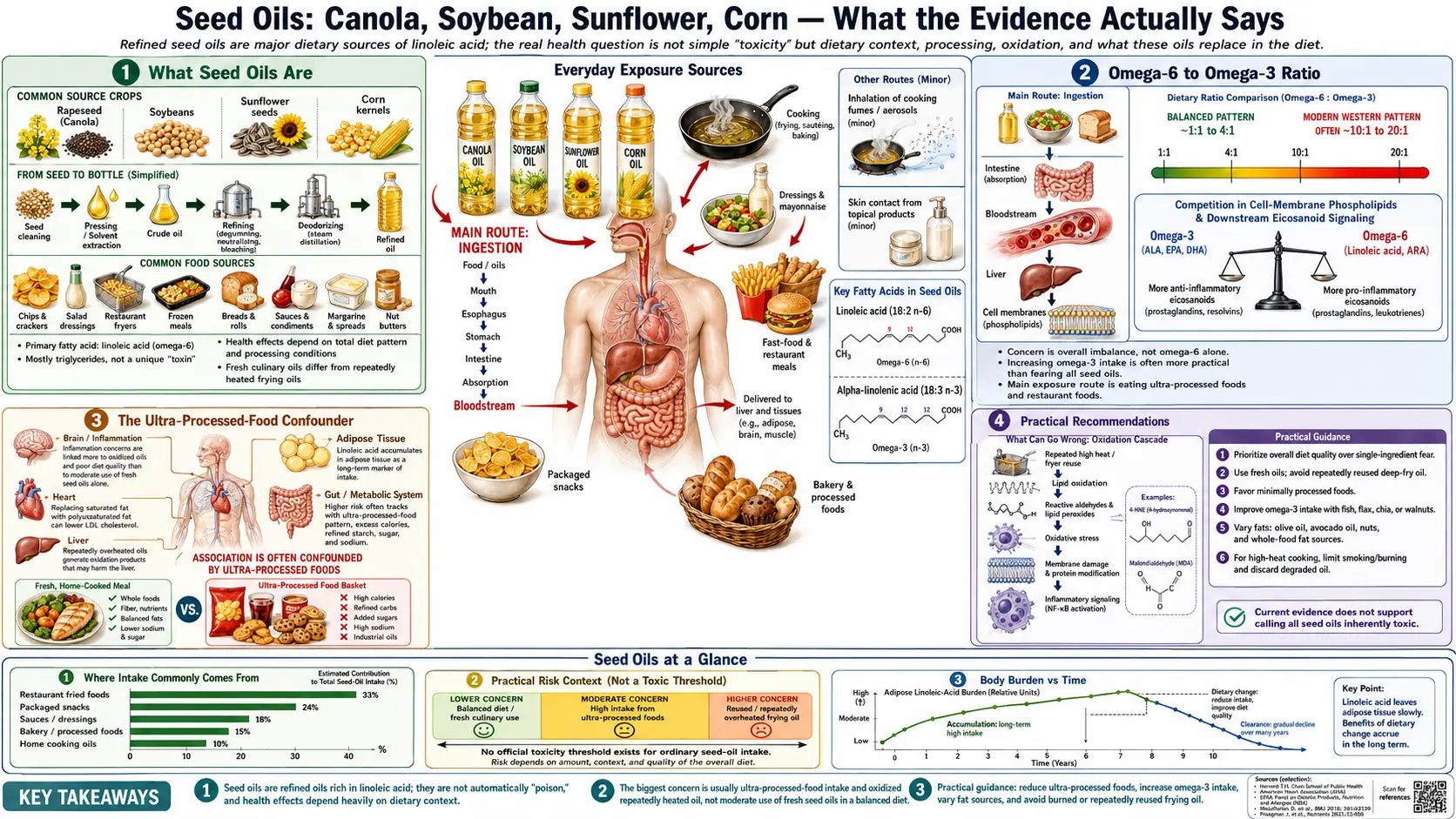

Few topics in modern nutrition have generated as much heated public debate as seed oils — industrial vegetable oils extracted from seeds and grains including soybean, canola (rapeseed), corn, sunflower, safflower, cottonseed, grapeseed, and rice bran. Proponents of avoidance argue that the high linoleic-acid (omega-6) content, industrial extraction with hexane, oxidation during high-heat cooking, and their pervasive presence in ultra-processed foods make them a major driver of chronic inflammation and metabolic disease. Defenders cite long-term randomized trials of linoleic acid reducing cholesterol and cardiovascular risk. The truth, as usual, is considerably more nuanced than either camp acknowledges.
This article sorts through what is well-established, what is contested, and what the practical takeaway should be for someone trying to eat well without getting lost in social-media shouting matches.
Table of Contents
- What Seed Oils Are
- The Claims, Laid Out
- The Linoleic Acid Debate
- Omega-6 to Omega-3 Ratio
- Heating, Oxidation, and Aldehydes
- Industrial Processing
- The Ultra-Processed-Food Confounder
- The Randomized-Trial Evidence
- What the Cohort Studies Show
- Where the Evidence Actually Leaves Us
- Practical Recommendations
- Choosing and Using a Cooking Fat
- Research Papers
- Connections
- Featured Videos
What Seed Oils Are
“Seed oils” is a popular rather than a scientific category. It generally means the industrially extracted oils pressed or solvent-extracted from seeds and grains: soybean, corn, canola (rapeseed), sunflower, safflower, cottonseed, grapeseed, rice bran and peanut. What they have in common is a high proportion of linoleic acid, an omega-6 polyunsaturated fatty acid, and a manufacturing process that involves heat and usually a solvent.
Their share of the diet has changed more than almost any other food component in the last century. Soybean oil consumption in the United States rose more than a thousandfold across the twentieth century, and estimated linoleic acid intake roughly doubled or tripled from around 2–3% of calories to around 7–8%. That is a genuinely unprecedented dietary shift, and it is a perfectly reasonable thing to ask questions about. The argument is not about whether the change happened; it is about whether it caused harm.
One clarification that avoids a lot of confusion: olive oil and avocado oil are fruit oils, not seed oils — pressed from the flesh rather than the seed, mostly monounsaturated, and traditionally produced by mechanical pressing. They are not part of this debate on either side.
The Claims, Laid Out
The case against seed oils, stated fairly and at its strongest, is a chain of four claims. Each link is examined separately in the sections below, because they are of very different evidential strength — and the chain is only as strong as its weakest link.
- Linoleic acid is inherently inflammatory, because it is a precursor to arachidonic acid and thence to pro-inflammatory eicosanoids.
- The omega-6 to omega-3 ratio has shifted catastrophically from an ancestral 1:1 to a modern 15:1 or worse.
- Polyunsaturated fats oxidise readily when heated, producing toxic aldehydes that are consumed with fried food.
- The industrial process itself — hexane extraction, bleaching, deodorising — produces a degraded product.
The Linoleic Acid Debate
The mechanistic story is real: linoleic acid can be elongated and desaturated to arachidonic acid, which is the substrate for prostaglandins, thromboxanes and leukotrienes, several of which are pro-inflammatory. From a biochemistry diagram, the inference that eating more linoleic acid means more inflammation looks obvious.
It does not survive measurement, on two counts.
- Eating more linoleic acid does not raise tissue arachidonic acid. Rett and Whelan (Nutrition & Metabolism, 2011) systematically reviewed controlled feeding studies in adults on Western diets and found that increasing dietary linoleic acid did not increase tissue arachidonic acid content. The conversion step is tightly regulated and is not driven by substrate supply.
- Eating more linoleic acid does not raise inflammatory markers. Johnson and Fritsche (Journal of the Academy of Nutrition and Dietetics, 2012) reviewed randomised controlled trials in healthy people and found essentially no effect of dietary linoleic acid on CRP, interleukin-6, TNF-α or other markers of inflammation.
So the first link in the chain — the one doing most of the rhetorical work — is the one that has been tested most directly and has not held up. That does not settle the whole question, but it should change how much weight the mechanism argument carries.
Omega-6 to Omega-3 Ratio
The ratio argument holds that omega-6 and omega-3 fats compete for the same desaturase and elongase enzymes, so an excess of omega-6 crowds out the conversion of alpha-linolenic acid to EPA and DHA. The competition is real at the enzyme level.
Its practical importance is more doubtful, for a specific reason: conversion of plant omega-3 to EPA and DHA is poor regardless of the ratio — typically a few per cent to EPA and under 1% to DHA in adults. If the conversion pathway contributes so little either way, improving the ratio by cutting omega-6 does relatively little for tissue EPA and DHA. What reliably raises them is eating pre-formed EPA and DHA — oily fish, or a supplement.
This reframes the practical advice usefully. The productive move is not to obsess over lowering the denominator’s numerator; it is to raise omega-3 intake directly. Two portions of oily fish a week — salmon, sardines, mackerel, herring — does more for your fatty acid status than eliminating sunflower oil.
Heating, Oxidation, and Aldehydes
This is the strongest part of the case against, and it deserves to be stated at full strength.
Polyunsaturated fats have multiple double bonds, and every double bond is a site where oxygen can attack. Heat, light, oxygen and time all accelerate this. Repeated heating — as in a commercial deep fryer where the same oil is used for hours or days — produces measurable quantities of lipid oxidation products including 4-hydroxynonenal (4-HNE), malondialdehyde and various alkenals, which are cytotoxic and genotoxic in laboratory systems and are absorbed when eaten.
What the evidence supports:
- Repeatedly reused frying oil produces substantially more aldehydes than fresh oil. This is well documented analytically.
- Higher polyunsaturated content means more oxidation at a given temperature. Also well documented.
- Frequent consumption of fried food is associated with worse cardiometabolic outcomes in cohort studies.
What it does not support:
- That normal home cooking produces meaningful aldehyde exposure. A sauté at moderate temperature with fresh oil is a different situation from a commercial fryer.
- That the fried-food association is caused by the aldehydes specifically, rather than by the calories, the salt, the refined starch, or the lifestyle pattern that goes with frequent fried food.
The honest conclusion is that the problem is repeated high-heat frying, not the presence of a seed oil in your kitchen — and the correct response is to eat less deep-fried food and never reuse frying oil, which is advice worth following whatever oil is in the pan.
Industrial Processing
Most seed oils are extracted with hexane, then refined, bleached and deodorised (the “RBD” process). This is genuinely industrial and quite unlike pressing olives.
- Hexane residue in finished oil is in the parts-per-million range and far below established safety thresholds; it is not where the plausible concern lies.
- The deodorising step, which uses high temperature under vacuum, can generate small amounts of trans fats — typically well under 1% but not zero. This is a more legitimate concern than the solvent, and it is one reason cold-pressed and expeller-pressed versions are preferable where available.
- Refining strips most of the antioxidant compounds — tocopherols, polyphenols — that would otherwise protect the oil from oxidation and contribute some benefit of their own. This is a real difference from extra-virgin olive oil, whose polyphenols are a substantial part of why it performs well in trials.
So the processing objection is partly valid, and its valid part points at refinement stripping protective compounds rather than at contamination.
The Ultra-Processed-Food Confounder
This is the single biggest interpretive problem in the whole debate, and it cuts both ways.
Seed oils are ubiquitous in ultra-processed food: crisps, biscuits, fast food, ready meals, commercial baked goods, salad dressings. Anyone eating a lot of seed oil is, with few exceptions, eating a lot of ultra-processed food — along with the refined starch, added sugar, salt, emulsifiers and calorie density that come with it. Observational studies of “seed oil intake” are therefore studying a whole dietary pattern.
That ultra-processed pattern has independent, randomised evidence of harm. Hall and colleagues (Cell Metabolism, 2019) admitted 20 adults to a metabolic ward and gave them ultra-processed or unprocessed diets matched for calories, sugar, fat, fibre and macronutrients, eating freely for two weeks each. On the ultra-processed diet participants ate about 500 kcal more per day and gained weight; on the unprocessed diet they lost it. That is a controlled demonstration that processing itself matters, independent of nutrient content.
The implication is uncomfortable for both camps. It means the observational signal blamed on seed oils may belong to the food they arrive in — but it also means the practical advice that follows from the seed-oil hypothesis is largely correct for a different reason. Eat less ultra-processed food and your seed oil intake falls sharply as a side effect.
The Randomized-Trial Evidence
Two recovered-data analyses by Christopher Ramsden are the most-cited evidence against linoleic acid, and they are genuinely important. They are also frequently overstated, so here is what each actually found.
- Sydney Diet Heart Study (Ramsden et al., BMJ 2013). 458 men with recent coronary events were randomised to replace saturated fat with safflower oil and safflower-oil margarine, or to usual diet. In the recovered data the intervention group had higher all-cause mortality (17.6% vs 11.8%), higher cardiovascular mortality and higher coronary mortality. An important caveat: the safflower margarine of that era contained substantial trans fat, which is independently harmful, so the trial cannot cleanly separate linoleic acid from trans fat.
- Minnesota Coronary Experiment (Ramsden et al., BMJ 2016). Over 9,000 institutionalised participants randomised to a linoleic-rich diet or the usual one. The intervention lowered serum cholesterol substantially — and produced no mortality benefit. In participants over 65, greater cholesterol lowering was associated with higher mortality. Caveats: high participant turnover, a short average exposure, and the intervention margarine again containing trans fat.
Set against these, the systematic evidence is more equivocal than either side usually admits. The Cochrane review of omega-6 fats for cardiovascular prevention (Hooper et al., 2018) pooled 19 randomised trials with over 6,400 participants and concluded that increasing omega-6 intake probably makes little or no difference to all-cause mortality, cardiovascular mortality or major cardiovascular events, with low- to moderate-quality evidence throughout. It found possible small reductions in myocardial infarction, and no clear harm.
The American Heart Association’s 2017 presidential advisory (Sacks et al., Circulation) reached the opposite practical conclusion — that replacing saturated fat with polyunsaturated vegetable oil reduces cardiovascular disease by around 30% — based on a different selection of trials, notably excluding those where the comparator contained trans fat. That disagreement over which trials to include is where much of the dispute genuinely lives, and readers deserve to know that rather than being handed one side’s trial list.
What the Cohort Studies Show
The largest biomarker evidence points the other way from the seed-oil hypothesis, and leaving it out would be dishonest.
Marklund and colleagues (Circulation, 2019) pooled individual-level data from 30 prospective cohorts across 13 countries, measuring blood and tissue linoleic acid rather than relying on food questionnaires. Higher linoleic acid biomarker levels were associated with lower risk of total cardiovascular disease, cardiovascular mortality and ischaemic stroke. Arachidonic acid levels were not associated with higher risk.
Wang and colleagues (JAMA Internal Medicine, 2016), following over 126,000 people for up to 32 years, found that higher polyunsaturated fat intake was associated with lower total mortality, and that replacing saturated fat with polyunsaturated fat was associated with lower mortality still.
These are observational and carry the usual confounding caveats — people with higher linoleic acid biomarkers differ in other ways. But biomarker-based studies avoid the recall error that plagues dietary questionnaires, and the consistency across 30 cohorts is not easily dismissed. Anyone presenting the seed-oil case without mentioning this body of evidence is not giving you the full picture.
Where the Evidence Actually Leaves Us
Setting aside the rhetoric on both sides, this is a fair summary by strength of evidence:
- Well supported: repeatedly reused, high-heat frying oil produces harmful oxidation products, and frequent fried-food consumption is associated with worse health. Ultra-processed food causes excess calorie intake and weight gain in a controlled trial.
- Well supported: dietary linoleic acid does not raise tissue arachidonic acid or inflammatory markers in humans.
- Genuinely contested: whether replacing saturated fat with linoleic acid reduces cardiovascular events. The randomised evidence is mixed and heavily influenced by trans-fat contamination of old intervention margarines; expert bodies reading the same literature reach different conclusions.
- Points away from harm: large biomarker-based cohorts consistently associate higher linoleic acid with lower cardiovascular risk and lower mortality.
- Not supported: that seed oils are the primary driver of modern chronic disease, or that hexane residue is a meaningful hazard.
- Unknown: whether the sheer magnitude of the historical increase in linoleic acid intake has long-term effects that no trial has been long enough to detect. This is the most defensible version of the concern and it is not answerable with current data.
The useful conclusion for a reader is that the practical advice does not depend on resolving the dispute. Cooking real food at home with olive oil, eating oily fish, and avoiding deep-fried and ultra-processed food is right under either reading of the evidence.
Practical Recommendations
- Do not eat deep-fried takeaway or restaurant food often. Recycled fryer oil is by far the highest-aldehyde exposure in a normal diet, and this is the single best-supported recommendation on this page.
- Never reuse frying oil at home, and discard any oil that smells rancid, has darkened, or is foaming.
- Use extra-virgin olive oil as your default kitchen oil. Its polyphenols are protective, it performs well at normal cooking temperatures, and it has the best trial evidence of any fat — olive oil consumption is associated with lower cardiovascular risk in large cohorts.
- Eat oily fish twice a week — salmon, sardines, mackerel, herring — which raises EPA and DHA directly rather than trying to shift a ratio.
- Cut ultra-processed food. This has controlled-trial evidence behind it, and it reduces seed-oil intake substantially as a by-product.
- Prefer cold-pressed or expeller-pressed where you do use a seed oil, and store all oils cool, dark and sealed.
- Build meals from whole foods — vegetables, fruit, olive oil, fish, eggs, meat, nuts, legumes, and whole grains such as brown rice, oats and barley. This is the change that matters, and the oil question largely takes care of itself.
- Do not fixate. Someone who cooks whole-food meals at home with olive oil and occasionally eats a restaurant salad dressed with canola oil is not sabotaging their health. Anxiety about trace exposures has its own cost, and it displaces attention from changes that would actually help.
Choosing and Using a Cooking Fat
Smoke point is the temperature at which an oil starts to break down visibly. It is a useful rough guide but not the whole story — degree of unsaturation and antioxidant content matter as much for how an oil behaves under heat.
- Salads, dressings, finishing — extra-virgin olive oil, cold-pressed rapeseed, walnut or flaxseed oil (the last two are highly unsaturated and should never be heated).
- Everyday sautéing and roasting (up to roughly 190–200 °C) — extra-virgin olive oil, which is considerably more heat-stable than its smoke point alone suggests because of its polyphenols and mostly monounsaturated profile. Butter and ghee also work well; ghee tolerates higher heat than butter because the milk solids are removed.
- Occasional high-heat cooking — avocado oil, refined olive oil, or ghee.
- Deep frying — best avoided as a routine. If you do it, use fresh oil, keep the temperature controlled, and discard the oil afterwards rather than straining and reusing it.
- Storage — a dark bottle, a cool cupboard away from the hob, tightly closed, and used within a few months of opening. Oxidation begins before the oil ever meets a pan.
- A note on cost. Extra-virgin olive oil is more expensive than sunflower oil, and that is a real constraint for many households. If budget is tight, prioritise cutting deep-fried and ultra-processed food over upgrading the bottle in your cupboard — the first change is far better supported by evidence than the second.
Research Papers
Each citation below was checked against its PubMed record; the linked DOI resolves to the paper named. Papers supporting and opposing the seed-oil hypothesis are both included at full strength, because the dispute is real and readers are entitled to see both sides of it.
- Ramsden CE, Zamora D, Leelarthaepin B, et al. Use of dietary linoleic acid for secondary prevention of coronary heart disease and death: evaluation of recovered data from the Sydney Diet Heart Study and updated meta-analysis. BMJ. 2013;346:e8707. (PMID 23386268) — higher mortality in the linoleic acid arm; intervention margarine contained trans fat.
- Ramsden CE, Zamora D, Majchrzak-Hong S, et al. Re-evaluation of the traditional diet-heart hypothesis: analysis of recovered data from Minnesota Coronary Experiment (1968–73). BMJ. 2016;353:i1246. (PMID 27071971) — cholesterol fell, mortality did not improve.
- Hooper L, Al-Khudairy L, Abdelhamid AS, et al. Omega-6 fats for the primary and secondary prevention of cardiovascular disease. Cochrane Database Syst Rev. 2018;11(11):CD011094. (PMID 30488422) — probably little or no effect on mortality or major events.
- Sacks FM, Lichtenstein AH, Wu JHY, et al. Dietary fats and cardiovascular disease: a presidential advisory from the American Heart Association. Circulation. 2017;136(3):e1–e23. (PMID 28620111) — the opposing expert reading of the same literature.
- Marklund M, Wu JHY, Imamura F, et al. Biomarkers of dietary omega-6 fatty acids and incident cardiovascular disease and mortality. Circulation. 2019;139(21):2422–2436. (PMID 30971107) — 30 cohorts; higher linoleic acid associated with lower risk.
- Johnson GH, Fritsche K. Effect of dietary linoleic acid on markers of inflammation in healthy persons: a systematic review of randomized controlled trials. J Acad Nutr Diet. 2012;112(7):1029–1041. (PMID 22889633) — no effect on inflammatory markers.
- Rett BS, Whelan J. Increasing dietary linoleic acid does not increase tissue arachidonic acid content in adults consuming Western-type diets: a systematic review. Nutr Metab (Lond). 2011;8:36. (PMID 21663641)
- Wang DD, Li Y, Chiuve SE, et al. Association of specific dietary fats with total and cause-specific mortality. JAMA Intern Med. 2016;176(8):1134–1145. (PMID 27379574)
- Hall KD, Ayuketah A, Brychta R, et al. Ultra-processed diets cause excess calorie intake and weight gain: an inpatient randomized controlled trial of ad libitum food intake. Cell Metab. 2019;30(1):67–77.e3. (PMID 31105044) — the confounder, tested directly.
- Guasch-Ferré M, Liu G, Li Y, et al. Olive oil consumption and cardiovascular risk in U.S. adults. J Am Coll Cardiol. 2020;75(15):1729–1739. (PMID 32147453)
Live PubMed searches
These queries surface current peer-reviewed work as it is indexed.
- PubMed search: linoleic acid cardiovascular disease
- PubMed search: omega-6 to omega-3 ratio and inflammation
- PubMed search: 4-hydroxynonenal and frying oil
- PubMed search: repeatedly heated cooking oil and health
- PubMed search: ultra-processed food and cardiometabolic risk
- PubMed search: vegetable oil refining and trans fat formation
- PubMed search: extra-virgin olive oil polyphenols and heat stability
- PubMed search: ALA conversion to EPA and DHA
- PubMed search: replacing saturated with polyunsaturated fat, randomized
- PubMed search: fried food consumption and cardiovascular outcomes
Connections
- Fake Olive Oil — How seed-oil dilution of olive oil is detected — and why grade fraud is the bigger problem
- All Toxins
- Ultra Processed Foods
- Olive Oil
- Avocado
- Anti-Inflammatory Diet
- Processed Oils
- Cardiovascular Disease
- Inflammatory Markers
- Omega-3 Fatty Acids
- Lipid Panel
- Insulin Resistance
- Obesity
- Food Additives
- Trans Fats